Solving a Case: How to Check Clues and Name a Culprit
You're three clues in and already sure who did it. The muddy boot by the door, the torn note, the guest who won't meet your eye. That rush is the best part of a whodunit, and it's also where solving a case usually goes sideways. A striking find feels like a verdict. It isn't. It's one observation that still has to survive the timeline, the rest of the evidence, and a blunt look at how often that kind of clue fails.
I would rather spend five extra minutes trying to knock out my favourite suspect than name the wrong person because one object looked guilty. Don't treat each find as standalone proof. Lock the scene, test the clue, then see which story is still standing.
Table of Contents
- The Six-Stage Workflow for Solving a Case
- How to Collect and Document Clues Without Ruining Them
- Testing Each Clue Before You Trust It
- Connecting Clues Without Fooling Yourself
- Checking Statements, Alibis and Confessions
- Naming a Culprit Only When the Proof Holds
The Six-Stage Workflow for Solving a Case
Run the case in this order. The middle column is the work. The last column is the gate. No check mark, no next stage.
| Stage | What You Do | Check Before Moving On |
|---|---|---|
| 1. Lock down the scene | Note the layout and photograph objects before touching them | Is every object logged and placed? |
| 2. Collect and label clues | Bag, tag and record where each clue came from | Can you trace each clue back to its source? |
| 3. Test each clue | Ask whether it is relevant, validated and independent | Could another source produce the same result? |
| 4. Connect the clues | Build a timeline and rank the competing explanations | Does any clue fit only your favourite theory? |
| 5. Check statements | Compare every account against the timeline and the clues | Which statement fails first? |
| 6. Accuse with proof | Name the suspect and list the evidence behind each claim | Did you try to disprove your own theory? |
The stages look like a straight line. They aren't. A new object, a receipt, or a footprint can send you back to rebuild the timeline from stage 4. Skipping ahead is how players jump to a name while the scene is still a mess.
Say five guests in a snowed-in hut all claim they were asleep when the keeper died. If you treat that shared line as a fact, nobody has a window to act, and the case stalls. If you test it, one person's "asleep" may not cover the only hour the act could have happened. One untested claim can wipe out motive, means and opportunity for everyone else.
Check before moving on: that last column is the habit that stops an early accusation. A clue you haven't gated is a guess with a label on it.
Copy the six stages into a notebook and keep the page open on your next case. Put a check mark on a stage only after the gate is true. If a later find breaks an earlier check, erase the mark and go back.
How to Collect and Document Clues Without Ruining Them
Collection decides whether a later result means anything. A clue you move, mix or forget to label can't be trusted when you need it. The PCAST forensic science report treats forensic evidence as a measured, fallible input, not as proof on sight. Preserve and document the scene first, keep the chain of custody, separate items so they don't cross-contaminate, and record the lab method, the examiner, the conclusion and the uncertainty.
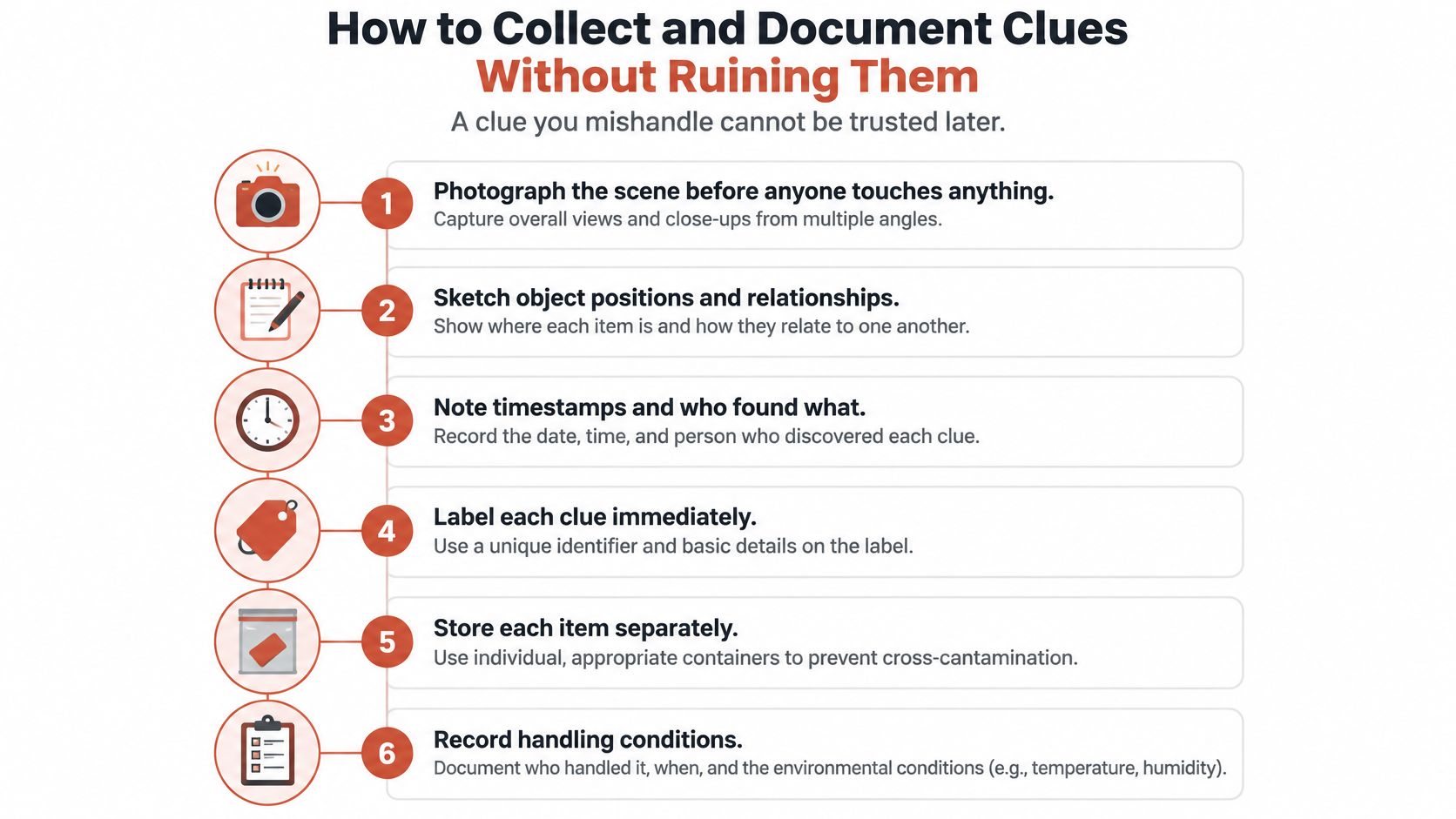
A six-step collection routine
- Photograph before anyone touches anything. Positions disappear the moment a hand "tidies." A photo is the only copy of the scene as you found it.
- Sketch positions and relationships. Note which chair faces the door, which glass sits closest to the window, which coat is on top. A photo shows objects. A sketch shows how they relate.
- Bag or mark each item on its own. Two hairs in one envelope become one contaminated sample. Separation is what keeps a later match from being your own handling.
- Label time, place and collector. "Knife, kitchen table, 9:14, found by you" beats "knife." If you can't say who picked it up, you can't defend it.
- Log every handoff. Write who passed the item, to whom, and when. A broken chain is a reason to downgrade the clue, not a detail to fix in your head later.
- Record light, conditions and contamination risks. Wet floor, open window, gloves or bare hands, a cup someone shifted. Those notes are how you, or anyone else, judge whether the result came from the scene or from the search.
Moving a cup to neaten the table is the classic slip. You erase the only evidence of who sat there. The print on the cup may survive. The seat does not.
What the log is for later
That record is what lets you ask whether a match came from a validated method or from an examiner's hunch. PCAST recommends black-box studies on samples with known answers, because you can't reliably read an error rate out of ordinary casework. All lab tests and feature comparisons have non-zero error rates. For latent fingerprints, cited estimates run from about 1 false positive in 306 examinations to 1 in 18 in another study, which is why a universal "fingerprints don't fail" line is useless. Ask for the validation that belongs to that method.
A clean log traces every clue from the moment it was found to the final conclusion: where, who, how it was handled, what test was used, what the examiner said, and what uncertainty they left on the page. If any of those blanks is empty, the clue stays a lead.
Testing Each Clue Before You Trust It
The useful question isn't "is this clue cool?" It's "does this clue prove what I think it proves?"
A striking print, a sure witness, or a tidy lab line is not a solved case. In a review of 250 U.S. DNA exonerations reported in 2010, the Innocence Project found eyewitness misidentification in 76% of cases, unvalidated or improper forensic science in 50%, and false confessions, admissions, or guilty pleas in 27%. A witness who is certain is not the same thing as a witness who is right. A forensic conclusion can be wrong even when it sounds scientific.
The National Registry of Exonerations recorded 97 exonerations in 2025, and 39 of those cases, 40%, involved false or misleading forensic evidence, up from 29% in 2024. Official misconduct appeared in at least 70 of the 97. A clean-looking report still needs its method and its disclosure record checked before you rank it.
Four checks, in the order they actually bite
Relevance. Does the clue bear on the event, or does it only look interesting? A muddy boot matters if the path was mud. It doesn't if everyone walked that path.
Alternative sources. Could another person or object leave the same mark? Shared coats, shared glasses and shared door handles fail this check all the time.
Method. Was the conclusion a validated comparison, or someone's gut? If you can't name the method, you don't have a result. You have an opinion.
Reliability. How does this type of evidence usually fail? Eyewitness memory fails by picking the familiar face. A single technique fails when nobody asks for its error rate. A match is not certainty.
Rank every clue from strongest to weakest and write one line of reasoning beside it. Flag anything that hangs on a single witness or a single technique. Those flags don't delete the clue. They stop you building a theory on it alone.
Write a reliability label beside every clue before you build any theory. If you can't finish the label, the clue isn't ready to connect.
The Hut on the Grauhorn is a short place to practise the labels. Five people, one scene, and a pile of finds that look decisive until you ask which ones could have come from someone else.
Connecting Clues Without Fooling Yourself
A theory is a ranking you keep trying to break. The moment you start protecting it, it becomes a story.
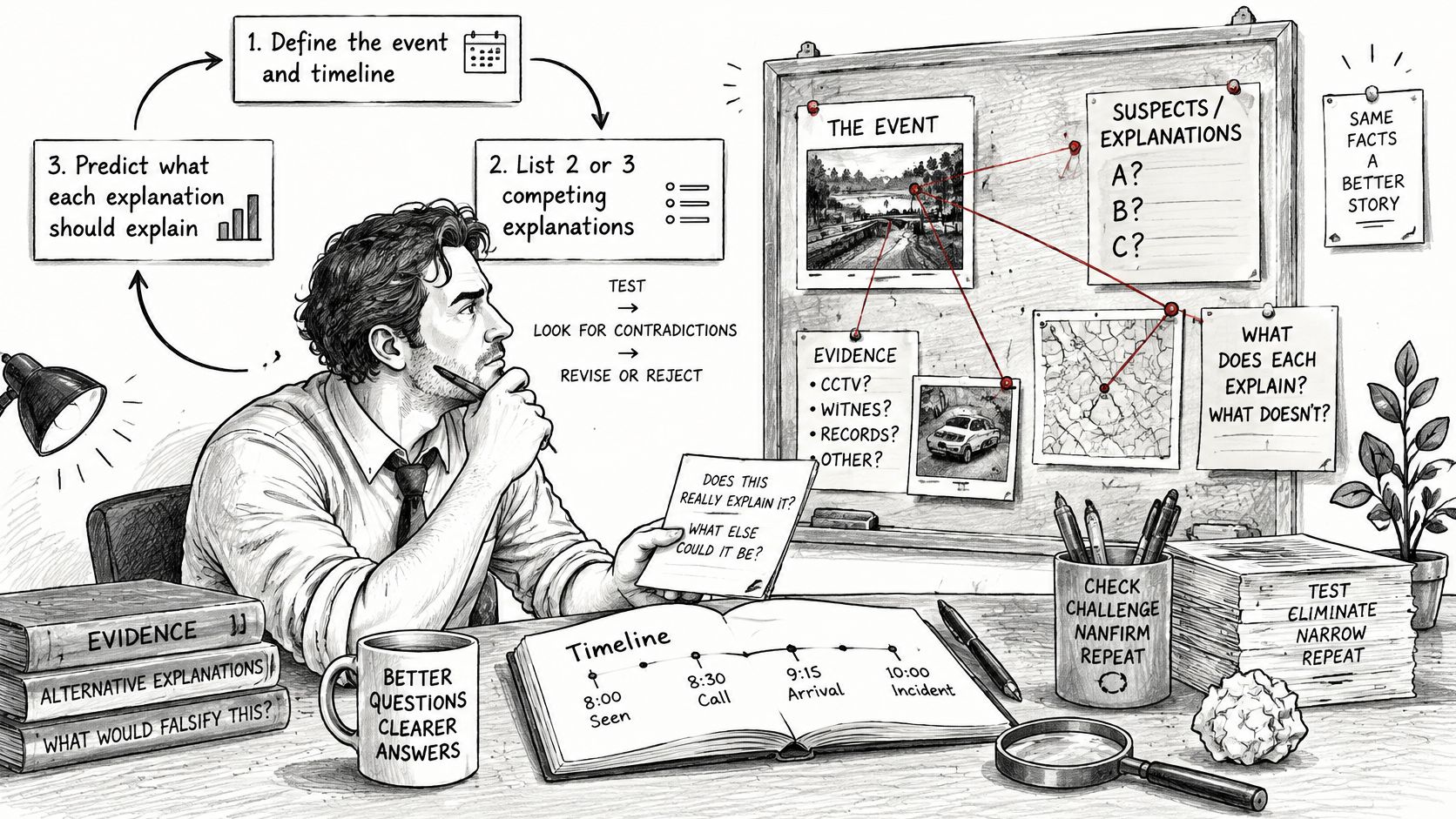
Most failed theories share one root cause: each clue got weighed on its own and passed, but nobody tested it against the timeline or against the rest of the pile. A find that looks decisive alone can collapse when you ask where it sits in the sequence of events.
The PCAST materials released through the Justice Department describe a high-reliability investigation as an explicit hypothesis test. Validation should measure both sensitivity, the chance of catching a true common source, and the false-positive rate. Subjective methods need black-box validation. Reliability standards should set an explicit limit on false positives, and the acceptable level depends on how the evidence will be used. "We closed a lot of cases" is not that bar. Reproducible results under blind testing, with the uncertainty written down, are.
The loop
- Define the event and the timeline. What happened, and in what window could it have happened?
- List two or three competing explanations. Include "someone we haven't named" if the scene allows it.
- Predict what only that explanation would produce. A unique prediction is a test. A prediction every story shares is decoration.
- Hunt for what could knock out your favourite. Support is easy to find once you've picked a name. Falsifying evidence is the point.
- Re-rank after every result. A new clue that only fits the leader is a warning, not a trophy.
When you line the clues up, the question that decides everything is independence: does this find lean on the same source, the same witness or the same technique as the last one? Two clues from one source add less than one clue from two sources.
Two traps that feel like progress
Double-counting. Three notes about one dropped cup are one confirmation, not three. If they all come from the same source, they don't vote separately. Count the source.
Reading "inconclusive" as a quiet yes. Inconclusive means the method didn't support either conclusion. It doesn't mean your preferred suspect wins on points. Leave that clue off the scoreboard.
Before you close, run a contradiction review. Try to break the leader's motive, means, opportunity, timeline and evidence link. Recheck the strongest clue on its own. Write down the alternatives you couldn't kill. Forcing one neat answer is how a gap becomes a culprit.
The Countess's Necklace is a good drill for this loop. A locked case and a missing necklace invite one tidy thief. Make yourself write a second explanation that predicts a different object, then see which prediction the scene holds.
Checking Statements, Alibis and Confessions
A statement is a claim. It becomes useful only after you set it against the timeline and the physical clues. People repeat what they heard, what they wish, or what they agreed to say. None of that is a timestamp.
| Statement Problem | What It Usually Means | What to Check Next |
|---|---|---|
| Everyone says they were asleep | Shared story, or no one can prove actual timing | Find a timestamp, sound or footprint each person left |
| Two accounts match word for word | Rehearsed or coordinated answers | Ask each person separately for a detail they would not normally guess |
| Confession with no specific details | Pressure, or guessing at what happened | Compare it with scene facts the person could not have known |
| Alibi covers only part of the timeline | A gap where the act could have happened | Test the gap with records, receipts or another witness |
| Suspect has no obvious motive | Motive is hidden rather than missing | Look for money, secrets or grudges in the timeline |
Get the accounts apart first
Write each person's story down separately before you compare them. Once people hear each other, matching phrases stop meaning anything. Then ask for a detail only a real witness would have: the order of rooms, which chair faced the stove, where a glass sat. A rehearsed pair usually matches on the headline and splits on the small object.
Test every gap with something outside the speaker's mouth. A record, a receipt, a sound, a footprint, or a second person who wasn't in the room when the story was told. If the gap survives those, the alibi is a lead, not a verdict.
Physical evidence clears people as well as it points. A 1995 National Institute of Justice study of 10,060 cases in which FBI laboratories did DNA testing found suspects excluded in more than 25% of them, as the Innocence Project's DNA exoneration summary notes. About 25% of DNA exonerees had confessed, so an admission doesn't settle factual guilt by itself.
A confession is strong only when it contains facts the person couldn't have guessed from the questions, the news, or a walk past the scene. "I did it" with no unreleased detail is pressure or a guess. Hold it up to the log. If it invents a weapon you don't have, or misses a mark everyone at the scene would have seen, it fails.
An alibi with a verified gap is a lead to chase, not a reason to accuse.
Grandma Hilde's Recipe Book turns on who was where when a door was wet and a book was gone. Separate the accounts, then see which sentence dies first against the timeline.
Naming a Culprit Only When the Proof Holds
Accusation is a gate, not a mood. If any item below fails, go back to the stage that failed. Don't pick a name to finish the evening.
- Two independent clues point at the same person, and they don't trace back to one object.
- Every clue still carries its reliability label, including the ones that make your theory worse.
- The alibi gap is closed by a record, a trace, or a witness who wasn't coached by the group.
- Unresolved alternatives are written down, not dropped because they were annoying. That's the contradiction review, applied as a stop sign.
How to write the accusation
One short paragraph. One clue per sentence. Each sentence names the source and the reliability label, not a vibe.
"The receipt puts them in the kitchen at 9:10, and that record doesn't depend on anyone's memory. The print on the inner box matches them under a validated comparison, and it still needs a second independent trace before I'd call it dispositive. Their account of being outside fails against the wet threshold, which they would have crossed."
If you can't write a sentence without "I just know," you don't have that claim yet.
Practise on a short case
We built free browser cases that take about 5 to 10 minutes. You tap rooms and objects, combine what you find in a notebook, check what people say, and accuse with proof. Each case can earn up to three stars. If you get stuck, a partner hint costs one star.
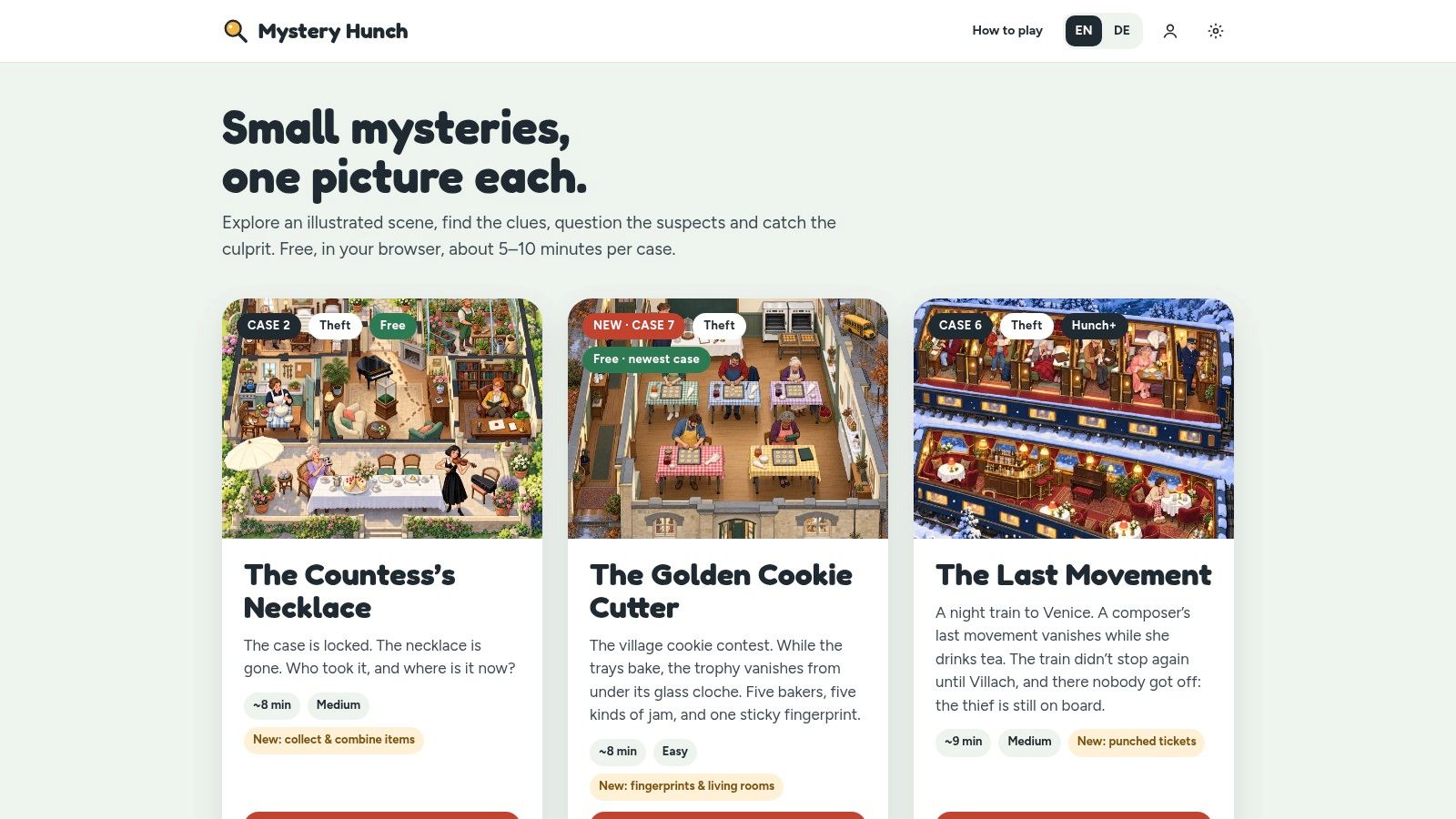
Start with the easiest theft, Grandma Hilde's Recipe Book, about seven minutes. Run all six stages from the photograph onward. Notice where the checklist stops you from naming someone the scene only suggests.
Mystery Hunch is a set of free illustrated detective puzzles you can finish in a few minutes, designed for you to collect clues, test what people claim, and accuse only with proof. If you want to feel the difference between a shiny find and a case that holds, open a scene and run the six stages before you name anyone. Start your next short case at Mystery Hunch.