Solve It Mysteries: 10 Free Browser Detective Games
Want to crack a case without downloading anything, or do you just want a game that calls finding a hidden key detective work? A satisfying mystery needs more than clickable clues. You should finish knowing who did it, which evidence matters, and why another explanation doesn't hold up.
That's the test for these solve it mysteries: can you reach a worthwhile deduction in a short sitting? All the picks offer browser play without installing an app, but they don't offer the same experience. Some let you inspect illustrated rooms. Others ask you to compare testimony, interpret a report, or choose questions that expose a contradiction.
Free access also doesn't mean identical access. Optional subscriptions, sign-in requirements for multiplayer, and limited daily attempts can change how comfortably a game fits your break.
- For visual investigation: Choose a scene you can inspect, with evidence you can revisit.
- For direct deduction: Pick testimony or logic puzzles that put the relevant facts in front of you.
- For a longer commitment: Look for archives, career modes, or flexible investigations rather than assuming every case is coffee-break length.
The strongest choice isn't necessarily the game with the most investigative systems. It's the one that lets you finish a coherent case in the time you have, without turning the final accusation into a guess.
Table of Contents
- 1. Mystery Hunch
- 2. Midnight Casebook
- 3. Inkspektor
- 4. Daily Detective
- 5. Enquetix
- 6. Suspectle
- 7. Ask the Truth
- 8. PLAY INQUEST
- 9. LiarHunt
- 10. NOIR
- How the 10 browser detective games compare
- Pick Your Case and Start Deducting
1. Mystery Hunch
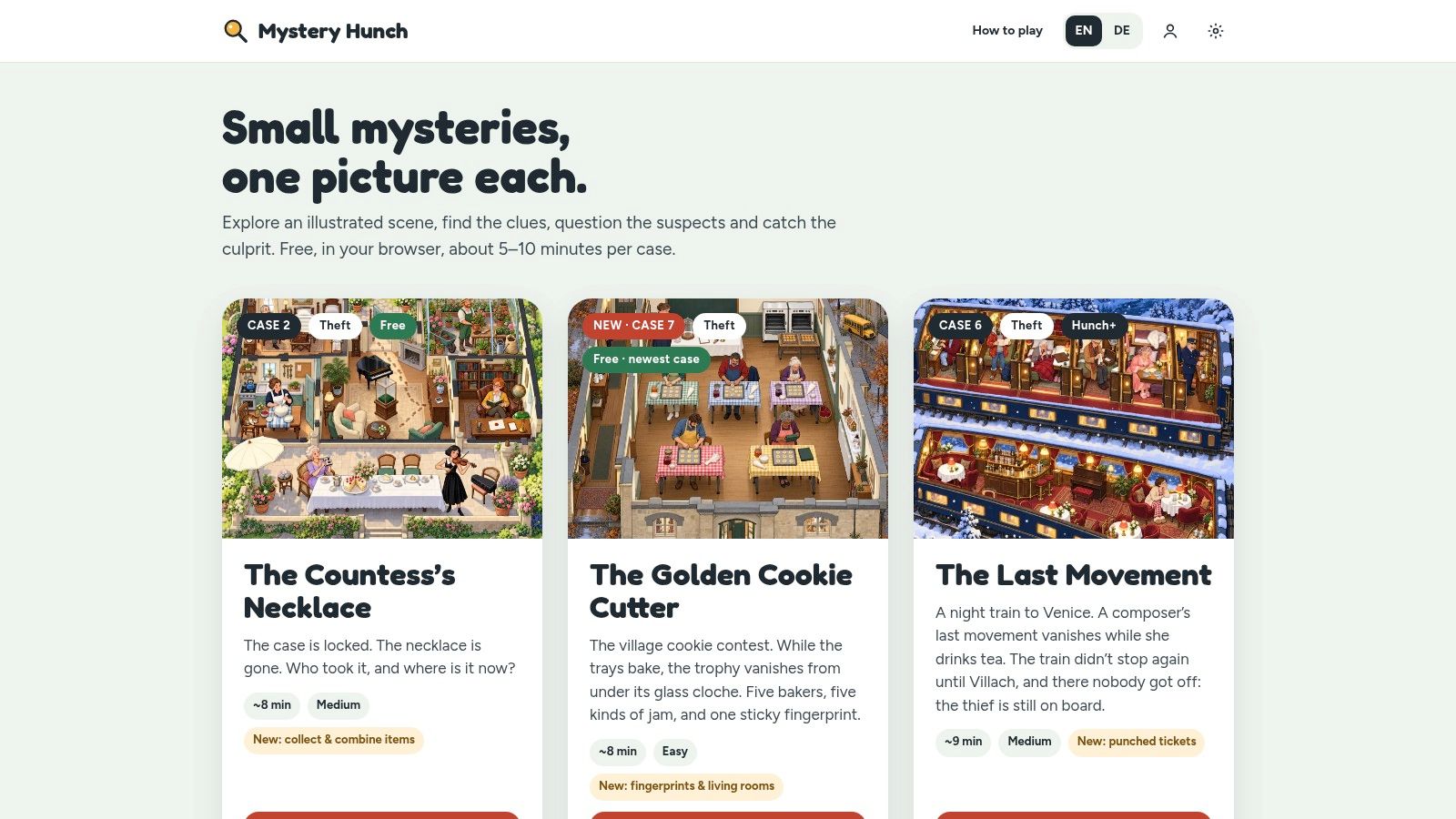
Mystery Hunch suits players who want an illustrated scene and a proper accusation, not just a hidden-object search. Our free browser puzzles let you tap rooms and objects, collect evidence, combine clues in a notebook, and test suspects' statements before identifying the culprit with proof.
The listed cases take approximately six to nine minutes, with easy and medium difficulty labels. Settings include a snowed-in mountain hut, a Halloween costume party, and a missing recipe book investigation. Different cases introduce mechanics such as pencil rubbings, seating arrangements, masks, and combining objects, so the investigative task isn't always identical.
Where the short format works
Keeping the investigation inside an individual scene gives you a manageable set of relationships to examine. The useful question isn't whether an object looks suspicious, but whether it contradicts someone's account or explains how the theft or murder happened.
- Evidence organisation: The notebook supports combining clues and comparing them with statements.
- Optional assistance: A partner can help when you're stuck, at the cost of one star.
- Clear scoring: You can earn up to three stars per case, and earned stars remain after restarting.
- Presentation choices: Phone-friendly layouts, English and German options, and bright or noir styles offer different ways to play.
The limitation is the project's early stage. This is a new, solo-developed prototype, so cases, features, and scoring may change or be removed as feedback comes in. A darker visual style also isn't automatically easier to inspect, so choose the presentation in which you can distinguish the clues.
Short-sitting verdict: A strong fit for players who want scene exploration, a compact suspect pool, and an evidence-backed finish.
2. Midnight Casebook
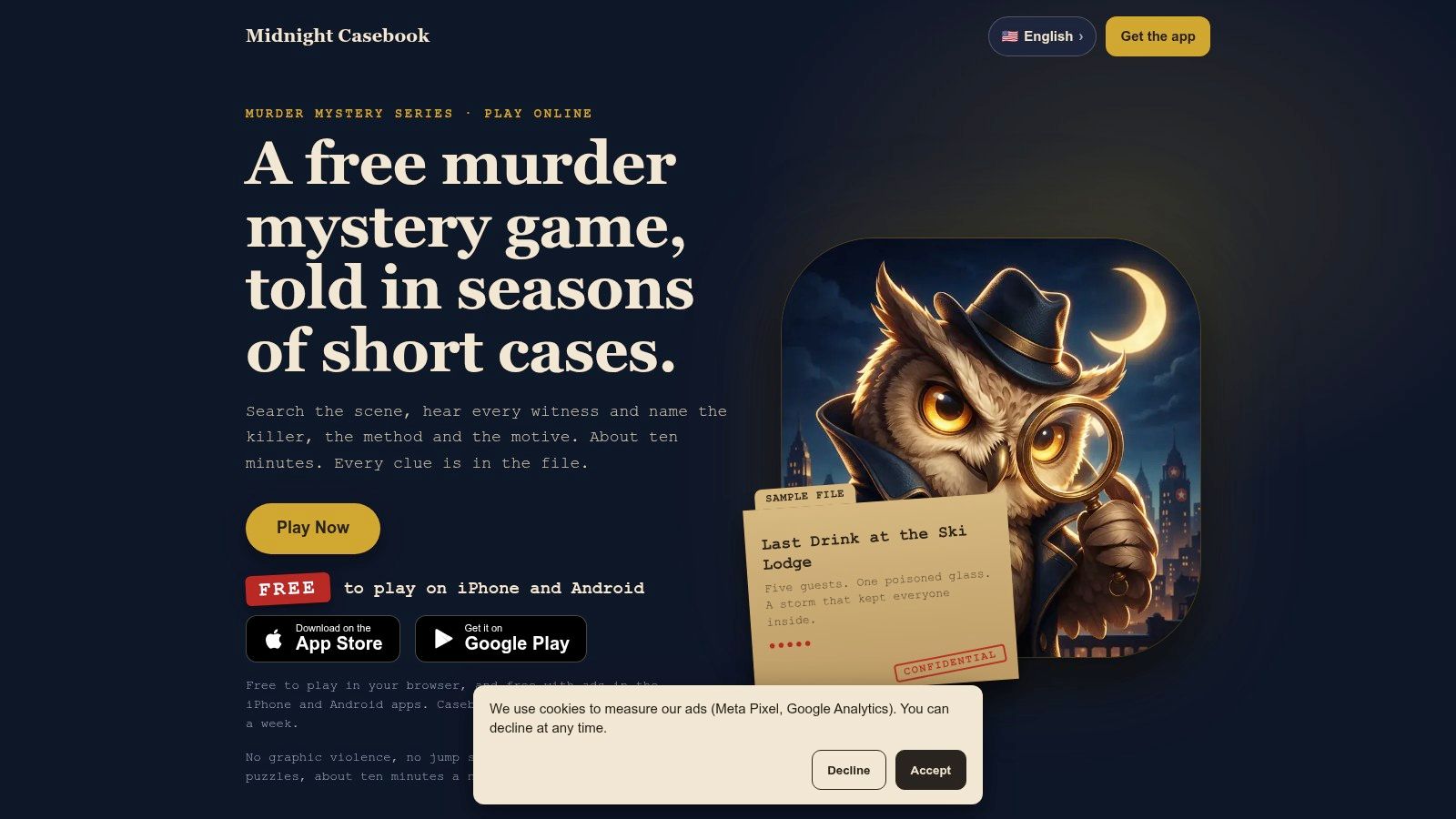
Finding the culprit is only part of the job in Midnight Casebook. Its illustrated investigations ask you to establish who committed the crime, how they did it, and why, using scene evidence and voiced suspect statements.
That combination matters. A suspicious statement can suggest a suspect, but connecting it to physical evidence makes the conclusion more satisfying than choosing whoever sounds least trustworthy. The evidence board gives the investigation a focal point while you move between searching and testimony.
Before accusing: Separate what a suspect claims from what the scene actually establishes. A convincing story isn't the same thing as a supported alibi.
A wrong accusation costs a life, so this isn't the best place to click through suspects experimentally. Read the accusation requirements before committing, then make sure your explanation covers the method and motive rather than stopping at a name.
You can start without an account, and browser play avoids needing the mobile apps. Optional subscription features exist, so don't assume every part of the wider experience has the same access conditions.
Short-sitting verdict: A close match for a compact whodunit, especially if you enjoy listening as well as looking. If you prefer to begin with an individual scene, start an illustrated investigation instead of choosing solely on atmosphere.
3. Inkspektor
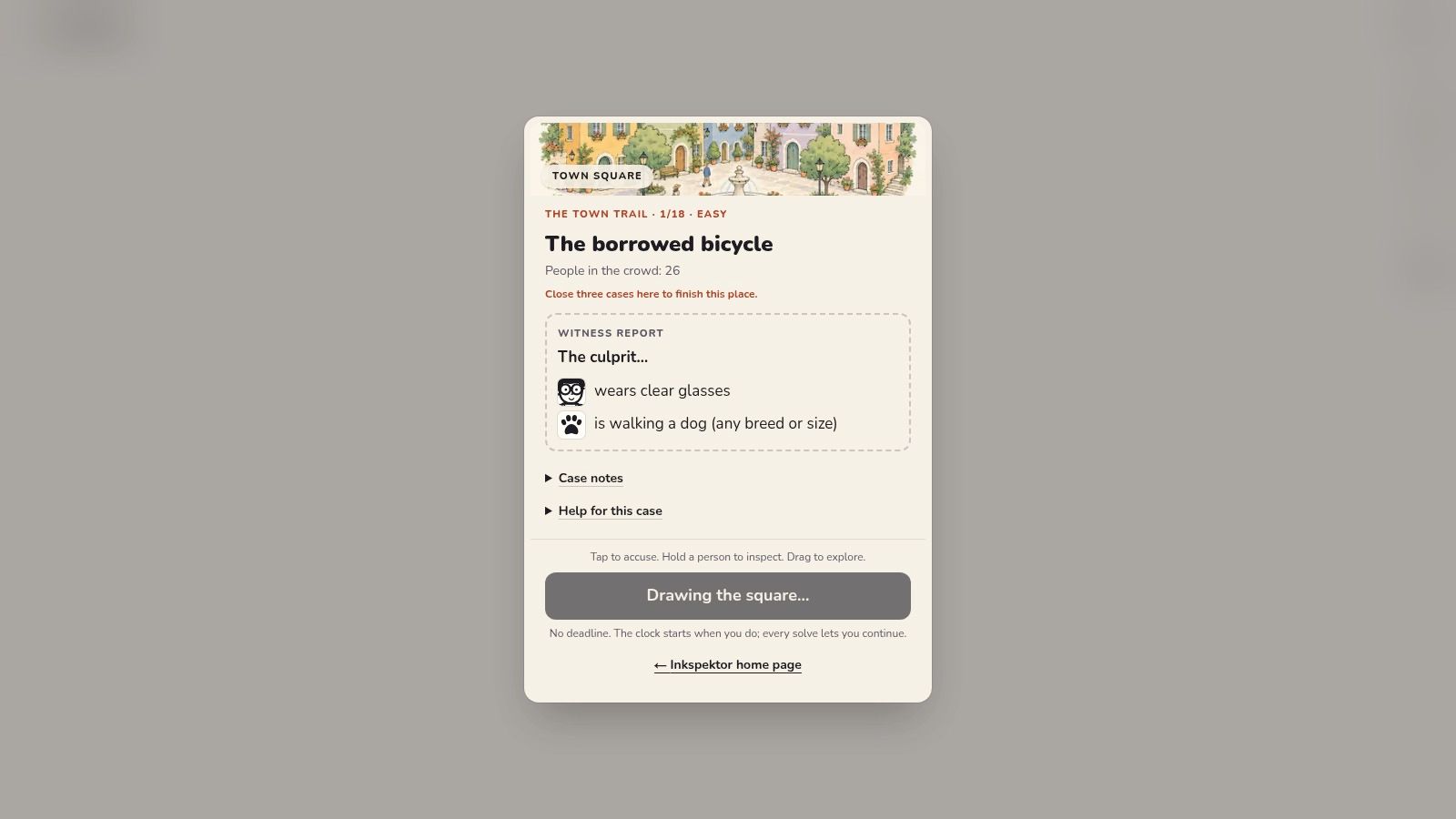
Inkspektor is detective observation rather than a traditional whodunit. In Inkspektor's browser game, you read a witness report and locate the person in an illustrated crowd who matches its clues.
Markets, stations, museums, parks, and harbours provide different visual search spaces. Panning and zooming are central tools, not decorative extras, because the decisive detail may be small enough to miss in the full scene.
Treat the report as a set of conditions
Don't select someone because they match the most memorable detail. Check every condition against the same person, especially when several figures share clothing, accessories, or other visible characteristics.
- Best feature: The report gives your search a purpose beyond spotting an arbitrarily hidden object.
- Useful flexibility: Difficulty choices, hints, and visual controls let you adjust the task.
- Main limitation: You're identifying a matching person, not reconstructing motive, opportunity, and method.
Quick cases restart if you leave or reload, which makes interruption a practical consideration. Choose a moment when you can finish the round rather than assuming browser play means automatic progress recovery.
Short-sitting verdict: Excellent for a focused visual challenge, less suitable if your favourite payoff is explaining a crime. For that alternative, open an evidence-led case and compare the kind of reasoning you prefer.
4. Daily Detective
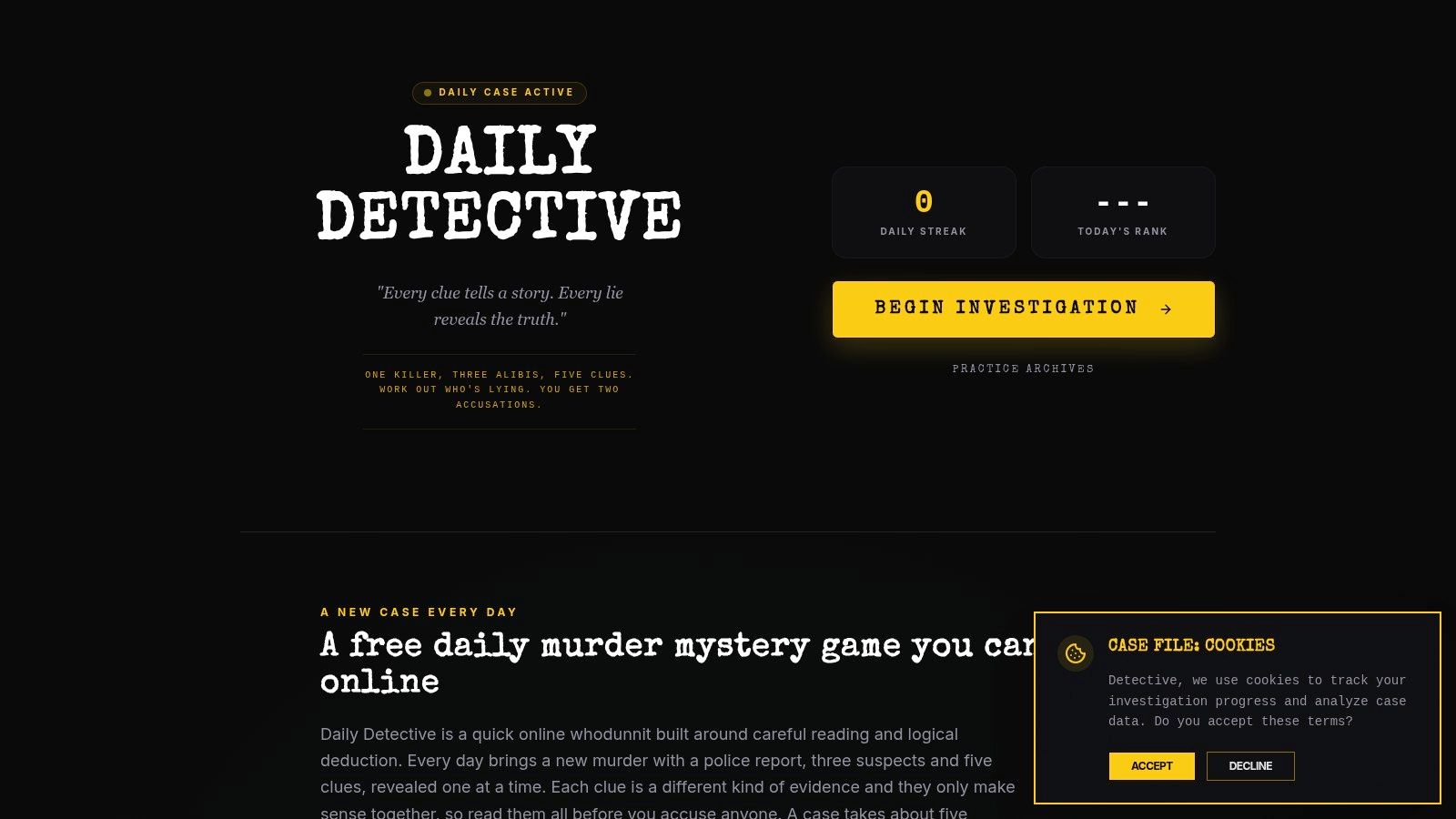
A police report, suspect alibis, and progressively revealed clues keep Daily Detective focused on reading for contradictions. There's no illustrated room to sweep for overlooked hotspots, so your attention goes straight to what the evidence permits.
This is a good choice when you want a daily ritual rather than an expanding adventure. It's free without signing up, and solved cases and streaks are saved in the browser.
The important distinction is between an unusual statement and an impossible one. A suspect can sound evasive without contradicting the report; another can sound completely ordinary while claiming something the evidence rules out.
Don't accuse the most suspicious personality. Accuse the person whose account you can disprove.
Because accusation attempts are limited, use each newly revealed clue to revise your explanation rather than rushing to confirm your first impression. Keep track of which facts eliminate suspects and which merely add background.
The trade-off is format and supply. Players who enjoy spatial investigation may find the text-led presentation too spare, while players wanting a long run of fresh investigations may find the daily structure restrictive.
Short-sitting verdict: A strong choice for readers who want a clear stopping point and minimal interface learning. It works best when you enjoy rereading a sentence and noticing why its precise wording matters.
5. Enquetix
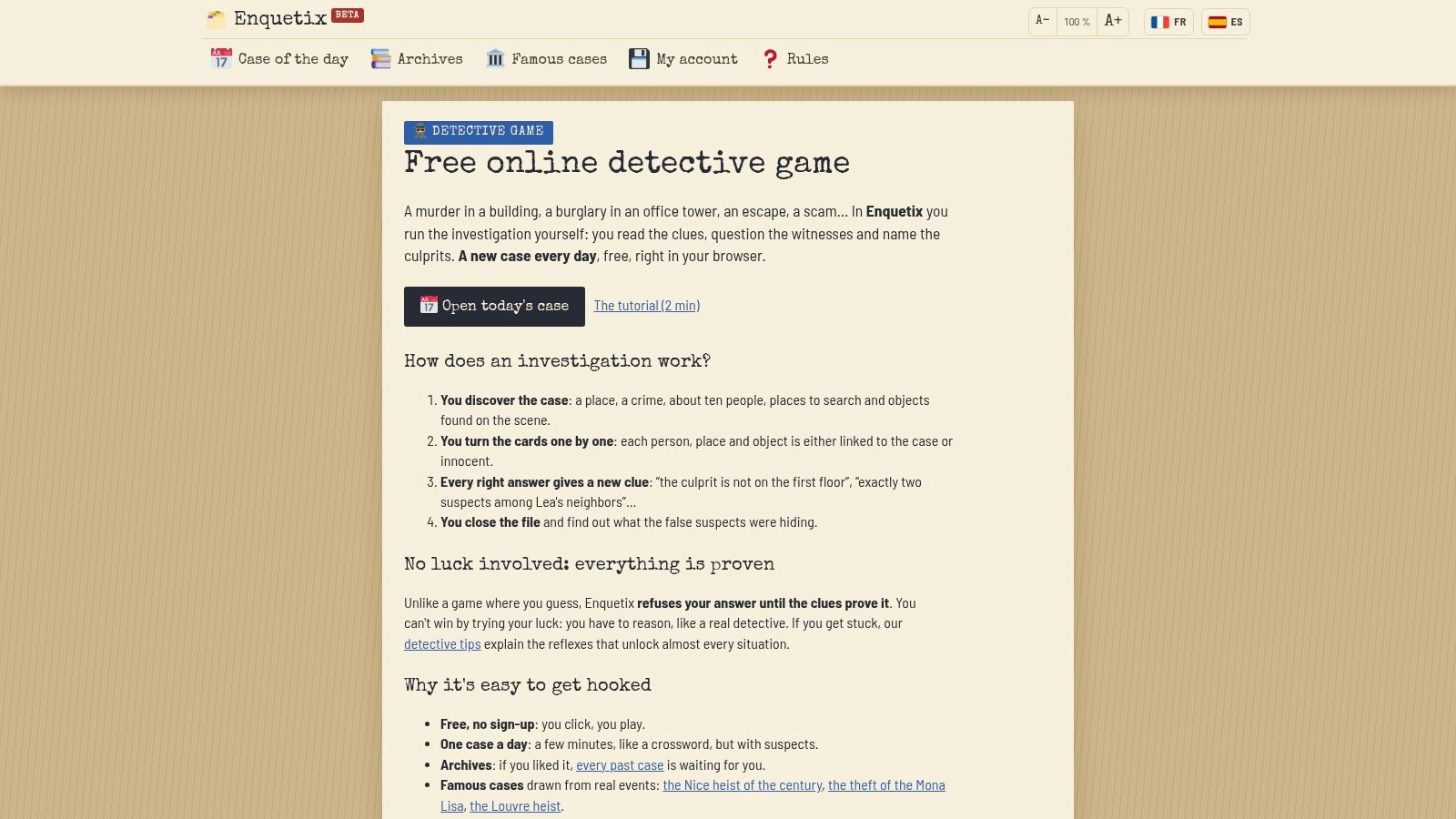
Enquetix presents investigations through cards representing people, places, and objects. Turning them over reveals information you can use to support deductions across cases involving crimes such as burglary, murder, scams, and escapes.
The appeal is organisation. Instead of remembering which corner of a room contained an object, you work with distinct information units and their relationships. That makes it a useful alternative when visual scene searching feels more frustrating than investigative.
- Daily play and an archive: You can follow the current case or choose an earlier investigation.
- Low-friction entry: You can start free without an account and learn through the tutorial.
- Readable presentation: Phone and computer support, plus text enlargement, help accommodate different screens.
Follow the clue, not the category
An object card isn't automatically incriminating, and a person card isn't necessarily the answer. Connect the revealed information before deciding what role each card plays.
Regular cases are set in France and translated into English. That isn't a problem, but unfamiliar names or local context may demand more careful reading than a highly visual puzzle.
Short-sitting verdict: A good fit if you like structured evidence and want an archive when the daily case isn't enough. It's less suitable if your idea of detective play depends on physically exploring an illustrated location.
6. Suspectle

Choose Suspectle when the deduction matters more than the detective performance. Its puzzle formats include floor plans, suspect statements, evidence sorting, and scene reconstruction, so you're not limited to reading another set of alibis.
That variety gives you a practical way to identify your preferred kind of reasoning. You might enjoy mapping where people could stand but dislike sorting statements, or find evidence relationships more satisfying than reconstructing a scene.
Daily puzzles, archived cases, and difficulty options make it easier to select a manageable challenge. The starter option is the sensible entry point if you haven't learned how a particular format communicates its constraints.
Pick the mechanic before the difficulty
- Floor plans: Choose these if spatial relationships make sense to you quickly.
- Statements: Choose these if you enjoy comparing claims and identifying contradictions.
- Evidence sorting or reconstruction: Choose these if organising facts is the main attraction.
Suspectle is free without an account, but progress isn't saved to a profile. Don't confuse being able to open the game anywhere with having a cross-device investigation record.
Short-sitting verdict: A strong option for a contained logic workout. The compromise is narrative depth: players seeking a richly staged crime scene and sustained character interaction may find the puzzle-first approach too abstract.
7. Ask the Truth
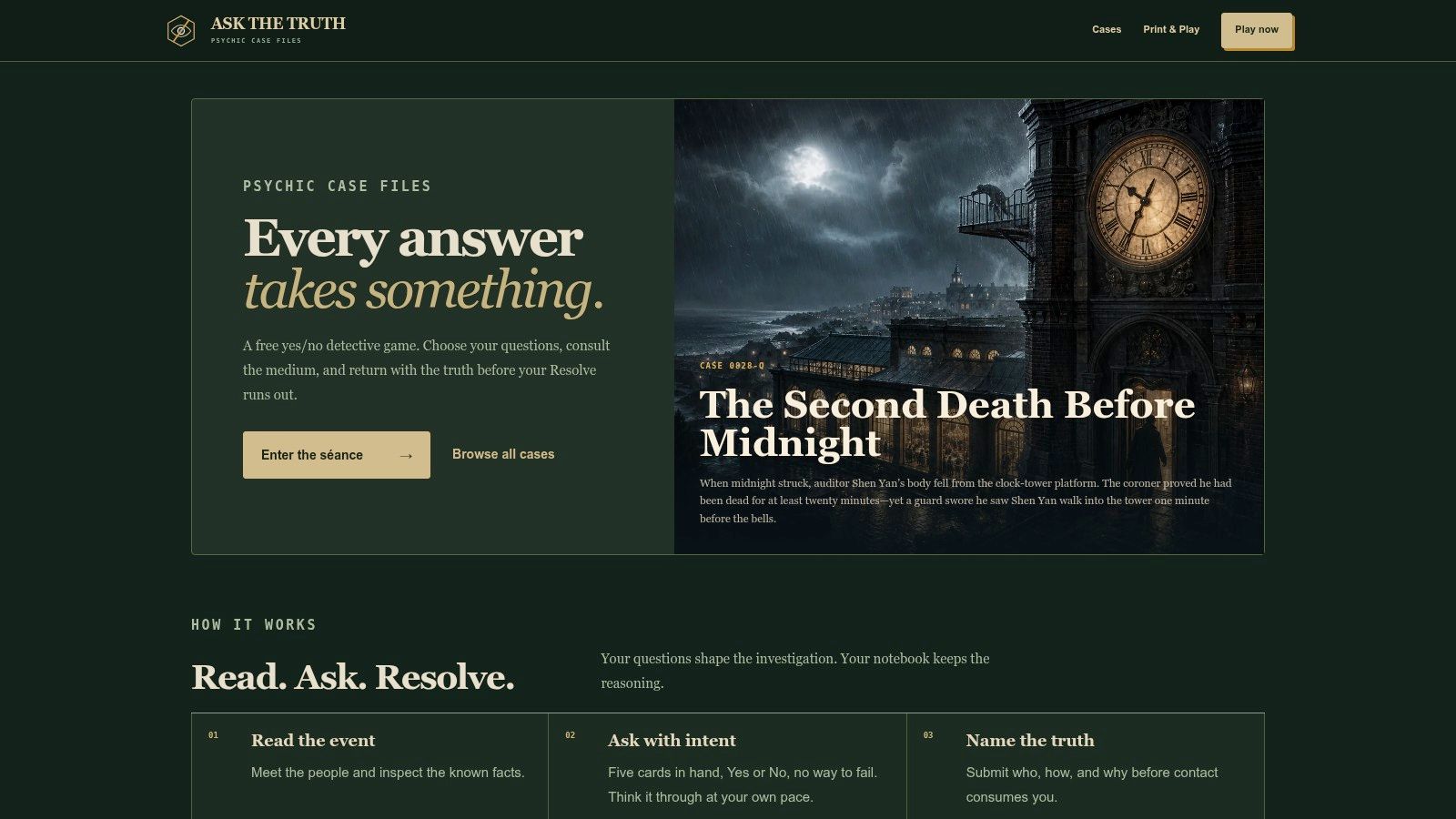
In Ask the Truth, your main tool is choosing which authored yes-or-no question to ask next. You gather evidence, pursue further inquiries, and build an explanation of who was responsible, how, and why.
This isn't an unrestricted conversation simulator. You choose from available questions, which gives the investigation clearer boundaries but limits how freely you can pursue a theory.
The interesting decision is whether a question will distinguish between plausible explanations. Asking everything indiscriminately is less useful here because inquiries consume Resolve, and a negative answer costs extra.
Question strategy: Before spending Resolve, decide what you'll learn from either answer. If neither changes your theory, another question may be more useful.
Private notes and locally saved progress help you preserve context in the same browser. That's a meaningful advantage for interrupted play, although you shouldn't assume local saving means your notes will follow you to another device.
The game is free without an account or download, and its public version is in English. A wrong conclusion lowers your rating, adding another reason to organise your evidence before submitting.
Short-sitting verdict: Best for players who enjoy directing an inquiry rather than searching a picture. The resource system adds tactical pressure, but it may frustrate anyone who wants to explore every question without a scoring consequence.
8. PLAY INQUEST
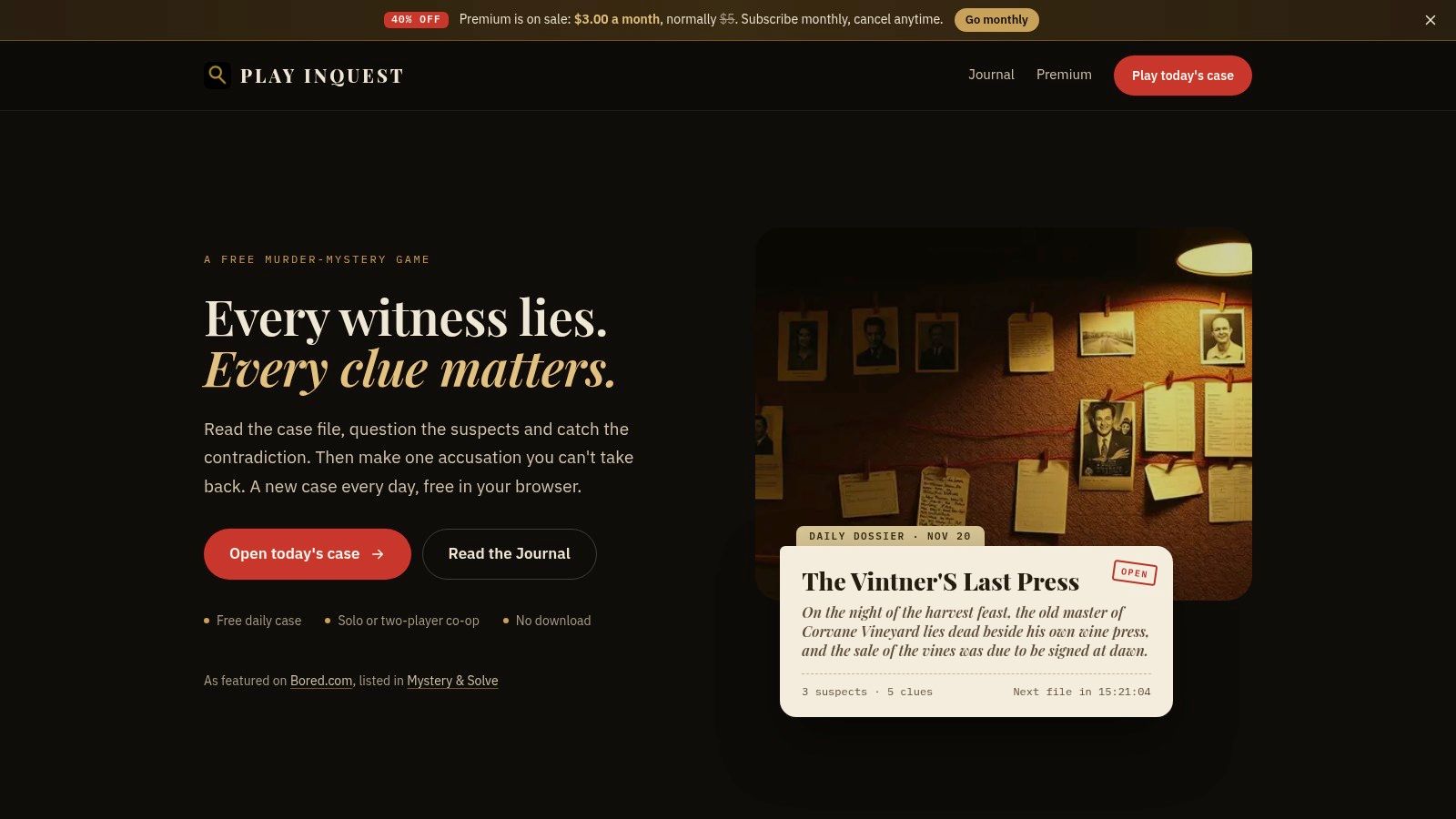
PLAY INQUEST is closer to working through a dossier than solving a compact visual riddle. At PLAY INQUEST, you search scenes, review witness statements, compare evidence, and pin down the lie that breaks an alibi.
The daily dossier and the earlier casebook give you options, but case length varies. A detailed file can produce a satisfying explanation while still being a poor pick for a break with a hard stop. Check how much reading a case asks of you before you start.
Co-op changes the rhythm
Optional real-time co-op lets signed-in players discuss evidence together. It suits anyone who enjoys defending a theory out loud, though it adds coordination and account friction that solo browser play skips entirely.
- Strongest fit: Players who want to cross-reference statements and documents.
- Useful option: Shared investigation when talking through clues is part of the fun.
- Main compromise: More reading and comparison than a quick, single-scene case.
When reading a dossier, separate established facts from witness claims in your notes. A confident statement can become something you treat as proven.
Short-sitting verdict: Conditional rather than automatic. Choose it when you can give the file your full attention, not just because it runs on your phone. For a faster or more visual format, compare the other free browser mystery games before committing.
9. LiarHunt
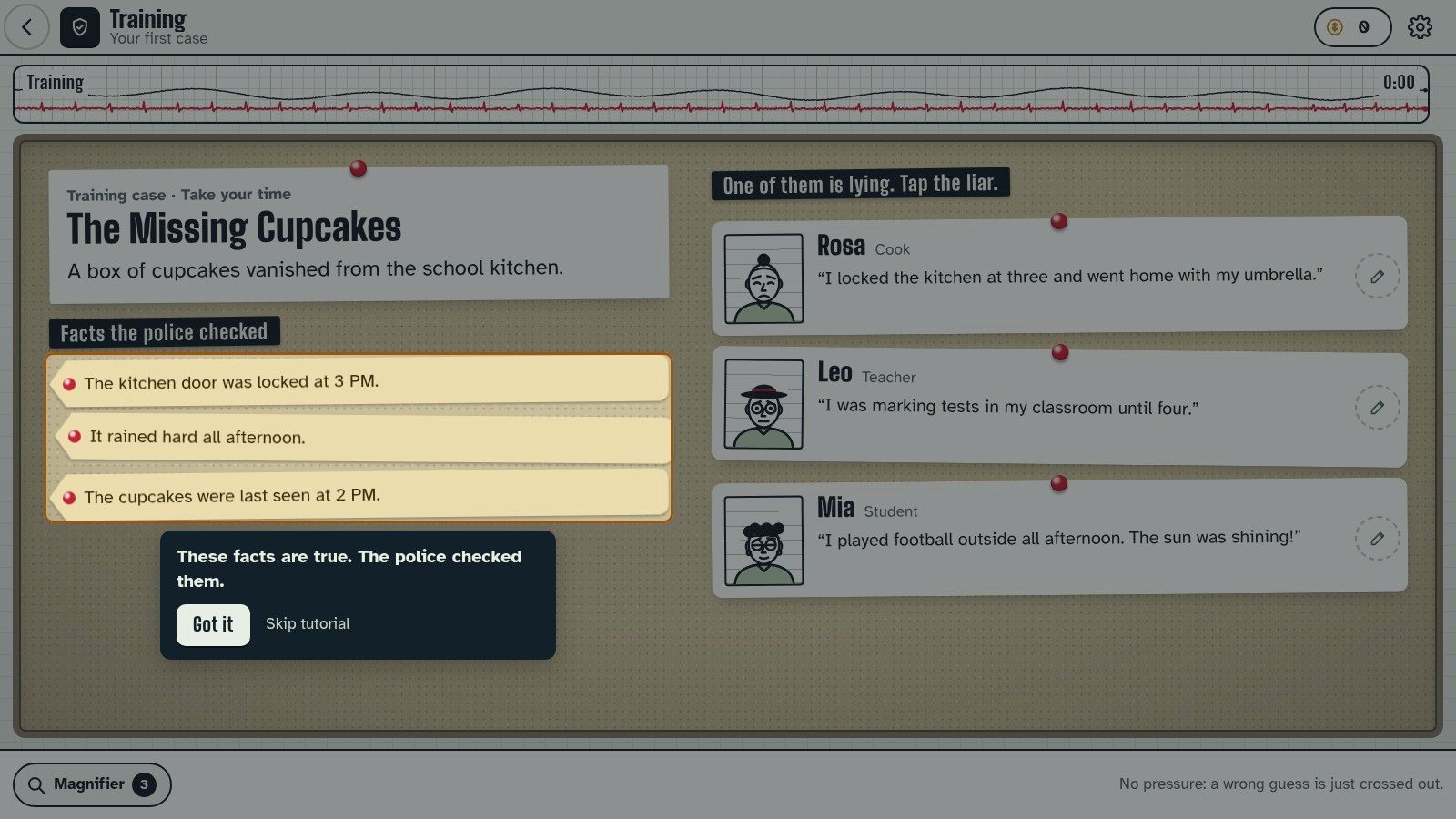
An alibi is only useful until a fact contradicts it. LiarHunt builds around that idea, with quick daily cases alongside Career and timed Rush modes.
Choose your mode according to how you want to think. Daily play gives you a contained challenge, Career expands into scene searches, questioning, timeline reconstruction, and connecting evidence, while Rush adds time pressure.
Those aren't interchangeable experiences. A player who enjoys careful elimination may like the daily investigations but dislike making the same kind of decision against a timer.
- Daily cases: Best when you want a defined task and can commit to your answer.
- Career investigations: Better when you want progression and varied investigative activities.
- Rush mode: Appropriate when speed is part of the challenge, not an unwanted distraction.
Daily attempts are unforgiving: a mistaken suspect or incorrect proof can end the attempt. Identifying the right person isn't enough if you can't also identify the evidence that demonstrates the lie.
Before submitting, state the contradiction plainly to yourself. If you can only say that someone seems suspicious, keep examining the relationship between their account and the facts.
Short-sitting verdict: A good fit through daily play, with a sharper penalty for guessing than some alternatives. Browser support across phones, tablets, and computers makes entry straightforward, but it doesn't make rushed accusations safer.
10. NOIR
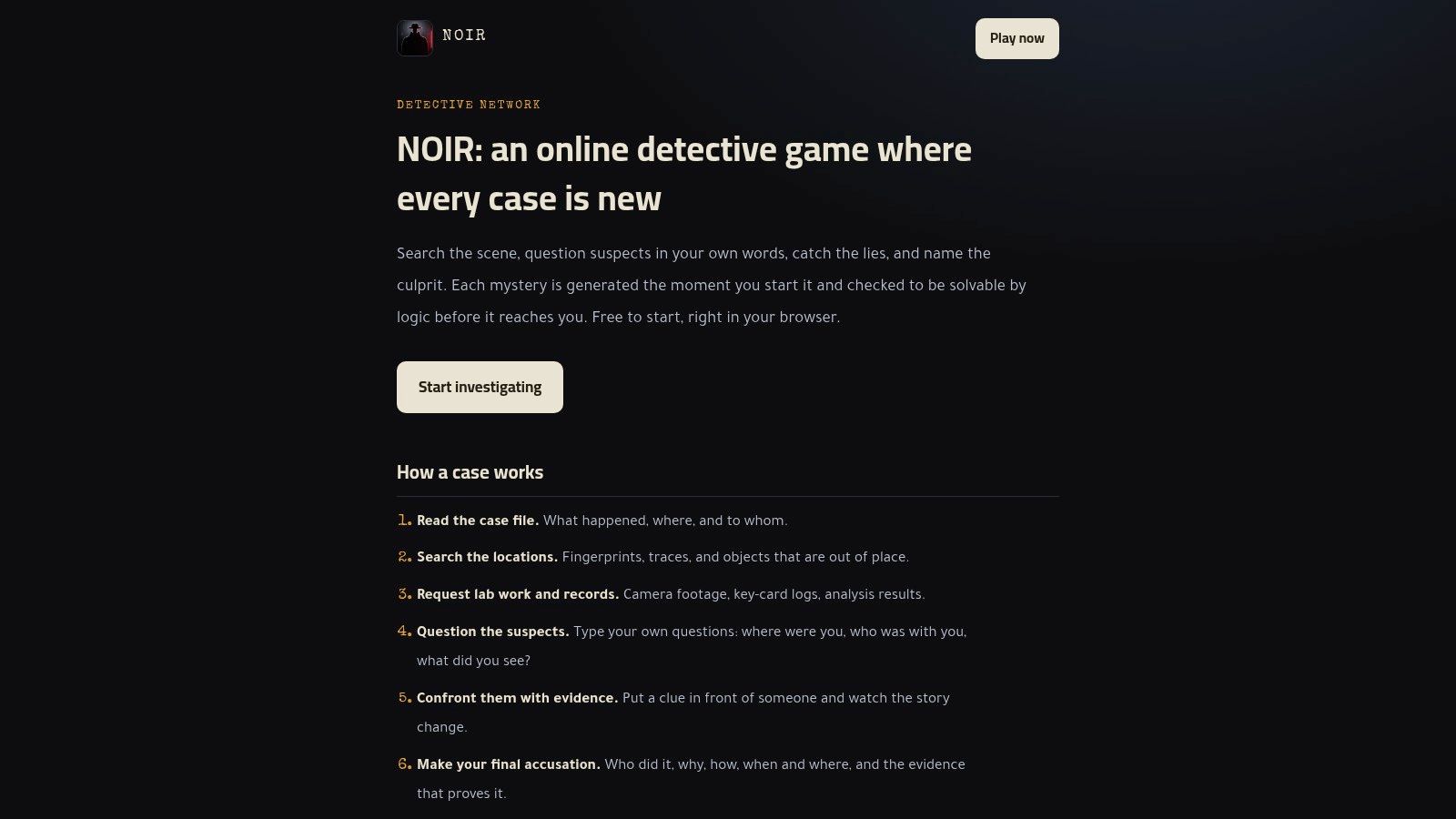
NOIR offers the most open-ended style of investigation in this selection. You can search locations, request lab work and records, ask typed questions, and confront suspects with evidence.
Cases are generated when started, with quick, standard, and extended lengths. Only the quick setting makes sense as the default choice for this short-sitting test; longer settings ask for a different level of commitment.
The freedom is attractive if fixed question menus feel restrictive. It also means you have more decisions to manage than finding the clue that opens the next authored exchange.
Freedom needs a plan
Start with a theory you can test through records, traces, or testimony. Broad questioning without a purpose can create more material to review without making your conclusion clearer.
- Investigative range: Crimes include theft, fraud, arson, and kidnapping.
- Flexible approach: Search, forensic requests, records, and questioning provide different routes.
- Solo or shared play: Co-op is available if you want to investigate with others.
The compromise is directness. Typed questions and generated cases are a less predictable fit for a brief break than a tightly bounded illustrated puzzle.
Short-sitting verdict: Worth choosing when investigative freedom is your priority and you deliberately select a short case. Skip the longer settings when what you really want is a compact mystery with a clear finish before your next obligation.
How the 10 browser detective games compare
| Game | Case length | Core mechanic | Difficulty options | Account needed | Best for |
|---|---|---|---|---|---|
| Mystery Hunch | About 6–9 minutes | Explore a scene, compare clues with statements, and accuse the culprit with proof | Easy and medium cases; hints cost one star | No account needed to play in the browser | Short illustrated whodunits with clue-combining and suspect statements |
| Midnight Casebook | Short case sessions | Search scenes, review voiced statements, and identify who, how, and why | Difficulty options depend on the case | No account required to start | Quick cases combining visual search and testimony |
| Inkspektor | Short observation puzzles | Match a witness report to a person in an illustrated crowd | Several difficulty choices | No account required | Visual observation and matching |
| Daily Detective | Short, text-led daily cases | Compare evidence with three suspects' alibis | Daily puzzle format, with challenge rising through the case | No sign-up required | A quick daily whodunit focused on alibis |
| Enquetix | Short daily investigations | Turn over people, places, and object cards as clues are revealed | Daily puzzle format with an archive of past cases | No account required to start | Daily investigations with an archive of past cases |
| Suspectle | Short daily logic puzzles | Solve logic puzzles involving statements, evidence, floor plans, or scenes | Starter through Case File | No account required | Varied daily detective logic puzzles |
| Ask the Truth | Short, question-led sessions | Choose yes-or-no questions, gather evidence, and draw a conclusion | Player-directed questioning, with the case defining the limits | No account required | Player-directed investigations through questions |
| PLAY INQUEST | Quick, standard, and extended settings within each case | Search locations, request records and lab work, ask typed questions, and confront suspects | Quick, standard, and extended case lengths | Sign-in required for co-op | Detailed dossier cases and optional two-player co-op |
| LiarHunt | Daily cases are quick; career mode has 30 missions | Find conflicts between alibis and evidence; career mode adds scene searches and timelines | Timed Rush mode, daily cases, and career progression | Account depends on mode | A mix of daily puzzles and longer career progression |
| NOIR | Quick to multi-hour cases | Search locations, question suspects, and challenge accounts with evidence | Quick, standard, and extended cases | Account needed for co-op | Flexible solo or co-op investigations |
The useful split in this list is not “story games versus puzzle games.” It is how much structure the game gives you before you start reasoning. Mystery Hunch, Inkspektor, LiarHunt, and Suspectle give you a bounded task and ask you to notice details. Ask the Truth and NOIR give you more control over the investigation, which is rewarding when you already know what kind of evidence you want. PLAY INQUEST sits between those styles: it has authored cases and dossier work, but asks you to direct the questioning more actively.
For a single sitting, the clearest fit is a case with a stated short length and a firm endpoint. Mystery Hunch is the easiest example to judge here. Its cases run about 6–9 minutes, with easy and medium labels, clue collection through taps, a notebook for combining evidence, and accusations backed by proof. Hints are available through a partner, but each one costs a star, so the scoring keeps some tension even when you ask for help.
The trade-off is scope. Mystery Hunch uses individual illustrated scenes, not long chains of locations. That makes it clean for short sessions, especially in cases built around objects, seating, statements, and small visual details. It also means the deduction stays close to observation rather than open questioning. If you want to type your own theory and chase records, PLAY INQUEST or NOIR will feel less confined.
Midnight Casebook and Daily Detective are better described as short cases rather than by exact minute counts. Midnight Casebook combines visual search with voiced statements and asks you to identify the culprit, method, and motive. Daily Detective is more text-forward, built around comparing evidence with three suspects' alibis. Both fit a short sitting, but they ask for different attention: Midnight Casebook rewards looking, while Daily Detective rewards reading carefully.
Enquetix and Suspectle both suit repeat play. Enquetix turns people, places, and object cards into clue pieces, with past cases available in an archive. Suspectle leans harder on logic, using statements, evidence, floor plans, and scenes. I would pick Enquetix for casual deduction and Suspectle for players who like constraints that can be checked cleanly.
The more open games need a different standard. Ask the Truth gives you yes-or-no questions and leaves more of the route to you. NOIR offers quick, standard, and extended cases, with solo or co-op investigation and evidence challenges. PLAY INQUEST has quick, standard, and extended settings too, plus typed questions, records, lab work, and optional two-player co-op. Those are stronger choices when you want investigative range, but the longer settings stop being casual fillers.
One practical caveat: “free” and “quick” are separate promises. Mystery Hunch is free to play in the browser, and its cases are short. It is also an early prototype, so cases, features, and scoring can change or be removed. That matters if you care about a stable campaign, but it matters less if you want a detective puzzle you can open and finish now.
Short-sitting verdict: Choose Mystery Hunch for illustrated clue work with a clear proof-based accusation. Choose Midnight Casebook or Inkspektor for visual searching, Daily Detective or LiarHunt for alibi conflicts, and Suspectle or Enquetix for daily logic habits. Choose Ask the Truth, PLAY INQUEST, or NOIR when you want to steer the investigation yourself and accept the extra time that comes with it.
Pick Your Case and Start Deducting
Choose the investigative mechanic first, then the time commitment. If examining objects and spatial relationships is the fun part, an illustrated scene will suit you better than a dossier. If you mainly want the moment when an alibi falls apart, Daily Detective or LiarHunt gets you closer to that task without much scene searching.
For question-driven play, Ask the Truth offers bounded choices, while NOIR gives you more freedom and more responsibility for directing the investigation. Suspectle is the better fit when you want logical constraints rather than sustained storytelling, and Inkspektor suits players who want close observation without reconstructing an entire crime.
Make your first case manageable
Start with an easy or starter case before increasing difficulty. Learning an interface and solving a mystery are separate demands, and a difficult introduction can obscure whether you enjoy the underlying puzzle.
- Use hints deliberately: First identify whether you're missing an object, a connection, or an interpretation.
- Respect attempt limits: Don't use an accusation button as a substitute for checking evidence.
- Plan for interruptions: Saved notes help, but a browser game doesn't automatically preserve progress.
- Check readability early: Enlarge text or change presentation before committing to a visually demanding case.
Fast access alone doesn't establish accessibility. The Sentinel Assam's coverage of browser gaming discusses the appeal of avoiding slow loading and large downloads, but your own test should also include readable clues, usable controls, and whether essential information depends on sound or colour.
The best short mystery leaves you with an explanation, not merely a success screen. Before submitting, connect the suspect to the decisive evidence and explain why the competing account fails.
Our early prototype welcomes specific feedback, especially where an instruction, clue, or interface makes the reasoning harder to follow than intended. Describe where you became stuck without posting the solution publicly, so the next player can still enjoy the deduction.
For a compact introduction to solve it mysteries, visit Mystery Hunch and choose a free illustrated browser case lasting about six to nine minutes. Inspect the scene, compare the evidence with suspect statements, and make your accusation with proof, with stars tracking your accuracy and hints available if you get stuck.