Detective Games Unblocked: 10 Quick Picks for 2026

You've got ten minutes before the bell, or before a meeting you only half need to be in, and you want a mystery that ends. Not a forty-hour adventure. Not a download that asks for admin rights you don't have. Something you can finish before you have to look busy again.
That's where most lists of detective games unblocked fall apart. They tell you a game is free and browser-based, then you discover it wants an account, a plugin, a decent laptop, or a network that doesn't filter game portals at all. So this list sorts by how long a session really takes and by what happens when a filter gets in the way.
Some of these are five-minute puzzles you can finish standing up. Others, like the generated-case game further down, want an evening and a friend on the other end of a voice call. Pick by the time you have, not the time you wish you had.
One caveat before the list. Unblocked isn't a property of a game. It's a property of your network, your device, your browser and whoever runs the firewall that day. A game that opens fine on your phone at home can die instantly on a school Chromebook, and that's not the developer's fault.
Table of Contents
- 1. Mystery Hunch
- 2. Detective Murder Mystery at Zoomy Games
- 3. Detective Logic Puzzle at Coolmath Games
- 4. Inkspektor
- 5. Enquetix
- 6. LiarHunt
- 7. NOIR
- 8. Midnight Casebook
- 9. Who Is? on Poki
- 10. Night Incident at CrazyGames
- How the 10 browser detective games compare on session length, focus, and access
- Pick One Case Tonight and Check Your Network First
1. Mystery Hunch
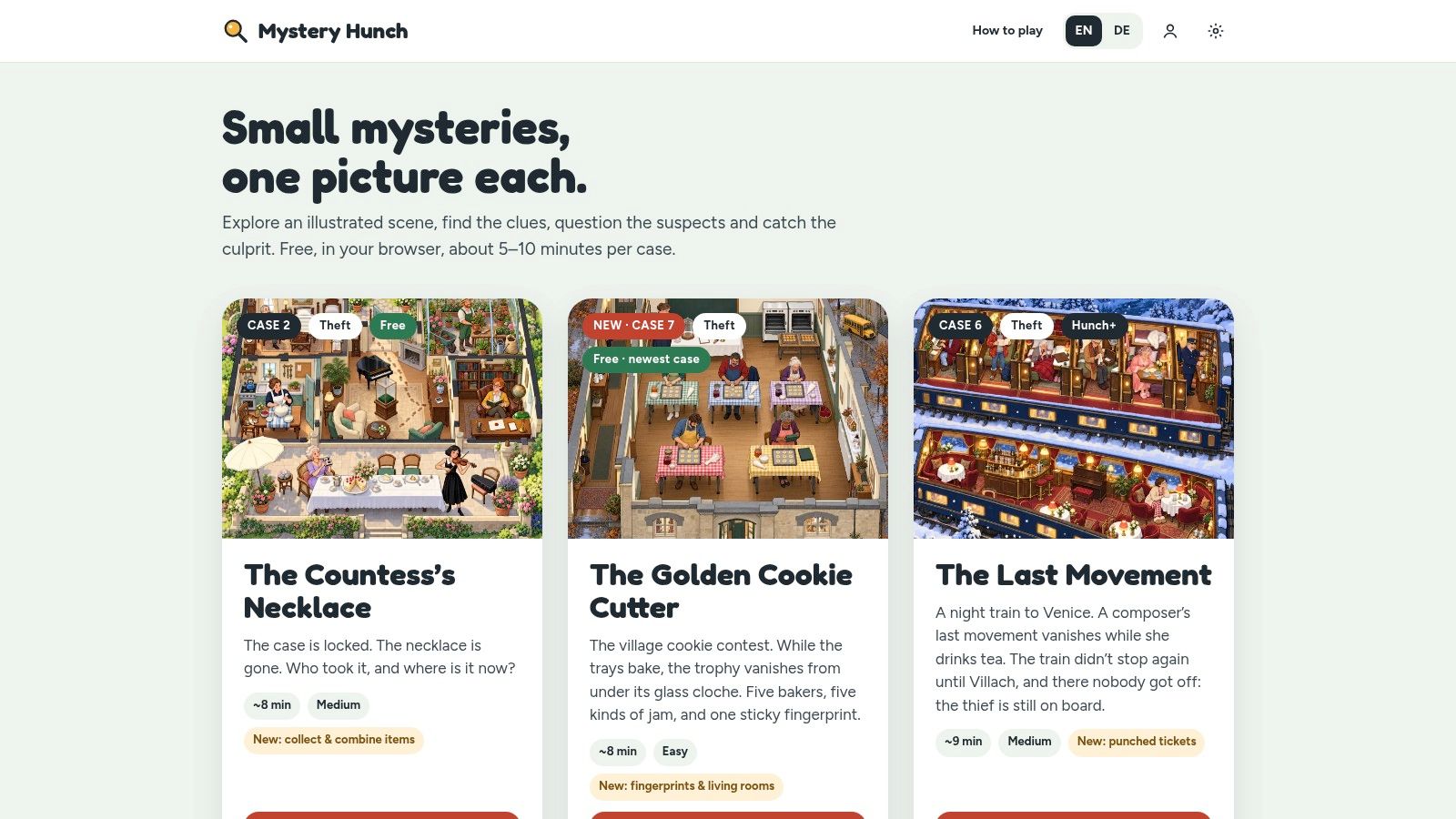
Mystery Hunch runs the shortest full detective loop on this list. Every case is a single illustrated scene, the case cards show an estimated time and a difficulty label before you commit, and the five listed cases take about five to ten minutes each. Settings cover a snowed-in mountain hut, a dinner table, an apple farm, a lakeside villa and a Halloween costume party.
What a case actually asks of you
You tap rooms and objects to collect clues, combine what you find in a notebook, and check it against what each suspect said. When you accuse someone, the game wants proof attached. That requirement gives a wrong answer a clear cause: you missed something, or you believed the wrong person.
Start with The Hut on the Grauhorn, a murder case of about six minutes where a snowed-in hut keeper is dead and five guests say they were asleep. The latest case, Theft, runs about nine minutes and sends a raven's ruby eye missing at a Halloween costume party.
- Structure over guessing: combining clues and comparing statements gives the investigation a shape, so a failed accusation feels like your mistake rather than the game's.
- Hints with a cost: a partner character helps when you're stuck, and each hint costs one star out of a maximum of three per case.
- Built for the device you have: the layout works on phones and wider screens, with English and German versions and a bright or noir visual style.
- Variety inside a small package: cases lean on different mechanics, including pencil rubbing, seating arrangements, masks and a blackout.
The limits matter too.
- It's an early prototype: the site says so plainly, it's made by one person, and cases, features and scoring can change or be removed at any time.
- The library is small: five cases listed, enough for a handful of short sessions.
On access, the game lives on its own domain rather than a big portal, so whether it loads depends on how your filter treats sites it doesn't recognise. A network that only blocks the major game portals will usually let it through; one that blocks everything unfamiliar will stop it like anything else. And because each mystery is one illustrated scene rather than a full 3D environment, there's less to load than the heavier games further down this list, which helps on a weak connection.
Time check: read the estimate on the case card before you start. It's the difference between finishing and getting caught mid-investigation by a bell.
Free to play in the browser at Mystery Hunch.
2. Detective Murder Mystery at Zoomy Games
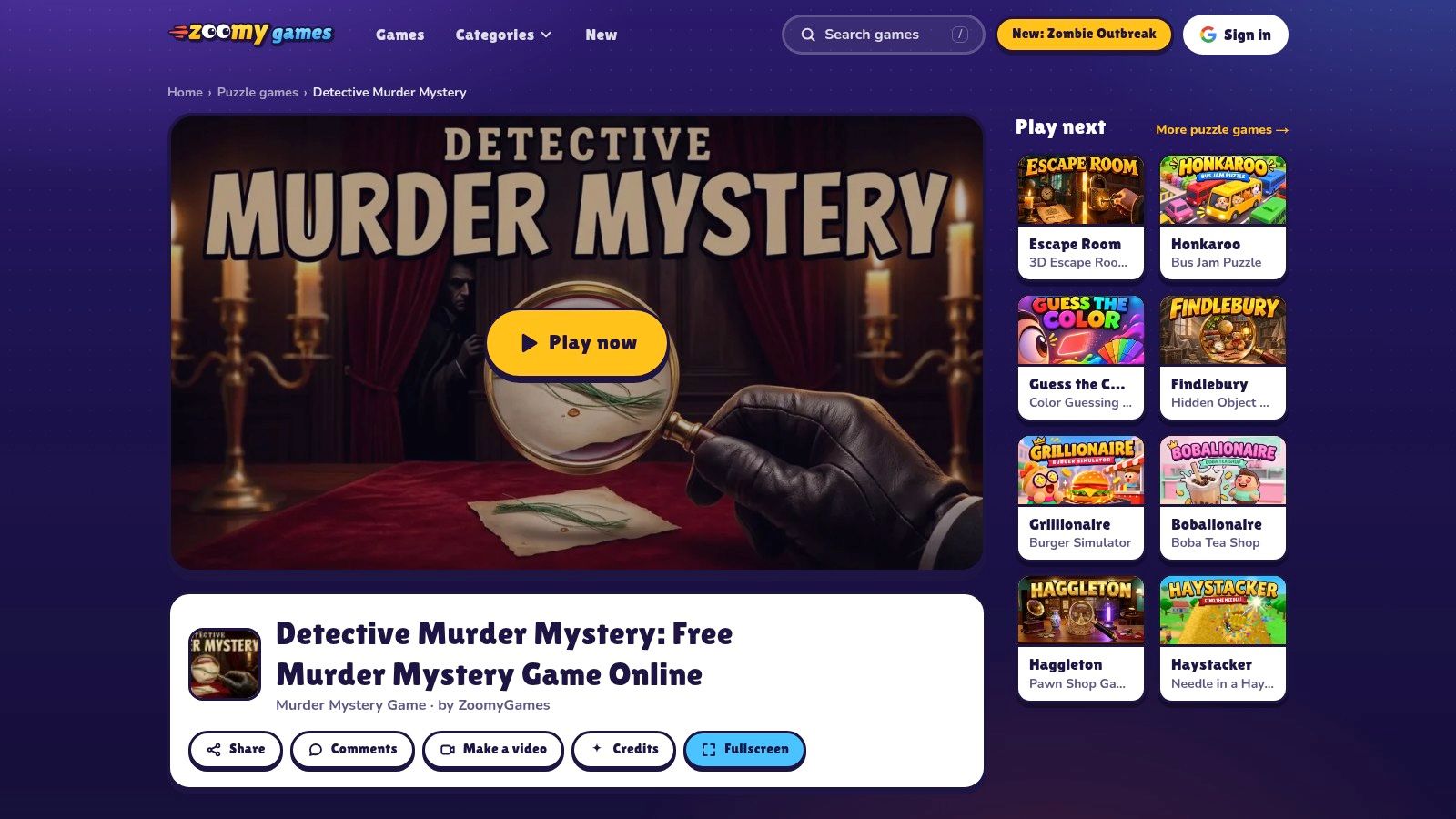
This is the long-session pick: a case-file setup with illustrated 3D scenes, suspect statements and an evidence notebook, closer to a small detective episode than a quick logic grid. It runs in the browser, keeps the gore off screen, and fits a classroom better than a horror-leaning mystery.
The real limit is time and bandwidth
Plan on a lunch break, not a gap between classes. A case asks you to read statements, connect evidence and make an accusation; wrong calls can cost stars, and partner hints are there when you stall. If the bell is the risk, pick a shorter case elsewhere.
The 3D scenes are also the heaviest thing on this list. On a weak school or office network, watch Core Web Vitals metrics: Largest Contentful Paint for how long the scene takes to appear, Interaction to Next Paint for how fast the game reacts to a tap, and Cumulative Layout Shift for objects that move just as you touch them. A slow render can feel like a broken game even when it is only loading.
- Good for: players who want statements, evidence and a notebook rather than hidden-object clicking.
- Bad for: short windows, older devices, or a phone hanging onto weak signal.
- Test first: open one case before you need it, because 3D assets are what filters and slow connections punish earliest.
Play it at Zoomy Games.
3. Detective Logic Puzzle at Coolmath Games
No story, no suspects to grill, no crime scene to poke at. You get written clues and a grid, and you mark relationships between people, times and objects until only one arrangement survives. It is the puzzle you would do on paper on a train, and it is the lightest load on this list: nothing renders but text and a grid, so a strict filter has almost nothing to block.
Why the format has survived this long
Every mark you make is forced by a clue, so a finished grid feels earned rather than lucky. That purity is why the format keeps outliving the platforms built around it. Browser delivery has always been the low-friction way to run it: nothing to install, nothing to approve, nothing to download. The game sits in a tab you already have open, which is exactly why it still runs on locked-down machines where installing anything would be a non-starter.
Two things to know before you click. The player rating on the page is decent rather than glowing, which tells you the puzzle is sound but not everyone's cup of tea. And if you run out of keys, the site expects you to go play something else to earn more. That is a mechanic rather than a paywall, but it breaks the flow of a quick session, and it means your session length gets decided partly by the key system instead of by you.
- Best for: people who like elimination and certainty more than atmosphere.
- Worst for: anyone who wants a story, dialogue or a culprit with a motive.
- Network risk: low. Ads and page scripts are the only real failure points.
Play it at Coolmath Games.
4. Inkspektor
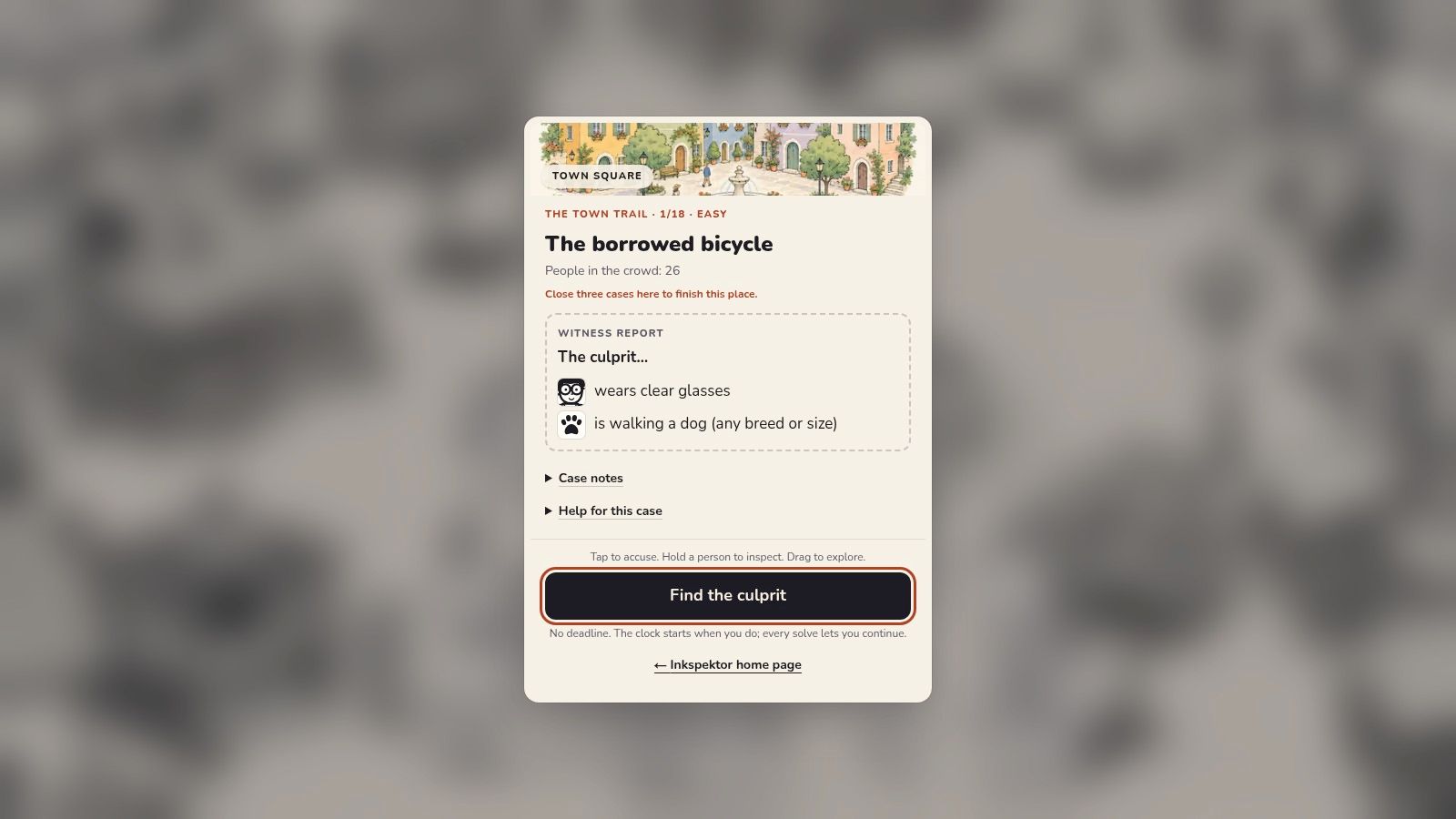
A witness report lands on screen, then a crowd of faces. Your job is to pick out the one person who matches every detail before the clock or your patience runs down. The report might describe a red scarf, a green hat and a limp, and only one figure in the crowd satisfies all three.
Short rounds, or a longer run if you want one
Quick cases are the default and they really are quick, which makes this the easiest pick on the list for a genuine five-minute gap. There are also optional multi-chapter cases across several locations if you'd rather sink into something. Scoring counts time, mistakes and hints, and the game tells you that up front, so a two-star result never feels arbitrary.
- No account, no download: open the page and you're playing.
- Visual over textual: good if dense paragraphs make your eyes slide off the screen.
- Disclosed scoring: time, mistakes and hints are all named as scoring inputs.
Where it thins out is depth. Matching a face to a description is the whole skill, and you won't combine physical evidence or break an alibi. If you want that kind of clue work after a few rounds, The Countess's Necklace is a free medium theft case of about eight minutes built on it, where you tap around an illustrated scene, collect clues and check suspects' statements to find what vanished from a locked case. Back in Inkspektor, one practical warning: reloading or leaving a quick case restarts that round, so don't refresh out of habit mid-search.
Play it at Inkspektor.
5. Enquetix
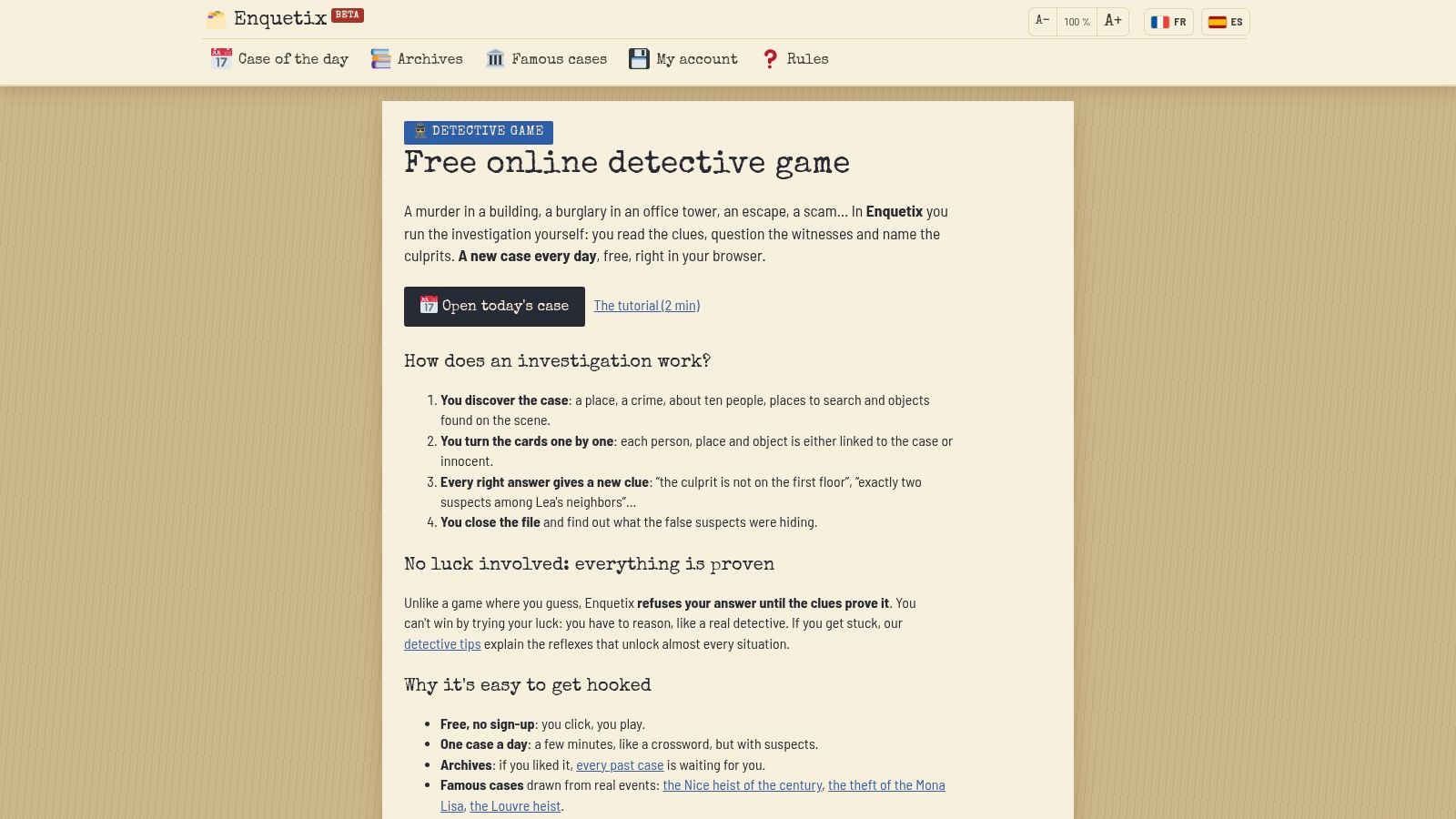
This one runs on a daily rhythm: one new case, solved carefully, with the accusation expected to rest on clues rather than a hunch. If you like the discipline of asking "does this evidence support this conclusion," that's the appeal. If you want a shelf of cases to pick by mood, it will feel narrow.
The daily format is the feature and the limit
A daily puzzle gives you a reason to come back tomorrow, and it keeps the case count from becoming overwhelming. The trade-off is choice: you get today's case, and that's your lot until the next reset.
Daily formats also assume reliable access. BroadbandNow's internet usage statistics put internet use at about 93% of U.S. adults, compared with 52% in 2000 and 76% in 2010. That's why a browser daily can work as a habit on most networks, and why a filtered school or office connection is the deciding variable: if the page loads, the routine is easy; if the domain is blocked, the routine ends there.
- Proof-first design: the game nudges you to support the accusation, which is the habit that makes deduction satisfying.
- Free daily case: the site describes the daily game as free.
- Session length: confirm the expected duration on the game page before starting; a daily format alone does not tell you whether today's solve fits a five-minute gap.
If your only window is four minutes between two classes, a daily case that turns out to be a twenty-minute investigation is a bad trade. Start it when you have slack.
Play it at Enquetix.
6. LiarHunt
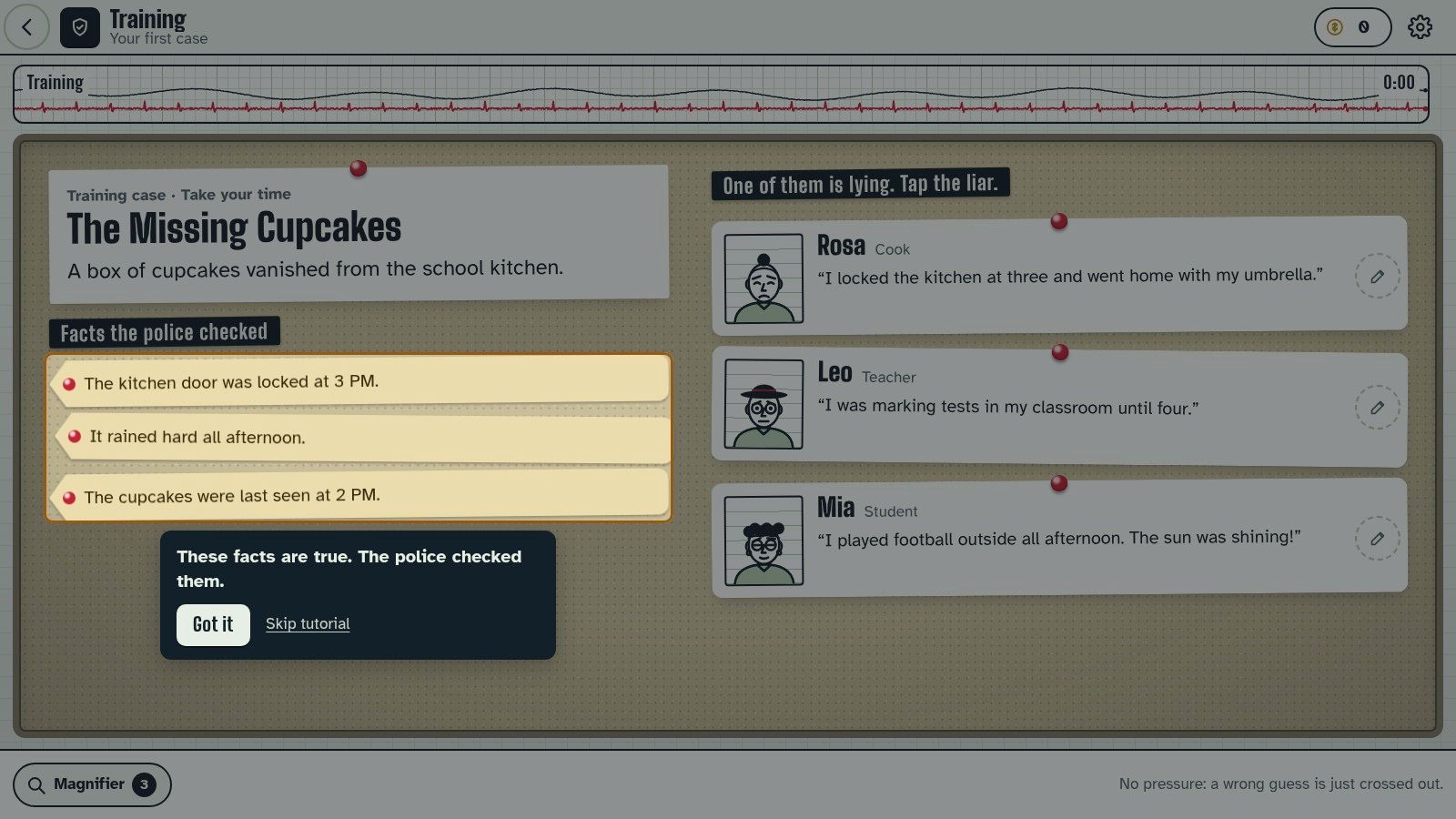
Three accounts of the same night, one that contradicts the case file, and a second step where you select the evidence that proves the lie. That second step is what makes this worth playing. Most browser detective games stop at "pick the guilty face"; LiarHunt makes you back the call with proof.
Match the mode to the clock
The timed Rush mode is the short-session option. The 30-mission career mode and live play with friends are the ones to save for real time, since both reward sticking around rather than dropping in. Session length depends on the mode you pick, which makes this one of the more flexible entries here.
The work itself is all reading and cross-checking, which sounds easy until the statements get dense and your screen is small. Text-heavy deduction is hard to follow on a phone when instructions run long. Play with the screen rotated, zoom the text if your browser allows it, and read the case file twice before touching the statements.
- Modes: daily cases, a 30-mission career mode, a timed Rush mode, and live play with friends.
- Devices: phone, tablet and computer.
- Focus: statement analysis rather than location exploration, so don't expect illustrated crime scenes.
- Free: browser-based, no download, per the site.
Nothing installs, so a filtered network either loads the whole site or blocks it outright. Confirm the domain resolves on your connection before you count on it for a break.
Play it at LiarHunt.
7. NOIR
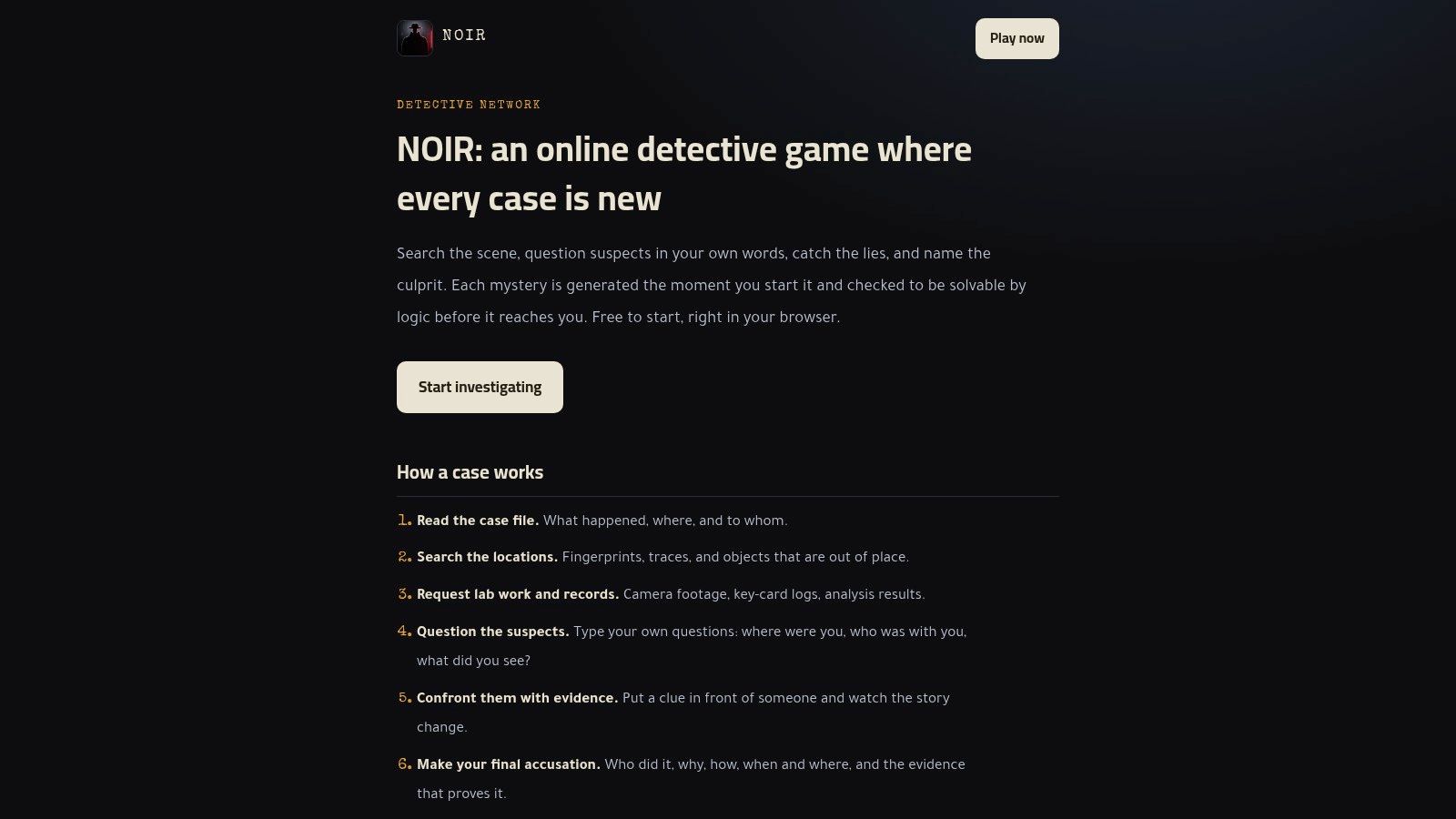
Do not start this one on a five-minute break. Cases are listed at 45 minutes to two hours, with generated scenarios, suspects who hide unrelated secrets, and private co-op rooms for two to six players. It's the deep end of the list, and it's the one I'd clear an evening for.
Session length versus real life
The gap between "average" play and "available" play is bigger than commonly assumed. One large study reported a mean game session of 41.9 minutes, but the 10th percentile was 9.1 minutes, according to the ACM study of game sessions. The lower end is where short detective games live, and it's the end NOIR ignores on purpose.
That's a legitimate design choice, not a flaw. Cooperative investigation benefits from time: you need space to argue about a suspect's timeline with a friend.
- Best for: a planned session with two or three people and a shared voice call.
- Bad for: a quick solo solve, or a shared school device where a two-hour tab is not going to survive.
- Pricing caution: the site describes it as free to start, so confirm what's included before you invest an evening.
Play it at NOIR.
8. Midnight Casebook
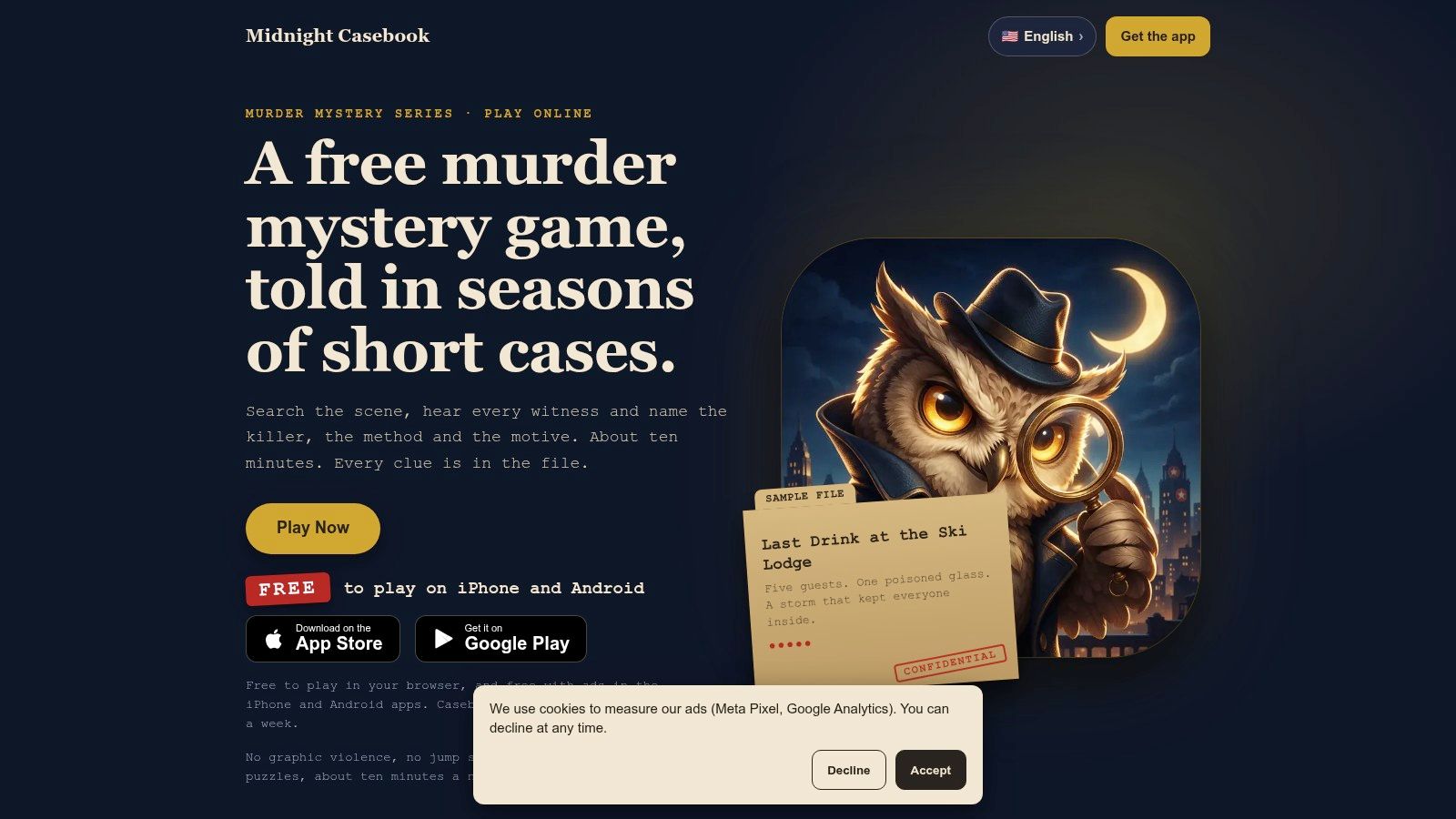
Story first, puzzle second. Daily murder cases come with illustrated scene searches and voiced witness statements, and each case asks for more than a name: who did it, how, and why. That extra layer keeps it from feeling like a hidden-object game wearing a trench coat.
Audio, story and the subscription line
Voiced statements are a genuine differentiator on this list, and they're also a network liability. Audio assets are the first thing to stutter on a throttled connection, and they're dead weight in a silent library or shared office. Play muted and you lose part of what makes this one worth picking.
The meter matters too. Casebook Pro is a paid weekly upgrade that removes the lives limit, and the mobile app versions carry ads. Browser play is described as free, so start there and see how far the free lives stretch. Once you've cleared a few single-scene cases from the Mystery Hunch case list, you'll know whether you want a story-heavy version of the same itch or a longer session.
- Strength: motive, method and culprit all matter, which is more than most free browser detective games ask.
- Weakness: it's story-led, so players wanting a compact logic puzzle should look elsewhere.
- Practical: if the voices won't load, don't assume the game is broken. Try again on a different network before you give up on it.
Play it at Midnight Casebook.
9. Who Is? on Poki
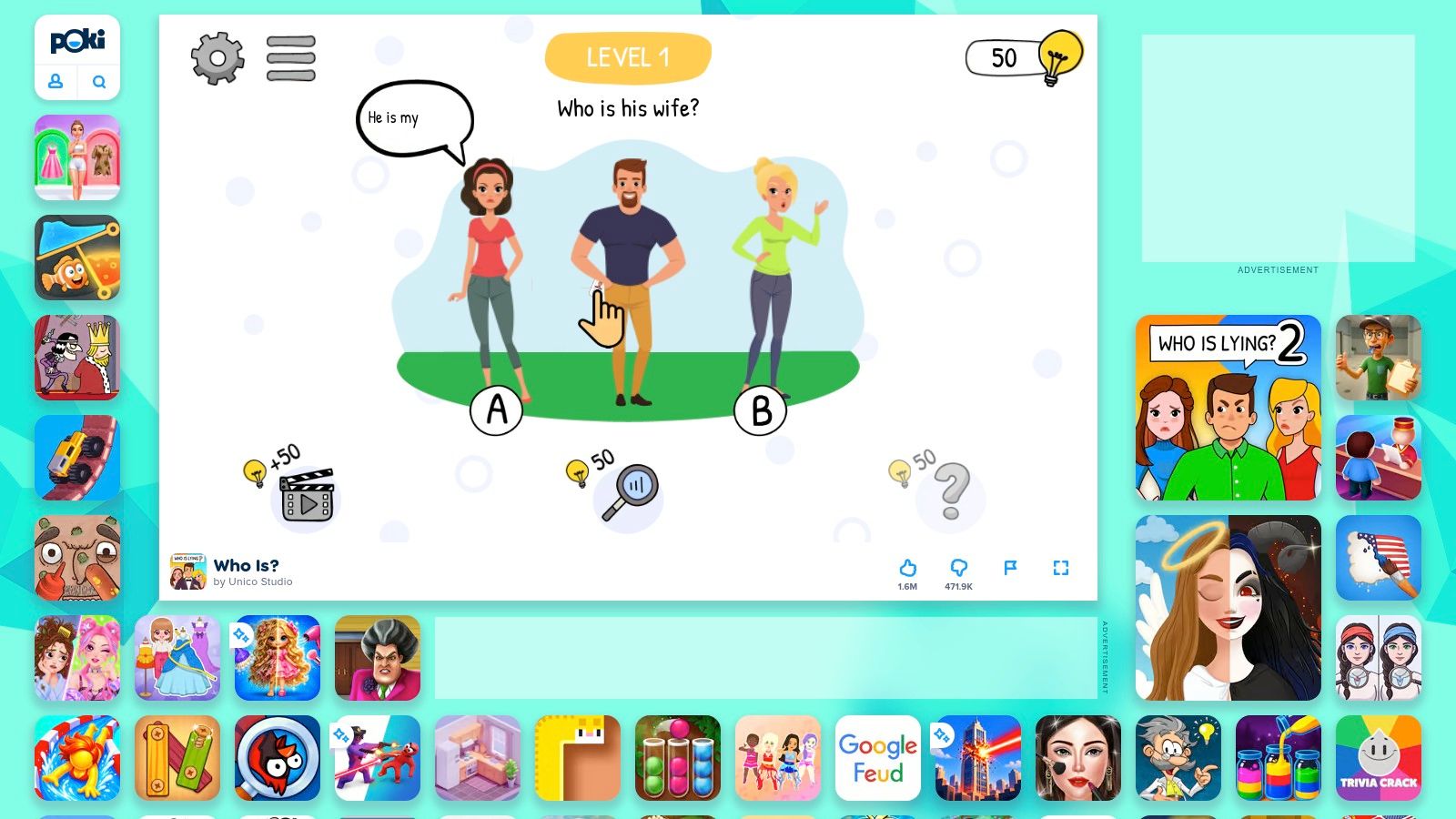
Who Is? is the quick-hit option: short visual riddles built around "who is lying" and "who doesn't belong" prompts, with a big stack of levels on the game page. You tap the odd detail, get the answer, and either leave or keep going. That makes it easy to fit into a break, but it also means there is no case file to carry in your head.
Why generic unblocked lists are getting useless
Portals like Poki are why "unblocked" roundups are hard to trust. More than 15,000 browser games were released in the first half of 2025, 2.7 times the volume from the same period in 2024, according to Unity's 2025 gaming report. Nobody is checking that flood on a school Chromebook, and plenty of browser-game players are on phones, so a page that loads on desktop can still be the wrong fit.
The trade-off is simple: instant start, hints and level skips when a riddle stalls, free per Poki's own description; but no continuous story, and many levels are trick questions rather than evidence gathering. Access is the main barrier. If your network allows poki.com, it is a low-commitment snack; if the domain is filtered, the game has no offline mode to save it.
Play it at Poki.
10. Night Incident at CrazyGames
Everything else on this list is you, alone, with a scene. This is a first-person multiplayer game with three roles, suspect, gunner and civilian, where civilians hunt for clues while working out who the threat is. It's social deduction with a weapon in it, not a quiet whodunit.
Multiplayer changes the network maths
A single-player puzzle can survive a shaky connection because nothing is happening in real time. This can't. If your ping spikes mid-round, you're out through no fault of your own, and a filter that lets a static game page load can still choke the live traffic a match depends on.
The game is listed as desktop-only, so a phone or a locked-down tablet is a non-starter. Sessions also run long: you're committing to full rounds with strangers, so I'd only pick this when you have an hour and a stable connection.
The upside is replayability. Every round plays out differently because the threat is a real person, and that live unpredictability is something no scripted single-player case can match.
- Best for: a group of friends on decent connections with an hour to fill.
- Bad for: solo play, quick sessions, mobile, or any network that throttles real-time traffic.
- Expectation setting: this is action-flavoured social deduction. If you want to examine a room and cross-reference statements, you'll be disappointed.
Play it at CrazyGames.
How the 10 browser detective games compare on session length, focus, and access
Session length is the sharpest dividing line here, running from a five-minute case to a two-hour investigation. Read the last column just as closely: desktop-only pages, account questions, ads and subscriptions decide what loads on a filtered network.
| Item | Typical session | Best for | Access notes |
|---|---|---|---|
| Mystery Hunch | About 5–10 minutes per case | Recommended: quick illustrated investigations with clues, evidence and suspect statements | Free to play in the browser; phone and wider-screen layouts; English and German versions |
| Detective Murder Mystery, Zoomy Games | About 15–25 minutes per case | Traditional case-and-evidence investigations with hints | Free in browser, no sign-up or download; phone and desktop; network access may vary |
| Detective Logic Puzzle, Coolmath Games | A logic-grid puzzle session | Deductive clue elimination and orderly puzzles | Browser and mobile; no download; keyboard controls and ads may affect access |
| Inkspektor | Quick cases or longer multi-chapter play | Matching witness descriptions to people in a crowd | Free in browser, no account or download; leaving or reloading a quick case restarts it |
| Enquetix | One case per day | Careful, proof-first deduction | Free daily game in the browser; check the game page for account requirements |
| LiarHunt | Daily cases, career missions or timed rounds | Checking alibis and proving which suspect is lying; solo or social play | Free in browser, no download; phones, tablets and computers |
| NOIR | About 45 minutes to 2 hours per case | In-depth investigations and private co-op with friends | Free to start in browser; desktop and phone; check what is included |
| Midnight Casebook | A story-led daily case | Illustrated scene searches, voiced statements and solving motive and method | Browser play is free; mobile apps available with ads; optional Casebook Pro is $1.99 per week |
| Who Is?, Poki | Short visual riddles | Quick spot-the-clue puzzles with hints and level skips | Free browser play; access depends on the network |
| Night Incident, CrazyGames | Multiplayer rounds | Action-oriented social deduction and clue finding with other players | Browser-based and listed as desktop-only; multiplayer required |
Pick One Case Tonight and Check Your Network First
The most useful thing you can do is match the game to the time you have. A ten-minute gap belongs to a single-scene case or a crowd search, not to a generated mystery that runs an hour and a half. A free evening belongs to NOIR or Zoomy Games, where statements and notebooks reward patience.
The second thing is to test before you need it. Load the game on the exact device and the exact network you'll use, at the time of day you'll use it. A page that works at home on a fast connection tells you nothing about a school Chromebook at 11am with a filter watching.
School and workplace filters change without warning. A game that was fine last month can be blocked this week, and there is nothing you can do about that except have a second option ready.
Try the actual device, not a similar one. Chromebooks, iPads and locked-down Windows laptops fail in different ways, and a game with keyboard controls is useless on a touchscreen only device.
Check what the page needs before you invest time. Downloads, logins, audio, WebGL and third-party cookies are all things a restrictive policy can kill, and a blank scene is usually blocked assets rather than a dead game.
Keep a fallback that needs nothing at all. A logic grid puzzle loads when almost nothing else will, which makes it a decent insurance policy on a managed network.
Here's the part most lists won't tell you. Access isn't a permanent property. The same game can be playable on your phone, blocked on the school laptop and throttled on office wifi, all on the same afternoon, and that has nothing to do with quality.
For what it's worth, Mystery Hunch is free to play in the browser and is an early prototype made by one person, so cases, features and scoring may change or disappear as the project develops. That's worth knowing before you get attached to a favourite case. If something breaks, or a hint doesn't explain the reasoning clearly enough, the developer reads the feedback and says so on the site.
Start with the case that matches your calendar, not the one with the best screenshots. Then tell the developer what happened when you played it.
Mystery Hunch is a browser-based game with free illustrated detective puzzles built around individual scenes, so you can explore a location, gather evidence, question suspects and name a culprit in about five to ten minutes without installing anything. If this list made you want a mystery that ends before your break does, visit Mystery Hunch and try the newest case. It's an early prototype made by one person, and every piece of feedback gets read.