Virtual Murder Mystery Game Formats Explained for 2026

Somebody in your group chat has floated a murder mystery night. Or you have an hour to yourself and want a puzzle with an actual culprit to catch. Either way you go looking, and the results sprawl in every direction: live hosted events run over video call, self-hosted kits you print and run at your own table, online multiplayer mysteries, and free solo browser cases you can finish in about 5 to 10 minutes.
A virtual murder mystery game is an online deduction game in which players investigate a fictional crime, examine evidence, question suspects and accuse a culprit with proof. That definition covers every format on that list, which is exactly why the category feels confusing. Prices, group sizes and time commitments vary wildly, and almost nobody explains what a game asks you to do, or whether it structures real deduction or just decorates a lucky guess.
One idea sorts the whole category. Every format, cheap or expensive, hosted or solo, runs the same loop of evidence, contradiction, accusation: you gather clues, you catch a story that fails to hold together, and you name a culprit with proof to back it. Judge a game by how well it builds that loop and you'll choose well at any budget.
Table of Contents
- What a Virtual Murder Mystery Game Actually Is
- Virtual Murder Mystery Formats at a Glance
- How a Virtual Murder Mystery Game Works
- What Each Format Looks Like in Practice
- How Everyone Can Join the Investigation
- Choosing the Right Format for Your Group
- Common Myths About Virtual Murder Mysteries
- Pick a Case and Start Detecting Tonight
What a Virtual Murder Mystery Game Actually Is
A video call is running on a Friday night. Someone has just found the body in the snowed-in chalet, five guests are explaining where they were, and the group is already arguing about whether the boot prints were made before or after the snowfall stopped.
That scene is the format in miniature. A virtual murder mystery game is an online deduction game where players investigate a fictional crime, examine evidence, question suspects and accuse a culprit with proof. Nobody has to act, nobody memorises lines. The game hands you a case, a cast and a set of clues, and your job is to work out which explanation survives contact with the evidence.
Here's the mood most groups are chasing when they book one.

The lineage runs back further than most players expect. Parker Brothers' The Jury Box, released in 1937 and widely identified as the first commercial murder-mystery game, put players in the jury box to weigh prosecution and defence arguments before a solution was revealed, and Cluedo followed in the United Kingdom in 1949, as the documented history of murder mystery games records. Both built the same skeleton you'll meet tonight: a defined case, evidence-based reasoning, competing explanations, a final verdict.
Remote work pushed the format into the mainstream, because a structured shared task beats another round of small talk on a call. Browser games finished the job. No download, no cost, no installation, so a case can start in the time it takes to open a tab.
The spectrum you'll meet runs from hosted live events with professional hosts, through self-hosted kits and online multiplayer apps, down to free solo browser cases that wrap up in minutes. What follows is a format comparison, the shared gameplay loop, a few real examples, a choose-by-situation guide and the myths worth dropping. By the end you'll be able to pick a format and start playing tonight.
Virtual Murder Mystery Formats at a Glance
The category sits inside a large entertainment market rather than a niche hobby. The global social-gaming market was valued at USD 28.4 billion in 2024, according to Market.us, and the dedicated murder-mystery segment was estimated at USD 2.16 billion in 2024, with HTF Market Intelligence projecting a 9.0% compound annual growth rate through 2031 in its murder mystery game market report. People already pay for this. The question is which shape you should pay for.
| Format | How it runs | Typical group | Session length | Typical cost | Best for |
|---|---|---|---|---|---|
| Hosted live event | Actor or game master runs the case over Zoom or Teams; teams share clues and make a final accusation | 6-100+ players in teams | 60-120 minutes | About $25-60 per person | Corporate team building and large parties |
| Self-hosted kit | Boxed, printed or app kit; one player hosts, deals roles and reveals evidence | 4-20 players | 2-3 hours | About $15-40 one-off for the whole group | Home parties and game nights |
| Online multiplayer mystery | Platform or app gives each player private clues; group talks by voice or text chat | 4-8 players | 60-90 minutes | Free to about $20 per group | Remote friends and small groups |
| Solo browser-based case | One illustrated scene in the browser; tap to inspect, note clues and accuse the culprit | 1 player | 5-15 minutes | Free | Quick solo whodunits and low-pressure practice |
Hosted live events are the theatre option. A game master controls pacing, drops evidence when the room needs it, and splits a big group into teams so that quieter people still get a job. You're paying for facilitation more than for the story.
Self-hosted kits put one friend in charge. Everyone gets a role sheet, the host reads reveals at set points, and the whole thing runs off a printed or app-based pack with no internet dependency. It's the cheapest way to give twelve people something to do for an evening, provided someone is willing to run it.
Online multiplayer mysteries sit in the middle. Each player holds private information, the platform handles clue delivery, and the group argues over voice or text. Small groups finish these in about the length of a film.
Solo browser cases strip the format to a single scene. One player, one illustrated location, no scheduling and no minimum headcount. It's a good place to start if you've never played a deduction game before.
How a Virtual Murder Mystery Game Works
Every format follows five stages. What changes is who controls the pacing, not the logic underneath.
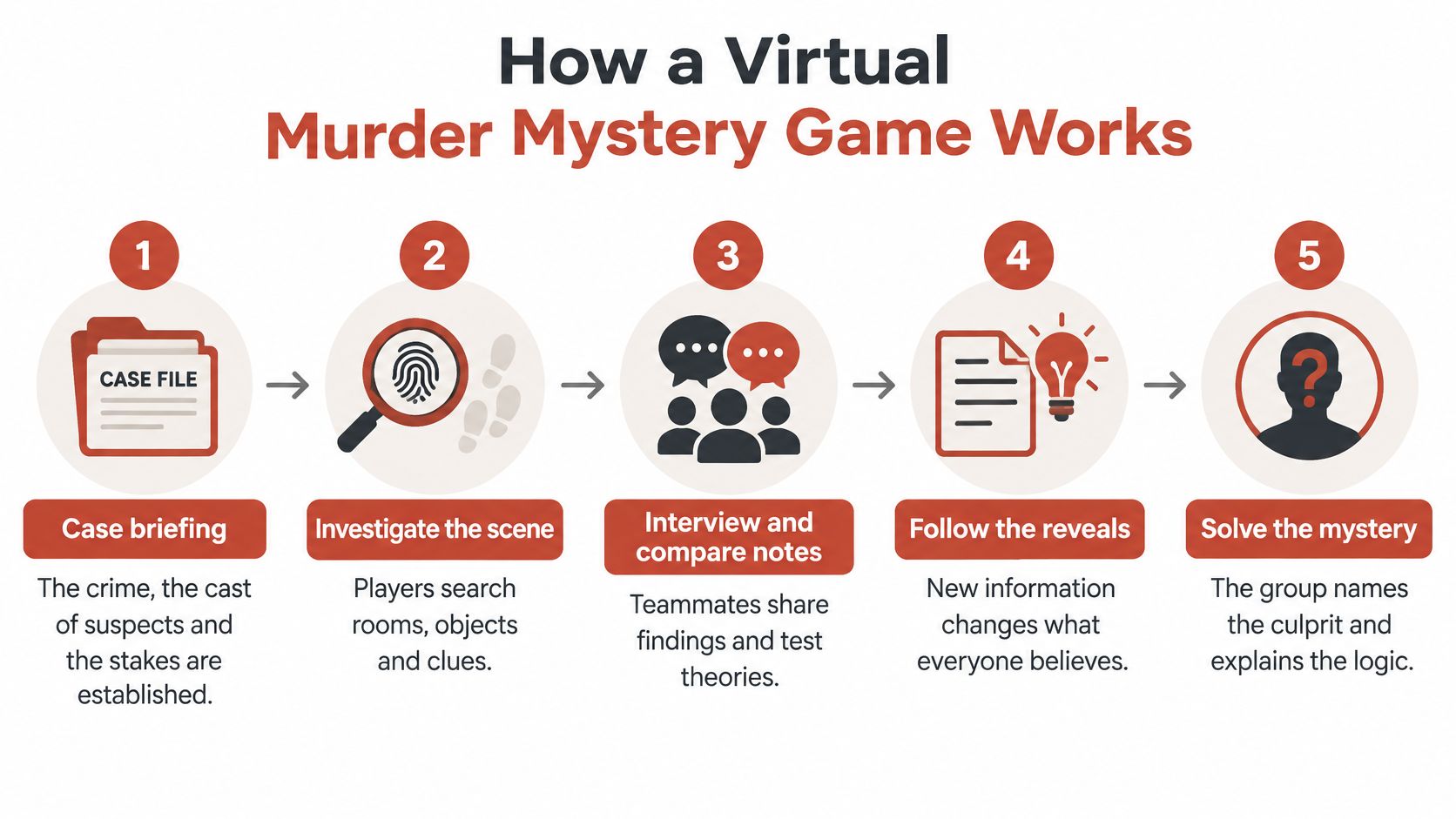
1. Case briefing. You get the crime, the suspects and the stakes. A hosted game opens with a host setting the scene and introducing a cast of characters. A browser case opens on a location, a victim and the people standing nearest the body.
2. Investigate the scene. In a solo illustrated game you tap rooms and objects to collect clues, and each find goes into a notebook. In a hosted event, evidence arrives in packs, documents or short videos on a schedule the host controls.
3. Question suspects. Live events give you actors answering in character. Kits and browser cases give you written statements. Either way, you're collecting alibis with the specific purpose of testing them.
4. Combine and eliminate. Deduction happens here. A notebook, a timeline or a shared document pulls physical evidence against statements until one of them breaks.
5. Accuse with proof. You name a culprit and, in a well-built game, say which evidence supports the claim. The reveal then walks the full chain, so you can see where your reasoning held and where it slipped.
The line between guessing and deducing is case design. A study of a narrative mystery-learning environment found that players' exploration of a hypothesis space predicted both in-game performance and subject-matter learning, and that players who chose a higher proportion of appropriate hypotheses learned more and completed more goals. Translated to game night: a clue should either support a statement, contradict one, or reveal a combination. If a footprint neither helps nor hurts anyone's story, it's scenery, not evidence.
Formats diverge in where the effort lands. Hosted events are discussion-heavy, so the work is talking, listening and noticing who hesitates. Solo browser cases are observation-heavy, so the work is looking harder at a chair, a window or a wet pantry door.
Practical habit: keep a written shortlist of suspects and rewrite it after every clue. If a clue didn't move anyone up or down, you haven't worked out what it connects to yet.
The five stages play out like this in a live session:
What Each Format Looks Like in Practice
Every format runs the same basic loop: clues go in, an accusation comes out. What changes between them is who delivers the evidence, who paces the session, and where your attention has to sit while you play.
Hosted, in practice. Team-building companies run live-actor cases over video calls: a host greets the room, introduces the suspicious characters, then paces evidence drops while teams debate in breakout rooms. Group sizes scale from a dozen colleagues to hundreds split into teams. You show up, and someone else carries the logistics, the timing and the story.
Kits, in practice. A boxed kit works like a board game with a script: roles, motives, secrets and a reveal schedule all sit inside the box, so one person can run an entire evening from a printed pack. The trade-off is real. If the host loses the thread, the room loses momentum with them, and no costume budget rescues a stalled reveal.
Online multiplayer, in practice. Multiplayer mysteries move the whole loop online: clues arrive digitally, suspects answer through the screen, and teammates split the evidence between them instead of around a table. The format now supports a sizeable market, with the social deduction games sector estimated at $4.8 billion worldwide in 2025, per Dataintelo's social deduction games market report.
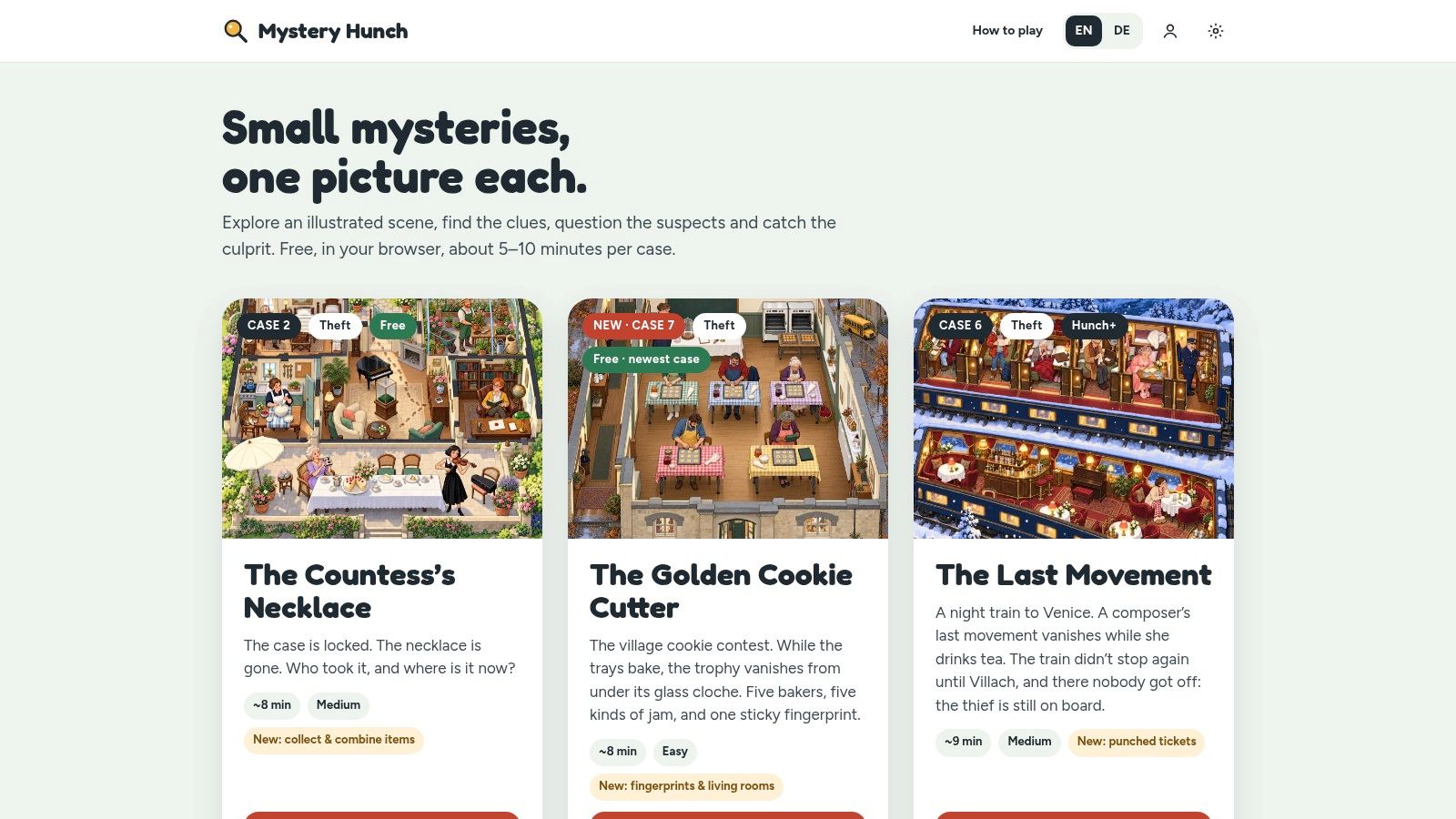
Solo, in practice. The browser end earns its place by stripping the loop down to the puzzle itself. Mystery Hunch runs free in a browser tab, and each case is a single illustrated scene rather than a chain of rooms. Case 1, The Hut on the Grauhorn, is a medium-difficulty murder case of about six minutes in which a snowed-in hut keeper is found dead and five guests all claim they were asleep.
Whichever format you pick, judge it by the same test: does the evidence carry weight? A hosted event with a great host and a thin case still ends in a shrug. A six-minute browser case where every object rules somebody in or out feels like a complete story. The production value changes. The deduction test does not.
How Everyone Can Join the Investigation
The most theatrical formats carry an accessibility problem inside their best features. Alibis arrive through voices, clues arrive as images, and the whole accusation can hang on who caught one spoken detail.
That detail sits inside the evidence loop. Every format asks a player to collect a clue, weigh it against a statement and turn it into an accusation, so a player who cannot reach the clue cannot reach the ending either.
The scale goes beyond one game night. A 2025 survey of 801 event participants by the Communications Workers of America found recurring communication barriers involving interpreters, microphones and captioning, with respondents also asking for remote-access options when travel was not possible, as the 2025 CWA member accessibility survey report details. Those needs map directly onto each format's weak spots, so run the same questions against a game before you book or play.
- Hosted video events. Ask for live captions, a text chat running beside the call, and a way to contribute clues in writing. A single microphone should never be the only channel carrying an alibi.
- Kits and online multiplayer. Written role sheets and text answers to suspect questions matter, because a player who can't hear the alibi is locked out of the deduction entirely.
- Solo browser cases. Text should hit the contrast ratios in MDN's mobile accessibility checklist, which sets a minimum of 4.5:1 for normal text and 3:1 for large text and requires that anything shown in colour is also shown another way. Suspect status needs a label, an icon or the word "contradiction" alongside the colour.
- Every tappable clue. A hotspot needs a keyboard path, a visible focus state and a descriptive name. A clue that only responds to a precise tap excludes players with limited mobility.
The cheap test works on any format. Can someone with no webcam, no voice and a phone still collect a clue, rule out a suspect and submit an accusation? If the answer is no, the game excludes people before the first reveal.
Choosing the Right Format for Your Group
Start with the situation, not the game.
| Your situation | Best fit | Why it works |
|---|---|---|
| Remote team building with 10+ colleagues | Hosted live event | A host keeps the energy up and teams create natural discussion |
| Birthday or holiday party at home | Self-hosted kit | One-off cost, everyone gets a role, no internet dependency |
| Friends scattered across time zones | Online multiplayer mystery | Shorter sessions and text chat tolerate patchy schedules |
| A quiet evening alone | Solo browser-based case | Free, no signup, finished in minutes |
| First-timers nervous about acting | Solo or online browser mystery | No performance pressure; observation and logic do the work |
Count heads first. Hosted formats scale upward almost without limit and usually set a minimum group size, so a party of four may not qualify. Kits run out of roles somewhere around twenty people, and beyond that you're splitting people into observers.
Decide how the money works. Hosted events price per person, which is fine for a company budget and painful for a birthday. Kits price per group, so a $15-40 box split eight ways is cheaper than most nights out.
Check the tech before you commit. A browser case asks nothing of anyone. A hosted event asks for a stable video call, working audio and possibly breakout rooms, which is exactly where a hybrid group with one bad connection starts to fray.
Match the clock to the group. A five-minute case suits a lunch break and an impatient teenager. A three-hour kit suits a themed party with food. Most disappointment comes from a mismatch in length, not from a bad story.
There's a social reason to weigh this properly. Roughly 30% of online multiplayer players reported playing primarily to connect socially, according to Plarium's 2024 compilation of gaming statistics, so a format that silences the group defeats the purpose.
Three fast rules. Under an hour, go browser or online multiplayer. More than ten players, go hosted. Mixed confidence in the room, choose a format where speaking is optional and observation counts.
Common Myths About Virtual Murder Mysteries
"It's just a social deduction game with a murder theme." Not the same mechanic. Social deduction games hide a traitor among players and settle it by voting, so persuasion wins. A murder mystery hides a culprit inside evidence, and the answer is fixed before anyone speaks. You can't talk your way to a different ending, which is why a confident guess and a proven case produce different star counts.
"Everyone has to act and stay on camera." Some hosted formats cast players as suspects, but kits work fine with a host reading reveals, multiplayer apps work through private text, and solo cases involve no performance whatsoever. If a colleague will not do voices, they can still track the timeline and catch the liar.
"It's online, so naturally everyone participates." The assumptions prove most costly at that point. A 2025 meeting report found that virtual participation worked well for accessing content but offered limited networking opportunities, and a separate 2025 conference survey reported that remote attendees wanted more interaction and found limited online community activity hindered networking, as the ESIP community report sets out.
Put plainly: moving an in-person mystery onto a video call doesn't automatically preserve the experience. Reading a chat box while three confident people talk over each other is not participation. Formats improve this by structuring turns, using teams of four to six, letting people investigate privately before a group accusation, and making voice optional so text counts equally.
"Free browser mysteries are throwaway." A short case is only throwaway if the answer arrives without reasoning. Done properly, five to ten minutes is enough for a briefing, three real clues, one contradiction and a reveal that explains the chain. Length isn't the measure. Whether the culprit could have been deduced, rather than guessed, is.
The test for any myth is the same: does the format make the player do something with the evidence, or just watch a story happen?
Pick a Case and Start Detecting Tonight
A good choice feels less like shopping and more like setting the rules of a fair deduction: who can act, what counts as evidence, and when a guess becomes an accusation. Hosted events, kits, multiplayer rooms and solo cases all run that same loop; they differ in how clearly they make you earn the reveal.
- Fix three numbers. Group size, session length, and the most you will spend per head. Write them down before browsing, because every format's marketing will flatter a different answer.
- Match them to the format. Ten-plus players and a company budget points at hosted. A home party with a willing organiser points at a kit. Scattered friends point at multiplayer. A quiet evening points at a browser case.
- If the answer is solo or short on time, play tonight. Mystery Hunch is free to play in your browser, and each case takes about 5 to 10 minutes: explore an illustrated scene, find clues, question suspects through their statements, and catch the culprit.
Start with an easier case to learn the rhythm of a notebook and a suspect list. If you stall, a hint can keep the reasoning moving at the cost of one star. Accuse only when you can name the clue that proves it, because the three-star score rewards a chain of evidence rather than a lucky guess. The right pick is the one where every clue can be used before the culprit is named.