Puzzle Mystery Game Guide: How Clues and Deduction Work
You're halfway through a picture on your phone, pretty sure the nervous guest did it, and just as sure you walked past something on the shelf. That tug is what a puzzle mystery game is built for. It works like a detective's case board that starts empty. You pin notes as you look, then you decide which notes connect before you point at anyone. The habit that saves you is small. Before you accuse someone, test each clue for what it can prove and what it might trick you into believing.
Table of Contents
- What a Puzzle Mystery Game Asks You to Do
- How Clue Gathering Works in a Scene
- Matching Evidence Against Suspect Statements
- Deduction Steps to Reach the Right Culprit
- Why Short Mysteries Still Feel Like Real Detective Work
- Making Clue Puzzles Playable for Everyone
- Pick Your First Case and Start Investigating
What a Puzzle Mystery Game Asks You to Do
A puzzle mystery game drops you into one illustrated scene after the crime is already done. You solve it with what you can see, what you can combine, and what people say. The case board starts blank. Every tap pins a note, and the work is spotting which notes share a string.
The Dataintelo puzzle-games market report puts global consumer spending on puzzle games at USD 19.5 billion in 2025. People already like looking at a picture and hunting a pattern. A mystery just asks you to do that with a story attached, on a phone or a laptop, without a long campaign.
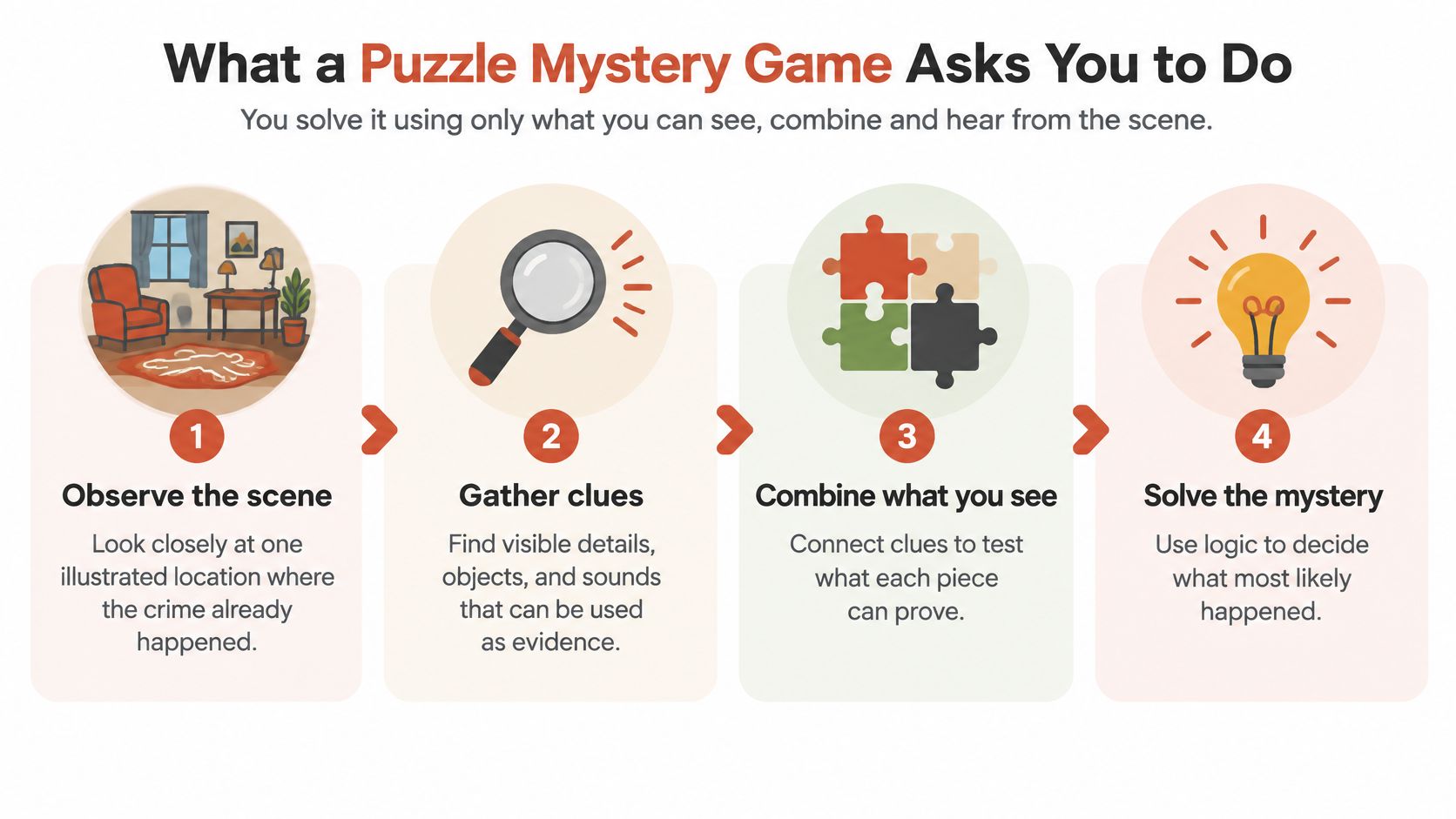
The loop has five stages, and each one hands something to the next.
| Stage | What you do | What it gives you |
|---|---|---|
| 1. Scene search | Tap rooms and objects in the illustrated scene | Raw clues |
| 2. Clue collection | Save anything that looks unusual or out of place | A growing evidence list |
| 3. Evidence matching | Pair clues with objects, people or times | Linked facts |
| 4. Statement check | Compare each suspect's story against the evidence | Contradictions to test |
| 5. Accusation | Name the culprit and show the proof | A solved case or a retry |
A miss in collection breaks matching and the statement check. A bad link in matching can make an honest line look like a lie. Most of the difficulty sits in those middle stages, not in the final tap. Slow down there.
How Clue Gathering Works in a Scene
Most lost cases start in the first minute, because you tap fast and treat the room like wallpaper. A scene hides three kinds of information, and decoration can be any of them.
Objects matter because of what they are. A torn cuff, a wet sleeve, or a key in the wrong pocket can place a person. Positions matter because of where something sits. A chair pulled out, a door left ajar, or a cup on the far side of a table says who could reach what. Absences matter because something is gone. A gap on a shelf, an empty box, or a hook with no coat is easy to skip if you're only hunting shiny items.
One scan, then every odd object
Scan the whole room once before you tap anything. Your eyes get the layout, the people, and the empty spots. Then tap every object that looks out of place, not only the ones that glow. A messy room is often just messy. Save a detail only if it could connect to a person, a time, or a route through the space.
A persistent marker helps more than a flash. If the clue stays visibly selected in your notebook, you can come back to it. A highlight that fades after a second is easy to forget on a phone.
Say you're in a snowed-in hut and you spot a dropped glove by the hall. It looks like clutter until someone says they never left the coat room. That glove is no longer decoration. It is a claim you can test. A short case like The Hut on the Grauhorn is a good place to practise that pause, because the room is small and every object has to earn its pin.
Before you leave the room: ask what this clue could prove, and about whom. If you can't name a person, a time, or a route, leave it marked and keep looking.
Matching Evidence Against Suspect Statements
Matching isn't "does this look suspicious?" It's "what can this prove?" Five clue types show up again and again, and each one has a usual trap.
| Clue type | What it usually proves | Typical trap |
|---|---|---|
| Physical object (torn fabric, dropped glove) | Presence at the scene | It may belong to an innocent guest |
| Timing detail (clock, stopped watch) | When someone could have acted | Clocks are often set wrong on purpose |
| Spatial clue (seating, route through a room) | Who could reach what | The layout is easy to misread |
| Statement | What a suspect claims happened | A claim can be true but misleading |
| Behavioural clue (nervous habit, slip of the tongue) | A possible motive or a lie | It is easy to overweight |
An object can sit in an innocent guest's pocket. A clock is a favourite prop for a lie. A seating plan is easy to flip in your head, so trace the route with your finger. A statement can be true and still hide the useful part. A nervous habit is the easiest thing to overweight, because it feels like a confession and usually isn't.
One suspect, one line, a second source
Pair each clue with exactly one suspect. Write what it proves in a single line. Then mark whether a second clue backs that line. A clue with no second source is a lead, not proof. The notebook earns its place when those pairings sit side by side and the gaps show up.
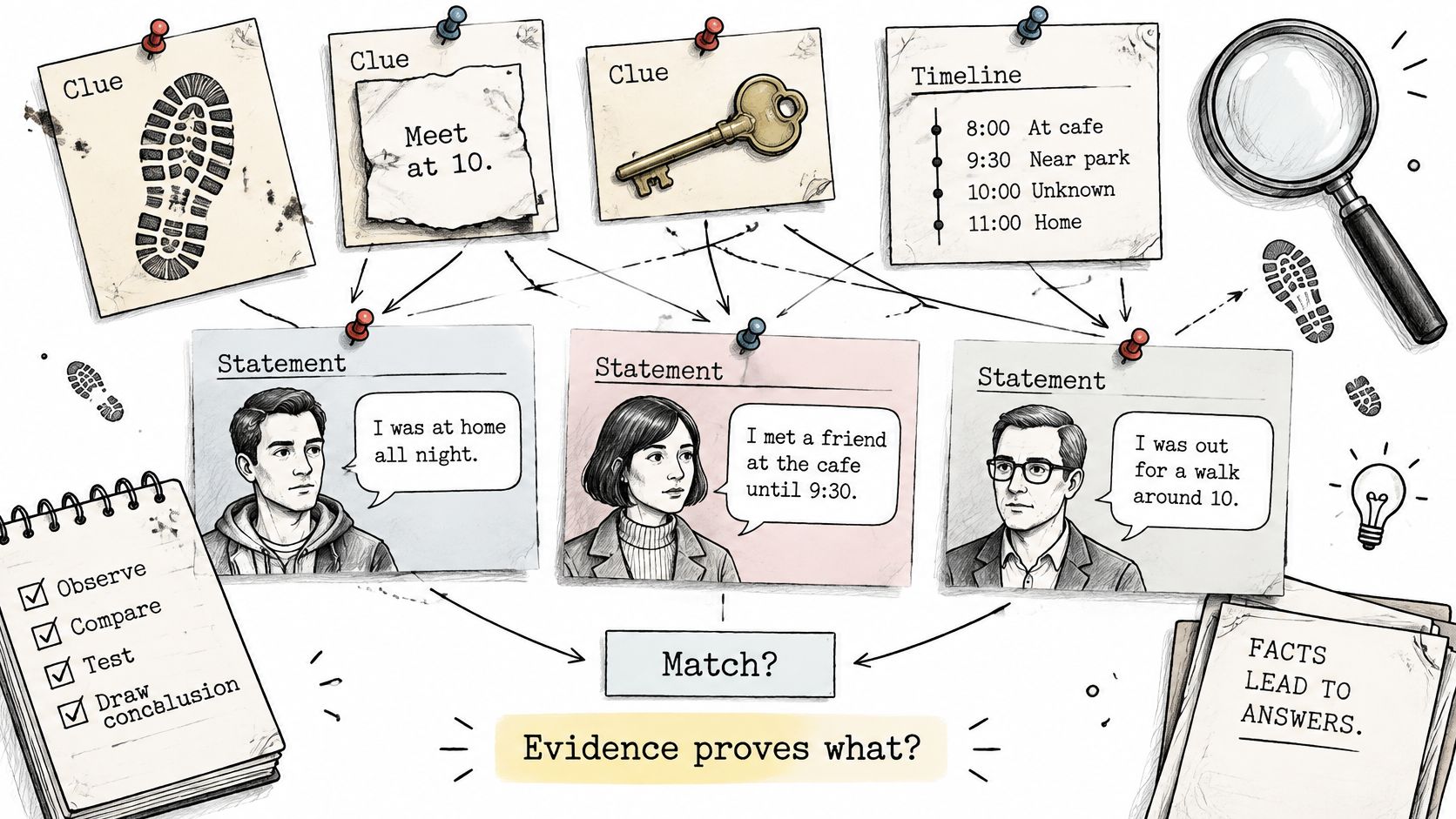
Use one test before you trust a vivid detail. A red herring looks loud and connects to no statement, time, or route. A real lead changes what a statement can mean. A dropped glove that contradicts "I stayed in the coat room" is a lead. A muddy boot that only shows the garden was wet is a herring. Keep the boot in the notebook, marked unlinked. Don't delete it. A later clue may give it a route.
A locked case with a missing necklace, as in The Countess's Necklace, is a clean drill for this. The object proves presence only after a statement or a route agrees with it.
A single source can start a theory. It can't finish one.
Deduction Steps to Reach the Right Culprit
Deduction is elimination with a reason attached. It isn't a guess about who looks shifty. Work in this order, and write it down so you can see the holes.
- List every suspect and their stated alibi. Names on one side, where they claim they were on the other.
- Turn each statement into a claim you can check. "I was in the library" becomes "this person was not in the kitchen."
- Mark every contradiction. A claim fights a clue, or it fights another claim. Both count.
- Eliminate anyone whose alibi is confirmed by two independent sources. One friendly witness isn't enough.
- Rank who's left by how many contradictions they carry, and by whether they had the means and the opportunity.
- Test your top suspect by asking what would be different if they were innocent.
A strong case leaves one person standing for a clear reason. If two people still fit, you don't have proof yet. You have a tie, and a tie means you missed a second source or you overweight a habit.
The accusation screen is the last check
A good case lets you review the chosen suspect and the supporting proof before you submit. Use that screen. A wrong accusation is harder to undo than a wrong tap. A confirmation step with a cancel option is thoughtful design. It stops an accidental finger from ending the case, especially on a small screen.
Here's a three-person drill. Ana says she never left the library, but a receipt places her in the kitchen at 9:15. That's one contradiction. Ben's alibi is confirmed by two independent sources, so Ben is out. Cole has a contradiction about a route through the hall, but no means to reach the study. The ranking puts Ana first. Now test her. If she were innocent, the receipt would need a second explanation, and only a second source can supply one. No second source, no accusation.
Why Short Mysteries Still Feel Like Real Detective Work
Can five to ten minutes really be deduction, or is it just spot-the-object? Length isn't the problem. An unearned ending is.
A 2025 GameAnalytics benchmark reports median game sessions of 3.1 to 3.5 minutes, while other industry data in that same benchmark reports casual-game session length rising 15% to 25.92 minutes. Short play is a mix of quick check-ins and longer casual sittings. A compact mystery sits in the middle of that mix. You can finish a case on a bus, or sit with two of them after dinner.
What makes the short case feel like detective work is a small set of decisive clues, reasoning you can see, and a restart that rewards a different look. Too many decoys and it feels like a trick. Too few clues and it feels like a guess. Puzzle games also hold up across day-one, day-seven, and day-28 retention in that benchmark, so brevity doesn't have to kill a reason to come back. Replay value comes from noticing a different route, not from a randomised room.
After you solve it, try this. Explain the culprit's motive and the route they took in your own words. If you can, the short case did its job.
Making Clue Puzzles Playable for Everyone
A case can be hard in a good way and still be unplayable, because the interface blocks you before the logic does. Fair play means you can reach the deduction, not only that the answer is clever. Four checks tell you whether a label of "easy" or "medium" is about the puzzle or about your hands and eyes.
Color isn't the only signal. A selected clue needs a visible marker, a tick, an outline, or a notebook entry. A red tint alone fails if you can't tell red from the room, or if you're playing in bright sun. If the only sign you grabbed the glove is a color shift, you will retap it and lose your place.
Text has to grow. Clue descriptions should enlarge without shoving the scene off the screen or covering the object you're reading about. Tiny captions turn a fair mystery into a squint test.
Touch or keyboard, not both at once. Every action should work with a finger or with keys alone. Precise tapping on a tiny hotspot isn't a deduction skill. It's a motor test, and it shuts people out for no story reason.
Pressure stays optional. A timer can add tension if you want it. A no-penalty assist lets someone with attention, memory, or motor limits keep going. A hint should cut overload, not punish you. If it costs something, show the cost before you confirm, and give you a cancel.
Check these four points before you trust a difficulty label. The label describes the logic. It doesn't tell you whether the interface works for you.
Pick Your First Case and Start Investigating
Start with a short, easy case that teaches the loop before you chase a harder one. You're learning where to slow down, not proving you're a detective on day one.
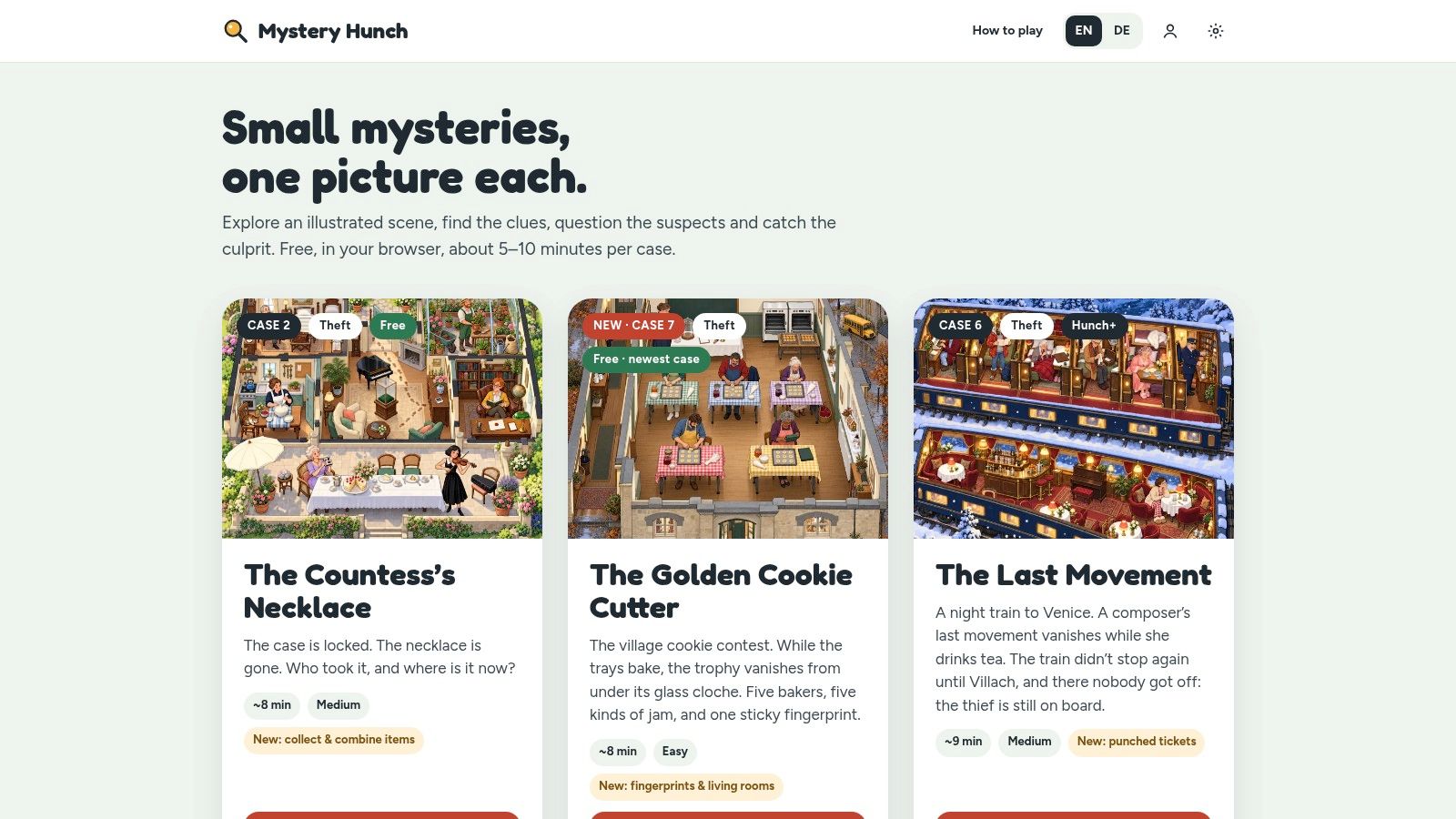
Look for four things in a first game. You want a clear case summary, a difficulty label that describes the logic, a notebook that combines clues, and a hint that shows its cost before you confirm. Then check that it works for you. Selection should show a marker, not only a tint. Clue text should enlarge without breaking the scene. Every action should work with touch or keyboard alone. Any timer should be optional.
We built Mystery Hunch as a free browser game for exactly that first sitting. You explore one illustrated scene, find clues, question suspects, and catch the culprit. Each case takes about five to ten minutes. A hint costs one star, and you can earn up to three stars per case. Grandma Hilde's Recipe Book is a gentle theft to start with, about seven minutes and marked Easy, built around a wet pantry door and a missing recipe book.
A short walkthrough shows the same loop in motion, from the first look at the room to the accusation.
Play one case and notice which stage felt hardest. That stage is where you practise next.
Mystery Hunch is a free, browser-based puzzle mystery game where you explore one illustrated scene, gather clues, question suspects, and accuse the culprit with proof. If you want a five-to-ten-minute case that lets you practise the red herring test before you point a finger, open a case on Mystery Hunch and see which clue changes the story.