10 Online Mystery Games for Adults Worth Playing in 2026

Got 15 minutes and a suspicious mind? Then you already have enough time for a proper whodunit, as long as you pick the right one. The last time most adults had two uninterrupted hours for a detective game was probably a rainy Sunday two years ago, and that's exactly why this list exists: every game here runs in a browser, works on a phone, and can be finished in a sitting you have.
Each entry is judged on three things and nothing else. How long a session takes, how hard the deduction is, and whether it's better solo or with someone else in the room. Not feature lists, not awards, not how many cases the marketing page claims.
The audience for online mystery games for adults isn't niche either. The Entertainment Software Association's 2024 U.S. video game industry study reports that 61% of Americans aged 5 to 90, roughly 190.6 million people, play for at least an hour a week, and 29% of players were 50 or older in 2024, up from 17% in 2004. Pick your entry by time: five minutes gets you a daily puzzle, twenty gets you a real investigation, an hour gets you a co-op case with friends.
Table of Contents
- 1. Mystery Hunch
- 2. NOIR
- 3. LiarHunt
- 4. The Detective's Desk (Detekts)
- 5. Wysteryrooms
- 6. Suspectle
- 7. Daily Detective
- 8. Midnight Casebook
- 9. Confessd
- 10. Enquetix
- 10 Online Mystery Games for Adults at a Glance
- Pick Your Case and Start Sleuthing Tonight
1. Mystery Hunch

Mystery Hunch is built for a short solo deduction, not an evening. One illustrated scene, one culprit. The locations stay small on purpose: a snowed-in mountain hut, a dinner table, a lakeside villa, an apple farm, or a Halloween costume party. You tap rooms and objects, combine clues in a notebook, check the suspects' statements, and accuse with proof.
Difficulty and minutes are on the case card, which is the only honest way to sell a five-minute mystery. 'Grandma Hilde's Recipe Book' is Easy, about 7 minutes: a theft, a wet pantry door, a missing recipe book. 'The Countess's Necklace' is Medium, about 8 minutes, a locked case with the necklace gone. 'Theft' is Medium, about 9 minutes, and the missing piece is a raven's ruby eye at the costume party. Listed cases sit in that same band, about five to ten minutes, Easy or Medium.
A short loop still has to teach itself. Research on hyper-casual games found that around 80% of participants learned the rules with no tutorial once minimalist design lowered the entry barrier, and notes daily retention generally below 10%. That retention figure is the trade-off. One clean case is easy to finish and easy to forget unless the next one plays differently.
Mystery Hunch varies the trick instead of the map. One case wants a pencil rubbing, another a seating plan, another masks, a blackout, or a tape. The notebook keeps the logic on screen. Hints come from an in-game partner at the cost of one of your three stars. A restart leaves stars you have already earned.
Pros
- Session length is declared: you see the estimate before you start, and current cases run about five to ten minutes.
- Deduction stays on screen: clues combine in the notebook, then you match them to statements and accuse with proof.
- Each case has its own device: rubbing, seating, masks, a blackout, a tape.
- Nothing to install: free in the browser, phone and wider-screen layouts, English and German, bright or darker noir styling.
Cons
- Prototype terms: one person makes it, it is an early prototype offered free, and cases, features, and scoring may change or be removed at any time.
- No remote co-op: two players share a screen or pass a phone. I'd use it solo, or with one person on the same sofa. A scattered group will stall.
Hand the notebook to the second player. Reading clues aloud and arguing about a statement is what keeps a shared screen from turning into silence.
Start with the first Mystery Hunch case and stop after one if the single-scene format feels thin. It is free to play in the browser, so the only cost is those seven to nine minutes.
2. NOIR
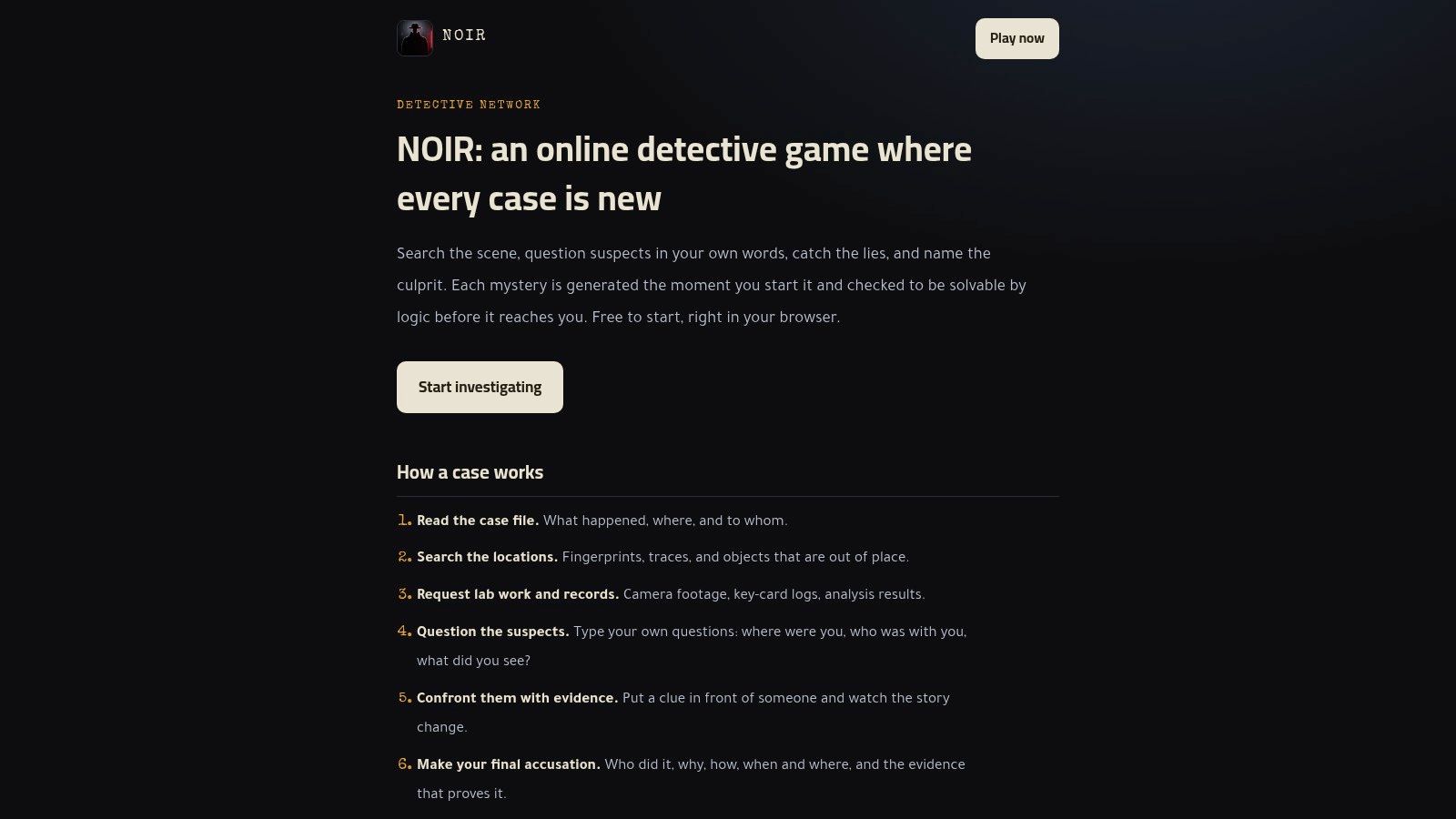
Most games hand you a suspect. NOIR makes you earn one. You search locations, request forensic reports, question the people involved, then confront them with hard evidence before you're allowed to accuse anyone. Cases go beyond murder as well, so you might be untangling theft, fraud, blackmail or espionage instead of another body in a locked room.
The time split matters more than the theme. Quick cases finish in about 5 to 15 minutes. The longer ones run from 20 minutes to two hours, which is a completely different kind of evening. The NOIR case list labels the difference, so you can pick a coffee-break file or a full-night one.
Solo or group: private co-op rooms take 2 to 6 players with live chat. That's the version I'd choose for a group, because the evidence chains are strong enough to argue about.
Shared digital investigation is older than the web. Roy Trubshaw and Richard Bartle built MUD at the University of Essex in 1978, one of the first virtual worlds, and Richard Bartle's history of the internet research medium traces it onto CompuNet in 1985 and CompuServe in 1986. The design principle hasn't shifted: drop players into an information-rich place, let them inspect it, let them form a theory.
The honest trade-off: a two-hour case with five friends is a scheduling problem dressed as a game. Give one player the notes job, or the final half hour becomes a reread of forensic reports nobody remembers.
Pros
- Evidence-based deduction: cases are checked for logical solvability, so the answer is reachable.
- Two formats in one: a 10-minute file and a 90-minute investigation from the same library.
- Group play without installs: private rooms, live chat, nothing to download.
Cons
- The long cases are very long: don't start one at 10pm on a work night.
- Free-access limits aren't spelled out on the homepage, so check before committing a group.
- German isn't listed among the languages, which rules it out for some households.
3. LiarHunt
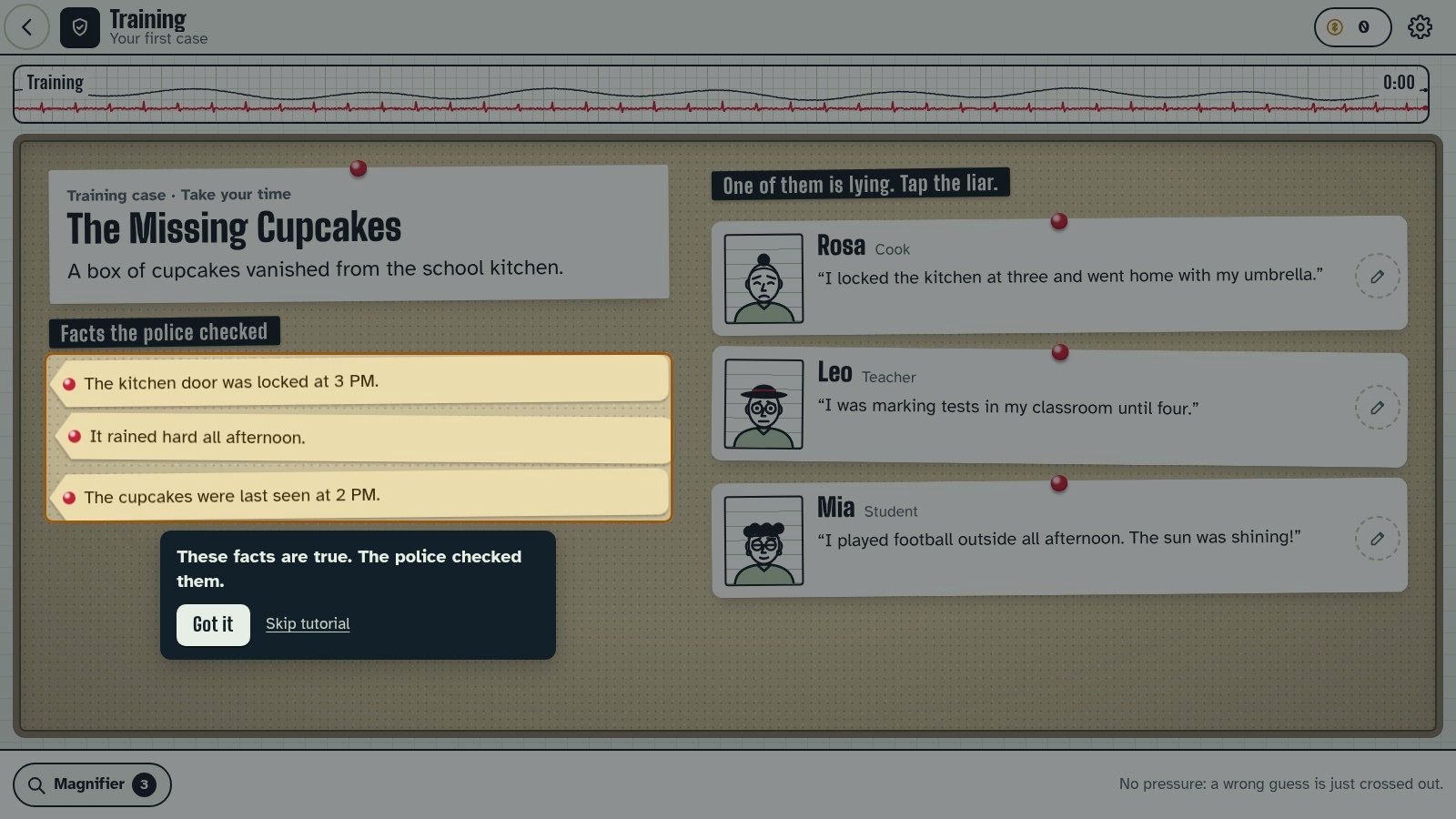
The fastest route into a mystery is a contradiction. LiarHunt drops the forensics and hands you alibis, then asks which one doesn't hold up against the others. It's a simpler skill than scene hunting, and that's why it works so well with people who claim they're bad at detective games: everybody can spot a lie if the timeline is written clearly enough.
Four ways to play, four different evenings
- Daily cases: five per day, shared by every player, which means you can compare notes with anyone.
- Career mode: a continuing mystery across 30 missions, so it rewards a weekly habit rather than a spare ten minutes.
- Rush mode: a timer on top of the deduction, for people who find the ticking clock motivating.
- Live rooms: play alongside friends in real time, with the notebook tracking evidence, suspects and timelines.
The social case for something like this is stronger than the marketing suggests. Multiplayer play among older adults has been linked with reduced loneliness and larger declines in depression than playing alone, and Pew data in the ESA's 2025 Power of Play report puts membership of online game communities at about 27% of U.S. adults under 30 against just 4% of adults 50 or older. That gap is the point: plenty of adults want to solve something with another person without joining a guild or wearing a headset.
Pros
- Multiple modes cover a solo coffee break and a Friday night with friends.
- The core skill is easy to explain, which makes it a good pick for mixed-experience groups.
- Free in a browser on phones, tablets and computers.
Cons
- Daily cases are time-sensitive, and some allow only one attempt, so a rushed morning costs you.
- Career mode is a commitment of 30 missions, not a quick puzzle.
- Accounts are needed for online saving and social features.
4. The Detective's Desk (Detekts)

A new murder lands on the desk every day, and nobody expects you to finish it in five minutes. The Detective's Desk is the one for a slow, methodical evening: you study crime-scene photos, question suspects, keep notes, and arrange evidence on an interactive corkboard before naming both culprit and motive. Typical cases run about 20 to 40 minutes, so treat it as a proper sitting rather than a filler.
The corkboard is the reason to play. Pinning a photo next to a statement and seeing the contradiction in front of you is closer to real investigative work than a list of clues in a sidebar.
What actually works here
The optional interrogations are the interesting part. Asking suspects questions can add to your case score, and a detective manual walks you through the format the first time, so the 20-minute format doesn't waste ten of those minutes on confusion. Missed cases drop into a cold-case archive, which takes the pressure off a daily habit you can't always keep, and guests can start without signing in.
That said, the AI-generated replies are the weakest link. Ask an unscripted question and the answer can drift, which breaks the illusion faster than a plain fixed line ever would. If you want airtight dialogue, look elsewhere. If you want volume and a flexible daily ritual, this delivers.
If a case is dragging past forty minutes, you've probably missed a clue rather than found a hard one. Re-read the photo captions before you accuse anyone.
Pros
- Scene, interview and deduction in one flow rather than one mechanic repeated.
- A cold-case archive means you never lose a story for missing a day.
- No sign-in required to try your first case.
Cons
- Longer than a casual session: 20 to 40 minutes rules out a queue or a bus stop.
- The AI interrogation can feel unpredictable compared with authored dialogue.
- Murder only, so no theft or fraud cases to break up the pattern.
5. Wysteryrooms
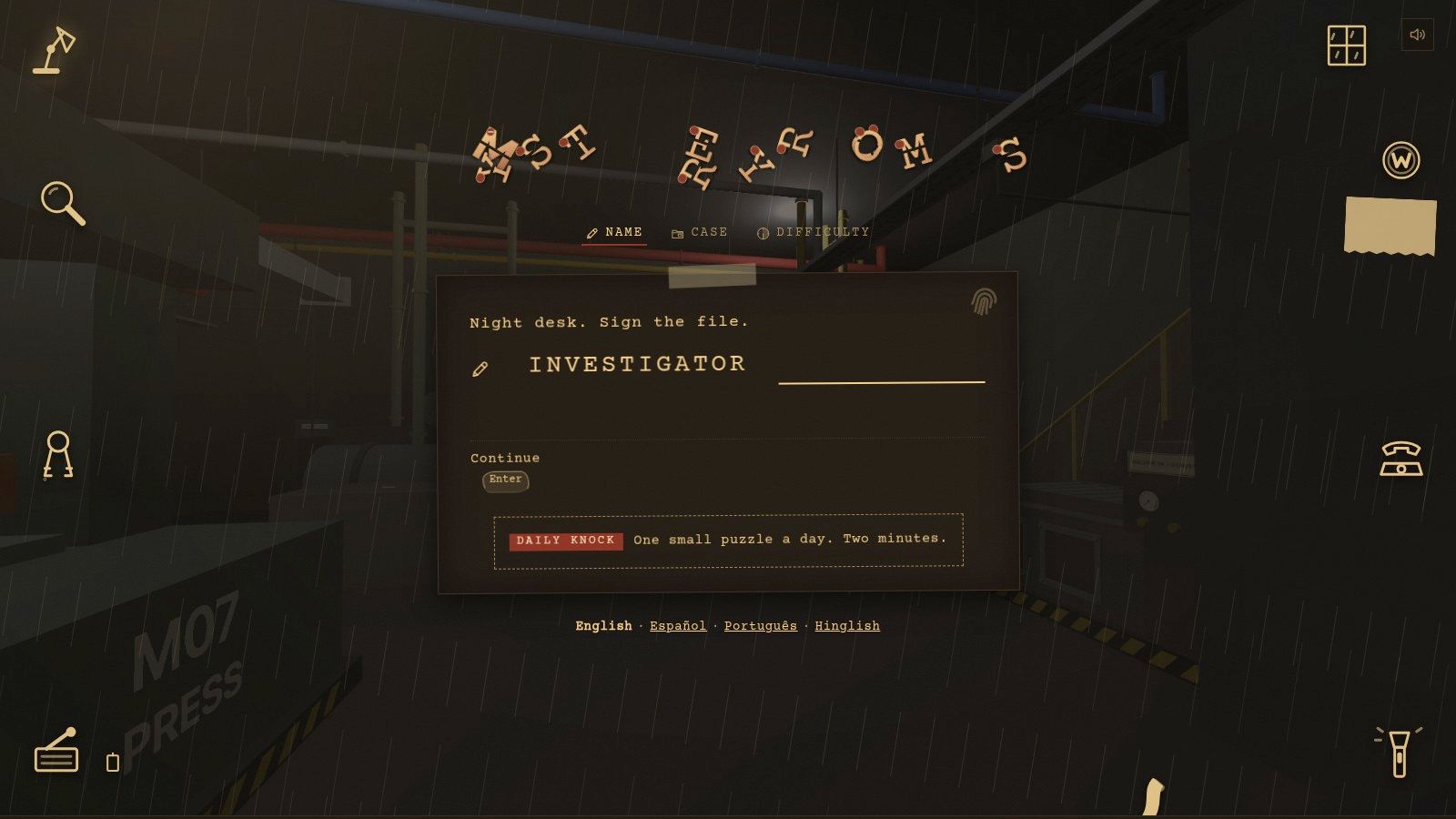
Have 20 to 40 minutes, and enjoy exploring an unsettling setting? Wysteryrooms is a browser-based, first-person mystery game with keyboard, mouse or touch controls. Its cases unfold in places such as a factory, haunted house, metro train and sanatorium, where you inspect objects and documents and solve puzzles against a clock.
The appeal is exploration, not suspect interviews. If you like checking every room and reading what you find, the full cases offer a longer solo session. For a shorter break, separate daily puzzles take roughly 2 to 5 minutes.
The accessibility catch nobody mentions
First-person horror relies heavily on visual and audio cues, which can make it harder for some players to follow. Wysteryrooms offers difficulty settings and tiered hints, but those help with puzzles rather than changing how the atmosphere is presented. One case includes a creature and loud scares, so consider whether that suits your setting before you start.
Pros
- Visual exploration offers a change from text-led detective games.
- Four full cases are free to play in the browser, with no installation.
- Difficulty settings and tiered hints can help when a puzzle stalls.
Cons
- Single-player only: friends cannot join the same live case.
- Tense atmosphere, including jumpscares in at least one case.
- Full cases take longer than the short daily puzzles.
6. Suspectle

If you'd rather reason than explore, Suspectle skips the scenery and gives you a logic grid with a body attached. Four puzzle types keep it from going stale: floor-plan cases where you place suspects, Break the Story for analysing statements, Sort the Evidence, and Piece the Scene for reconstruction. Nothing is solved by clicking around until something happens.
Difficulty labels do real work here. Starter cases walk you through the rules in a couple of minutes, while Case File entries can eat twenty minutes or more. Pick by the time you have, not by curiosity.
The trade-off is character. These are puzzles wearing a trench coat, not stories, and you won't remember the suspects' names an hour later. What you will remember is the moment three clues click into a single placement and the whole floor plan resolves.
The no-account design cuts both ways. You can start instantly with no download and no paywall, according to the site, but nothing saves to a profile either, so finishing a case in one sitting is the only way to keep your progress.
How I'd play it: start with one Starter case from each of the four modes rather than four cases from the same mode. You'll find out in ten minutes which mechanic your brain actually enjoys.
Pros
- Four distinct mechanics means variety without leaving the site.
- No account, download or paywall required.
- Clear difficulty ladder from Starter to Case File.
Cons
- Logic puzzles, not simulated investigations: no scene hunting, no interrogation.
- No saved progress because there's no profile.
- Some cases run long, so check the difficulty before starting at bedtime.
7. Daily Detective
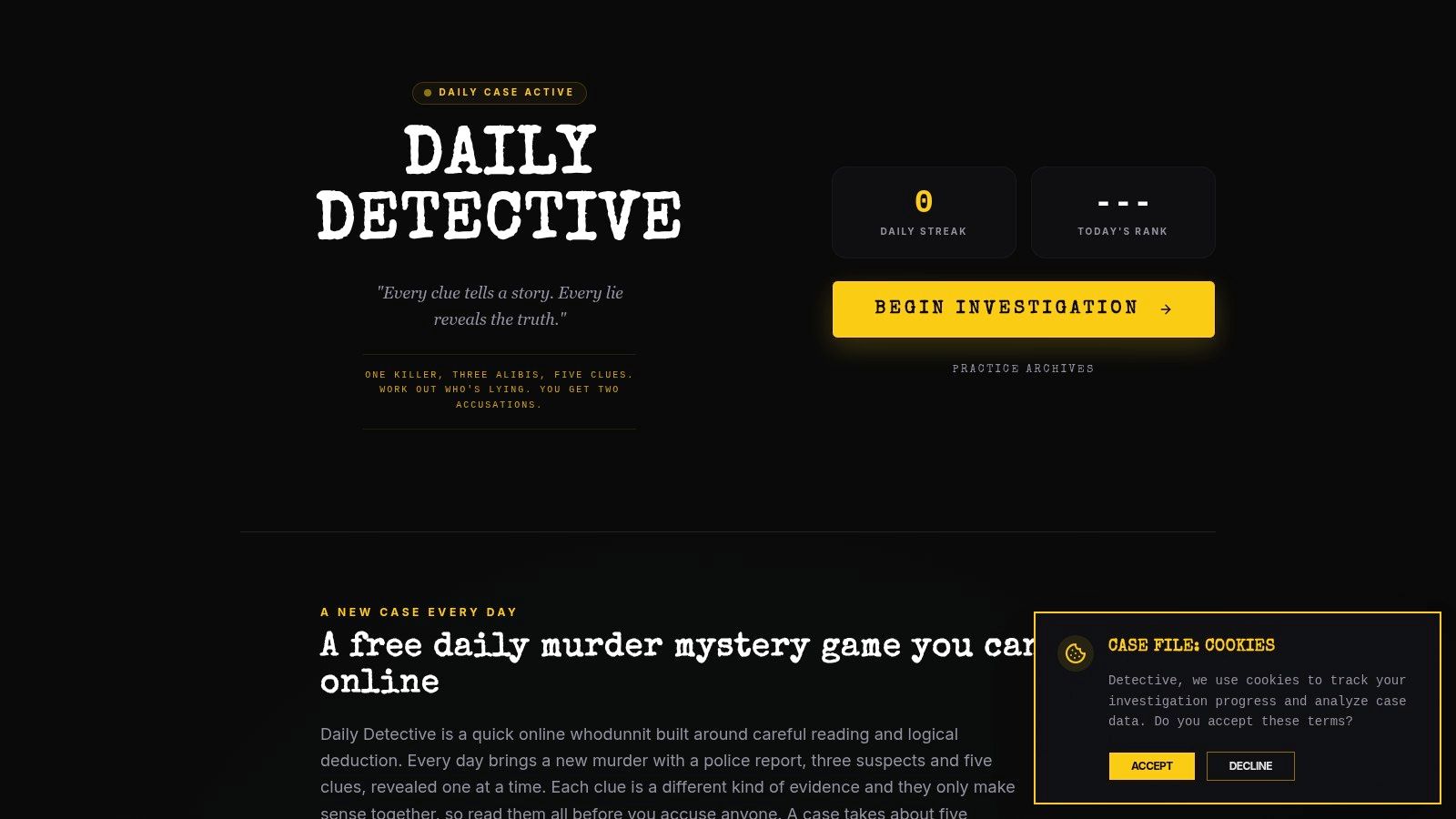
Three suspects, five clues, one police report, and about five minutes. Daily Detective is the shortest complete experience on this list, and it's ruthlessly focused: compare timelines, forensic details and witness information against each suspect's alibi, then commit. You get two accusations before the case is lost, which is exactly enough rope.
The format is fixed, and that's the honest limitation. There's no scene to search and no interview to run. What you get is a clean reasoning exercise you can finish while the kettle boils.
It also fits how people use browser games. Only 4% of H5 players play browser games exclusively while 75% also play mobile titles, according to a Newzoo survey of browser-game users across eight markets cited in TechJury's online gaming statistics. A five-minute daily case is a companion habit, not a replacement for a bigger game, and it works best when treated that way.
Solved cases and streaks stay in the browser, so the pull to keep the run alive does the retention work that a longer story usually handles.
Pros
- Start and finish in five minutes, free, with no sign-up.
- Two accusations reward careful comparison instead of one lucky guess.
- Streaks give a light reason to come back tomorrow.
Cons
- No exploration at all: just a report, three suspects and five clues.
- Simple for experienced solvers, who will want a deeper case.
- Daily format, so you can't binge a backlog the way you can elsewhere.
8. Midnight Casebook
The case opens at midnight whether you're ready or not. Midnight Casebook pairs an illustrated crime scene with flashlight exploration and voiced witness statements, and it asks for three answers rather than one: killer, method and motive. Cases are described as solver-checked and playtested, which matters when half the fun is arguing that the official answer is wrong.
The free tier is a demo, and that's fine
Be clear about what you get before you invest an evening. The free selection covers the nightly case and the first three cases. The archive, all hints and the longer Sunday Dossier sit behind Casebook Pro. If you like a daily ritual with a visual twist, the free tier is enough. If you want to pick any case on any night, it isn't.
The language list is unusually broad, including English, German, Turkish, French, Spanish and Brazilian Portuguese, which makes it one of the few entries here that a multilingual household can play together without translating on the fly. No account and no download are needed to begin.
The voiced statements are the standout feature and the main risk. Voice acting sells atmosphere, but a slow reader paired with fast audio can lose the thread. Play with headphones if you can.
Pros
- Visual searching plus classic deduction, rather than one or the other.
- Multilingual, including German.
- No account or download to start the nightly case.
Cons
- Free content is limited to the nightly case and the first three.
- Archive, hints and Sunday Dossier need Pro.
- One case per night, which is frustrating when you want three in a row.
9. Confessd
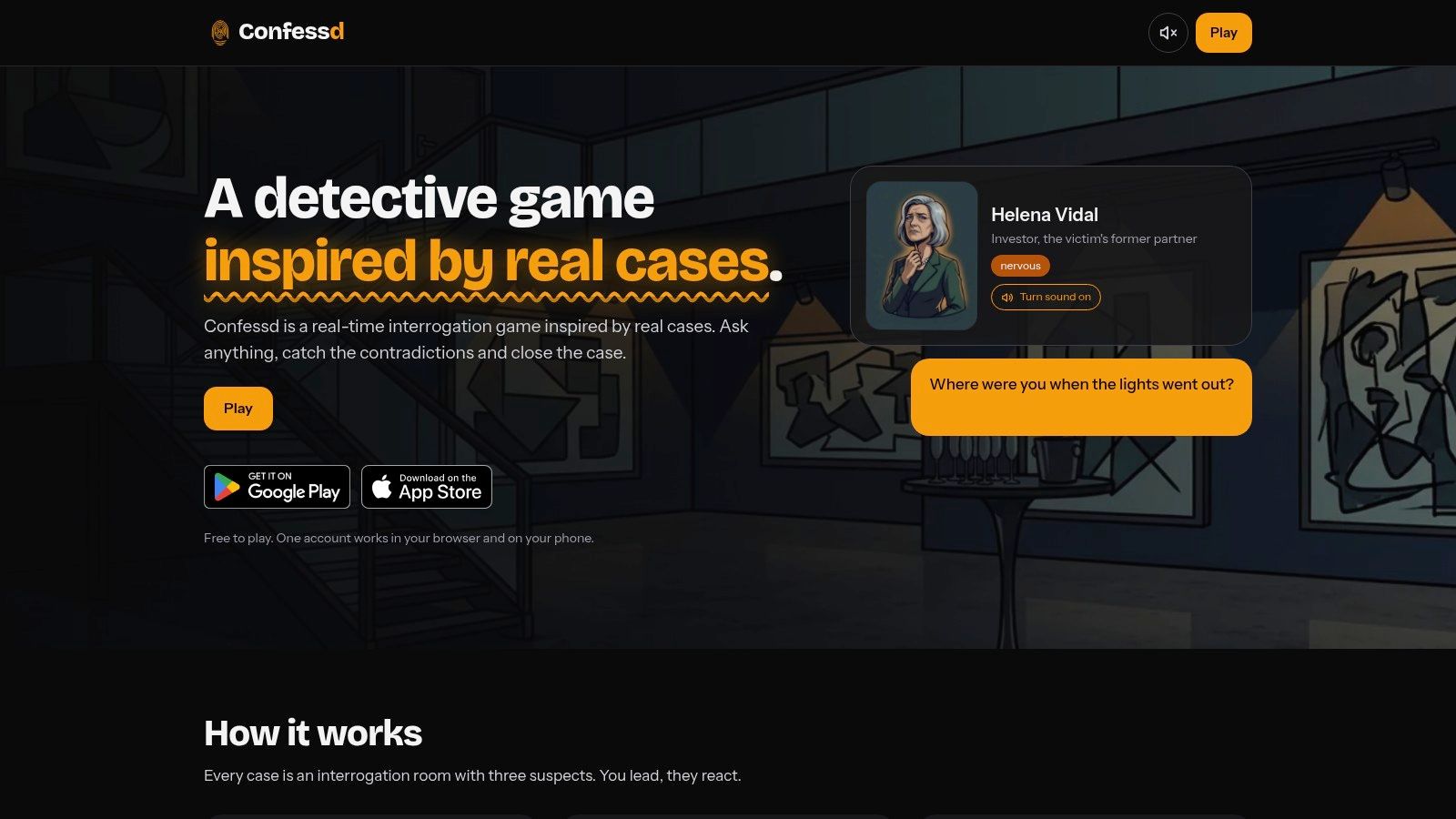
Interrogation is the whole game here, not a side panel. Confessd puts three suspects in front of you, lets you ask ready-made questions, type your own, or dictate them, and expects you to catch one suspect contradicting another before you support an accusation with evidence. The notebook tracks facts across interviews so you can line statements up side by side.
That focus is why it stands out. Most browser mysteries treat questioning as flavour text between clue hunts. Here the contradiction is the clue.
Case files cover murder, theft and cases inspired by real events, and the game runs free in a browser and on a phone, with several languages listed.
The limitation is temperament. If you like hunting for a tiny object in an illustrated room, this will feel like a lot of reading. The responses also arrive in real time, which can feel looser than a tightly scripted whodunit, and the homepage doesn't clearly state case lengths or paid-access details. Go in expecting to experiment rather than to be guided.
The best approach: write down what each suspect claims before you challenge anyone. Cross-referencing from memory is how you waste an interview.
Pros
- Interrogation as the core mechanic, which is rare in this format.
- Typed and dictated questions let you push beyond the script.
- Free to play in a browser and on a phone.
Cons
- Reading-heavy, with little visual investigation.
- Real-time responses can feel less authored than fixed dialogue.
- No clear case-length or pricing info on the homepage.
10. Enquetix
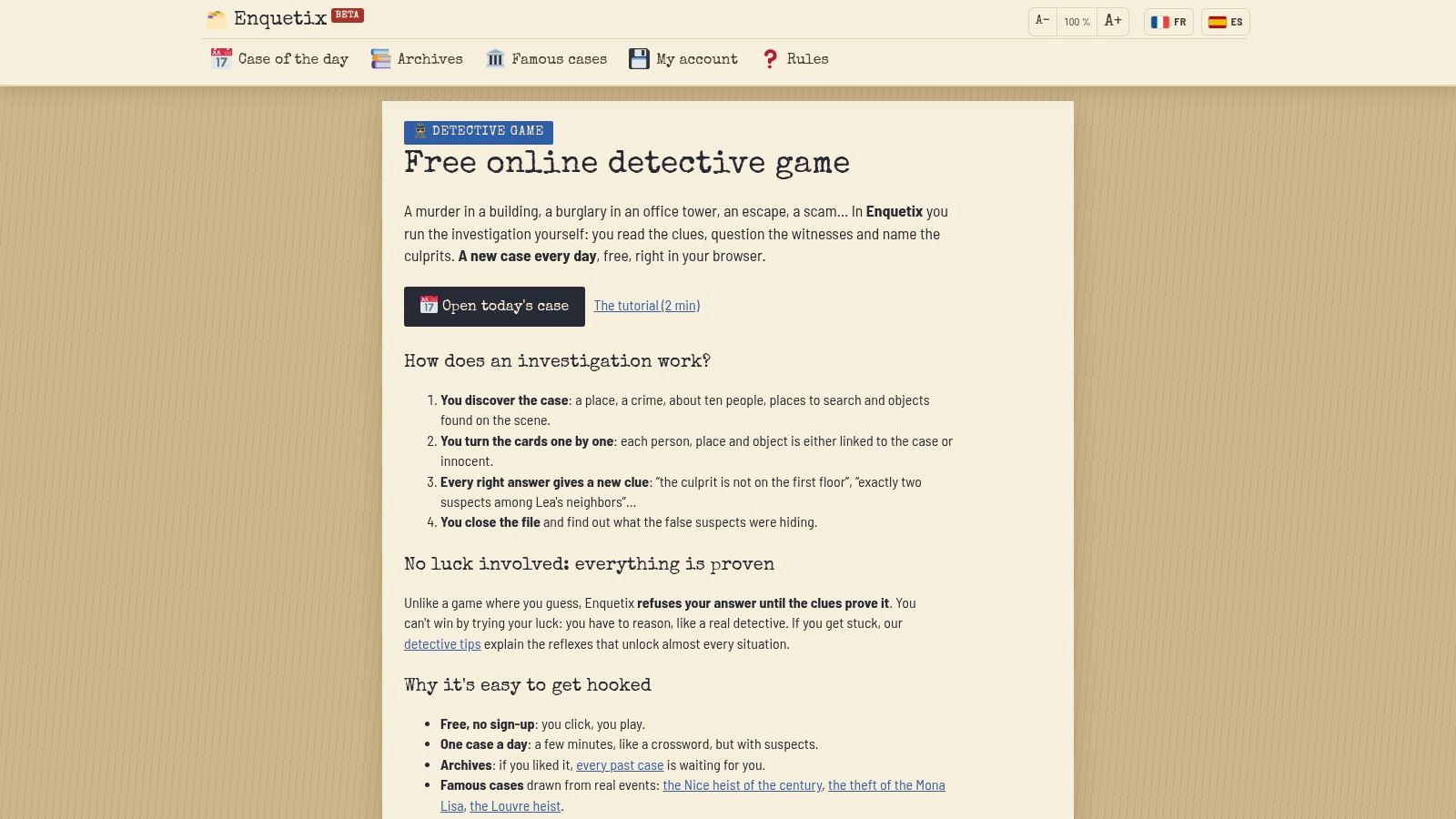
Reveal a card, get a fact, earn another clue. Enquetix builds its cases from cards about people, places and objects, and it refuses to accept a lucky guess: each answer needs proof before the game moves on. Tutorial takes about two minutes, cases run from a few minutes to roughly fifteen, and it all works on mobile and desktop with adjustable text size.
Who it suits, and who it won't
This is the best entry point on the list for someone who has never played a detective game and doesn't want to feel stupid. Cards reveal information in digestible pieces, the proof requirement forces actual reasoning, and the adjustable text size helps anyone reading on a small screen.
The cost is atmosphere. Revealing cards is never going to feel like walking through a crime scene, and the English-language cases use French names and locations, which takes a moment to adjust to. The daily-case structure also means there's no long continuous story to follow, so players who want a season-long mystery should look at the games higher up this list.
Crimes covered include murder, burglary, escape and scams, so the variety is broader than the title suggests. No account is needed to play or to keep progress in the browser, which makes it one of the easiest links to send someone who's curious.
Pros
- Proof-based answers reward deduction over trial and error.
- Short cases fit a lunch break or a commute.
- Free with no sign-up, on mobile and desktop.
Cons
- Card reveals are less immersive than illustrated scenes.
- French names and locations in English cases can distract.
- Daily focus means no long-running story.
10 Online Mystery Games for Adults at a Glance
Session length, difficulty, and whether you play alone or with friends are the three filters that matter on a weeknight. The table below uses those filters for all ten games.
| Item | Typical Case Length | Difficulty / Approachability | Best For | Solo or Group |
|---|---|---|---|---|
| Mystery Hunch | About 5–10 minutes | Easy and medium options; notebook and optional hints help | Quick illustrated whodunnits with varied puzzles | Solo |
| NOIR | 5–15 minutes for quick cases; 20 minutes to 2 hours for longer cases | Evidence-focused; case lengths suit different experience levels | Thorough investigations and a broad range of crimes | Solo or groups of 2–6 |
| LiarHunt | Daily cases plus a 30-mission format; Rush mode is timed | Accessible contradiction-based deduction; Rush mode adds a timer | Daily cases, career progression, or competitive play | Solo or with friends |
| The Detective's Desk (Detekts) | About 20–40 minutes | Notes and an interactive corkboard support clue organization | Daily murder mysteries with scene inspection and interviews | Solo |
| Wysteryrooms | About 20–40 minutes per full case; 2–5 minutes for daily puzzles | Difficulty settings and tiered hints | Atmospheric first-person exploration and puzzles | Solo |
| Suspectle | Starter: a couple of minutes; Case File: 20+ minutes | Difficulty levels from Starter to Case File | Structured logic puzzles and varied deduction formats | Solo |
| Daily Detective | About 5 minutes | Simple format with three suspects and five clues | A quick daily whodunnit | Solo |
| Midnight Casebook | Site does not publish case lengths | Solver-checked cases; hints available with Pro | Illustrated, voiced mysteries and multilingual play | Solo |
| Confessd | Site does not publish case lengths | Notebook and guided questions support suspect interviews | Interrogation and contradiction-focused cases | Solo |
| Enquetix | A few minutes to about 15 minutes | Tutorial provided; proof-based answers discourage guessing | Short, evidence-based daily investigations | Solo |
Pick Your Case and Start Sleuthing Tonight
Here's the shortcut, based on the only three questions that matter.
Under ten minutes and you want visual deduction. Start with Mystery Hunch's free illustrated cases. Difficulty labels and time estimates sit on every case card, so you know the commitment before you click, and the notebook does the memory work for you. Pair it with Daily Detective if you want a five-minute reasoning hit on the days you don't have ten.
Short solo reasoning with no scenery. Daily Detective and Enquetix are the two cleanest options. Both are free, both need no account, and both reward proof over guessing. Enquetix is gentler for a first-timer. Daily Detective is tighter once you know how these puzzles work.
Twenty to forty minutes and a proper sitting. The Detective's Desk for investigation with a corkboard and interviews, or Wysteryrooms if you want atmosphere and don't mind jumping at a loud noise.
A group evening. NOIR's private rooms take 2 to 6 players with live chat, and its longer cases run 20 minutes to two hours. LiarHunt's live rooms are the lighter alternative when your group would rather argue about alibis than read forensic reports. Neither needs an install, which matters when half the group is on a phone.
The twenty-minute trap is worth naming. Longer cases feel like better value, but the ones that get abandoned are almost always the ones started too late. A case you finish beats a case you admire.
Every game here runs in a browser with nothing to install, including Mystery Hunch, a free, newly launched prototype whose creator reads every piece of player feedback. Try one case, and if something's confusing or a clue feels unfair, say so. That's the whole point of an early build.
If you want the shortest possible path from curiosity to a solved case, Mystery Hunch gives you free illustrated detective puzzles that run in a browser and finish in roughly five to ten minutes. You search a scene, tap rooms and objects for clues, combine evidence in a notebook, check the suspects' statements and accuse with proof, so there's no tutorial to survive before the fun starts. Try the first case at Mystery Hunch and see whether a ten-minute whodunit fits your evening better than a forty-hour one.