9 Mystery Puzzles Games for Armchair Detectives in 2026

You've got a cup of tea, dinner isn't quite ready, and you suddenly want to accuse someone of theft. Not start a sprawling campaign. Not download an app that needs updating. Just examine something suspicious, catch a contradiction, and feel clever before your tea goes cold.
These mystery puzzles games offer different ways to scratch that itch. Some ask you to inspect illustrated rooms. Others turn a murder into a logic grid, make you choose questions carefully, or bury the answer inside witness statements. The right choice depends less on popularity than on what kind of thinking sounds fun tonight.
The order starts with scene observation, moves through structured deduction and interrogation, and finishes with dossiers and longer adventures. Session guidance below distinguishes published estimates from games where you'll need to leave yourself breathing room. Free entry doesn't always mean unrestricted access, either, so paid archives, premium titles, and progression friction get called out.
Most are straightforward browser picks. The exceptions need more care: Rusty Lake's availability varies by title, while Criminal Case points players toward Facebook and mobile platforms rather than a standalone browser experience.
Table of Contents
- 1. Mystery Hunch
- 2. Midnight Casebook
- 3. Suspectle
- 4. Deduce
- 5. Ask the Truth
- 6. Casebook Detective Logic Puzzles
- 7. PLAY INQUEST
- 8. Rusty Lake
- 9. Criminal Case
- How the mystery puzzles games compare at a glance
- Pick Your Case, Then Trust Your Notebook
1. Mystery Hunch

Best for scene observation with an actual accusation at the end. Our free browser game builds each investigation around one illustrated scene. You tap rooms and objects, collect clues, combine evidence in a notebook, and compare what you've found against suspects' statements.
Finding evidence and proving a theory are different skills. Spotting an odd object gets you started, but you still have to explain how it connects to the culprit. That makes this a better fit for whodunit fans than a game where success means checking every object off a list.
A small case, not a sprawling adventure
Our cases currently take approximately 6–9 minutes, with visible duration estimates and easy or medium difficulty labels. The Hut on the Grauhorn, a medium murder case, presents a dead hut keeper snowed in with five guests who all claim they were asleep. Other investigations lean on thefts, seating arrangements, masks, and physical clues, so the reasoning shifts from case to case.
- Cost and access: Free in the browser, with phone and wider-screen layouts.
- Help and scoring: A partner can offer a hint at the cost of one star. You earn up to three stars by accusing the culprit with proof, and restarting keeps the stars you've already won.
- Presentation: English and German options, plus bright and noir visual styles.
The limitation is deliberate scope. Each investigation stays inside one compact scene rather than spanning a connected world or a lengthy case file.
This is also an early prototype made by one person, and cases, features, and scoring may change or be removed as feedback comes in. Every message gets read. I'd pick it for a short, self-contained deduction session over a large adventure library.
2. Midnight Casebook

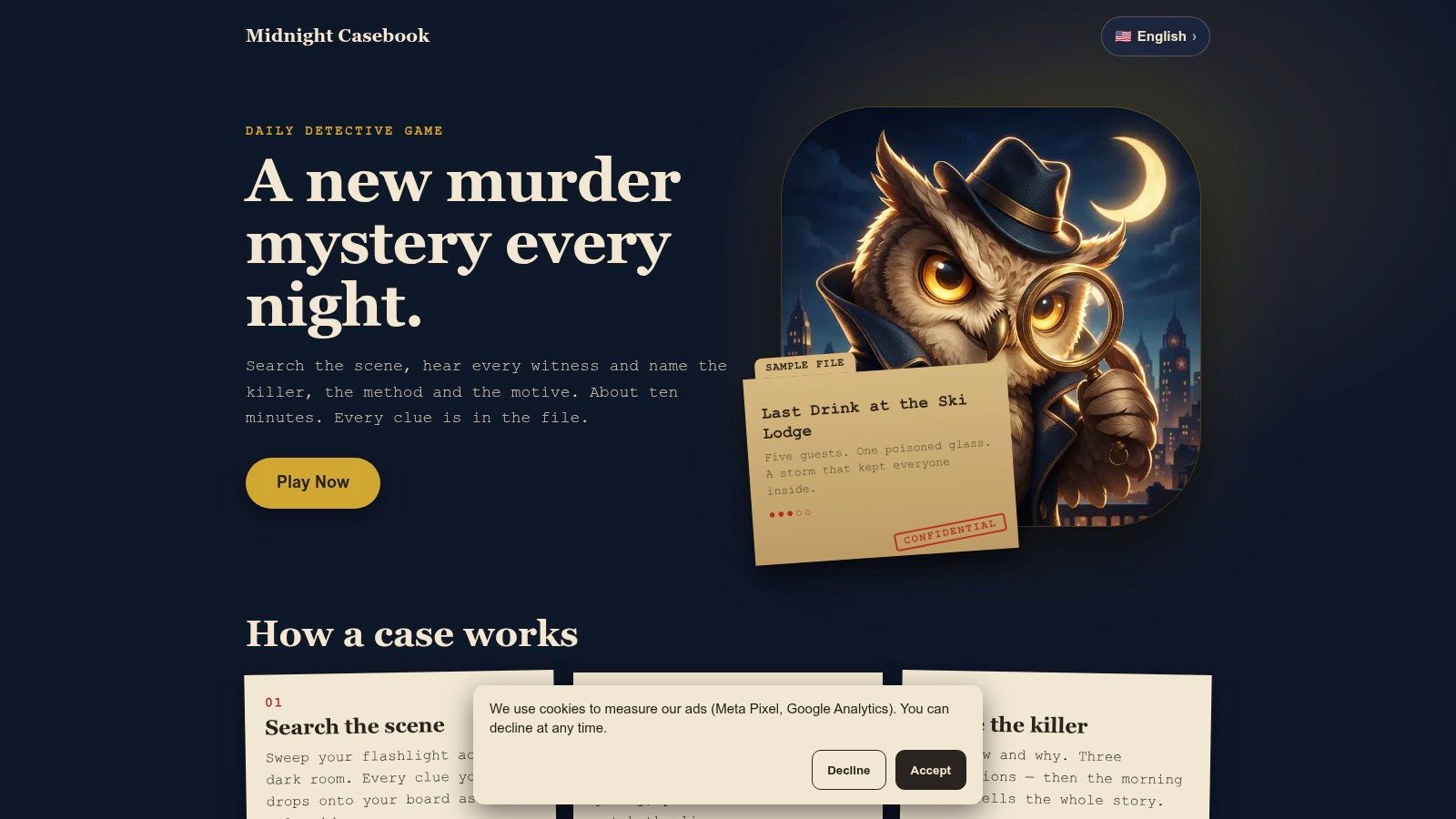
A nervous witness means little until their story clashes with the scene. Midnight Casebook pairs illustrated crime scenes with voiced statements, then demands more than a name. You identify the killer, the method, and the motive.
That three-part accusation is what separates it from a straightforward scene search. A suspect can look guilty and still be innocent if you cannot explain how the crime happened. Listen for testimony that contradicts physical evidence. A shaky delivery proves nothing on its own.
The site describes cases as taking about ten minutes, with a free daily mystery and free introductory cases. No download, no account. That makes it an easy pick when you want a classic whodunit in one sitting.
Before accusing: Make sure your explanation covers the person, the method, and the motive. A plausible suspect isn't yet a complete solution.
Difficulty here is interpretive. You weigh what witnesses say against what the scene shows, rather than checking items off a list. The voiced performances add atmosphere, though audio is awkward on a commute or in a quiet office.
The trade-off is access. The full archive and all hints require Pro. The daily case is a sensible free starting point, but anyone hoping to binge through an unrestricted library will feel the release rhythm quickly.
3. Suspectle
Suspectle is for the detective who wants to draw a floor plan. In its spatial cases, you place suspects using clues, then identify who was left alone with the victim. The fun comes from eliminating arrangements until the remaining placement explains the crime.
The Suspectle website offers free browser access, daily cases, an archive, and additional modes including Break the Story, Sort the Evidence, and Piece the Scene. No account or download is required.
Think in placements, not personalities
Start with the most restrictive clue. Fix a definite location before tackling a statement that leaves several possibilities open. Otherwise, you can spend the whole puzzle mentally rearranging people without learning anything.
- Session fit: A focused puzzle break, but no dependable universal solve-time estimate is established. Harder cases deserve uninterrupted attention.
- Difficulty: An increasing challenge ladder, with longer chains of reasoning at the harder end.
- Limitation: Progress isn't saved to a player profile, according to the site.
This is spatial deduction, not a point-and-click investigation. If you'd rather examine a setting than arrange suspects, an illustrated hut investigation offers a useful contrast.
I'd pick Suspectle when the satisfying part is proving where everyone must have been. Skip it when you want dialogue, atmosphere, or the tactile pleasure of inspecting objects.
4. Deduce

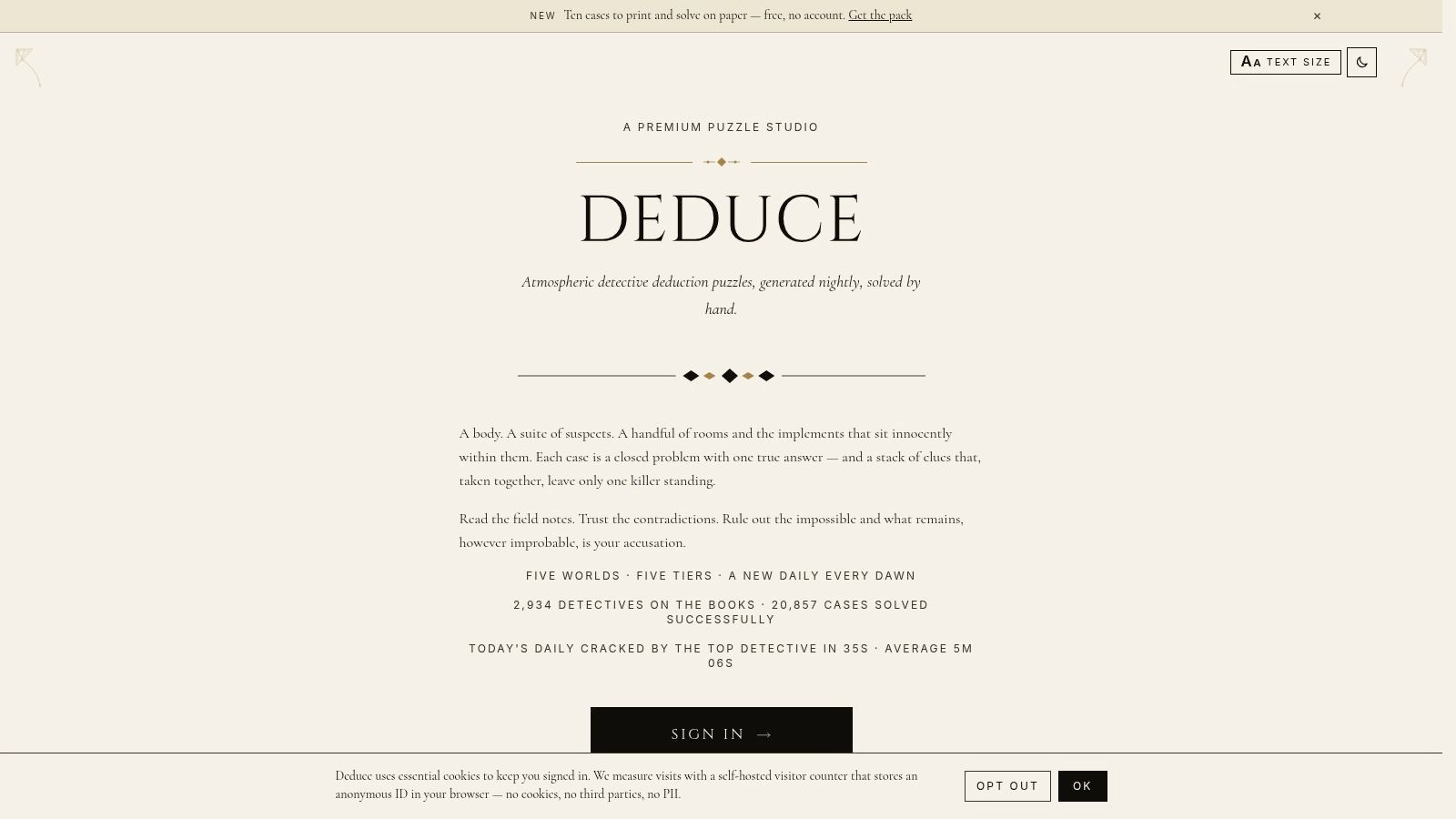
Some mysteries are better with a pencil. Deduce makes the grid itself the investigation: use the clues to establish the killer, room, and weapon, rather than searching a picture for something suspicious.
Its cases are checked for a single solution reachable through deduction. That's the attraction if you dislike guessing what a writer intended. You can work toward an answer by ruling out combinations, not by deciding which suspect seems most villainous.
Access is free, with daily puzzles, a permanent archive, and printable puzzle packs. Anonymous play is available, while an optional free account saves streaks and progress across devices.
A blank square means unknown, not probably false. Mark only what a clue or deduction actually establishes.
Difficulty progresses through detective ranks, with harder levels introducing new clue types. Session length depends on the level and your comfort with grids; don't assume a daily puzzle is automatically a quick solve.
The frustrating part is the accusation penalty: a wrong accusation ends the streak. That can sharpen your attention, but it can also make a casual break feel like homework.
For a change from formal elimination, try a necklace-theft investigation. Deduce is the stronger choice when you want explicit logical relationships and the option to take the puzzle away from the screen.
5. Ask the Truth
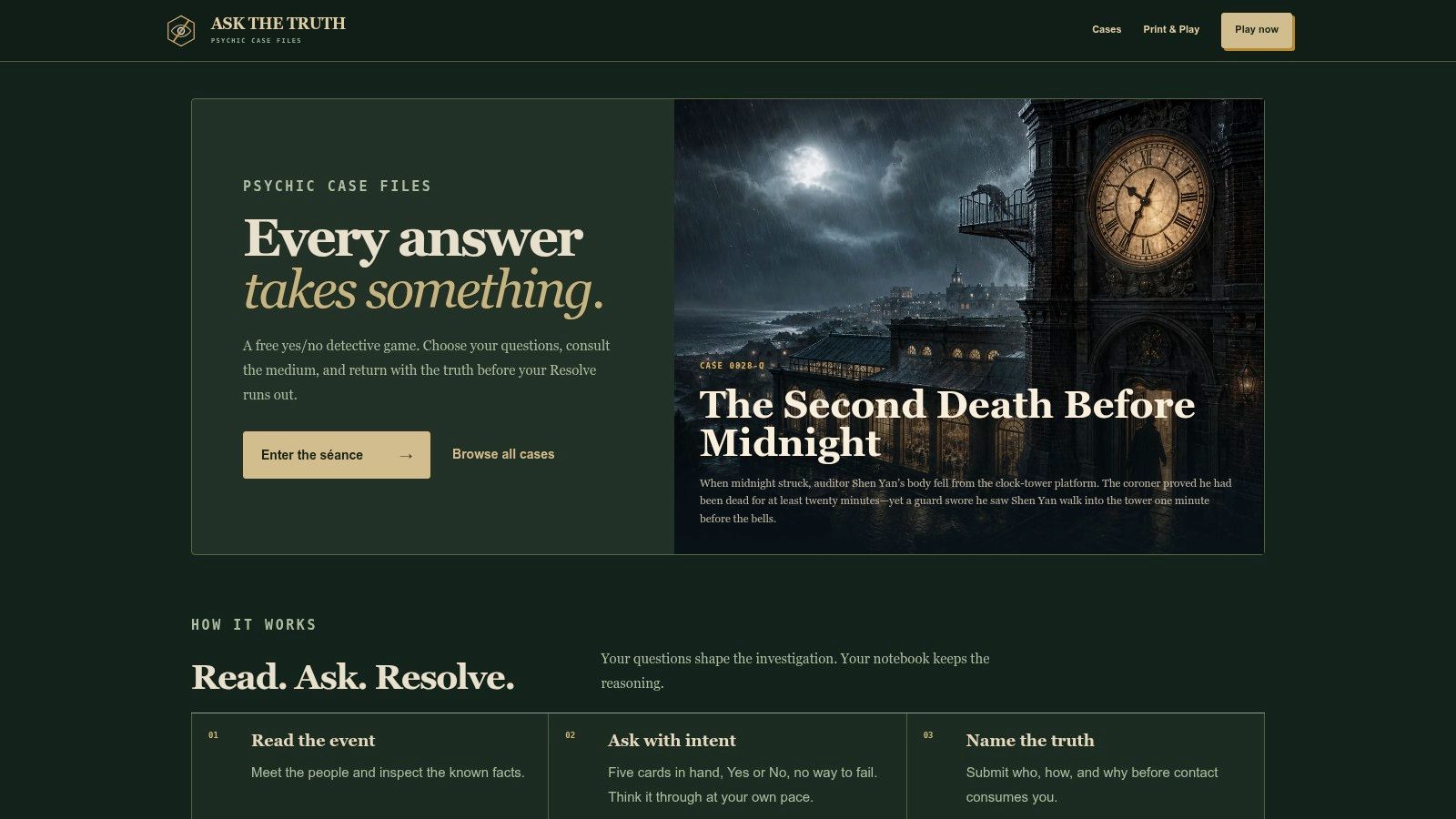
The key move in Ask the Truth happens before you receive an answer. You choose which yes-or-no question deserves asking, with a limited Resolve resource making that choice part of the puzzle.
Answers come from authored case files, not free-form AI conversations. You're investigating a fixed explanation, so the challenge is to uncover the right facts and connect them. A notebook helps organise the evidence.
Ask questions that separate theories
Say you're considering an accident and a deliberate act. A useful question should help distinguish those explanations. Asking for another detail that fits both may satisfy curiosity without moving the investigation forward.
- Cost and access: Available cases are free, with no account or download required.
- Session fit: Leave time to read and reason. Cases can be resumed in the same browser.
- Difficulty: Question selection and resource management, rather than tiny hotspots or inventory combinations.
The Resolve limit is the meaningful trade-off. It can make interrogation feel purposeful, but it's less relaxed than unlimited exploration. The public game is also in English.
If you prefer examining physical evidence before deciding what matters, an illustrated pantry mystery provides a different starting point. Choose Ask the Truth when you want to practise asking better questions, rather than collecting every available clue.
6. Casebook Detective Logic Puzzles
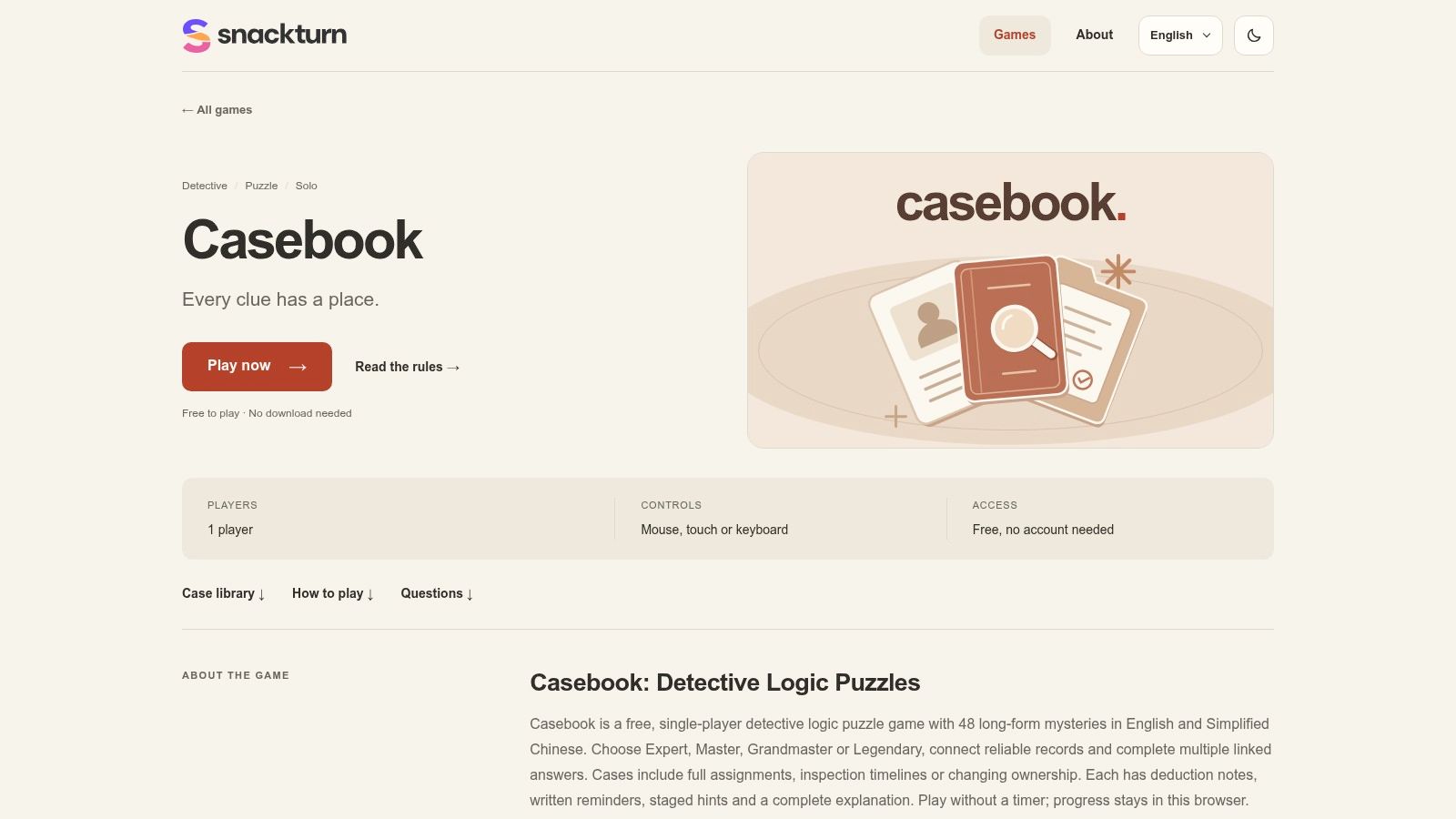
A timeline, an alibi, and an ownership record can be more demanding than a room full of suspicious objects. Casebook Detective Logic Puzzles leans into that style of investigation, asking you to connect records and clues rather than sweep an illustration.
This is a free, account-free collection with difficulty choices, staged hints, deduction notes, and full explanations. Its different structures cover places, ordering, alibis, and who owns what. Choose it when you want a substantial reasoning exercise rather than a brief accusation.
The useful habit here is to keep direct evidence separate from derived conclusions. Write down what a clue explicitly states, then record what follows from it. When your solution stops working, you can trace the mistaken inference instead of restarting mentally.
Better for an unhurried sitting
There's no timer, and browser saving is available when local storage works. However, progress doesn't sync across devices. Starting on your phone and expecting to continue on a laptop without interruption isn't the right plan.
Difficulty varies by case, and no reliable universal completion estimate is established. These are generally longer puzzles, so leave room for a proper sit-down.
The explanations are especially useful after a solve. Compare the reasoning, not just the answer. A correct guess won't teach you the logical step that would make the next case easier.
7. PLAY INQUEST
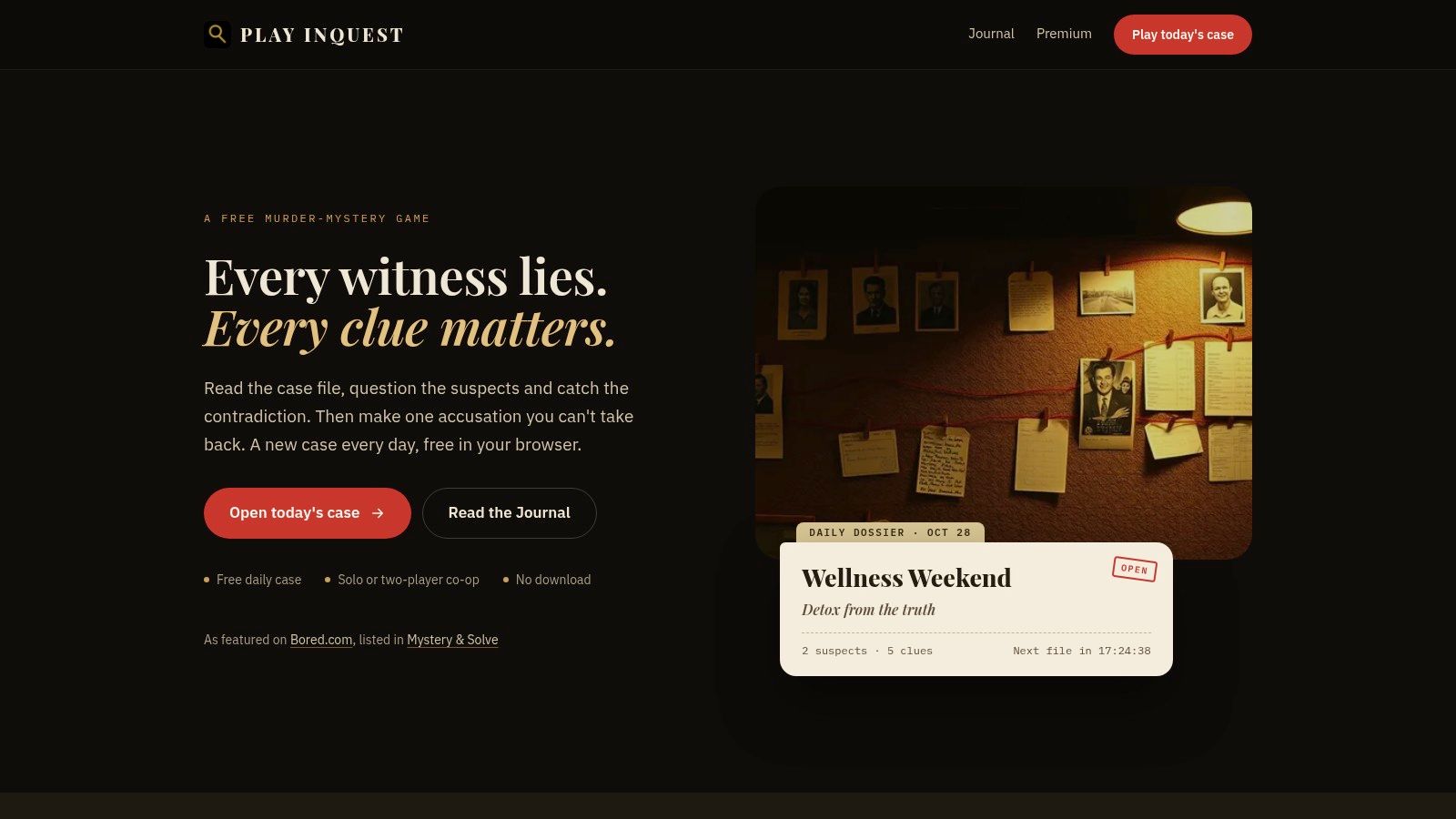
PLAY INQUEST suits people who want to argue about an alibi with a friend. Its police-style dossiers combine scene searches, statements, and evidence comparison. You're looking for the lie that makes an accusation defensible.
The PLAY INQUEST website offers a free daily dossier and optional co-op for signed-in players. It works through modern desktop and mobile browsers, though the detailed presentation describes fictional cases.
The cooperative option changes how I'd approach it. Let each player form an explanation before comparing notes. Otherwise, the more confident reader can steer the investigation while the other becomes a spectator.
- Session fit: Better for a reading-focused sitting than a rushed visual puzzle. A dependable case-duration estimate isn't established here.
- Difficulty: Comparing accounts, spotting contradictions, and distinguishing a suspicious statement from an impossible one.
- Cost limitation: The daily dossier is the clearest free entry point. Don't assume every other case has identical access terms.
The dossier format is also the main drawback. Reading through evidence feels more procedural than tapping objects in a scene, and co-op requires signing in.
I'd choose it for shared theory-building, especially if both players enjoy crime fiction. If you want immediate visual interaction, the documents may feel like a barrier rather than part of the fun.
8. Rusty Lake
Not every mystery ends with a tidy explanation across a dinner table. Rusty Lake is the atmospheric choice: surreal settings, point-and-click exploration, escape-room puzzles, and an interconnected story.
Its Cube Escape games sit closer to adventure puzzles than conventional whodunits. You inspect environments, experiment with objects, and work out how the setting operates. Choose it for strange discoveries, not strict police procedure.
Follow the environment, not just the suspects
The practical approach is to distinguish an unsolved mechanism from a missing item. Record symbols and unusual arrangements before trying random combinations. When you get stuck, revisit what changed after your last successful action.
- Session fit: An adventure sitting rather than a guaranteed quick case. Length varies by title.
- Difficulty: Observation, object use, and lateral associations, which can feel less explicit than grid deduction.
- Cost and access: Some games are free on the studio's portal. Premium adventures include Rusty Lake Hotel, Roots, and Paradise, with availability and pricing varying by title and platform.
The surreal tone is both the appeal and the warning. You may enjoy not knowing what a scene means yet, but players who want every clue to support a straightforward criminal explanation may find it frustrating.
I'd start with a free offering before committing to a premium adventure. Confirm the individual game's platform, too; the whole series shouldn't be treated as uniformly browser-based.
9. Criminal Case
Finding the clue and interpreting the clue aren't the same activity. Criminal Case puts much of its moment-to-moment emphasis on the former, with hidden-object searches in detailed crime scenes feeding ongoing murder investigations.
That makes it a good match for visual scanning and continuing stories. You get environments to search and a progression path through cases. It's less suitable if your ideal mystery consists mainly of testing alibis and proving a culprit through deduction.
Allow for an ongoing game rather than a clean standalone session. You can approach it in short visits, but searching a scene isn't necessarily the same as finishing an investigation. The official site points to Facebook and mobile availability, so it's not as direct a browser pick as a dedicated game page.
Keep the distinction clear: Enjoying a hidden-object search doesn't mean you want a logic puzzle. Pick the activity you like, not just the detective theme.
The other caveat is progression friction. Waiting or in-game purchases can become part of play, so don't treat access as a promise of unrestricted, uninterrupted solving. No universal purchase price applies to that model.
I'd recommend Criminal Case to someone who wants a recurring crime-game habit and enjoys searching busy illustrations. For a satisfying solution before dinner, a self-contained case is the safer choice.
How the mystery puzzles games compare at a glance
Match the row to the thinking you want and the time you have. Daily and ongoing games are easier to dip into, while labelled cases give a cleaner stopping point.
| Item | Session length | Difficulty | Free access | Best for |
|---|---|---|---|---|
| Mystery Hunch | About 6–9 minutes per case | Easy to medium | Free | Quick, illustrated whodunits with clue-based deductions |
| Midnight Casebook | About 10 minutes per case | Introductory cases first, then daily mysteries | Free daily mystery and free introductory cases | Short daily mysteries with voiced witnesses |
| Suspectle | One browser puzzle at a time | Increasing difficulty | Free browser access | Logic-grid and spatial deduction puzzles |
| Deduce | Daily puzzle plus archive play | Difficulty progresses through detective ranks | Free puzzles and archive | Daily logic-grid deduction and printable puzzles |
| Ask the Truth | Case by case, paced by questions | Set by question choices and resource pressure | Free available cases | Mysteries solved by choosing questions and managing a resource |
| Casebook: Detective Logic Puzzles | Longer puzzles; no time limit | Graded logic-puzzle challenge | Free case collection | In-depth, self-paced logic challenges |
| PLAY INQUEST | Daily dossier, solo or co-op | Reading-heavy evidence analysis | Free daily dossier | Evidence and alibi analysis, including optional co-op |
| Rusty Lake | Varies by game | Varies by game | Some games are free; others are premium | Atmospheric, connected point-and-click adventures |
| Criminal Case | Ongoing investigations in short visits | Hidden-object searching over alibi testing | Free to start, with waiting or in-game purchases possible | Hidden-object crime scenes and ongoing stories |
The cleanest sessions are the labelled, self-contained cases. Rows built around dailies, archives, dossiers or continuing stories can still fit short visits, but the finish line is less fixed.
Pick Your Case, Then Trust Your Notebook
Start with the kind of thinking you want, not the most dramatic cover image. Scene observation suits a curious mood. Logic grids suit an orderly one. Question-based investigations reward careful choices, while dossiers and adventures need more patience with reading, revisiting, and unresolved details.
Then match the game to the time you have. A labelled, self-contained case is easier to finish in a sitting than an adventure with an unknown stopping point. When a game doesn't publish a reliable duration, don't confuse browser access with brevity.
Make your notes earn their space
Read suspect statements slowly and record contradictions as you find them. Separate what happened, what someone claims happened, and what you currently suspect. Those categories shouldn't collapse into a confident accusation just because a character seems unpleasant.
- For scene puzzles: Note the object, its location, and why its condition matters.
- For grids: Record exclusions as carefully as confirmed placements.
- For interrogations: Ask what answer would change your theory before spending a question.
- For dossiers: Compare accounts of the same event side by side.
Hints work best after you've identified the blockage. Are you missing evidence, misunderstanding a rule, or holding onto an assumption? A targeted nudge can preserve the pleasure of deduction better than opening a full solution.
Uncertainty itself isn't a sign that a mystery has failed. The ACM study Questions without Answers examines enjoyment of irresolution in mystery play, a useful reminder that forming and revising explanations can be part of the appeal.
Still, interface friction isn't detective difficulty. Struggling to read a clue or select a small object doesn't make your reasoning worse. Choose a format you can comfortably inspect, and don't feel obliged to protect a streak at the expense of enjoying the game.
Try contrasting styles before settling into a routine. You might love the certainty of Deduce but prefer Rusty Lake when you want atmosphere. Keep whichever experience makes you curious enough to return, rather than whichever makes you feel obliged to finish.
For a short illustrated whodunit, visit Mystery Hunch and choose a free browser case by its duration and difficulty label. Inspect the scene, organise your evidence, and accuse the culprit with proof. If you get stuck, your partner can offer a hint at the cost of one star.