7 Mystery Games at Home You Can Play Free in 2026

It's 9 p.m., you're done scrolling, and you've got maybe twenty minutes before bed. You want a proper puzzle, not a download, not a three hour campaign, and not a party you have to organize first. That's exactly where the best mystery games at home earn their spot.
This list matches each game to a real situation instead of ranking by hype. You'll find a ten minute solo break, a printable case for the kitchen table, a daily logic habit, and a two player night where you each hold half the evidence. Every entry tells you what you'll do in practice, whether that's tapping an illustrated scene, sorting documents, or spending a limited number of yes or no questions.
You're also standing in a very old line of players. As a BBC history of board games notes, Senet emerged in ancient Egypt between approximately 3500 BC and 3100 BC, and chess now has an estimated 800 million players worldwide. A few picks below are early prototypes or betas, so expect charm over polish in places. Pick your situation and start there.
Table of Contents
- 1. Mystery Hunch
- 2. Crooked Clue
- 3. SnackTurn Casebook
- 4. Suspectle
- 5. Ask the Truth
- 6. Half Evidence
- 7. Small-Town Secrets
- How the 7 at-home mystery games compare on time, difficulty, and free access
- Pick Your First Case Tonight and Start Investigating
1. Mystery Hunch
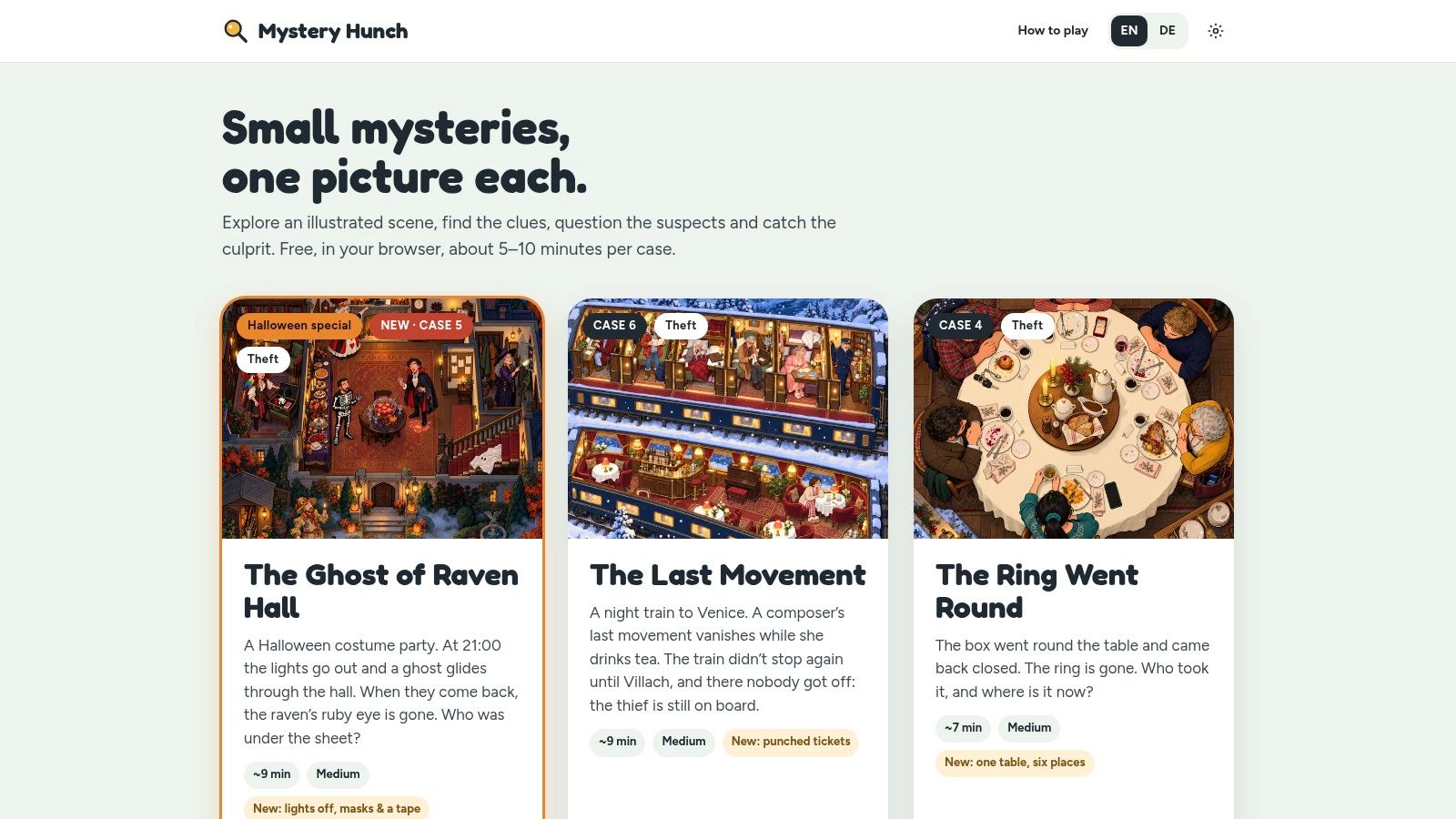
Best for a ten minute break when you want to feel like a detective, not a spreadsheet operator. Mystery Hunch puts you in one illustrated scene, lets you tap rooms and objects for clues, then asks you to compare that evidence with suspects' statements in your notebook before you accuse anyone. You don't wander a big world. You read a room properly, and that's the fun.
What You Actually Do in Each Case
Cases run about 6 to 9 minutes and are labeled easy or medium, so you know the commitment before you tap start. The settings keep rotating, from a snowed in mountain hut and a dinner table to a Halloween costume party and a lakeside villa. One case has you combining items, another uses pencil rubbing, another turns on seating arrangements, masks, or a blackout.
- Explore one scene: Tap objects and collect clues instead of reading walls of text.
- Use the notebook: Combine evidence and check it against what suspects claim.
- Accuse with proof: Earn up to three stars, or ask your in game partner for a hint at the cost of one star.
- Restart without losing stars: Earned stars remain, which makes a cleaner replay painless.
It also fits how people play now. The 2025 Newzoo Global Games Market Report projects approximately 3.6 billion players in 2025, equal to 61.5% of the world's online population, with mobile accounting for about 3.0 billion players. Mystery Hunch leans into that with phone and wider screen layouts, English and German options, and bright or noir visual styles.
Be clear about the tradeoff. This is an early prototype made by one person, so the lineup is still growing and the single scene format won't satisfy you if you want a sprawling investigation. For a Tuesday night, though, it's my first pick. It's free in your browser, it respects your time, and the accusation still feels earned.
2. Crooked Clue
Pick Crooked Clue when you want paper on the table and other people arguing over it. You can play its document based cases on screen or print them out, spread them across the coffee table, and work through competing accounts together. It's the closest thing here to a classic case file night without buying a boxed kit.
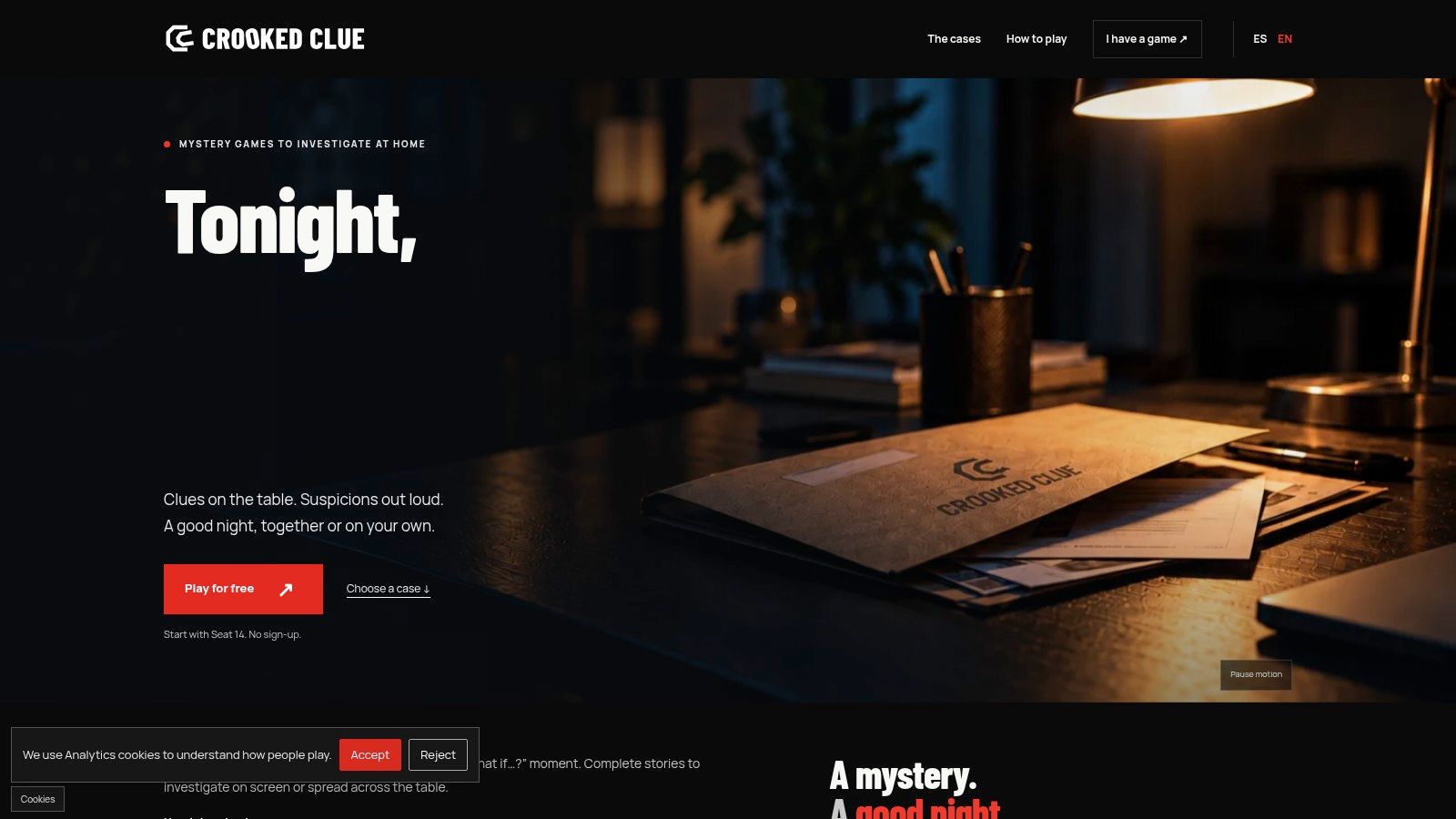
Start with Seat 14, the free starter case. It needs no sign up and uses five documents, which is enough to learn whether your group enjoys reading, comparing, and debating evidence. If it clicks, paid cases such as Off Catalogue for 1 to 4 players and Before the Demolition give you longer investigations with optional hints.
That tabletop feel still has a real audience behind it. According to SNS Insider's table top games market report, the global table-top-games market was valued at USD 7.15 billion in 2025. Crooked Clue keeps that shared table energy, just with printable PDFs instead of a shipped box.
Print the free case before you buy anything. One shared printout tells you instantly whether your friends love document work or would rather tap a scene.
The limits are simple. Paid cases take longer than a quick browser puzzle, and you're printing digital files, not opening a physical evidence kit. English and Spanish content is indicated on case listings, which helps mixed language households. Choose this for a small group evening, not a five minute solo fix.
3. SnackTurn Casebook
This one's for the logic puzzle person who'd rather untangle an alibi than search a pretty room. SnackTurn Casebook gives you structured records and asks you to work out alibis, locations, timelines, and who owned what. You're not hunting for a hidden object. You're eliminating possibilities until only one answer survives.
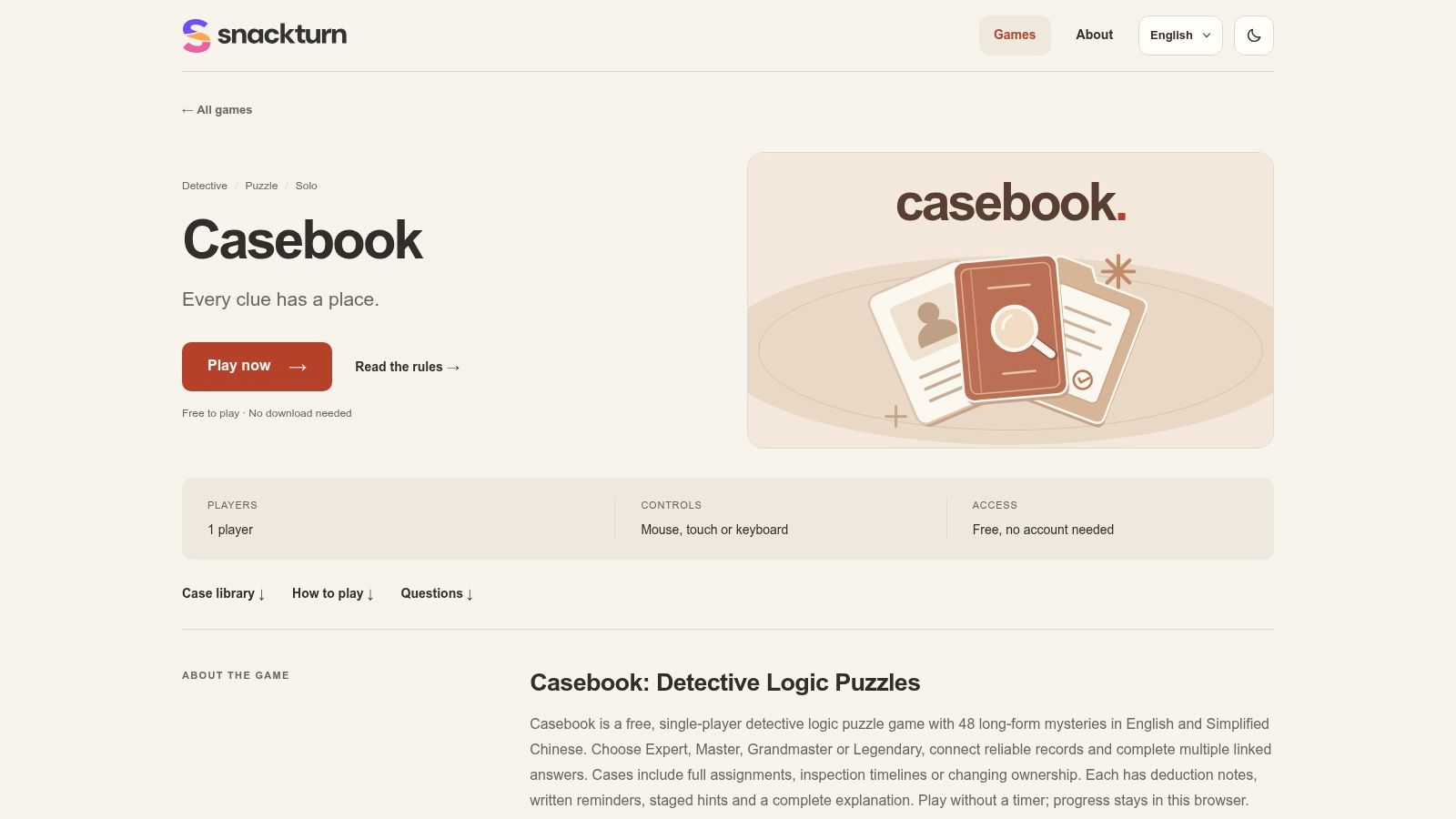
The library is the draw. You'll find 48 cases across four difficulty levels, running from Expert to Legendary, with suggested play times to help you choose. Optional notes, staged hints, and explanations mean a wrong turn teaches you something instead of just ending the session.
Why the Hint Ladder Matters
That staged help is the right design instinct. A study on puzzle game difficulty balancing found that dynamic difficulty balancing can improve engagement, immersion, and the occurrence of an "aha" moment, with a modest effect tied to higher completion rates. In practice, take the smallest hint first. You'll keep the satisfaction and still finish.
You don't need an account or a download, and it runs on a phone or computer, with English and Simplified Chinese listed. Progress is stored in your browser, though, so it won't sync between devices. It's also firmly single player and record based, not a social whodunit. For a quiet solo evening with your brain switched on, it's excellent.
4. Suspectle
Make Suspectle your daily habit if you already do a morning word or number puzzle. It drops a new puzzle every day, keeps an archive for catch up sessions, and rotates through four different ways of thinking like a detective. Some days you'll place suspects on a floor plan. Other days you'll break statements into parts, sort evidence, or reconstruct a scene.
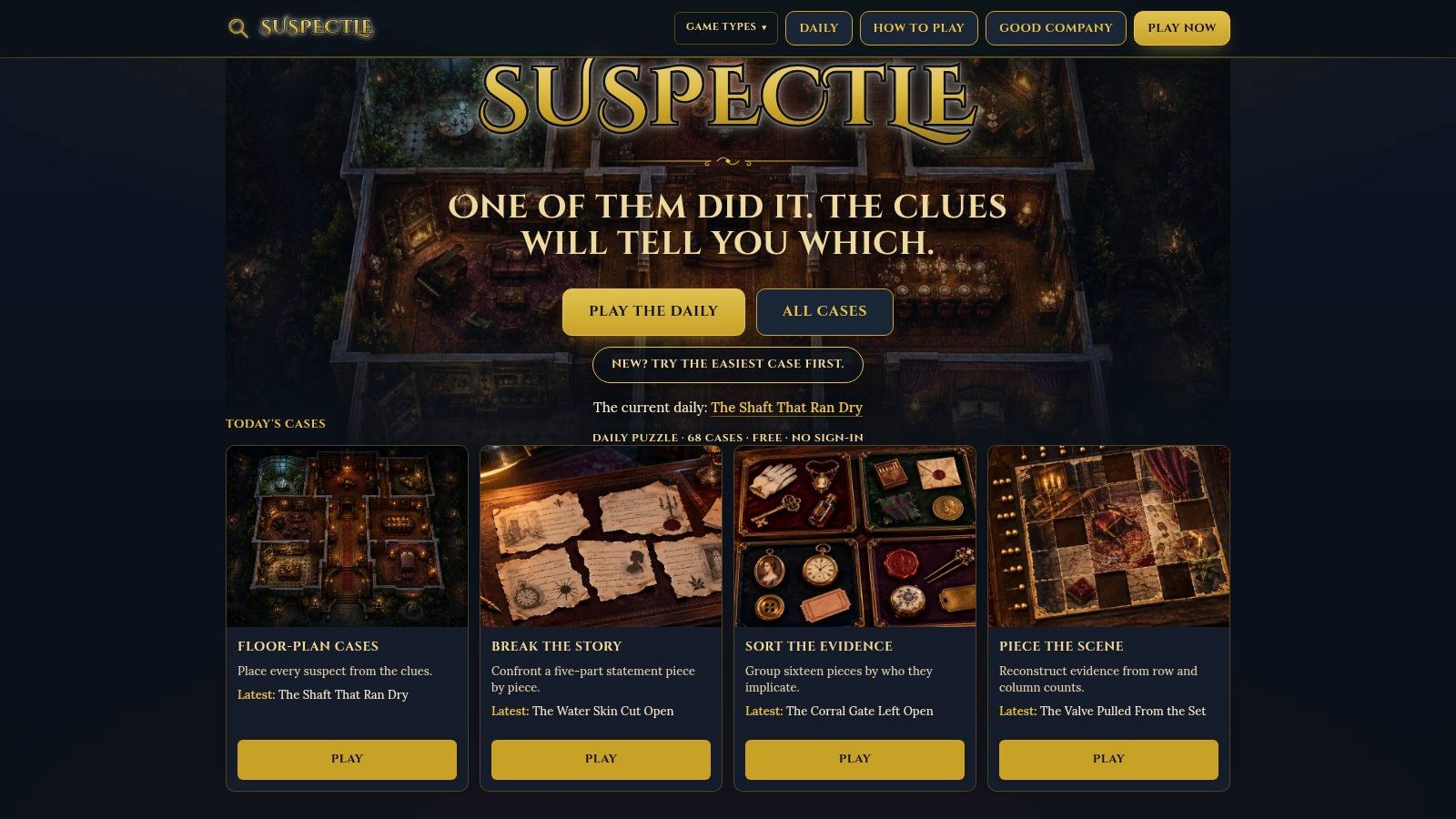
Difficulty labels run from Starter to Case File, so don't start at the top and blame the game. Pick a Starter puzzle from the archive, learn how each format wants you to reason, then move up. The variety is the point, and a format that feels awkward on day one often becomes your favorite by day four.
- Floor plan puzzles: Place people where the clues say they must have been.
- Statement puzzles: Split claims apart and test each piece for truth.
- Evidence sorting: Group what belongs together and spot what doesn't.
- Scene reconstruction: Rebuild the order of events from fragments.
It's free in your browser with no download, paywall, or account, which makes it the lowest friction option on this list. The tradeoff is that play isn't saved to a user profile, and there's no long narrative pulling you through. Some tougher puzzles will also outlast a casual coffee break. Treat it as a daily deduction workout, not a story night, and you'll love it.
5. Ask the Truth
Ask the Truth flips the usual format. There's no scene to search and no pile of documents. Instead, you choose from authored yes or no questions and spend a limited resource called Resolve to ask them. Every question costs you something, so you're constantly deciding what's worth knowing and what you can deduce for free.
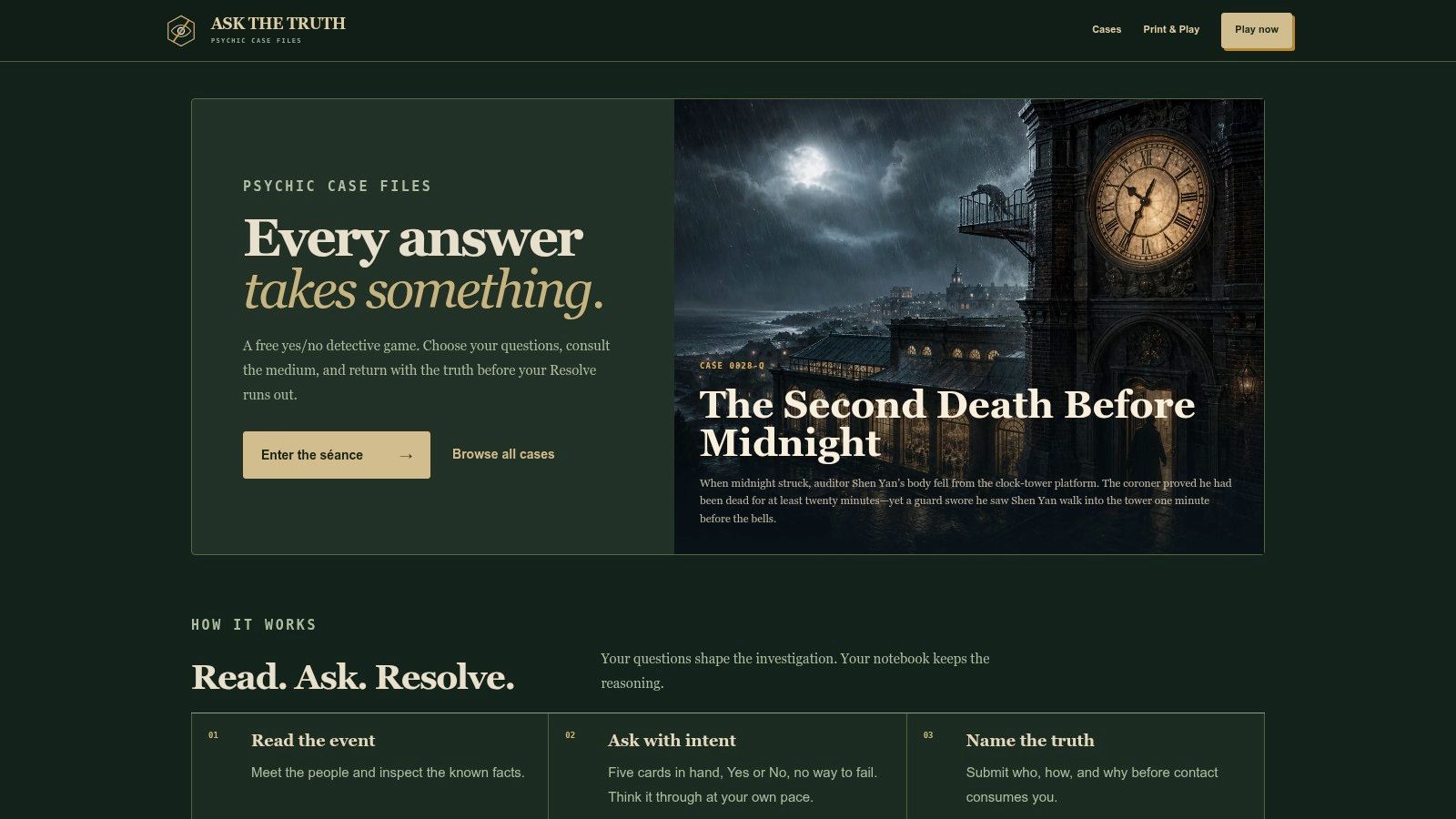
Don't expect an open ended chat. The questions and answers are written in advance, each case has a fixed solution, and that consistency is a strength. The logic doesn't change between playthroughs, and the game can't improvise a clue that breaks its own case. Your notebook is where the actual work happens, tracking what happened, who did it, and why.
Practical rule: Draft your theory before you spend Resolve. Ask only the question that would prove your theory wrong.
That slower, text led pace can suit players who dislike fast clicking, but readable text still matters. In gaming accessibility research covering 500 disabled adults, 81% had struggled to play a favorite game because of inaccessible features and hard-to-read text affected 33%. Check the text comfort early, enlarge your browser view if you need to, and use the notebook instead of holding everything in your head.
Cases resume in the same browser, there's no account or download, and it works on desktop or mobile. It's English only, and the Resolve limit will frustrate players who like to test everything. Choose it when you want deduction by conversation, one careful question at a time.
6. Half Evidence
This is the two player pick, and it isn't close. In Half Evidence, each of you sees different evidence on a separate device. You really can't solve it alone at your own screen. You have to describe what you've got, listen to your partner, and build one shared theory out of two incomplete pictures.
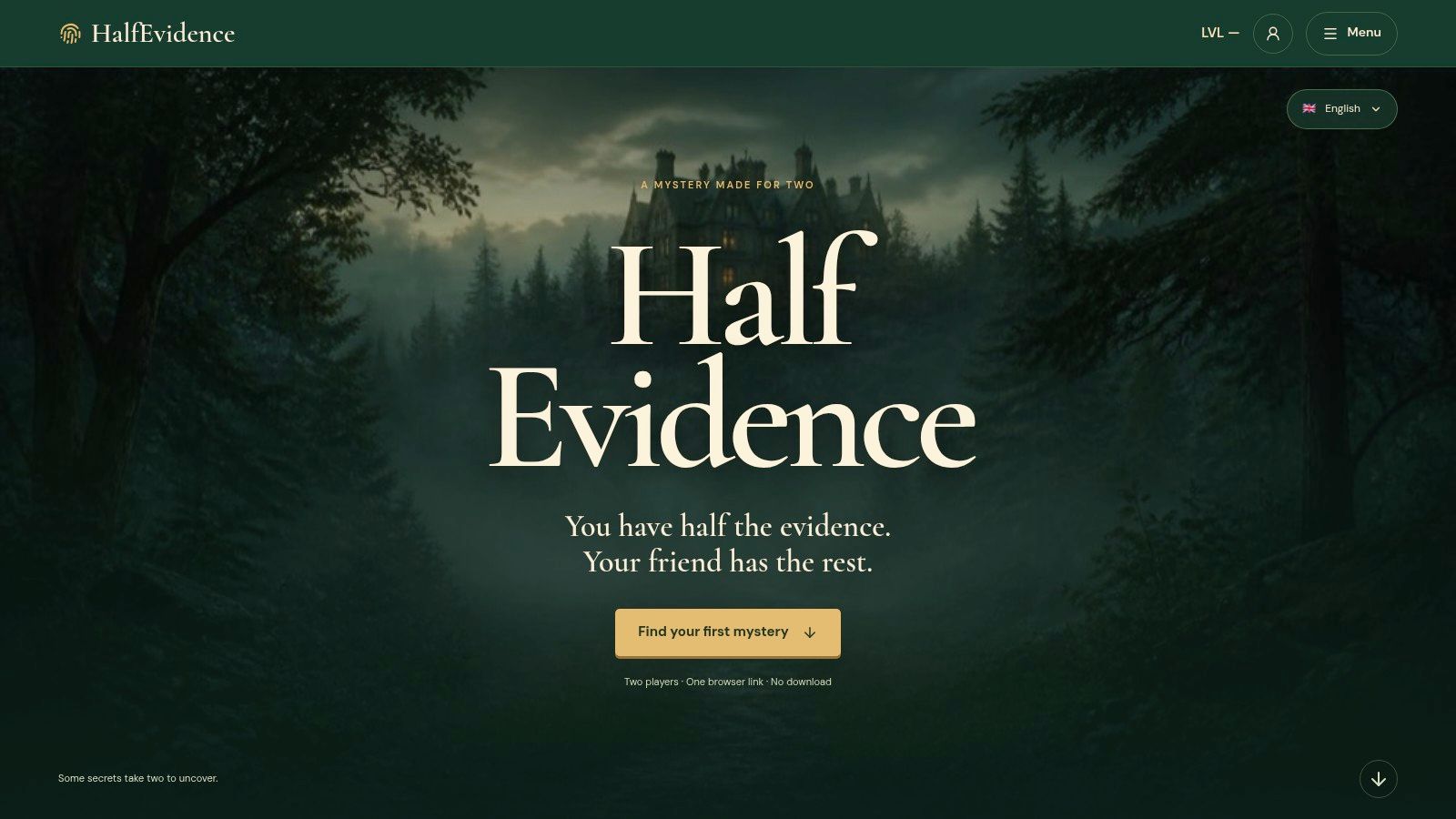
A partner joins with an invitation code, there's no download and no timer, and you can play across the sofa or across the country. Start with the free introductory mystery at about 15 minutes before committing to a longer case. Seven cases are listed, with English and Polish available.
Why Split Evidence Works So Well at Home
Most mystery games at home tend to become one person solving while everyone else watches. Split evidence kills that problem because your partner holds facts you need. That social design matters, since Gallup reporting on video games and wellbeing found 83% of U.S. adult players report regularly playing alone, while only 31% regularly play in person with friends or family, the setting linked with 51% thriving. This format turns a normal call into a cooperative ritual.
Set one ground rule before you start. Nobody accuses until both players can explain the proof out loud. It slows down the confident solver and gives the quieter player a real veto.
Skip it for solo play or a bigger group, since it's designed specifically for two. Longer cases also take considerably more time than a brief puzzle, and the site labels the experience a beta. For couples and long distance friends, though, it's the most genuinely social game here.
7. Small-Town Secrets
Choose Small-Town Secrets when you want a case that unfolds over days, not minutes. You're reviewing police style exhibits, including reports, witness statements, photographs, and logs, then marking the details that don't line up. It feels less like a puzzle snack and more like being handed a folder and told to find the lie.

Two tools do the heavy lifting. The notebook lets you mark evidence and add notes in your own words, which you'll need once names and times start multiplying. The timeline tool connects clues in order and exposes gaps and inconsistencies that are easy to miss when exhibits sit in a pile.
That browser based case file approach sits inside a growing digital tabletop space. According to DataIntelo's digital tabletop platforms report, the global digital-tabletop-platforms market was valued at USD 900 million in 2025. And Deep Market Insights' tabletop gaming report says individual consumers accounted for nearly 68% of global tabletop-gaming demand in 2025, which fits a solo, at home, episodic format like this.
Episode 1 is free, you can start in a browser without a download or account, and the site says new episodes are released weekly. Email sign up is used for new episode notifications, and pricing for further access isn't specified on the homepage. The episodic release also means the full story may not be available when you want to binge it. Play this on a long weekend, keep your timeline tidy, and annotate everything.
How the 7 at-home mystery games compare on time, difficulty, and free access
| Item | Typical Play Time | Difficulty Range | Best For | Free Option |
|---|---|---|---|---|
| Mystery Hunch | 6–9 minutes per case | Easy to medium | Quick, illustrated solo investigations | Free to play |
| Crooked Clue | Longer investigations | Not specified | Solo players or small groups; printable cases | Free starter case, Seat 14 |
| SnackTurn Casebook | Varies by case | Expert to Legendary; four levels | Solo logic-puzzle fans | Free case library |
| Suspectle | Varies by puzzle | Starter to Case File | Daily deduction puzzles and varied formats | Free to play |
| Ask the Truth | Not specified | Not specified | Players who enjoy structured yes-or-no deduction | Free to play |
| Half Evidence | About 15 minutes for the introductory case; longer cases vary | Not specified | Two players collaborating remotely | Free introductory mystery |
| Small-Town Secrets | Longer-form investigation; time not specified | Not specified | Players who enjoy case files and connecting evidence | Episode 1 is free |
Pick Your First Case Tonight and Start Investigating
Don't overthink the first pick. Match the game to the night you have, and you'll finish a case instead of abandoning one halfway through. Ten spare minutes means a short single scene case. A whole solo evening means structured logic or an episodic case file. Two people and two phones means divided evidence.
If you're new to mystery games at home, start free and start short. A free case tells you more in one sitting than any description can, including whether you enjoy searching a scene, reading documents, or grinding through pure logic. You'll also learn your own hint style fast, whether you want a tiny nudge, a full explanation, or no help at all.
For most readers, my direct recommendation is to open Mystery Hunch first tonight. It's free in your browser, cases take roughly 5 to 10 minutes, and you can tap through an illustrated scene, compare clues in the notebook, and make an accusation with proof before your tea goes cold. If you get stuck, a hint costs one star, so you've always got a way forward without quitting.
Then branch out based on what you liked. Logic fans should go straight to SnackTurn Casebook or make Suspectle a daily habit. Groups should print Crooked Clue, couples should book a night with Half Evidence, and case file readers should settle into Small-Town Secrets. Question driven players will get the most from Ask the Truth.
Share your results without spoilers when you're done, especially your star count and whether you needed a hint. That small ritual is how a five minute browser case becomes a household challenge instead of a solitary scroll. And send feedback where a game asks for it, since early prototypes and betas often change based on what players report.
Pick one case, set a timer only if you want the pressure, and write down your first suspect before the evidence talks you out of it. Your next night in can start with a murder and still end on time.
Tonight, skip the download queue and solve a complete illustrated case in your browser, tapping clues, testing suspects' statements in your notebook, and naming the culprit with proof. Cases are free and built for short sessions, with optional hints if you get stuck and up to three stars on the line. Start your first investigation now at Mystery Hunch.