10 Mysterious Puzzle Games to Solve in 2026

It's raining, you've got ten spare minutes, and your phone's already in your hand. A snowed-in hut keeper is dead. Five guests swear they were asleep. One of them's lying, and the proof's hidden somewhere in the room you're looking at.
That's the hook of good mysterious puzzle games. You get a small scene, a handful of clues, and that clean click when two facts finally contradict each other. No grinding. No huge download. Just you, the suspects, and a culprit waiting to be caught.
The ten picks below cover three different moods. Some ask you to poke around illustrated scenes. Some are logic grids where you tick and cross boxes until only one answer survives. Others hand you alibis to read and dare you to spot the lie. Session times run from about five minutes to a few hours, and I've noted pricing, hints, and the weak spots. Pick the style that sounds like you, not the one with the loudest hype. If you want a quick first test, start with a free browser case, finish it in one sitting, and ask yourself one question. Did you enjoy looking, deducing, or reading? That answer tells you where to go next.
Table of Contents
- 1. Mystery Hunch
- 2. Midnight Casebook
- 3. Casebook by No Fuss Games
- 4. PLAY INQUEST
- 5. Ask the Truth
- 6. Suspectle
- 7. Daily Detective
- 8. Deduce
- 9. Cold Case Inc
- 10. Murdoku Online
- How the 10 mysterious puzzle games compare at a glance
- Pick Your First Case and Start Digging
1. Mystery Hunch
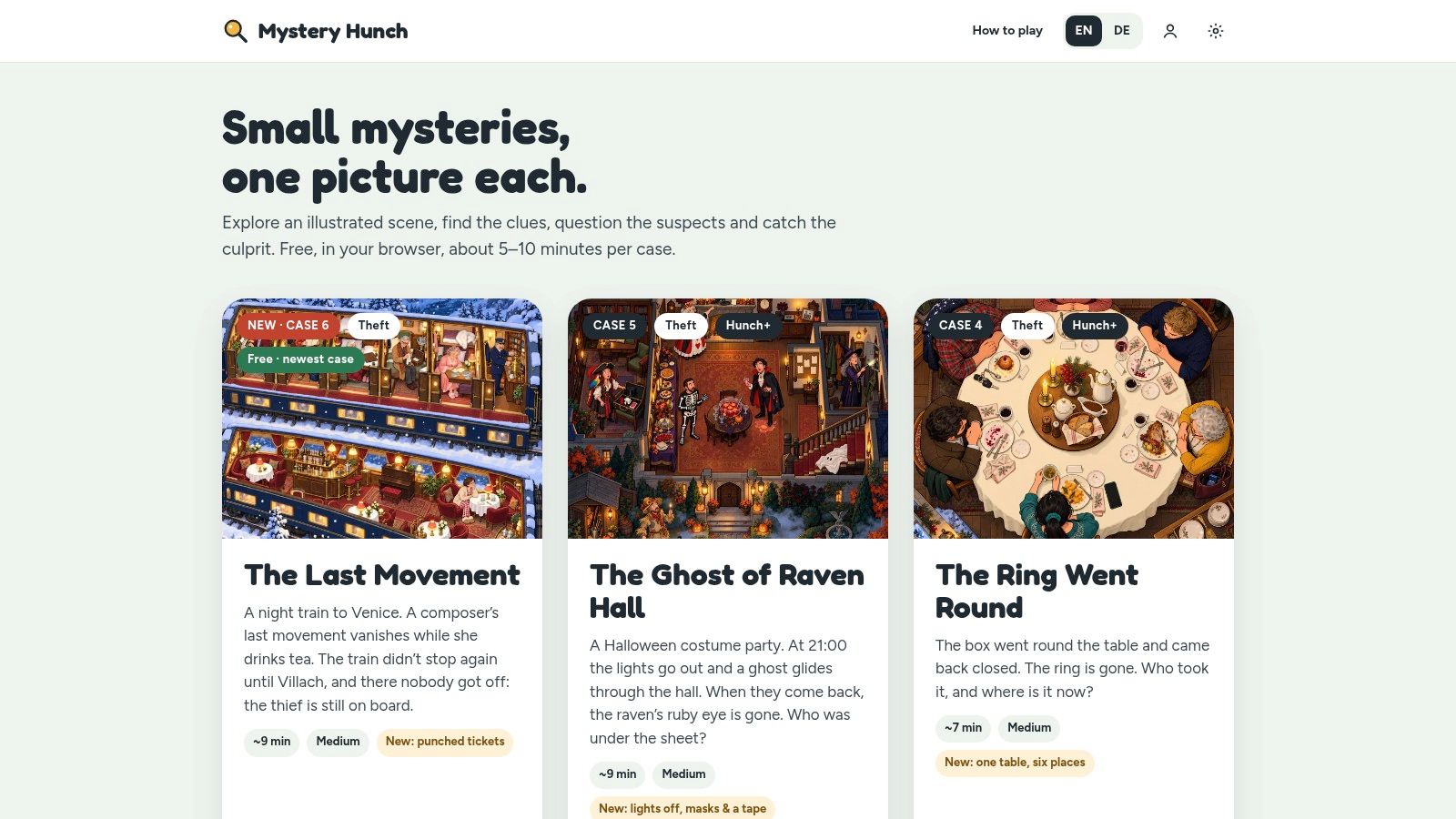
Mystery Hunch is the one I'd hand a curious friend first. It's free to play in your browser, built around compact illustrated scenes. You tap rooms and objects to collect clues, combine evidence in a notebook, check suspects' statements against what you found, then accuse someone with proof. It feels like real searching, far from a quiz with pictures.
What you actually do
The five listed cases run about 6 to 9 minutes each and are labelled easy or medium. Settings jump around nicely, from a Halloween costume party and a dinner table to an apple farm and a lakeside villa. Each one adds a small twist, like a pencil rubbing, a seating plan, a mask, a blackout, or a tape. In The Ring Went Round, a ring vanishes from a box that circled the table and came back closed. That variety matters, because you're using different detective muscles each time.
Stuck? Your partner will nudge you, but each hint costs one star from your three-star score. That's a fair trade. You keep moving, but the perfect run still means something. You can play in English or German, switch between bright and noir visuals, and use phone or desktop layouts.
The honest gaps are clear. It's an openly disclosed early prototype made by one person, so the catalogue is small and cases, features, and scoring can change or disappear at any time. There are no listed reviews or awards yet. On the plus side, the developer reads every feedback message, sharing spoiler-free results is welcome, and every case costs nothing. For a short, self-contained investigation with real evidence work, it's a strong starting point.
2. Midnight Casebook
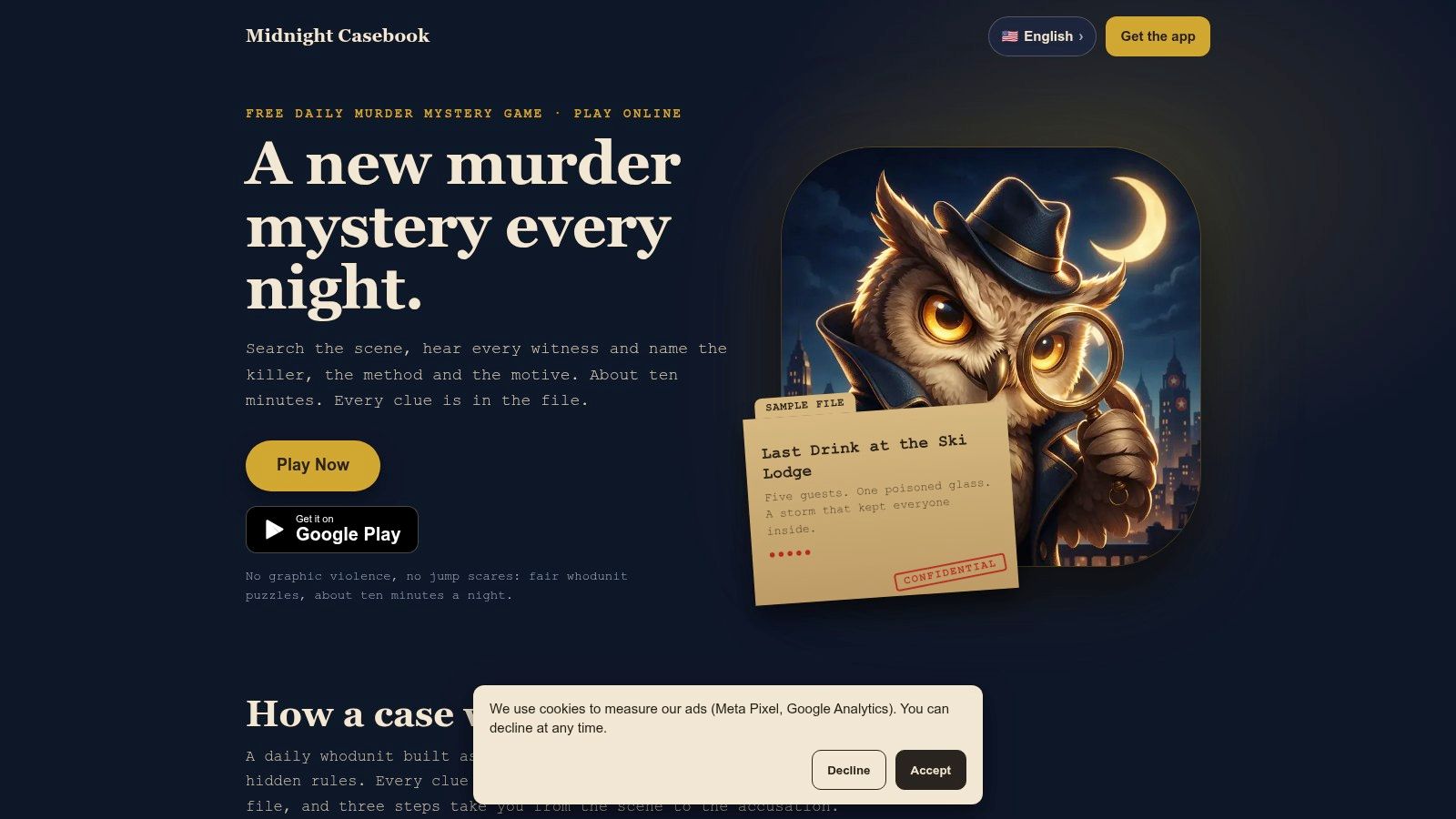
Want story more than spreadsheets? Midnight Casebook builds each whodunit around an illustrated crime scene and voiced witness statements. You search the scene, listen to what the witnesses say, then name who did it, how, and why. Cases take about ten minutes, and a new shared mystery opens each night. That three-part accusation stops lucky guessing, because spotting a suspicious face isn't enough.
It runs in multiple languages, including German, and you can start in a browser with no account or download. If you're torn on style, try this snowed-in hut murder case next to one of its nightly mysteries and see whether voiced statements or quiet scene searching hold your attention better.
The free tier covers the current case and the first three cases. Pro gives you the full archive, all hints, and the longer Sunday Dossier, so check the site's current pricing before subscribing if you only play occasionally. Try the free cases first.
Good fit check: if you replay witness lines in your head after finishing, this one's for you. If you mainly want clean logic, skip ahead.
3. Casebook by No Fuss Games
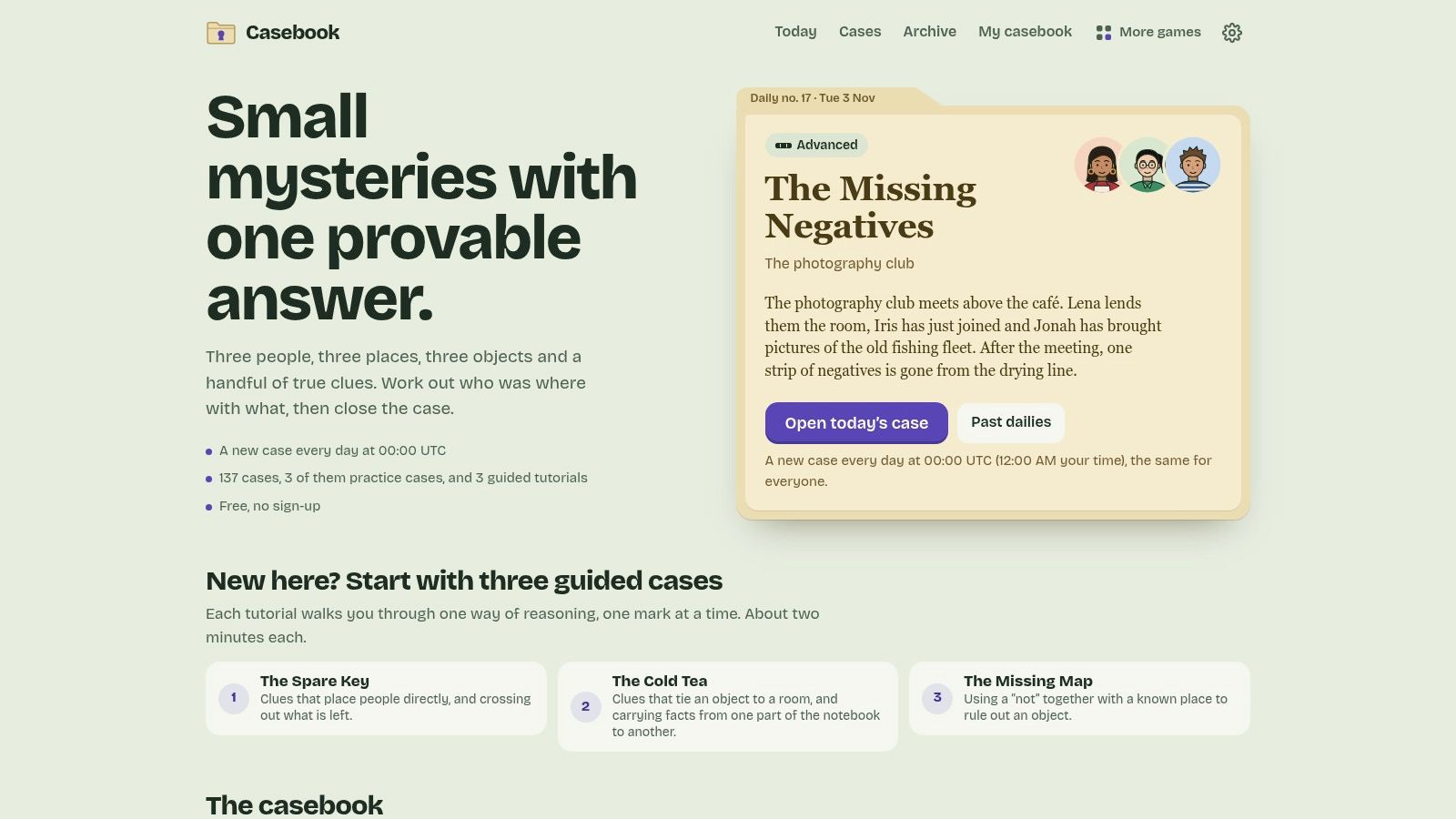
Casebook by No Fuss Games strips away the crime scene artwork. You're in the fictional town of Fernley, matching people with places and objects from written clues, then working out who was involved in an incident. It's deduction first, atmosphere second.
What makes it friendly is the help system. You get a notebook for your deductions, hints that reveal a valid next step instead of dumping the answer, and a worked explanation after each case. Cases are checked for a single solution and reviewed for ambiguous wording, so when you're wrong, it's usually your reasoning, not a trick sentence.
- Format: Daily cases, an archive, and practice cases, all free in a browser with no account.
- Best for: Players who like following a clean chain of logic to the end.
- Watch out: Incidents are nonviolent, not murder cases, and there's no illustrated scene to explore.
I'd recommend it as a training ground. Learn how logic clues behave here, and harder grids later in this list will feel much less intimidating.
4. PLAY INQUEST
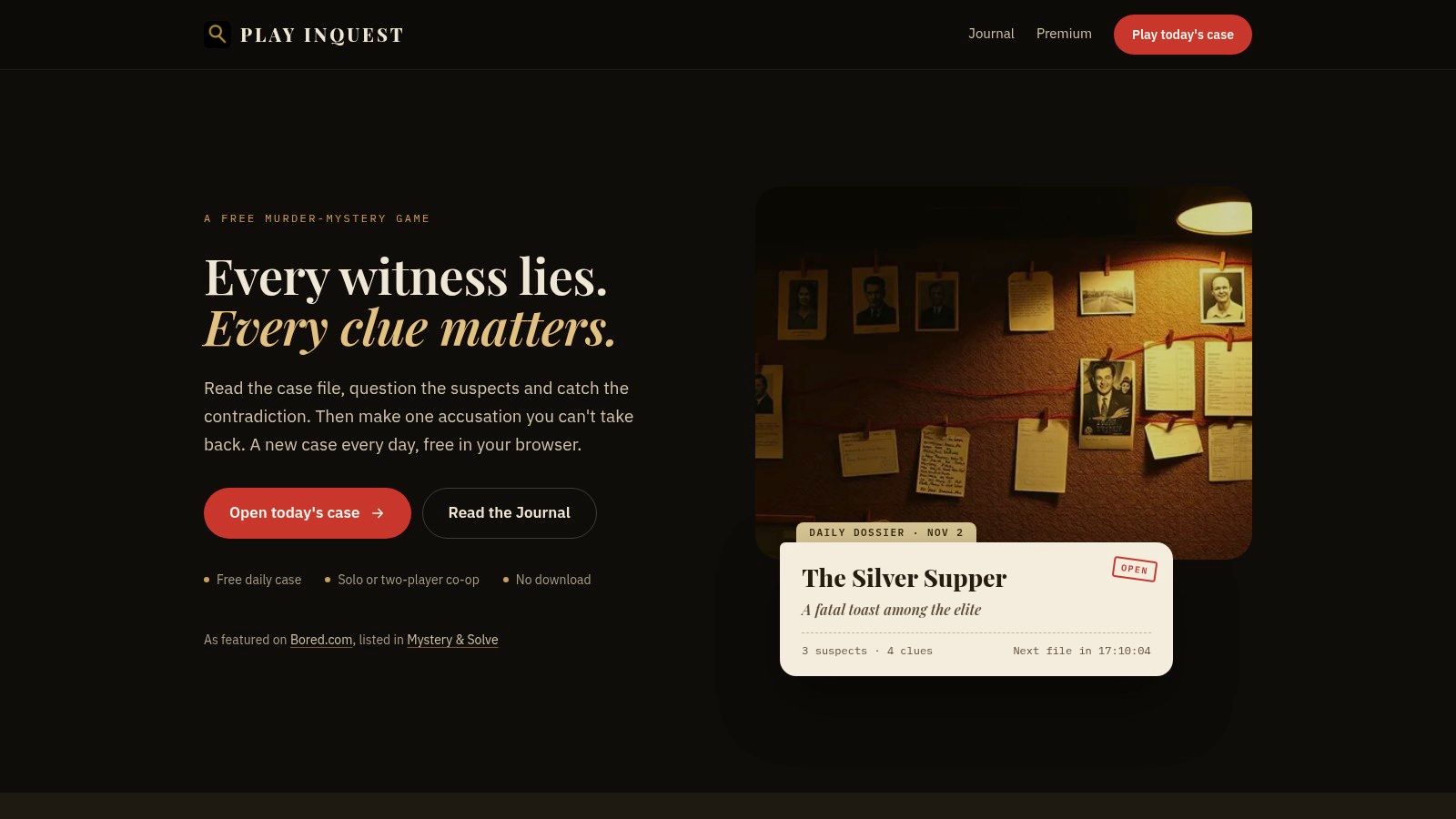
Some nights you don't want to solve alone. PLAY INQUEST presents fictional cases as police dossiers. You read the file, investigate scenes, question suspects, and hunt for contradictions in their alibis before accusing anyone. The standout is two-player cooperative play, so you and a friend can argue over suspects properly.
A new Daily Dossier arrives each day, and play each day, a tutorial, and co-op are free. It runs in a modern browser on desktop, tablet, or mobile. The dossier style suits players who enjoy reading evidence slowly rather than tapping every object in a room.
The trade-off is weight. Cases involve more reading and evidence review than a quick scene puzzle, so this isn't a two-minute distraction. The full casebook and replay features need a subscription or pass. Listed Premium pricing is $3 per month or $24 per year, with a $3.50 30-day pass. That's reasonable if co-op becomes a weekly habit. It's less appealing if you just want one solo case tonight.
5. Ask the Truth
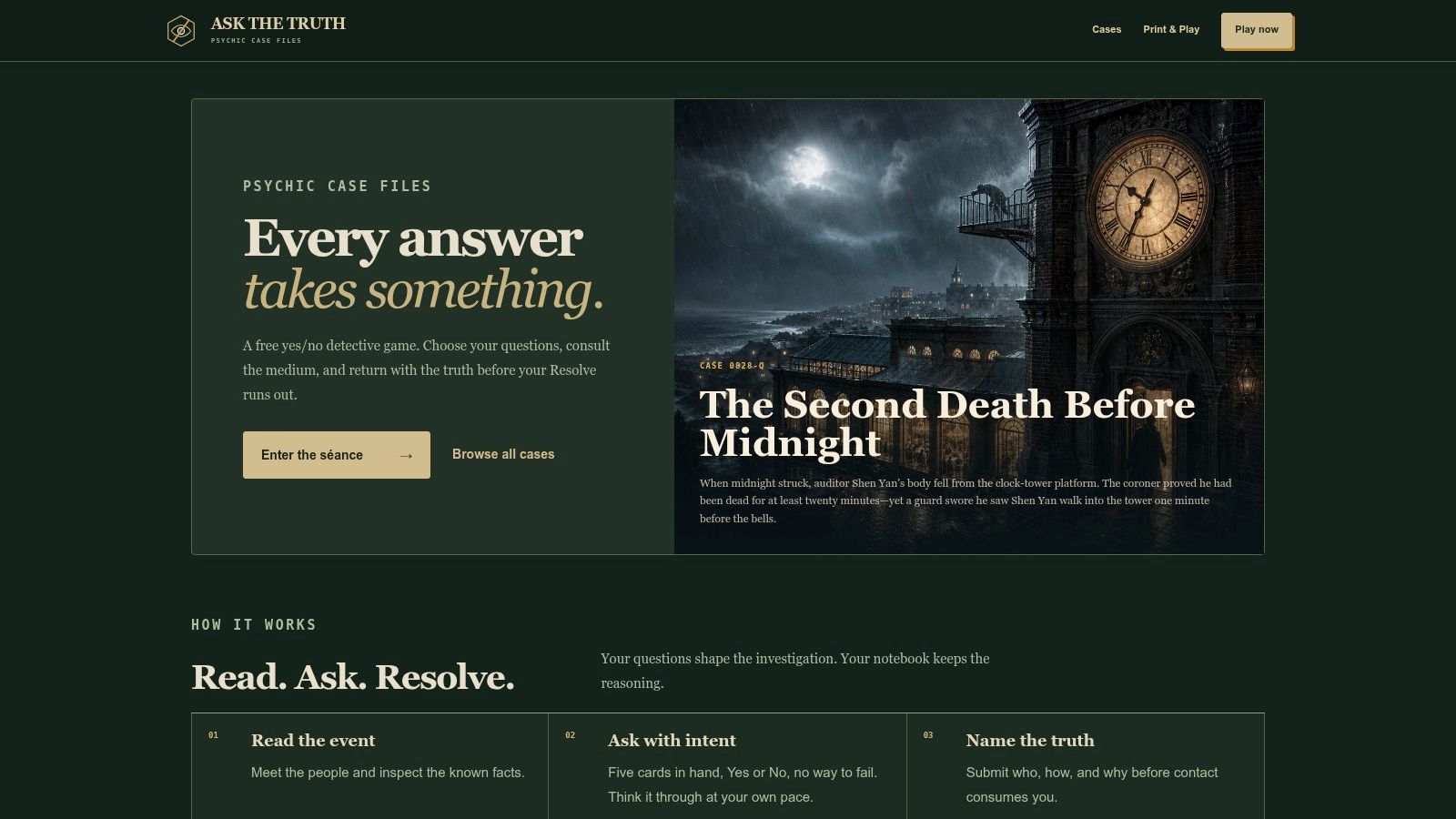
Here's a strange one, in a good way. Ask the Truth frames each investigation as a séance. You pick authored yes-or-no questions, consult a medium, track everything in a notebook, and deduce who was responsible, how it happened, and why.
The catch that makes it work
Every question spends Resolve. You can't just ask everything and sort it out later. Choosing which question is worth the cost becomes the puzzle itself. It rewards planning, and it punishes lazy clicking.
Answers are fixed and authored, not an AI conversation, so the logic stays consistent. Cases resume in the same browser after a refresh, which is handy on mobile. It's free without an account or download. For contrast, a locked-case necklace mystery shows the more relaxed, explore-first approach.
Two downsides. Public play is English only, and the Resolve limit can feel pressuring if you prefer wandering through evidence at your own pace. I like the tension. You might not.
6. Suspectle

If one format bores you, Suspectle gives you four. Its free murder-mystery logic puzzles include floor-plan arrangements, suspect statements, evidence sorting, and scene reconstruction. That mix keeps your brain shifting between spatial reasoning and plain old who-was-where deduction.
There's a daily puzzle plus an archive, with difficulty running from Starter to Case File. No account is required, and there's no paywall waiting at the good part. Cases are designed to be solved through reasoning rather than guessing, which I appreciate. Nothing kills a mystery faster than realising the answer was a coin flip.
- Floor plans: Best when you think in positions and movement.
- Statements: Best when you enjoy catching people in small lies.
- Scene reconstruction: Best when you like rebuilding what happened, step by step.
Be clear about what it isn't. This is primarily a logic-puzzle site, not a narrative detective adventure with characters you'll miss afterwards. Advanced cases can also run longer than a casual coffee break. Start at Starter even if you feel clever.
7. Daily Detective

Five minutes. That's the whole pitch, and Daily Detective delivers it cleanly. You read a police report, review evidence, compare three suspect alibis, reveal clues as needed, find the contradiction, and accuse the killer.
You can reveal up to five clues, so the difficulty adjusts to your patience that day. Feeling sharp? Reveal nothing. Half asleep? Take the help and enjoy the solve anyway. There's a new case daily, recent cases for practice, plus leaderboard and streak features if a little pressure motivates you. It's free in a browser, no sign-up, no download.
A daily case only works if starting it feels effortless. This one does.
The limits are obvious. The structure is simpler than a scene-exploration game, and you're reading alibis rather than collecting and combining objects. Once you've learned the rhythm, cases can feel familiar. But as a tiny daily habit, like a crossword with a body, it's hard to beat. I'd keep it bookmarked for queues and train rides.
8. Deduce
Deduce is for the grid lovers. Each daily murder mystery gives you clues about suspects, rooms, and weapons, and you work the logic grid until killer, location, and weapon are pinned down. No scene tapping. No dialogue trees. Just structured deduction.
Why the ranks help
Five detective ranks raise the difficulty gradually and introduce new clue types as you climb. That progression matters, because jumping straight into a hard grid teaches you nothing except frustration. Cases are checked for a unique, deduction-solvable answer, so you never need to guess. There's also a permanent archive and printable puzzle packs.
It's free and browser-based, with no account required. The archive alone makes it worth bookmarking, since you aren't stuck waiting for tomorrow's case.
Plan your time, though. Cases are estimated at 10 to 20 minutes, longer than most picks here. And if you love examining objects and watching a scene tell its story, a grid won't scratch that itch. I reach for Deduce when I want rigour, not atmosphere.
9. Cold Case Inc
Everything so far fits into a break. Cold Case Inc doesn't, and that's its point. These are standalone fictional case files where you examine witness statements, interviews, and CCTV inside a fictional police system, then work out who committed the crime.
Listed cases take roughly one to four hours. You can play solo or with another person, pause and resume, and print the case materials if spreading paper across a table helps you think. Different stories and difficulty levels let you choose how deep you want to go. It's browser-based, so there's still no download.
The cost is real. Cases are paid individually rather than offered as an all-free collection, with example listed prices of £7.99. That's fair for an evening's entertainment for two, but it's a commitment compared with free dailies. Try a short recipe book theft first if you're unsure whether evidence files hold your attention.
I'd save Cold Case Inc for a planned games night. Bring snacks, bring a second brain, and don't start at midnight.
10. Murdoku Online
Last, the purest puzzle on the list. Murdoku Online mixes murder-themed scenarios with Sudoku-style structure. You get named puzzles, varied grid sizes, and a large collection presented as free to play online.
The appeal is clarity. Rules are rules, the grid either resolves or it doesn't, and every solved cell narrows the next one. If Sudoku already relaxes you, the mystery framing adds just enough flavour to make a familiar habit feel fresh. With plenty of puzzles available, you won't run dry quickly.
- Strength: A clear, structured challenge you can dip into anytime.
- Strength: Multiple grid sizes, so difficulty scales with your mood.
- Weakness: No interviews, no evidence notebook, no scene to explore.
That's the honest line. The mystery lives in the puzzle framing, not in a detective narrative. Judged as a logic game, it's satisfying. Judged as an investigation, it's thin. Know which one you're in the mood for and you'll enjoy it.
How the 10 mysterious puzzle games compare at a glance
The Play Time column shows typical per-case session estimates, so scan it first if the clock is your constraint. Where a site doesn't publish a duration, the table says so rather than guessing. The Best For column names the kind of detective work each game asks of you: reading a scene, filling a logic grid, or weighing alibis.
| Item | Play Time | Price Model | Best For |
|---|---|---|---|
| Mystery Hunch | About 6–9 minutes per case | Free to play in the browser | Quick, hands-on illustrated investigations with varied puzzle mechanics |
| Midnight Casebook | About 10 minutes per case | Current and first three cases free; Pro from $1.99 per week | Short, story-led whodunits with illustrated scenes and voiced witnesses |
| Casebook by No Fuss Games | Not specified; daily and practice cases | Free | Logic-grid deduction with hints and explanations |
| PLAY INQUEST | Not specified; daily cases | Daily play free; Premium from $3 per month, or paid pass | Dossier-style investigations and cooperative play |
| Ask the Truth | Not specified | Free | Question-based deduction with limited inquiries |
| Suspectle | Not specified; advanced cases may take longer | Free | Varied murder-mystery logic puzzles |
| Daily Detective | About 5 minutes per case | Free | A quick daily whodunit focused on alibis |
| Deduce | About 10–20 minutes per case | Free | Structured, progressively challenging logic-grid puzzles |
| Cold Case Inc | About 1–4 hours per case | Paid per case; example price £7.99 | Longer, evidence-heavy investigations for solo or two-player sessions |
| Murdoku Online | Not specified | Free to play online | Sudoku fans who enjoy mystery-themed logic puzzles |
Pick Your First Case and Start Digging
Start with how you like to think. If you enjoy poking around a room and noticing what's out of place, choose scene-based clue hunting like Mystery Hunch or Midnight Casebook. If you want every fact to lock into place with no ambiguity, go for logic grids like Deduce, Casebook, or Murdoku. If you've only got a few minutes, daily whodunits like Daily Detective respect your time.
This style of play isn't new, and that history explains why it still works. During the golden age of text adventures, approximately two-thirds of the roughly 1,000 adventure games published combined graphics with text, according to the Inform design manual. Looking at a picture, reading what's said about it, and reasoning about the gap between the two is a durable pleasure. Browser mysteries are just the latest, faster version of it.
Commercial appetite for this kind of play is long proven too. In June 2001, Myst III Exile sold 49,287 units in that month in North American PC Data figures reported by Just Adventure's state of adventure gaming report. Observation and puzzles carried a mainstream release then. They still carry a ten-minute browser case now.
Short sessions also fit how people play. Newzoo's Global Games Market Report puts mobile at approximately 3.0 billion players, the largest audience of any platform. A case you can finish on your phone, in a browser, with no install, meets players where they already are. Microsoft's 2025 player research likewise found 86% of players game on mobile weekly, per Microsoft Advertising's player spectrum post. Short doesn't mean shallow. It means the mystery has to earn its minutes.
One more thing worth checking before you settle in. Can you read the clues comfortably? In the 2025 ESA accessibility survey, 50% of players with disabilities requested adjustable text size, according to the ESA's annual study announcement. Small visual clues, color-coded objects, and cramped tap targets can block you even when you've solved the mystery in your head. Look for clear text, good contrast, and hints that help without shaming you.
So try two cases from different categories this week. Notice which mechanic kept you thinking afterwards. That's your genre. Mystery Hunch is free to play in the browser, and its creator reads every piece of feedback, so if a case confuses you, say so. You'll probably shape the next one.
Ready for your first solve? Mystery Hunch gives you free illustrated detective puzzles you can finish in about five to ten minutes, right in your browser, with clues to combine, statements to test, and a culprit to accuse with proof. Pick a case, protect your three stars if you can, and tell the creator what worked and what didn't.