Murder Mystery Game Free to Play in Your Browser

You've got ten minutes on the couch, your phone in hand, and no patience for a download, a sign-up form, or a two-hour commitment. You just want a murder mystery game free to try right now, solve before your tea goes cold, and finish. That's a reasonable ask. The tricky part isn't finding something labeled free. It's picking a format that fits your evening, your device, and how you play.
Table of Contents
- Free Murder Mystery Games Compared by Format
- How a Browser Murder Mystery Case Works
- Using Hints Without Losing the Case
- Cases to Try First and How Long They Take
- Playing Without Sound or a Mouse
- Finishing a Case During a Short Break
- Start Your First Free Case Today
Free Murder Mystery Games Compared by Format
If you want to solve something tonight, start by choosing the format, not the title. These three options ask for very different amounts of time, people, and setup.
Free Murder Mystery Formats at a Glance
| Format | Players | Typical length | Cost | Best for |
|---|---|---|---|---|
| Browser-based solo case | 1 player | 5-10 minutes | Free | Quick play on a phone or laptop |
| Printable dinner-party kit | 5-8 players | 2-3 hours | Free for the kit | Group nights with costumes |
| Live-streamed hosted game | Host and viewers | 1-2 hours | Free to watch | Watching a host solve the case |
A browser solo case is the fastest test. You open a tab, inspect a scene, question suspects, and make your accusation. Nobody else needs to show up, and you don't need to print character sheets or learn hosting rules first.
A printable dinner-party kit is a social event. You hand out roles, people stay in character, and the fun comes from friends accusing each other across the table. It's a better pick when you've got a group and a whole evening, not a quick break.
A live-streamed hosted game suits viewers who enjoy watching. The host keeps the story moving, chat throws out theories, and you can guess along without carrying the investigation yourself. Watching is free, though hosting your own stream can bring platform, prop, or costume costs.
Simple verdict: Ten minutes alone means browser. Six friends and dinner means printable. Lean back and watch means stream.
Before you commit, ask yourself three quick questions.
- How many players? Solo play points to a browser case, while a full table points to a kit.
- How much time? Minutes suit a solo case, while an evening suits a party or stream.
- Solve or watch? Pick browser or printable if you want control, and a stream if you'd rather follow along.
The rest of this guide focuses on solo browser cases. They're the quickest way to learn whether you enjoy deduction before you organize a party, buy props, or sit through a long stream. You get a complete crime, evidence, suspects, and a payoff in one short sitting.
How a Browser Murder Mystery Case Works
Think of yourself as a detective walking through a house with a notebook. You look closely, write down what matters, check who said what, and only then name the culprit. That loop is the whole game.
The visual below maps the five moves you'll repeat.
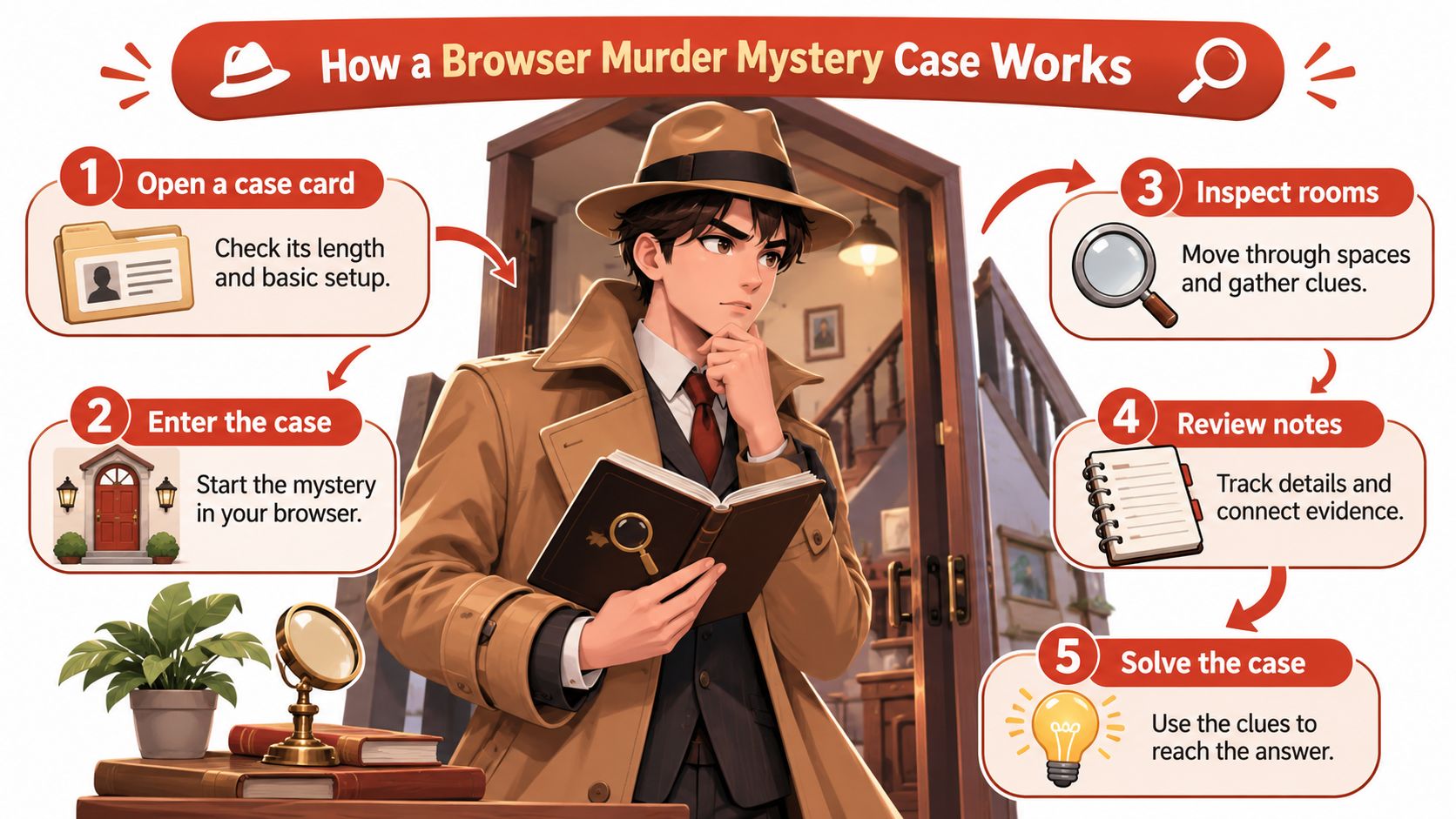
The Five-Step Loop
- Open a case card. Check its length and difficulty before you start.
- Tap rooms and objects. Work through the illustrated scene and collect clues.
- Use the notebook. Store evidence and combine items when a case asks you to.
- Question each suspect. Compare every statement against what you've found.
- Accuse with proof. A supported accusation can earn up to three stars.
That last step matters more than new players expect. A lucky guess isn't the same as a conclusion your notebook supports. If you say, "She did it because she seems shifty," you've got a hunch. If you can point to an object, a timeline clash, and a statement that doesn't fit, you've got a case.
On Mystery Hunch, each mystery centres on one illustrated scene rather than separate environments. Observation of objects, spatial relationships, and statements forms the basis of the investigation. You're not wandering a huge map. You're learning to read one place well.
Cases vary inside that structure. You might use a pencil rubbing, study a seating arrangement, sort out masks, work through a blackout, or listen for what a tape proves. Learn the basic loop on an easier case first, then those twists feel like fresh clues, not new rules.
This short walkthrough shows the rhythm of inspecting, noting, and accusing.
A solved case looks tidy in hindsight. Each suspect's statement either fits the evidence or breaks against it. Try that loop in Grandma Hilde's Recipe Book and you'll see the chain form. One clue explains where someone was, another explains what they touched, and together they leave only one person who could've done it.
Don't accuse when you have a favorite suspect. Accuse when the other explanations stop fitting.
Using Hints Without Losing the Case
Getting stuck doesn't mean you've failed. It usually means one clue hasn't connected yet. Your in-game partner can give a hint, but it costs one star, so treat it like buying speed, not buying the answer.
The scene below shows the partner setup you'll use when you need that nudge.
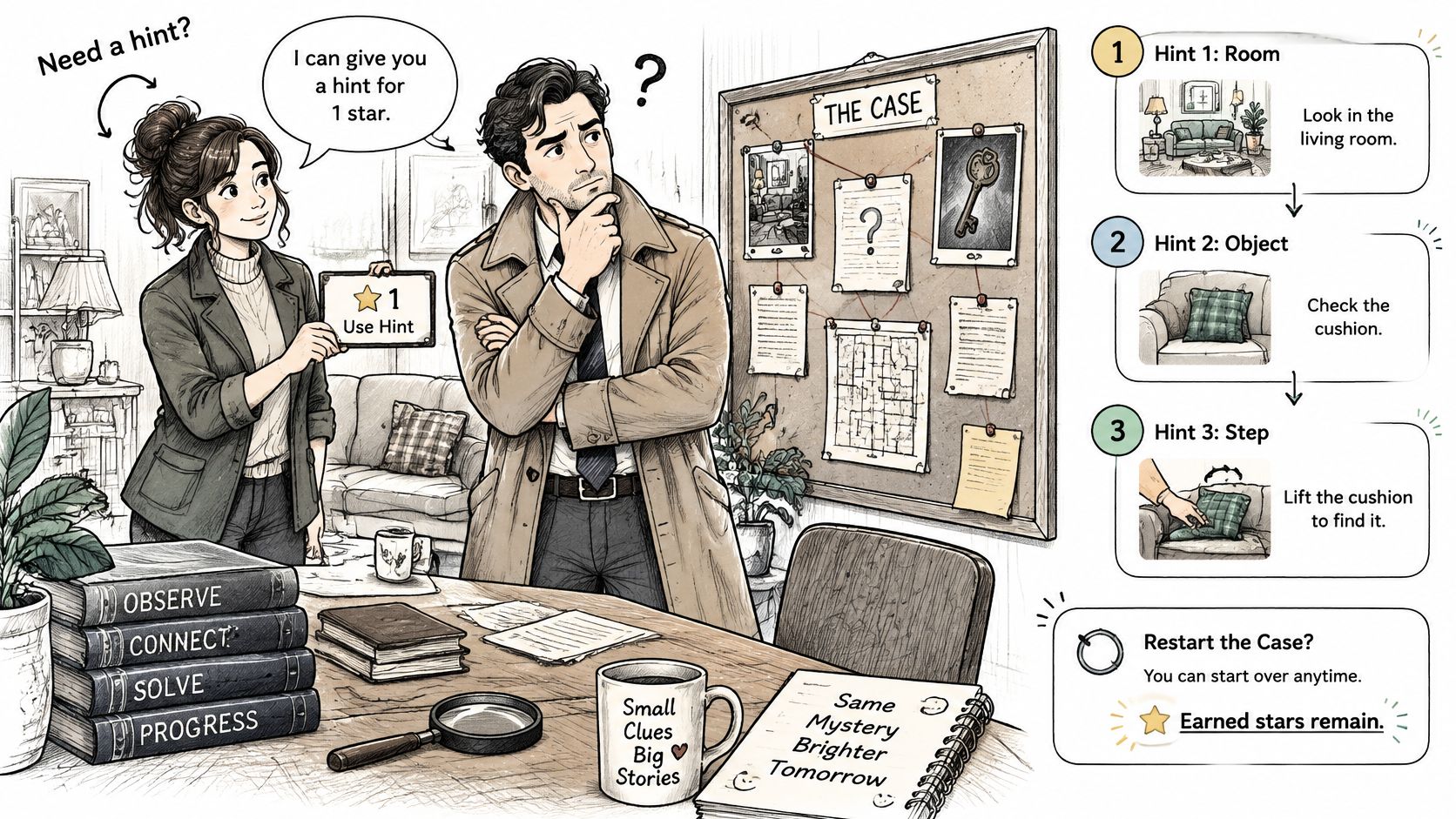
A hint has the most value when it confirms a direction you were already testing. Take one too early and it answers a question you hadn't finished asking. Cases run about 5–10 minutes, so one stalled minute is a real chunk of your play time. The goal is spending that minute on your own checks first.
Do These Four Checks First
- Re-read the suspect statements. Look for one detail you skimmed, like a time, place, or object.
- Check the notebook for contradictions. Pair clues that can't both be true and ask which person benefits.
- Sweep untouched spots. Tap rooms and objects you haven't inspected yet, especially small items near doors, tables, and containers.
- Take a hint last. Use it only after those checks, then continue on your own from the new lead.
There's a reason for waiting. The Springer chapter on scaffolding in game-based learning reports that premature or excessive hints can interrupt exploration, while autonomy-preserving guidance led to greater progress with fewer interventions. In plain terms, hints taken too early can train you to stop searching.
When you do take a hint, treat it as a lead rather than a verdict. Read it once, then put it into your own words before you act on it. If you can say what you're about to check and why, the hint did its job without doing the thinking for you.
If you want the full challenge, finish your first run without hints and accept a slower solve. If you're learning the system, one hint is a fair trade. And a restart costs nothing but a few minutes, so a messy first attempt is never wasted.
Cases to Try First and How Long They Take
Start with the case that teaches the rules gently, not the one with the scariest title. This table gives you the current lineup by crime, estimated length, and difficulty.
Mystery Hunch Cases by Crime Length and Difficulty
| Case | Crime | Estimated length | Difficulty |
|---|---|---|---|
| The Hut on the Grauhorn | Murder | About 6 minutes | Medium |
| The Countess's Necklace | Theft | About 8 minutes | Medium |
| Grandma Hilde's Recipe Book | Theft | About 7 minutes | Easy |
| The Ring Went Round | Theft | About 7 minutes | Medium |
| Theft (Halloween costume party) | Theft | About 9 minutes | Medium |
Play Grandma Hilde's Recipe Book first. It's the only Easy case in the list, at about seven minutes, so you can learn tapping, notebook use, and suspect checking without a tough deduction on top. A wet pantry door and a missing recipe book give you concrete details to track.
Move next to The Hut on the Grauhorn. It's a Medium murder at about six minutes, with a snowed-in hut keeper dead and five guests saying they were asleep. That setup teaches a different skill. The timeline and alibis do the work, so you compare who claims what and look for the story that can't hold.
The thefts each reward a different habit. In The Countess's Necklace, a necklace is missing from a locked case, so containers and access matter. In The Ring Went Round, a ring disappears from a box that went around a table and came back closed, so you track where the object traveled and who handled it.
Rule of thumb: Choose by the time you have first, then by difficulty. The Medium cases run about six to nine minutes, and the challenge sits in the reasoning, not the length.
Treat every time on a case card as an estimate. Your first attempts will run longer while you learn where to tap and how to read statements. Hints stretch the clock too. That's normal. A nine-minute card doesn't mean you're slow at twelve minutes. It means you're still building the detective routine.
Playing Without Sound or a Mouse
Price and platform are the two details free game pages always list. Whether a case works on mute, by keyboard, or with enlarged text almost never makes the page. The fix is a five-minute test, run before you count on a case for your break.
This matters for a lot of players. The 2025 SciTePress review on game accessibility estimates about 400 million gamers live with disabilities. Good information is scarce, so your own five-minute check counts.
A Four-Step Test You Can Run Today
- Turn sound off. Play muted and note whether spoken dialogue, sound-based clues, or alerts lose their meaning without captions or text.
- Use only Tab and Enter. Move through the scene by keyboard and check whether every clue, suspect, and accusation control stays reachable.
- Enlarge text in your browser. Zoom in and see whether labels stay readable, contrast stays clear, and buttons don't vanish off screen.
- Finish one case and log gaps. Write down any clue you couldn't reach, read, or tell apart from an undiscovered one.
The test works like a fire drill. It feels pointless when nothing is wrong, and it's the only reason you catch a problem before it costs you a case.
While you test, watch three details. Check whether color alone marks discovered clues, whether a screen reader announces new evidence, and whether motion effects distract or block you. Small text, low contrast, and mouse-only hotspots are the usual culprits.
A failed step is a result, not a dead end. Pick a different case that fits your setup, or report the problem through the site's feedback channel. Name the case, your device, and the exact clue you couldn't reach. On a small prototype like Mystery Hunch, that kind of report lands well. The game is an early build that changes as feedback comes in, and one person reads every message sent.
Finishing a Case During a Short Break
A card that says five to ten minutes doesn't guarantee a case fits your break. That's the part most listings skip. Your real time depends on interruptions, hints, and whether the game survives the messy way people use phones.
Demand for this kind of play is real. Meta's 2025 survey of approximately 8,000 U.S. respondents identified a price-sensitive segment that seeks free-to-play experiences and reported that this group tends to have the shortest sessions. Short doesn't help, though, if a reload wipes your notebook.
Check These Before Your Break Starts
- Keep one tab open. Confirm the case runs in the browser tab you plan to leave alone.
- Avoid refreshing mid-case. Reload once on purpose during a practice run and note whether progress survives.
- Rotate or resize your phone. Test the layout before you're deep in evidence.
- Leave and return. Switch apps for a minute and check whether your clues and suspect notes are still there.
If someone interrupts you, don't trust your memory. Write the two or three key clues on paper, list which suspects you've questioned, and note your current suspect. Thirty seconds of notes saves a full restart later.
Then time one quiet first run from opening tap to final accusation. That number, not the card estimate, is your real answer. If a six-minute case took you eleven, plan eleven next time.
A case fits a break only when you can pause it, leave it, and come back without losing your place.
Start Your First Free Case Today
Keep your first session simple. Open Mystery Hunch in your browser, where our cases are free to play, and start with Grandma Hilde's Recipe Book, the Easy theft at about seven minutes. Learn the notebook, tap everything, and accuse only when the proof lines up.
Once that routine feels natural, try The Hut on the Grauhorn, the Medium murder at about six minutes where a snowed-in hut keeper is dead and five guests say they were asleep. You'll feel the step up right away because alibis matter more than objects.
Run your sound, keyboard, text-size, and reload checks before you play for real. Each case takes about 5-10 minutes, though hints and a first-run learning curve can stretch that. One honest limit to keep in mind is that we're still an early prototype, so cases and scoring may change. Treat star totals as current, not permanent.
If a case breaks or a clue feels unfair, use the feedback channel on our site. Report the case name and the step where it went wrong. We read every message, and specific reports help us fix the right thing. So, which case will you solve tonight?
Pick up a free illustrated case at Mystery Hunch, inspect the scene, question the suspects, and make your accusation with proof in about five to ten minutes. Start with the Easy recipe book theft tonight, earn your first stars, and tell us which clue fooled you longest.