7 Classic Murder Mystery Cases That Teach You to Solve
What makes a murder mystery case actually solvable, rather than merely surprising? A memorable culprit reveal isn't enough. You need evidence you could have noticed, statements you could have tested, and a way to distinguish a clever explanation from the explanation that fits.
The best murder mystery cases let you practise different kinds of deduction. A snowbound train tests testimony. A sealed bedroom tests spatial reasoning. A missing object tests whether you understand what should have been present.
These classics work as training grounds, not just entertainment. The difficulty judgments below concern practising their central mechanic in a short session, not finishing an entire novel or film. There are no culprit reveals, and you won't need to memorise publication dates or adaptation trivia. Bring a notebook and a willingness to abandon your favourite theory.
Table of Contents
- 1. Murder on the Orient Express
- 2. And Then There Were None
- 3. The Adventure of the Speckled Band
- 4. The Mystery of the Yellow Room
- 5. The Roman Hat Mystery
- 6. Knives Out
- 7. Cluedo (Clue)
- The Seven Cases at a Glance
- From Reading Clues to Catching a Culprit Yourself
1. Murder on the Orient Express
Best for closed-circle deduction. Short-session difficulty feels demanding because the statements overlap.
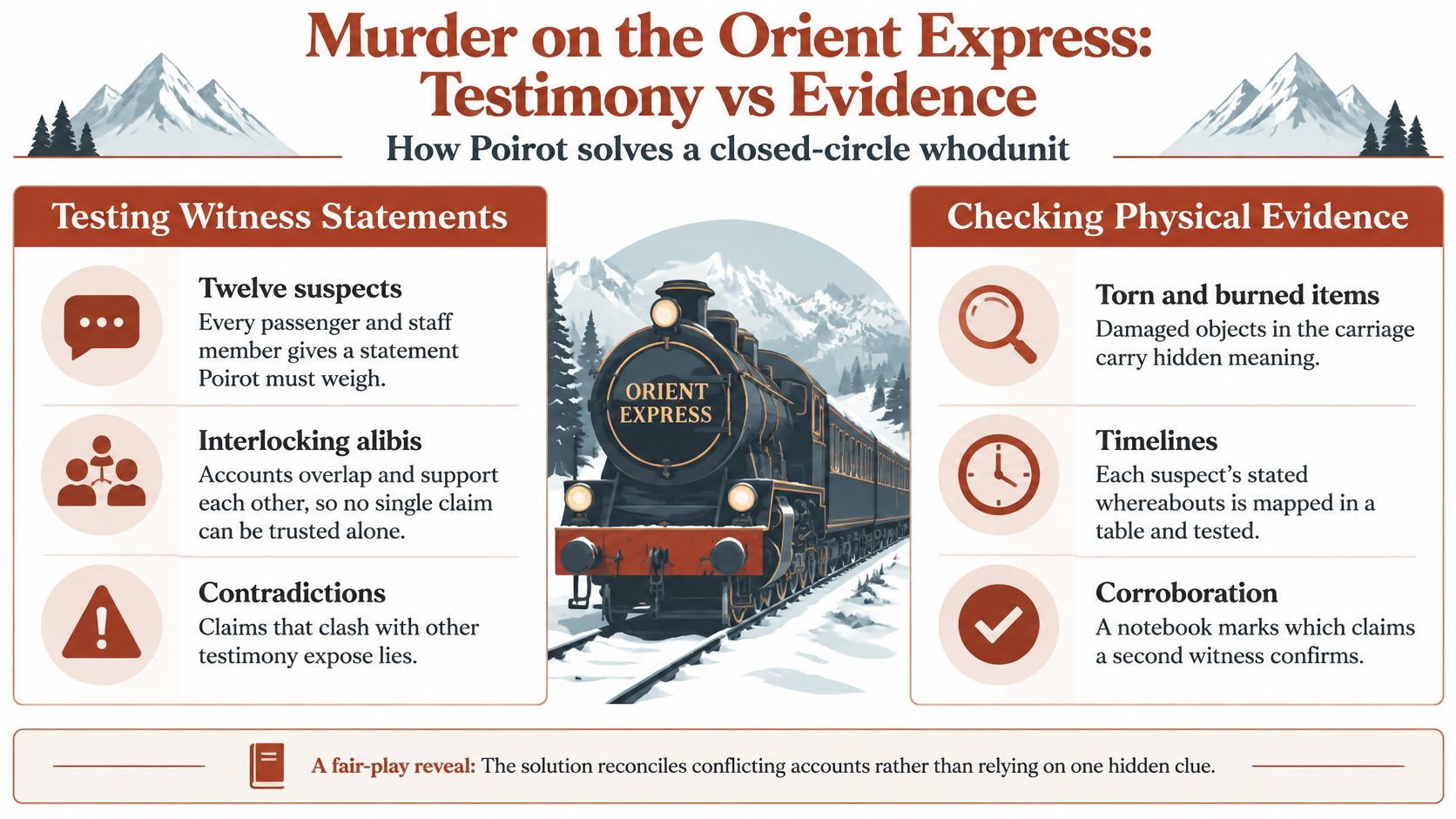
A passenger is found dead aboard a snowbound train, and Hercule Poirot must reconcile the accounts of the people travelling with him. The confined setting makes the suspect pool manageable, but it doesn't make the testimony trustworthy.
The useful lesson isn't that someone must be lying. It's that agreement between witnesses isn't necessarily independent confirmation. Before treating an alibi as established, ask how each person knows what they're claiming.
Separate claims from observations
Divide your notes into claimed whereabouts, supporting evidence, and unresolved conflict. A passenger saying they heard someone in the corridor establishes a reported sound, not necessarily the identity of whoever made it.
For a practice scenario, suppose a guest says they stayed in bed, while another reports hearing their voice outside. Don't immediately choose which witness to believe. Check whether either person saw the speaker, whether the timing is reliable, and whether a physical clue contradicts the account.
Practical rule: An alibi is only as strong as the evidence supporting it, not the confidence of the person delivering it.
For a compact application, use the snowbound closed-circle practice case to organise statements before choosing a suspect. The transferable habit is tracking dependencies: if an alibi rests entirely on another unverified account, keep it provisional.
2. And Then There Were None
Best for elimination under uncertainty. Short-session difficulty feels high when your suspect list keeps changing.
An isolated island, a confined group, and deaths patterned around a nursery rhyme create an unusually uncomfortable deduction problem. You don't just assess who had an opportunity. You must reconsider which assumptions about the situation remain safe.
The trap is letting the pattern substitute for evidence. Recognising how a death resembles a verse can help organise observations, but it doesn't establish who acted or how.

Keep elimination reversible
Use different marks for excluded, unlikely, and not yet checked. Crossing someone out permanently because they appeared frightened or lacked an obvious motive turns an impression into a false constraint.
- Presence: Record who was observed near the scene, rather than who was assumed to be nearby.
- Access: Distinguish being absent when a death was discovered from being unable to prepare it.
- Hidden information: Keep a character's admitted secret separate from accusations made by others.
Say a playable scene contains a disturbed ornament beside a body. Its resemblance to the story's recurring pattern may seem decisive, but your next question should concern access: who could have moved it, and when?
This mechanic transfers well to browser puzzles with changing statements. Update your suspect list when evidence changes, rather than defending your earliest choice. The trade-off is slower progress at first, but far less backtracking after a confident mistake.
3. The Adventure of the Speckled Band
Best for spatial observation. Short-session difficulty feels moderate until you have to explain how the objects work together.
Sherlock Holmes investigates a disturbing death associated with a bedroom, an unexplained sound, and an ambiguous dying clue. The strongest exercise isn't guessing what the title means. It's noticing how the room's fittings relate to one another.
A locked-room setup encourages you to hunt for a concealed entrance. That can be useful, but it's also a distraction when you haven't examined the ordinary-looking features already in view.
Draw function, not decoration
Sketch the bed, doors, windows, and unusual fittings. Beside each object, write its apparent purpose, then ask whether its placement makes sense for that purpose.
In a practice puzzle, suppose a cord hangs beside a bed but doesn't operate anything obvious. Don't label it the murder weapon immediately. Check where it leads, whether it can move, and what other object it connects to.
An unexplained object is a question to investigate, not permission to invent a mechanism.
A screen version can make this exercise especially useful: pause before the explanation and describe the room from memory.
For a related spatial exercise, try the locked-display theft puzzle. It's a theft rather than a murder, but testing access and object relationships uses the same reasoning.
The limitation matters: fictional ingenuity isn't scientific validation. Learn the observation method without assuming every dramatic mechanism would work outside the story.
4. The Mystery of the Yellow Room
Best for testing impossible-crime assumptions. Short-session difficulty feels demanding because timing matters as much as architecture.
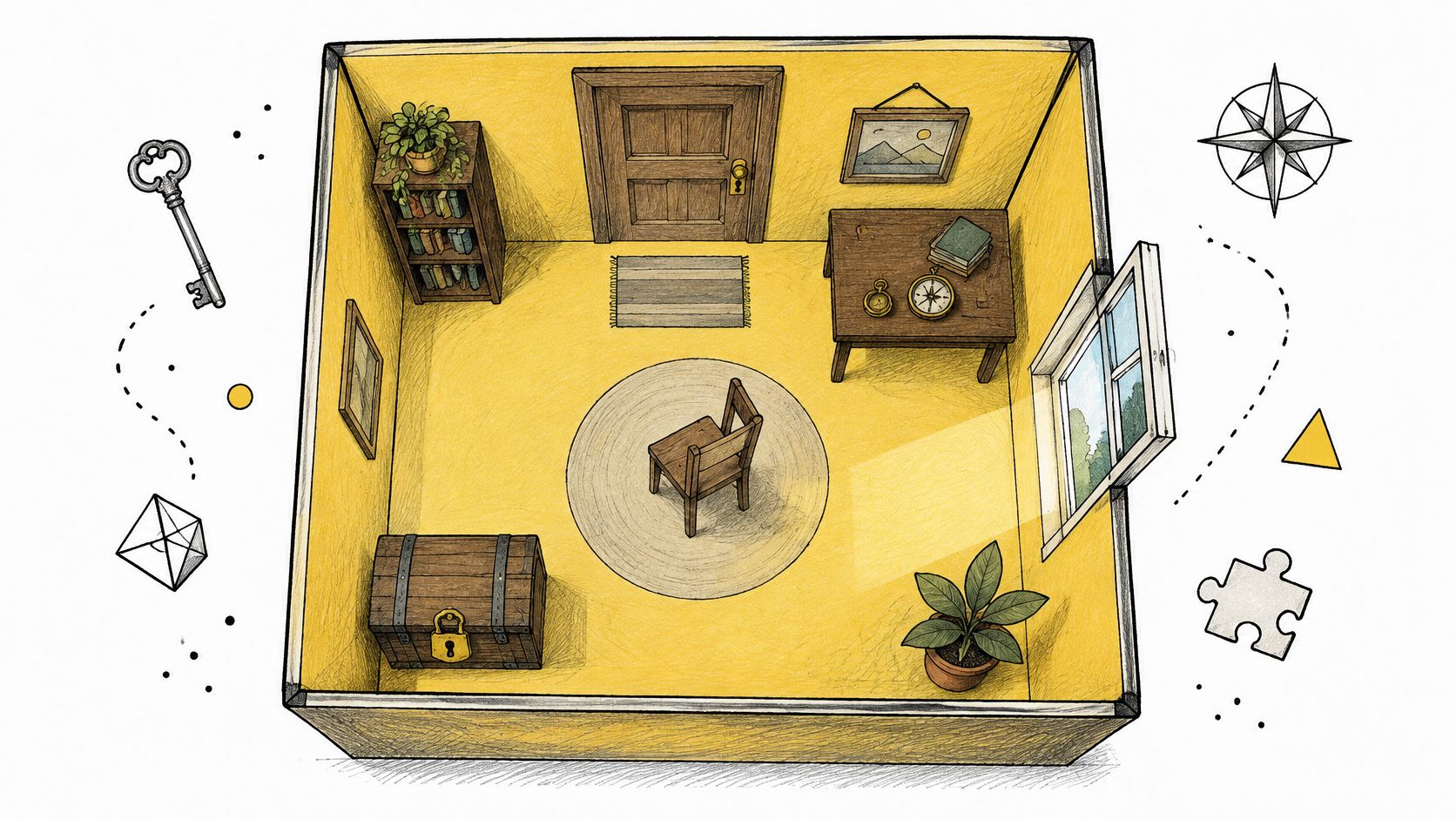
Gaston Leroux's mystery centres on an attack inside an apparently sealed room. Joseph Rouletabille's investigation makes a useful distinction: what witnesses believe happened isn't automatically identical to what the scene establishes.
Unlike a simple search for an overlooked opening, this is an exercise in examining the entire account. A room can be accurately described while the assumed sequence of events remains wrong.
Audit the word impossible
Before proposing a secret passage, write down what supposedly makes the crime impossible:
- Boundary: What establishes that the door or window couldn't be used?
- Timing: What establishes when the attack occurred?
- Observation: Who directly witnessed an event, and who inferred it afterward?
Say witnesses hear a crash and later discover an injured person behind a locked door. The crash may help establish a timeline, but it doesn't automatically prove when every relevant action occurred.
Physical traces deserve the same contextual treatment. A Los Angeles homicide study summarised by the National Institute of Justice found that collecting fingerprints and gun casings was associated with higher odds of clearance after controlling for other case characteristics.
For puzzle-solving, the lesson is corroboration, not object matching. A displaced chair becomes useful when its position supports a specific action or contradicts a statement. Without that connection, it remains just a displaced chair.
5. The Roman Hat Mystery
Best for fair-play reasoning. Short-session difficulty feels moderate if you notice absences, harder if you only catalogue visible objects.
Ellery Queen's theatre-set mystery makes a missing hat central to the investigation. It's a useful corrective to the habit of searching only for suspicious things that are present.
Missing evidence can matter, but only after you've established a reason to expect it. Otherwise, you can invent endless absent objects and make any suspect seem plausible.
Establish the expected state
Start with a practical question: what would this person normally have brought, worn, touched, or taken away? Then distinguish a supported expectation from a guess.
Suppose a browser case shows a wet entrance, muddy shoes, and an empty umbrella stand. The empty stand doesn't prove someone removed an umbrella. You'd first need a statement, a visible mark, or another clue establishing that an umbrella belonged there.
- Record the absence: Describe what's missing without attaching a culprit.
- Establish relevance: Find evidence that the item should have been present.
- Test explanations: Consider ordinary removal, concealment, mistaken expectation, and deliberate staging.
You can use the same method with the illustrated detective puzzle collection, treating each scene as an inventory with relationships rather than a collection of clickable decorations.
Fair-play test: Before an accusation, explain how the available clues support your conclusion without borrowing knowledge from the reveal.
The trade-off is that fair-play reasoning can feel painstaking. But revisiting an earlier object after learning something new is usually more productive than repeatedly guessing at the most suspicious character.
6. Knives Out
Best for statement-checking and revising a theory. Short-session difficulty feels approachable until you separate dishonesty from guilt.
The death of novelist Harlan Thrombey brings detective Benoit Blanc into a household full of conflicting interests. Family relationships, selective disclosures, and competing accounts make it tempting to equate unpleasant behaviour with responsibility.
That's the skill to resist. A character can lie for a reason unrelated to the killing, while an apparently helpful character can still provide an incomplete account.
Give every contradiction a job
Instead of writing “suspicious” beside a statement, identify exactly what changed. Did the speaker revise their location, deny a relationship, or reveal knowledge they previously claimed not to possess?
Say a suspect denies entering a study, then correctly describes a recently moved object inside it. That creates a useful question about their knowledge. It doesn't yet tell you whether they entered during the crime, saw it earlier, or learned about it from someone else.
Forensic confirmation also shouldn't become an automatic shortcut. A Cleveland study summarised by the National Institute of Justice found that probative forensic results more often emerged after arrest than before it.
For playable murder mystery cases, use that distinction as a discipline: form a hypothesis from the scene and statements, then test it against physical evidence. Don't wait for a magical laboratory result to do all your reasoning, and don't let a compelling motive excuse a broken timeline.
7. Cluedo (Clue)
Best for structured elimination. Short-session difficulty feels approachable, with a higher ceiling when you track other players' information.
Cluedo turns the mystery into a constrained question about suspect, weapon, and room. Unlike a novel, it gives you explicit categories and repeatable opportunities to test combinations.
That clarity makes it excellent deduction practice, but there's a trade-off. You're learning to manage information within a rule system, not to assess whether a witness misunderstood an event or whether physical evidence was contaminated.
Record what a response actually proves
When another player disproves a suggestion, you know they hold a relevant card. Unless you see it, you don't necessarily know which category it belongs to.
- Your information: Mark cards you've personally seen as confirmed exclusions.
- Shared constraints: Note when someone must hold a card from a particular group.
- Unresolved possibilities: Keep uncertain deductions visibly separate from confirmed facts.
For example, if someone repeatedly responds to suggestions sharing the same suspect, that may support a hypothesis about their cards. It doesn't prove that hypothesis unless other possibilities have been excluded.
Choose a suggestion for the information it could reveal, not simply because it sounds like a plausible accusation.
Transfer this habit to illustrated cases by asking what you expect to learn before inspecting an object or questioning a suspect. Exploration still matters, but purposeful testing reduces random clicking.
Don't confuse a game's guaranteed answer with real-world certainty. The Bureau of Justice Statistics reported a 54.8% homicide clearance rate in the United States in 2024, and clearance isn't equivalent to conviction. A puzzle promises a bounded solution; an investigation may not supply enough evidence for one.
The Seven Cases at a Glance
| Case | Setting | Difficulty | Core Investigative Method | Best For |
|---|---|---|---|---|
| Murder on the Orient Express | Snowbound passenger train in 1930s Europe | Medium to hard | Compare witness statements, alibis, and physical evidence | Players who enjoy untangling conflicting accounts |
| And Then There Were None | Isolated island mansion | Medium | Deduce from scene details, objects, and a recurring pattern | Players who enjoy observation-based, pattern-solving mysteries |
| The Adventure of the Speckled Band | Country manor house in Victorian England | Easy to medium | Observe clues and reason through sounds, objects, and room layout | Short sessions and locked-room puzzle fans |
| The Mystery of the Yellow Room | Sealed room in a French chateau | Medium | Examine the room and test possible routes and physical evidence | Players who enjoy impossible-crime puzzles |
| The Roman Hat Mystery | Locked apartment in New York City | Medium | Interpret object clues and assess evidence through deduction | Players who enjoy fair-play clues and careful note-taking |
| Knives Out | Family estate in Massachusetts | Medium | Test statements against evidence, motives, and contradictions | Players who enjoy modern whodunits and comparing testimony |
| Cluedo (Clue) | Mansion with multiple rooms | Easy | Eliminate suspects, weapons, and rooms using gathered clues | Beginners and players who enjoy structured deduction |
From Reading Clues to Catching a Culprit Yourself
Strong deduction doesn't depend on recognising a famous plot twist. It depends on keeping observations, claims, and inferences separate long enough to test them properly.
Start with what the scene shows. Record what each suspect says, identify what independently supports it, and look for a contradiction that would distinguish competing explanations. Motive helps explain an action; it doesn't establish that someone performed it.
Make your next session an evidence exercise
Choose the mechanic you find hardest rather than the setting you like most. If you rush toward accusations, practise elimination; if you overlook objects, practise spatial observation; if you believe confident witnesses, practise corroboration.
When you're stuck, write the unanswered question before requesting a hint. Afterward, identify whether you missed an observation, misunderstood a relationship, or relied on an unsupported assumption. That makes the hint useful beyond the current case.
Keep a boundary between fictional puzzles and real deaths, too. Interviews with co-victims described harms including inaccuracies, sensationalism, privacy loss, intrusive fan interactions, and lack of editorial control, according to research coverage published by Phys.org. Practising on fictional cases lets you enjoy deduction without treating a bereaved person's life as an invitation to speculate.
The most useful finishing test is simple: can you explain why your solution fits, and why the strongest alternative doesn't? If you can only name the culprit, you may have guessed correctly. If you can connect the scene, the statements, and the mechanism, you've built a method you can use again.
Our free illustrated cases let you examine a scene, collect clues, question suspects, and accuse with proof in your browser. Visit Mystery Hunch, choose a case, and practise the classic mechanic you found most challenging before checking your conclusion.