8 Murder Mysteries Games for Short Sessions in 2026

You've got a short break, the kettle's on, and a suspicious dinner guest sounds more interesting than another scroll through your phone. You want to inspect a clue, catch someone lying, and name the culprit before real life interrupts. You don't want to spend the whole break creating an account.
The trouble is that a browser game isn't automatically a quick game. A detailed case file can turn into an evening of reading. A free opening can lead to a subscription prompt. Inviting a friend can mean proper shared evidence, or just taking turns looking at the same screen.
The useful distinction isn't which detective game is biggest. It's which one fits the time and company you have. These murder mysteries games range from compact illustrated puzzles to longer, conversation-led investigations. Some also include thefts and other crimes, so don't assume every case starts with a body.
Start with the practical limits: Can you begin without paying? Do you need an account? Will you finish before your break ends?
The shorter options come first, followed by games worth saving for a longer sit-down. Where a site doesn't make its pricing, account requirements, or real-world duration clear, that uncertainty matters. There's no point recommending a supposedly frictionless mystery and skipping the friction.
Table of Contents
- 1. Mystery Hunch
- 2. Midnight Casebook
- 3. Ask the Truth
- 4. PLAY INQUEST
- 5. NOIR
- 6. Third Suspect
- 7. Your Scenario
- 8. CASE-48
- How the eight picks compare for short, solo, or group play
- Pick One Case Tonight and See Where It Takes You
1. Mystery Hunch
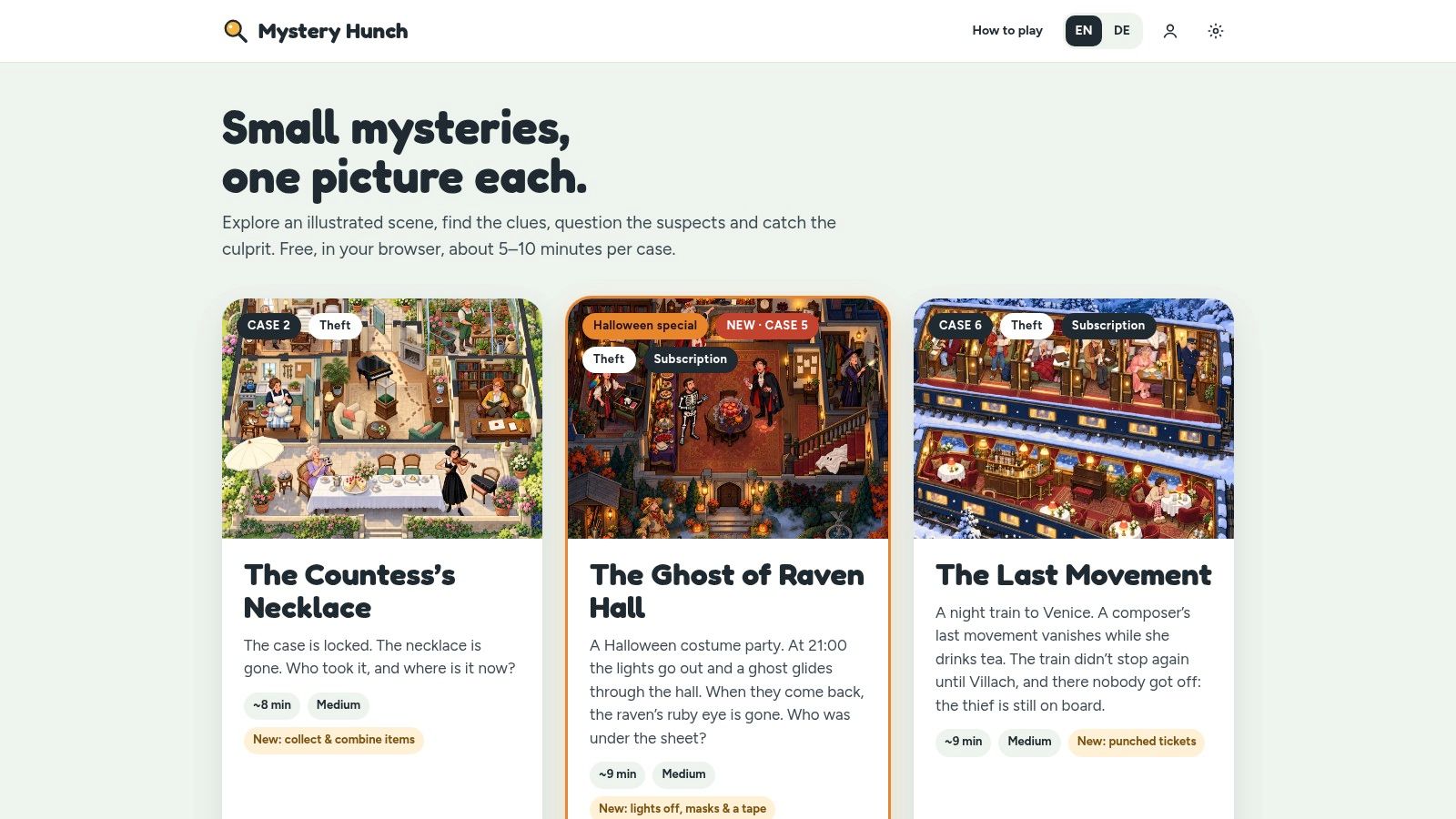
Mystery Hunch is the compact, visual choice for a solo break. Our free browser prototype centres each investigation on an illustrated scene. You tap rooms and objects, gather clues, combine evidence in a notebook, and check suspects' statements before accusing someone with proof.
Cases take approximately five to ten minutes, with individual estimates and difficulty labels helping you choose. That's a useful format when you want a complete puzzle rather than the opening chapter of something you'll struggle to resume.
The murder case, The Hut on the Grauhorn, takes about six minutes and is rated Medium. A snowed-in hut keeper is dead, and five guests claim they were asleep. Other cases concern theft, so choose that hut investigation if a whodunit is specifically what you're after.
What works, and what needs patience
The notebook gives you something more purposeful than a collection of clickable objects. The important step is connecting what you found to what someone said. For a short mystery, that distinction matters: finding an unusual object shouldn't be the same thing as proving guilt.
- Helpful structure: Scene exploration, clue combinations, and suspect statements give you a clear investigative loop.
- Optional assistance: Your in-game partner can provide hints, each costing one star, with up to three stars available per case.
- Presentation choices: Phone and wider-screen layouts, English and German support, and bright or noir visual styles offer different ways to play.
- An honest limitation: This is a new, solo-developed prototype, not a finished library with a guaranteed release schedule.
I'd treat the star score as an optional challenge, not a reason to remain stuck. A hint that helps you understand an evidence connection is more useful than a perfect score earned through random tapping.
The trade-off is early-stage uncertainty. Cases, features, and scoring may change or be removed while we collect feedback. Choose it for a brief, self-contained investigation, not for a promise of a sprawling campaign or built-in multiplayer.
2. Midnight Casebook
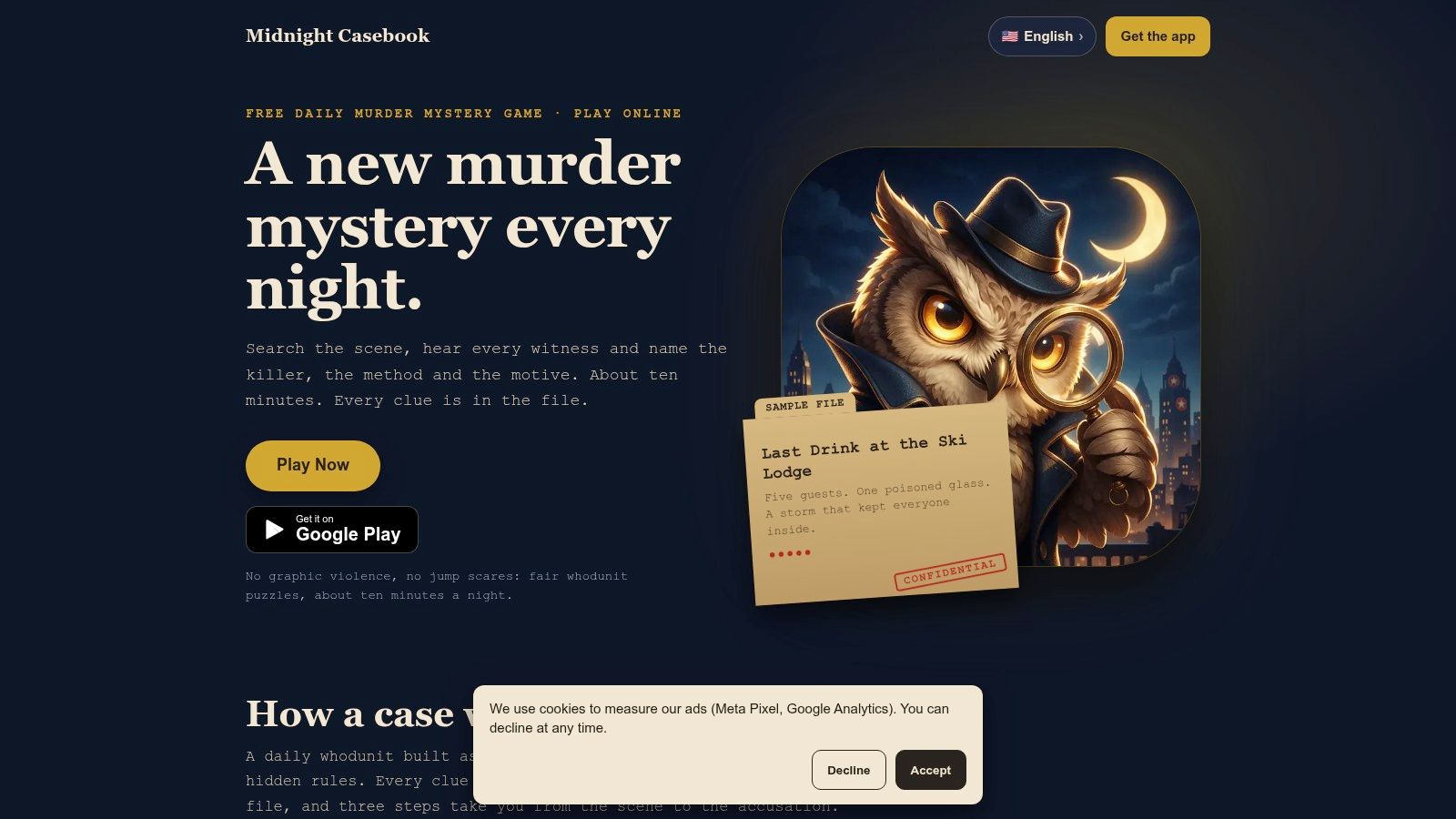
Midnight Casebook suits a daily-puzzle habit. Rather than browsing a large catalogue and debating where to begin, you can tackle the current case. Illustrated crime scenes and voiced witnesses give you both objects and testimony to investigate.
Midnight Casebook describes sessions of about ten minutes, offers a free daily case and three introductory cases, and asks you to establish the killer, method, and motive. That final requirement is the interesting part. Naming a suspicious person isn't enough if you can't explain what happened.
The free daily case is the main attraction
You don't need an account to start. Apple or Google sign-in can preserve progress across devices, but it's separate from opening an investigation on its own. That's a sensible distinction for someone testing whether the format suits them.
The archive, full hint access, and longer Sunday cases sit behind Pro. Free access therefore works best if you're happy with a daily appointment, rather than an unrestricted evening of cases. Don't confuse a free daily puzzle with a free back catalogue.
A daily release is convenient when you want someone else to choose your next mystery. It's less convenient when you want to keep playing immediately.
The accusation cap also changes how you should play. Read witness statements carefully and settle the method and motive before committing, rather than using guesses to narrow the answer.
Prefer a scene-led alternative without making a daily routine of it? The snowed-in hut investigation offers a different starting point.
Pick Midnight Casebook for a repeatable solo ritual. Skip it if you dislike limited accusations or expect unrestricted hints without upgrading.
3. Ask the Truth
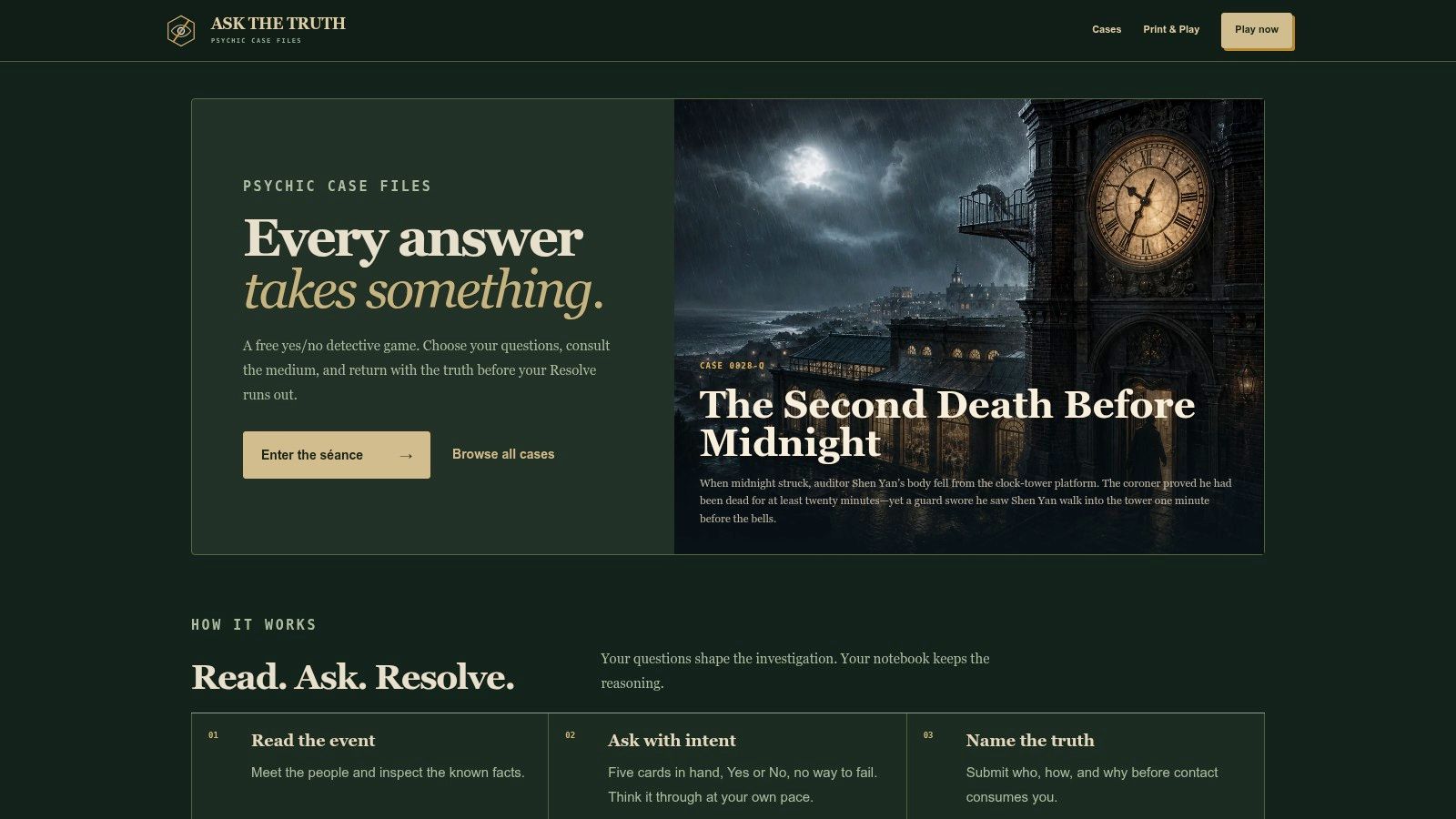
Sometimes the satisfying part of an investigation isn't spotting a muddy footprint. It's asking the question that makes an impossible story suddenly make sense. Ask the Truth is for that kind of deduction.
Ask the Truth is a free browser game built around authored yes-or-no questions, a medium, and a notebook. Each case has a fixed written solution rather than an open-ended generated answer. You choose the order of the available questions, so your investigation has direction without requiring you to invent the exact wording.
That structure offers a useful compromise. You have more agency than reading a reveal, but less conversational freedom than a free-text interrogation game. If you enjoy narrowing possibilities methodically, that can be a strength.
- Free entry: The site describes the game as free to play.
- Low setup: No account or download is required, and you can resume in the same browser.
- A meaningful constraint: Resolve is limited, so poorly chosen questions can end an investigation.
- Language limitation: The public game is available in English only.
Ask questions that separate explanations
Say you're deciding whether someone entered a room or was already inside. A question that distinguishes those possibilities is more valuable than another piece of background about the suspect. Use the notebook to record what an answer rules out, not just what it says.
The drawback is that a resource limit can punish curiosity. If you want to explore every possible question without consequences, this isn't the relaxed format you're looking for.
There's no firm session estimate to rely on here. Treat it as a resumable reasoning game, not a guaranteed kettle-break completion. It's a strong choice for deliberate solo questioning, less so for visual scene exploration.
4. PLAY INQUEST
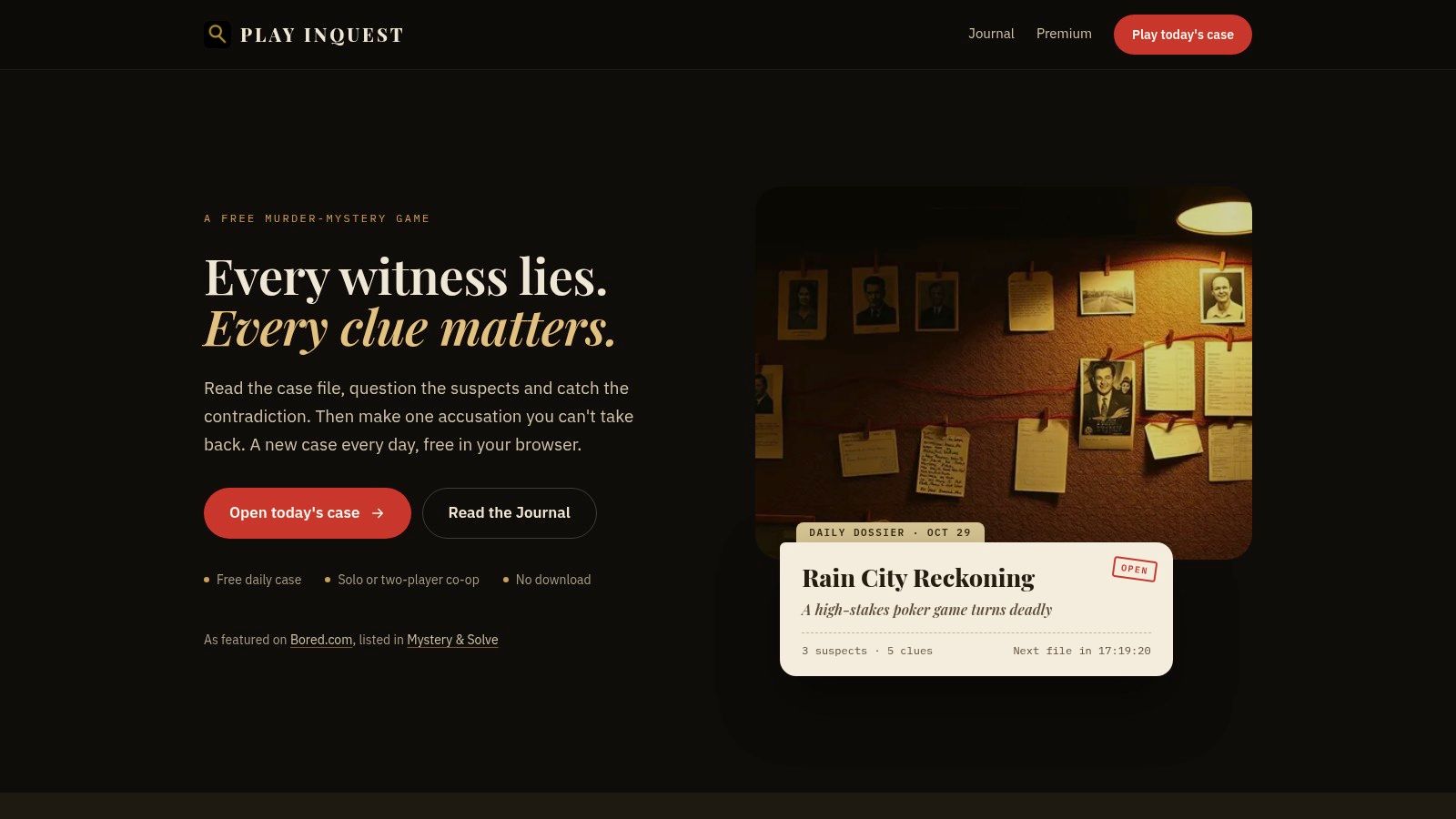
PLAY INQUEST is the practical pick when you want to bring a friend without organising a party. Its police-style dossiers, scene searches, and witness contradictions put the emphasis on checking an account against evidence.
PLAY INQUEST offers a free Daily Dossier and supports two-player co-op rooms with shared dossiers and in-game chat. Handcrafted cases sit alongside the daily investigations, and it runs in modern desktop, tablet, and mobile browsers. The appeal is shared reasoning, not acting out suspect roles.
Use that shared case file actively. Have one player inspect the physical evidence while the other checks the alibis, then swap explanations before accusing anyone. Both players should be able to explain the theory.
The accusation rule changes the pace
A single wrong accusation can be costly here, so this isn't a good fit for casual suspect roulette. The productive question is not who seems most suspicious. It's which statement the evidence makes impossible.
- Best reason to try it: The free daily case provides a straightforward entry point.
- Main paywall: Some cases and replays require a subscription.
- Setup uncertainty: Account requirements aren't clear in the available game description.
- Timing uncertainty: A daily release doesn't establish how long a particular case will take.
That last distinction matters. A game can publish a compact-looking dossier and still demand careful reading, especially when you're discussing it with someone else.
I'd choose PLAY INQUEST for a low-key detective session with a friend who likes comparing theories. I wouldn't choose it for an impatient group that wants to make accusations immediately. The restrictive accusation rule rewards agreement backed by evidence, not whoever clicks fastest.
5. NOIR
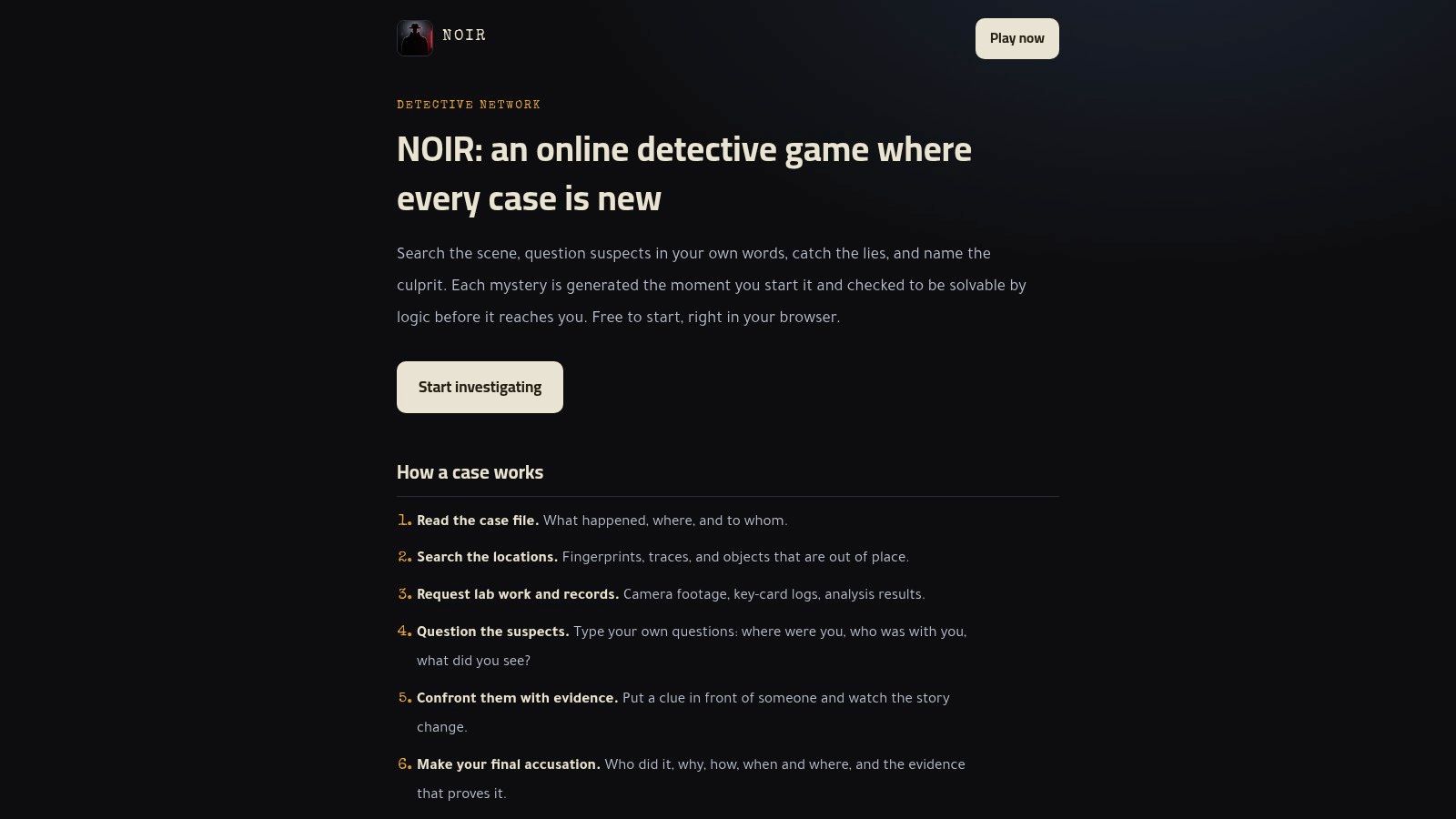
Want to type your own question instead of choosing from a menu? NOIR gives you a more conversational investigation. You search locations, request lab work, question suspects, and confront them with evidence.
NOIR lists quick cases at five to fifteen minutes and private co-op rooms for two to six players, alongside longer case formats. English and Arabic interfaces and cases are available. Its catalogue also covers crimes beyond murder, so read the premise before starting.
More freedom means more room to wander
Free-text questioning is appealing because you can pursue a particular inconsistency directly. Ask where a suspect was, then challenge that answer with a clue. That feels different from exhausting a fixed dialogue menu.
The trade-off is focus. If you spend your break asking broad questions about everyone's background, you may finish with plenty of conversation and no usable theory. Start with the timeline, access to the scene, and any claim that conflicts with physical evidence.
A useful questioning habit: Ask about a specific fact, then follow up with the evidence that appears to contradict it.
NOIR's generated-case approach won't suit everyone. I'd favour a fixed, authored puzzle if your main pleasure is examining how carefully every clue supports the reveal. Choose this format if conversational freedom matters more.
The main page doesn't establish paid-plan pricing clearly, so don't assume unrestricted play is free. Account requirements also aren't clear enough to promise a signup-free start.
If you'd rather switch to a more bounded scene puzzle, try the missing necklace investigation. For NOIR itself, select the quick format deliberately. The longer scenarios aren't interchangeable with a short break.
6. Third Suspect
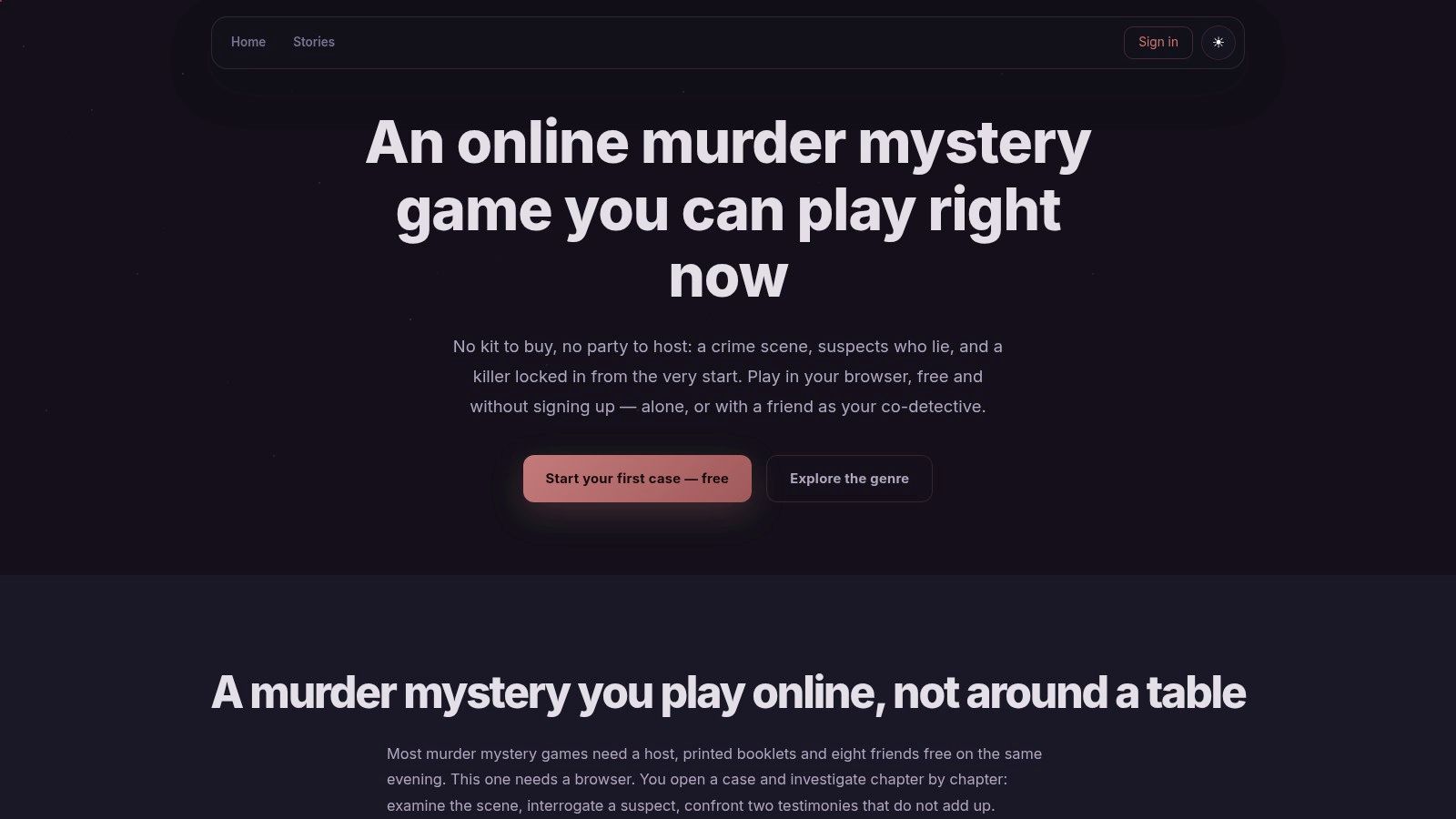
Third Suspect is for players who would rather question a witness than search a room. Its investigations revolve around lies, inconsistencies, and follow-up questions. That makes it a better fit for interrogation fans than for players who mainly enjoy illustrated object hunting.
Third Suspect lists cases of roughly fifteen to thirty minutes, with solo and invite-a-friend play, and says no signup or download is required. Those durations put it beyond a tiny break. Save it for when you can finish a conversation without watching the clock.
The case variety is useful if you don't want a daily-puzzle schedule. Different settings and lengths let you choose an investigation that matches your mood, rather than taking whatever case has just opened.
Keep a record of the actual contradiction
Interrogation games work best when you distinguish a suspicious manner from an incompatible statement. Someone being evasive gives you a reason to investigate. It doesn't, by itself, establish guilt.
A simple note format helps:
- Claim: Write down what the witness says happened.
- Conflict: Record the testimony or evidence that doesn't fit.
- Follow-up: Ask a question that could resolve that conflict.
For shared play, agree on the next line of questioning before sending it. Otherwise, you risk jumping between topics and losing the thread that made a witness interesting.
The public description doesn't establish a clear free allowance or paid-access boundary, so no signup shouldn't be read as unlimited free play. That uncertainty belongs in your decision.
I'd pick Third Suspect for a longer conversational break. If you need a quick visual puzzle with a visible endpoint, the interrogation-heavy format probably isn't for you.
7. Your Scenario
Your Scenario belongs in an evening slot, not a kettle break. You examine scenes, question suspects, compare testimony, and keep track of unresolved leads in a case file. It's a fuller investigation rather than a compressed daily riddle.
Your Scenario estimates a focused case at about thirty to sixty minutes and offers solo or two-player investigation. The site says the solution is locked before play, so the killer and underlying facts are intended to remain consistent as you question suspects.
That is an important design promise. Conversational freedom is more satisfying when you're uncovering an existing answer rather than wondering whether the mystery changes to accommodate your questions. It still pays to keep track of which statements are claims and which facts you've independently supported.
A duo game with a longer commitment
The co-detective format suits people playing from separate screens. You can discuss theories while consulting the case file, rather than relying on one person to describe everything they've clicked.
You can start without a download or signup, but free play uses complimentary credits. Longer play requires a plan, and subscription pricing isn't clear in the available page content. Treat those credits as an introduction, not proof that a whole evening is free.
- Choose it for: A planned investigation with a partner.
- Avoid it for: A short, interruption-prone break.
- Watch for: The distinction between starting free and having enough access to continue.
If tonight's available time suddenly shrinks, the missing recipe-book case offers a different style of investigation.
Your Scenario makes the most sense when you want sustained questioning and shared theory-building. Don't rush that format just to make it fit a shorter window.
8. CASE-48
The title needs explaining immediately: CASE-48's clock measures investigative time inside the story, not your real-world session. Don't use it to estimate when you'll finish.
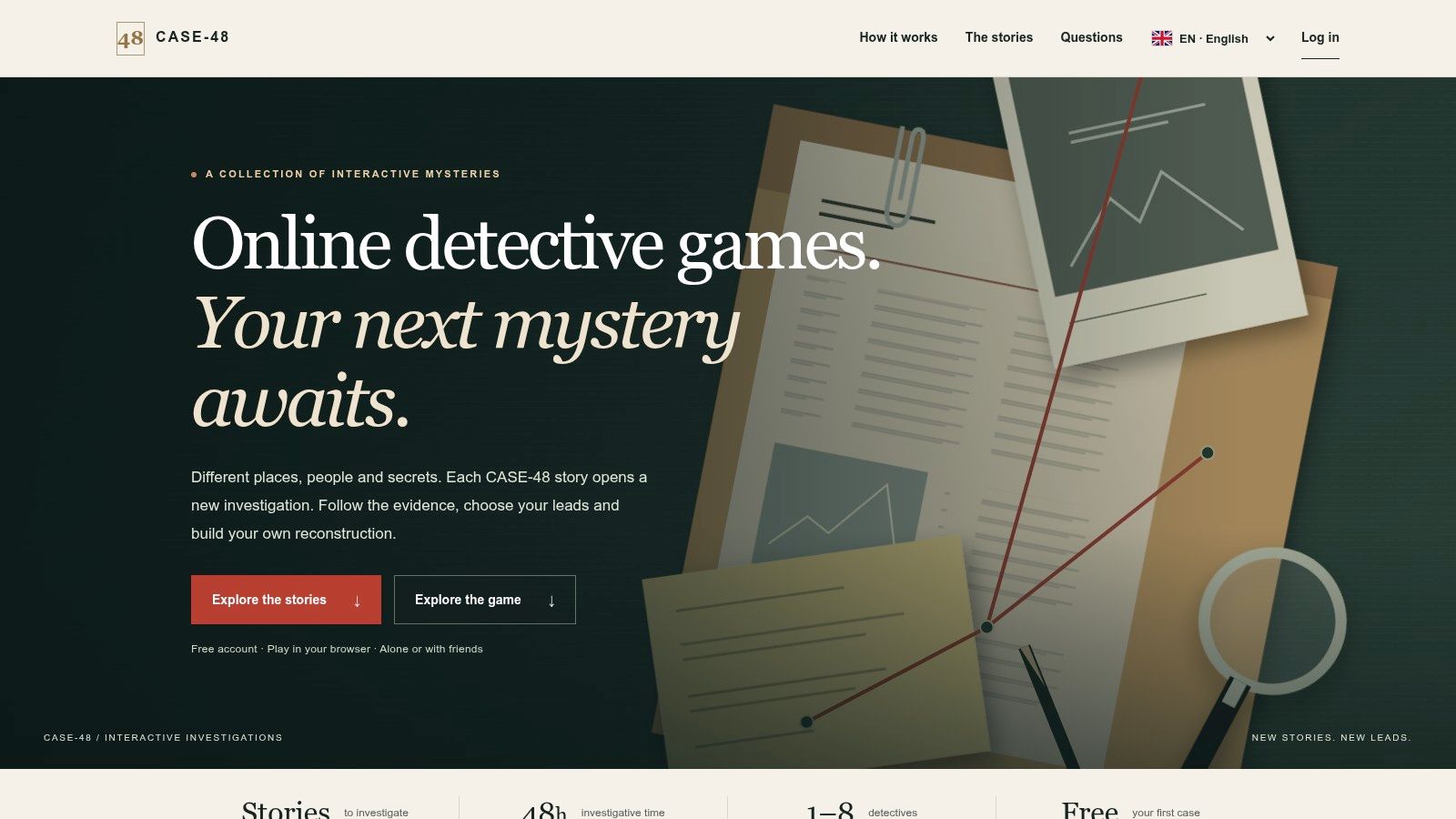
CASE-48 presents its opening Alaska mystery, The Weight of Snow, through 100 illustrated cards, with solo play or rooms for up to eight detectives. You choose leads, visit locations, interview witnesses, and connect evidence on a relationship board.
This is the option for someone who wants to organise a case, not just reach an answer quickly. The board and archive give you a place to connect people, claims, and discoveries. That can be satisfying, but it also asks for more attention than a self-contained scene.
Spend investigative time on new information
Visits, interviews, and examinations consume the game's investigative time. Reading collected evidence and adding notes don't. Use that distinction before chasing another lead: review what you already know and identify the specific gap you're trying to close.
Don't spend an investigative action just because it's available. Spend it because the answer could change your theory.
An account is required to play, so CASE-48 isn't the frictionless option for someone who refuses signup. The available description also doesn't establish a clear free-access boundary.
The collection currently has an opening story available, with more planned. Judge the game on what you can play now, not the size of a future catalogue.
I'd recommend it for patient solo investigation or a group that enjoys maintaining a shared evidence board. I wouldn't pick it for a short session, because neither the fictional clock nor the browser format tells you the completion time.
How the eight picks compare for short, solo, or group play
Sort by the column that matches your situation. Session length tells you whether a case fits a break, free entry tells you what "free" covers, and the last column decides who gets to sit at the table.
| Item | Listed session length | Free entry | Solo or group |
|---|---|---|---|
| Mystery Hunch | About 6–9 minutes per case | Free to play in the browser | Solo; group play not stated |
| Midnight Casebook | About 10 minutes | Free daily case and three introductory cases | Not stated |
| Ask the Truth | Not stated | Free to play | Not stated |
| PLAY INQUEST | Not stated | Free daily case | Two-player co-op; solo play not stated |
| NOIR | Quick cases: 5–15 minutes; longer formats also available | Not stated | Solo or 2–6 players |
| Third Suspect | About 15–30 minutes | Not stated | Solo or small groups |
| Your Scenario | About 30–60 minutes | Complimentary credits | Solo or two players |
| CASE-48 | Not stated; 48 hours refers to in-game time | Not stated | Solo or up to eight players |
A "Not stated" cell is its own answer. Games that don't publish a session length or a free boundary leave you to find out after you've started, so treat them as open-ended commitments rather than quick cases.
Free entry comes in different shapes. Free to play means the whole thing costs nothing. A free daily case resets each day while the rest sits behind access you pay for. Complimentary credits run out, and a required account adds a signup step before your first clue.
Group support only counts when the game states it. NOIR, Third Suspect and CASE-48 name their player counts, and PLAY INQUEST is built for two. Passing one screen around the room works with any solo pick, but the other players get no role of their own.
Pick One Case Tonight and See Where It Takes You
Choose your time limit before choosing your detective fantasy. A short gap calls for a clearly bounded scene or a daily case you can finish in one sitting. A quiet evening gives interrogation games and evidence boards room to breathe, so the investigation can become enjoyable instead of rushed.
Midnight Casebook is the straightforward daily-habit choice. Ask the Truth suits deliberate question selection. PLAY INQUEST makes sense when you want shared dossiers with a friend, while NOIR offers more conversational freedom and a choice of case formats.
That match matters more than the theme.
Match the friction to the occasion
A signup requirement is not automatically bad. It is a poor fit for a break you planned to spend playing rather than registering. A subscription can be reasonable for a game you enjoy, but a free opening case should never be mistaken for unrestricted access to everything after it.
Use the first available case to judge the investigation itself. Can you distinguish clues from decoration? Does the notebook help you reason, or does it just log what you already saw? When the game asks for an accusation, can you explain why your answer fits better than the alternatives?
- For a brief solo break: pick a case with a visible duration and a clear endpoint.
- For shared play: choose a game with real co-op support, then agree on how you will compare findings before anyone accuses.
- For a longer session: leave room to review evidence instead of spending the whole time opening new leads.
- Before paying: check whether the upgrade buys cases, hints, replays, or continued questioning.
Accessibility deserves the same attention as price. Check whether you can adjust text size before committing to a reading-heavy case, because comfortably reading testimony is part of being able to solve it.
Judge the explanation, not just the score
After the reveal, ask whether you could have reached that conclusion from the evidence presented. A satisfying short mystery does not need elaborate backstory. It needs a fair connection between what you discovered and what you proved.
For our prototype, feedback carries extra weight because cases, features, and scoring may change. The creator reads every message, so a precise note about a confusing clue, an unclear instruction, or an awkward interaction helps more than a general complaint. If you describe the problem publicly, keep the solution out of it.
Pick a case you can realistically finish tonight. Follow the strongest contradiction, make an accusation you can defend, and share a spoiler-free result if you enjoyed it. Links back to our site are welcome, but keeping the culprit secret is the better gift to the next detective.
Mystery Hunch offers free illustrated browser mysteries where you inspect a scene, connect clues, and accuse the culprit with proof. Visit Mystery Hunch, choose a short solo case, and see whether your theory survives the evidence.