Interactive Detective Game Explained: Clues and Suspects
You're ten minutes from your next thing, scrolling for something smarter than another match-three, and you click a mystery that promises clues and suspects. Five minutes later you're just tapping every lamp and cushion, wondering if that's all there is. Sometimes it is. Sometimes you've found a real interactive detective game, where the tapping is only the start and the fun is proving who lied.
Table of Contents
- What an Interactive Detective Game Really Is
- The Core Loop Behind Every Case
- How Scene Exploration Turns Objects into Clues
- Using Evidence and Suspect Statements to Reach a Verdict
- Hints, Stars and Staying Stuck Without a Spoiler
- Common Misconceptions About the Genre
- Accessibility Features That Make a Mystery Fair to Play
- Pick a Short Case and Test Your Deduction
What an Interactive Detective Game Really Is
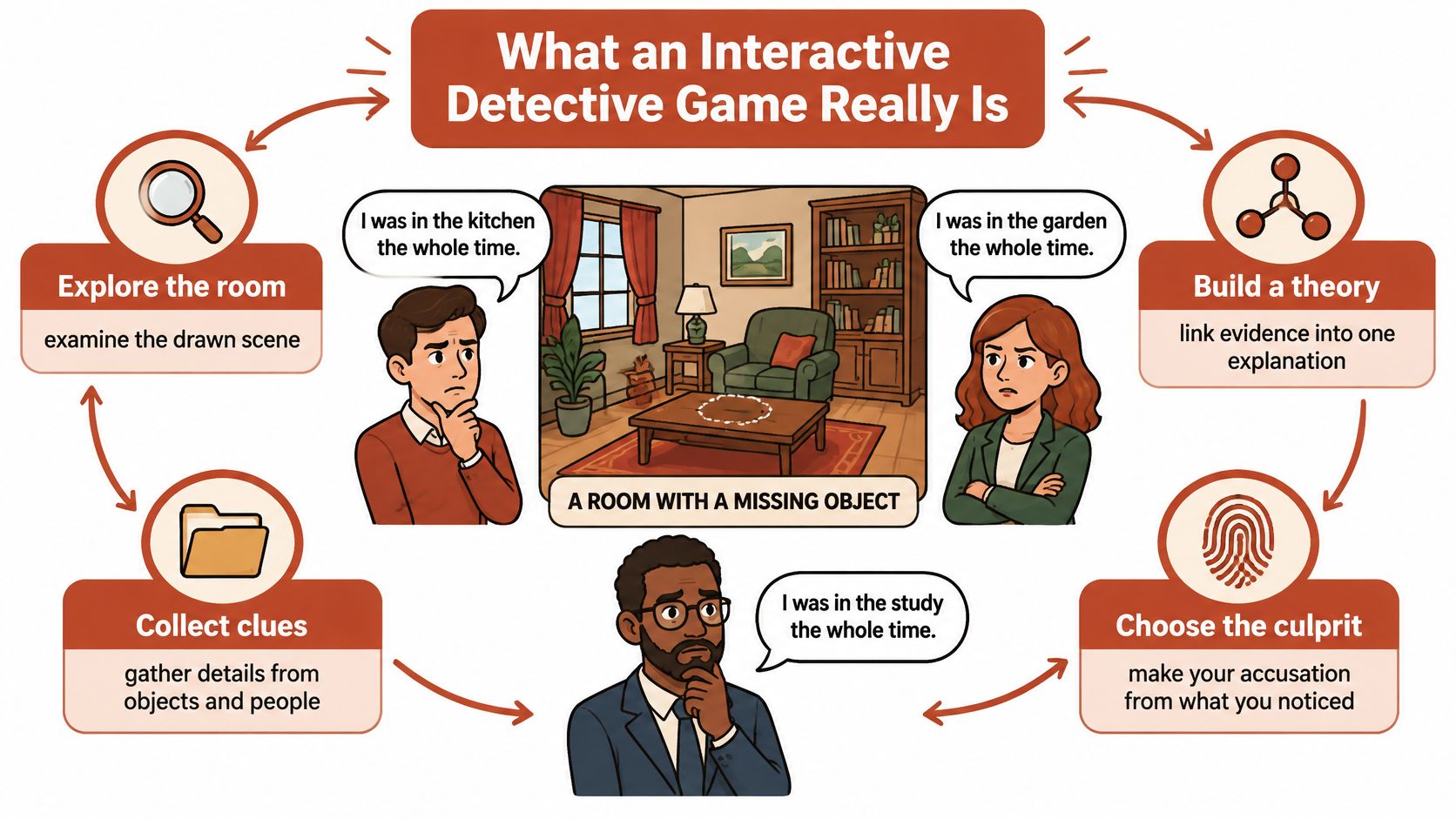
One illustrated room. A necklace has vanished from its box, and three people each swear they were somewhere else when it happened. Nobody's going to tell you who took it. You have to look, ask, and work it out.
An interactive detective game is a mystery you solve by examining a drawn scene, collecting clues, questioning suspects, and naming the culprit with reasons. Think of it as a detective novel that waits for your answer before the story moves on. It's closer to working a logic grid than watching a film, because your reasoning is the engine.
That separates it from its neighbours. A novel makes every choice for you, however cleverly it hides the answer. A point-and-click adventure often hinges on carrying the right item to the right door. Here, carrying things matters less than connecting them. A muddy footprint means little until someone claims they never went outside.
Why the Format Fits Short Sessions
Browser play helps because there's nothing to install and no console to own. You can open a case on a laptop or phone and finish it in one sitting. That low barrier sits inside a sizeable format, since the DataIntelo Browser Game Market report put the global browser-game market at $11.3 billion in player spending and advertising revenue in 2025.
Before you commit to any title, run three quick checks.
- Is there a culprit to name? A case should end with an accusation, not just a completed checklist.
- Do clues come from examining things? You should discover details in the scene, not only read them in text boxes.
- Can statements be tested? What a suspect says should be checkable against what the room shows.
If a game passes those checks, you're probably looking at deduction. If it fails the third one, you're mostly hunting objects.
The Core Loop Behind Every Case
Most cases run on the same five stages, look, collect, combine, question, and accuse. The loop repeats inside a single case, because each stage gives you a better question for the next one.
Look means tapping rooms, furniture, and objects to see what raises a question. A clock stopped at 9:40 isn't proof of anything yet. It's a prompt. Why did it stop, and who benefits if you believe that time?
Collect means storing the details that matter rather than everything you touch. A wet boot print by the door goes into your notebook. The plain rug under it probably doesn't.
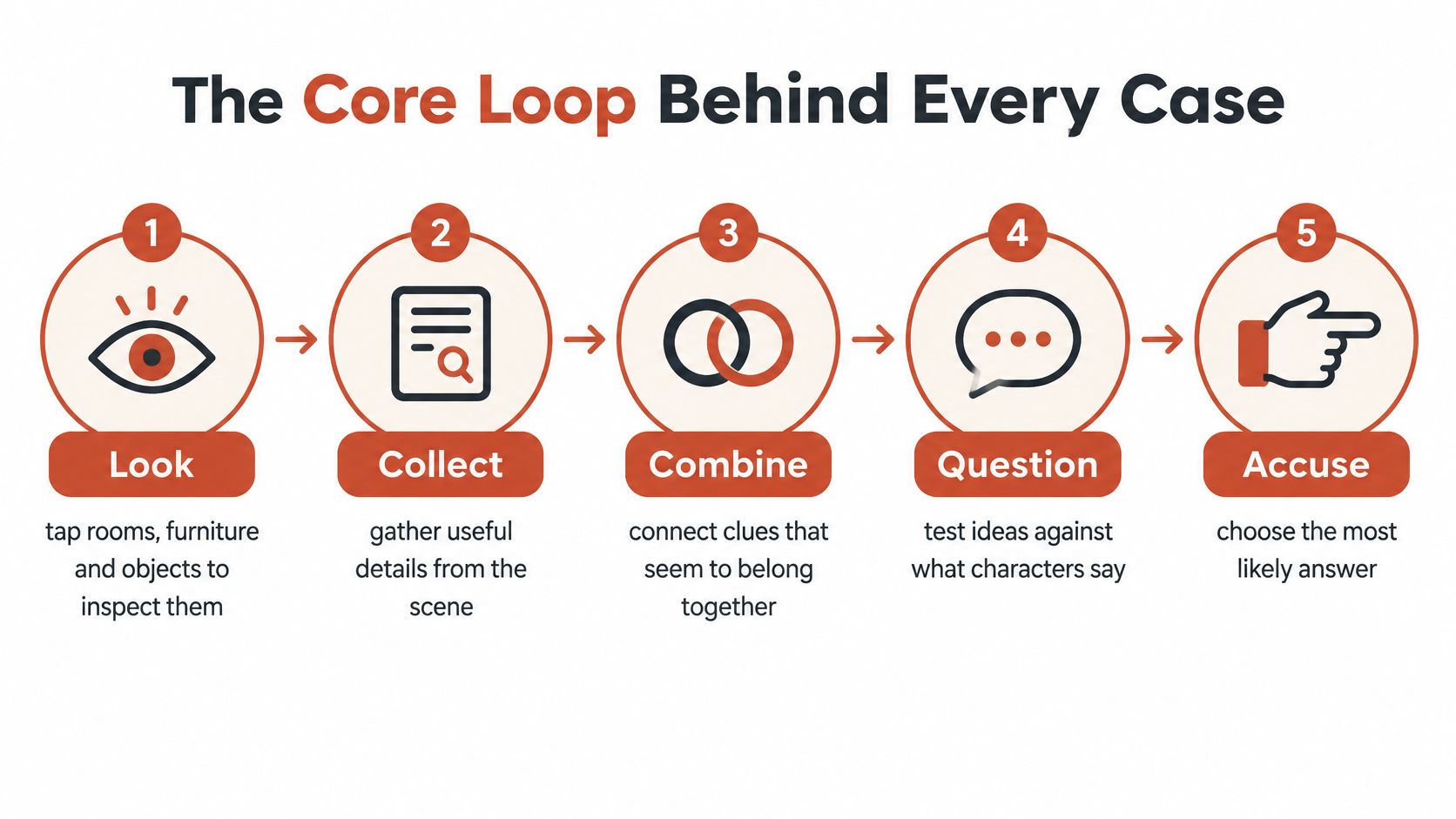
Combine is where a puzzle appears. Pair that wet boot print with the clock stopped at 9:40 and you get an insight neither clue gives alone. Someone may have left in a hurry around that time, in wet weather.
Question means testing that idea against a suspect's stated movements. If the gardener says he was inside all evening, the print challenges him. Accuse means naming the culprit and attaching the proof that makes the claim stick.
| Mechanic | Player action | Skill tested |
|---|---|---|
| Scene exploration | Tap rooms, furniture and objects | Observation |
| Evidence collection | Pick up and store items that matter | Attention to detail |
| Evidence combination | Pair two clues to form a new insight | Logical linking |
| Statement checking | Compare a suspect's story with the scene | Spotting contradictions |
| Accusation | Name the culprit and attach the proof | Reasoned conclusion |
This style of play sits within a growing corner of games, since the Emergen Research Gaming Market report projected the puzzle-games segment to grow at an 18.7% compound annual growth rate during the 2024-2034 forecast period.
After each stage, you should hold something concrete, a noted observation, a combined clue, or a contradicted statement. If you've tapped ten objects and hold nothing new, stop tapping and decide what question you're actually trying to answer.
Strong cases keep that loop tight, so one case can take roughly five to ten minutes. That short length isn't a limitation. It's the design working as intended.
How Scene Exploration Turns Objects into Clues
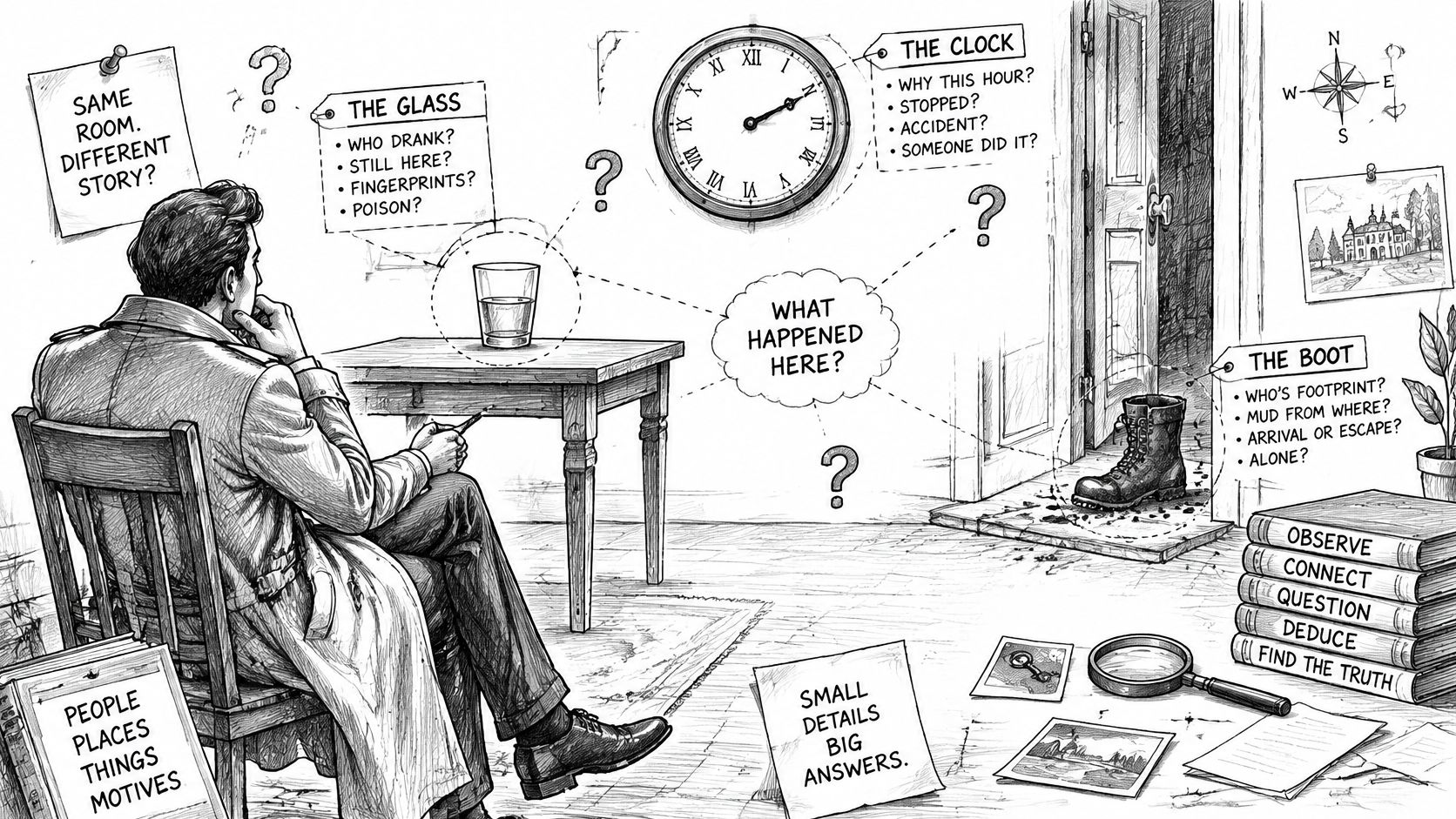
Work a scene like a crime-scene photographer. Shoot wide first to take in the whole room, then move closer to one area, then closer still to individual objects. That order stops you fixating on the first shiny thing you notice.
A scene is really a map of questions. A glass on the table, a muddy boot by the door, and a clock stopped at a strange hour each ask something different. The game's job is to make those questions easy to ask, and yours is to ask them in a sensible order.
Three Habits That Make Searching Fair
- Divide the room into zones. Work the table, then the doorway, then the clothing rack, then the fireplace. Zones turn random hunting into a system you can finish.
- Watch for completion feedback. Good scenes signal when a zone has been fully examined and mark a clue as found, so you don't rescan the same corner five times.
- Let discoveries reveal detail. Secondary evidence should appear after a meaningful find, so the next clue feels earned rather than buried.
Crowding breaks all of this. Eye-tracking findings in a Springer chapter on visual search and interface complexity link interfaces with more than 20 elements, or elements that are too small, to significantly increased visual fatigue. That's why keeping simultaneously visible interactive targets below about 20, with hit areas large enough to tap comfortably, makes a case fairer rather than easier.
There's a memory trap here too. Your notebook should separate raw observations from confirmed deductions, so you don't treat "I saw a wet floor" and "the cook lied" as the same kind of fact. Mixing them up is how innocent suspects get accused.
Try this in a contained setting like our snowed-in hut case, where a small space rewards a full sweep. After one pass, ask yourself one question. Can you say what you haven't looked at yet? If you can, the scene is doing its job.
Using Evidence and Suspect Statements to Reach a Verdict
A ring vanishes from a box that went round a dinner table and came back closed. Three guests say they were in the kitchen when dessert was served. Searching the room harder won't crack this one. The scene only starts to matter once you can test what people say against it, and that test is what separates real deduction from clicking everything in sight.
Step One: List Each Claim Plainly
Write down exactly what each suspect must be claiming. Guest A says she never touched the box. Guest B says he passed it on immediately. Guest C says the box felt light when it reached her.
A claim you haven't written down clearly is a claim you can't test.
Step Two: Test Each Claim Against the Scene
Now look for details that support or break each statement. A dropped napkin under Guest B's chair suggests he fumbled with something. The seating order tells you who held the box before it came back closed and empty.
If nothing in the scene could ever confirm or break a statement, that statement is decoration. One solid contradiction eliminates a story: if Guest A swears she never touched the box, but her napkin is tucked inside its lid, her account falls apart. That makes her a liar, which is a different finding from the thief.
Step Three: Combine Two Clues Into One Conclusion
Pair the seating order with the timing of the serving round. Alone, seating only says who sat where. Together, they can show who held the box during the one moment nobody was watching.
A suspect who is never contradicted may simply be innocent. Absence of a broken claim isn't evidence of guilt, and treating it as proof is the fastest route to a wrong accusation.
A plausible story fits your gut feeling about a character. A proven one names the clue that makes it stick and survives every other statement in the case.
You can run the same three steps on The Countess's Necklace on Mystery Hunch, a Medium theft case of about 8 minutes where a necklace goes missing from a locked case. Before you commit an evening to any title, four checks tell you whether it rewards deduction or thorough clicking:
- Can each suspect statement be tested against something in the scene?
- Does a broken claim change who you suspect?
- Do two clues combine into a conclusion neither gives alone?
- Does accusing ask for the proof behind the name?
Whatever you play, keep one habit. Write down your reason before you name the culprit. If you can't finish the sentence "It was her because this clue shows it," you're guessing, and guessers blame the game when the verdict comes back wrong.
Hints, Stars and Staying Stuck Without a Spoiler
Getting stuck isn't a sign you're bad at this. It's the genre working, because a case you never pause on probably never asked you to think. The question is whether the game helps you think or hands you the answer.
Good help comes as a hint ladder. The first rung points to a region of the scene. The second names the kind of object worth examining. Only the last explains how a clue connects to a suspect's statement. Each rung gives away more, so you choose how much of the deduction stays yours.
| Hint tier | What it reveals | Trade-off |
|---|---|---|
| Tier 1, region nudge | Which part of the scene holds the next clue | Keeps the deduction in your hands |
| Tier 2, object type | The kind of item worth examining | Narrows the search without naming the clue |
| Tier 3, logical link | How a clue connects to a suspect's statement | Largest help, best saved for when you are truly stuck |
That graduated approach matches how support helps people select, organize, and integrate relevant information, a relationship described in a Springer reference work on game-based learning. A hint that organizes what you already found teaches you something. A hint that replaces your search teaches you nothing.
Cost matters too. A hint that costs too much discourages experimenting, so players sit stuck rather than risk their score. A hint that's completely free removes the sense of earning a solve. In our cases, a hint costs one star and a partner can help when you're stuck, which keeps the trade-off visible without blocking progress.
Read stars as a signal, not a punishment. Three stars say you solved it independently. Fewer stars say you solved it with support, which is still a solve, and often the reason the next case feels easier.
Practical rule: Spend your first hint on where to look, not on what the answer is, and only reach for the final tier after you've tried connecting two clues yourself.
Common Misconceptions About the Genre
"It's just object hunting." It can be, and that's worth checking. A game can fill a room with clickable items and still offer no reasoning if each clue only reveals the next click. Ask whether a clue can be combined with another clue, or used to test a statement, in more than one meaningful way.
"More realism means a better mystery." Not necessarily. Long forensic procedures and repeated collection steps can replace reasoning with chores, a frustration raised in an RPGFan review of a cozy detective title that flagged pixel hunting and repetitive puzzles. Notice where your time goes. If you're repeating a procedure instead of thinking about the case, realism is costing you the puzzle.
"A short case can't be deep." A tight scene can hold a challenging puzzle if every clue earns its place. Test it afterwards. Can you name the single clue that mattered most? If you can, the case had a real logical spine.
"A wrong accusation means I failed." A good game explains why your accusation failed, and that explanation is itself information. Check whether it tells you which statement or clue your theory ignored. Use these four checks on any title before deciding whether it rewards deduction or just patience.
Accessibility Features That Make a Mystery Fair to Play
A suspect's alibi can be perfect and still useless if the line that breaks it is too small to read. Accessibility works like the lighting in a sealed room: it leaves the solving to you while deciding which clues can enter the reasoning at all.
In U.S. survey data reported by the Entertainment Software Association in its annual study announcement, 49% of players with disabilities called accessibility extremely or very important. For a detective game, the useful question is simpler: can every player perceive the evidence, keep the statements straight, and act on the scene without fighting the controls?
| Feature | What fair play looks like |
|---|---|
| Adjustable text size | Evidence cards and notes stay readable without squinting or constant zooming. |
| Adjustable difficulty | Repetition and tedium can be reduced while the deduction stays intact. |
| Camera comfort | The scene remains steady enough to inspect, with motion kept gentle or optional. |
| Subtitles | A suspect's exact wording can be reread and tested against the room. |
Start with text size, because readable evidence is the first requirement in any scene. Then look for subtitles on spoken statements, since fairness means placing an exact phrase beside a detail and seeing whether they agree. Contrast and reduced clutter matter just as much: a low-vision player can miss a small, pale object that another player spots instantly.
Adjustable difficulty should cut repetition while preserving consequence. Larger hit areas or a way to cycle through objects keep the challenge in your reasoning instead of your aim.
Before you commit a session, run four checks.
- Can you change the text size? Evidence you cannot read cannot be reasoned about.
- Are statements subtitled? You need exact wording you can revisit.
- Are hit areas generous? No clue should require pixel-perfect tapping.
- Is the scene uncluttered? You should be able to scan the visible targets without losing the thread of the case.
Short cases help most when they lower fatigue. Trouble starts when a brief game makes you hold too much in mind at speed; the logic can be sound even if the delivery excludes you.
Pick a Short Case and Test Your Deduction
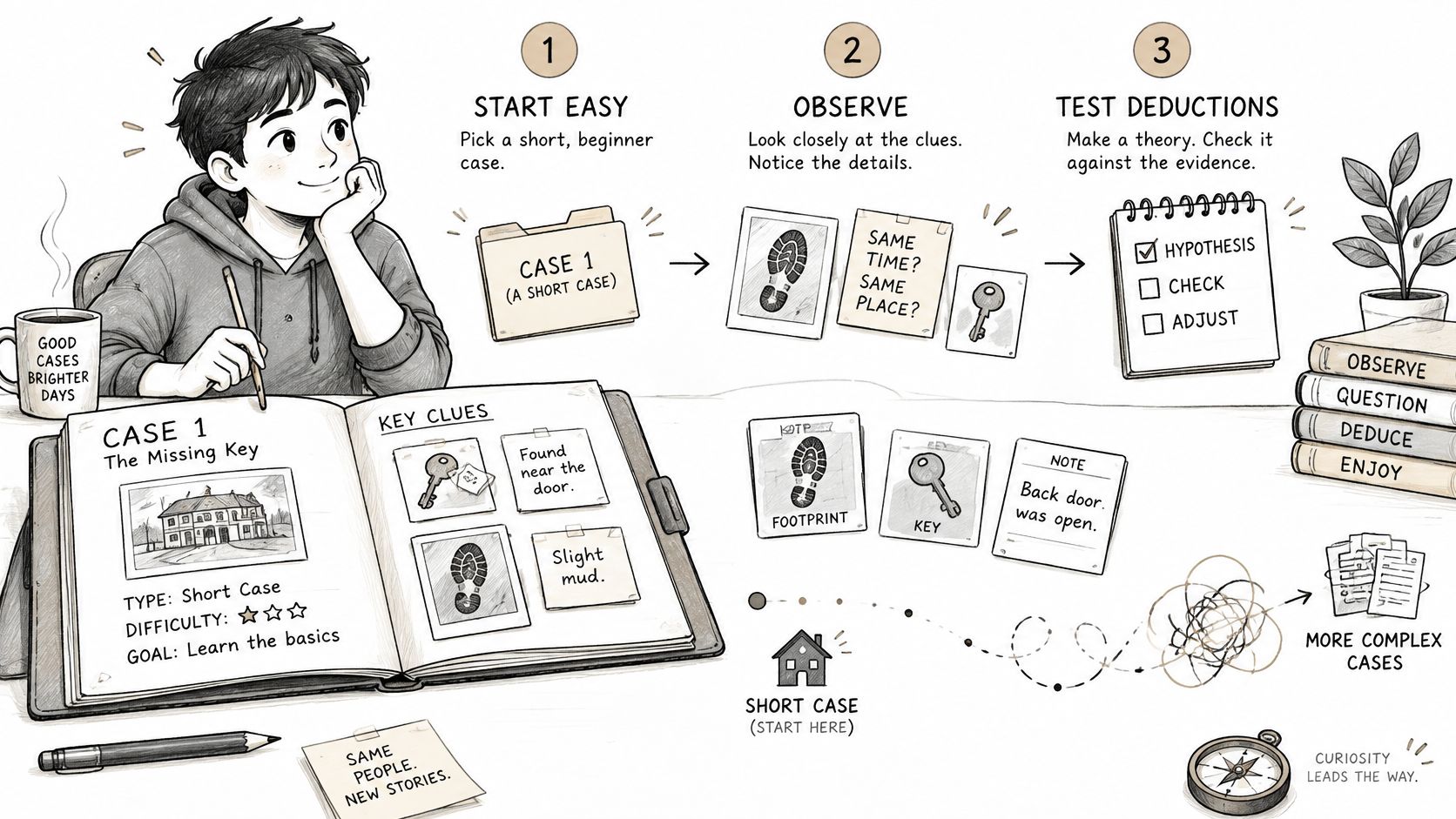
Start with a short, easy case so the loop becomes familiar before the statements get tangled. This short walkthrough shows the rhythm you're aiming for.
Use a three-part routine for your first session. First, spend two minutes scanning the scene and listing every object that raises a question. Second, write down each suspect's claim before you open your notebook for anything else. Third, pair at least two clues before you accuse anyone.
The picture below captures that learning curve, from scattered observation to a verdict you can defend.
Mystery Hunch is free to play in the browser, and each case takes about 5 to 10 minutes, so you can judge the genre in one sitting by starting at our homepage. Keep hints in reserve, then ask afterwards whether you linked clues or guessed. Right now, open the shortest case you can find, set a two-minute timer, and list three questions the scene raises before you touch a single statement.
Ready to test whether you deduce or just collect? Visit Mystery Hunch for free illustrated cases where you examine one scene, combine evidence in a notebook, and check suspects' statements before accusing anyone. Pick an easy case, list your three questions first, and see if your verdict holds up.