8 Detective Games for Adults to Play in Short Sessions

You've got fifteen spare minutes on your lunch break, a coffee beside you, and absolutely no interest in starting an adventure that'll still be explaining its controls when you need to get back to work. You want a suspicious statement, a useful clue, and the satisfaction of catching someone out.
The problem is that short detective game can mean very different things. Sometimes you'll finish an entire whodunit in a browser. Sometimes you'll watch a handful of interviews, close the game, and spend the afternoon trying to remember which suspect mentioned the window.
The useful distinction is a short case versus a short session. A self-contained puzzle gives you an answer before you leave. A longer mystery lets you investigate in chunks, but you'll need to carry names, relationships, and unfinished theories between them.
Pick a game you can comfortably stop playing, not just one you can quickly start.
These detective games for adults cover quick browser deductions, illustrated clue hunts, and longer narrative investigations. The browser picks come first; the later games ask for more attention, installation, or patience.
Cost matters too, but so does what you're paying for. A free daily puzzle can be the better lunch-break choice, while a paid mystery makes more sense when you want a sustained investigation. Each recommendation below separates the appeal from the friction, including where a small screen, fragmented story, or demanding deduction can get in your way.
Table of Contents
- 1. Daily Detective
- 2. Enquetix
- 3. Mystery Hunch
- 4. Her Story
- 5. The Case of the Golden Idol
- 6. Return of the Obra Dinn
- 7. Sherlock Holmes Crimes and Punishments
- 8. Tangle Tower
- How the detective games compare on format, session length, cost and best use
- Pick Your First Case and Start Investigating
1. Daily Detective
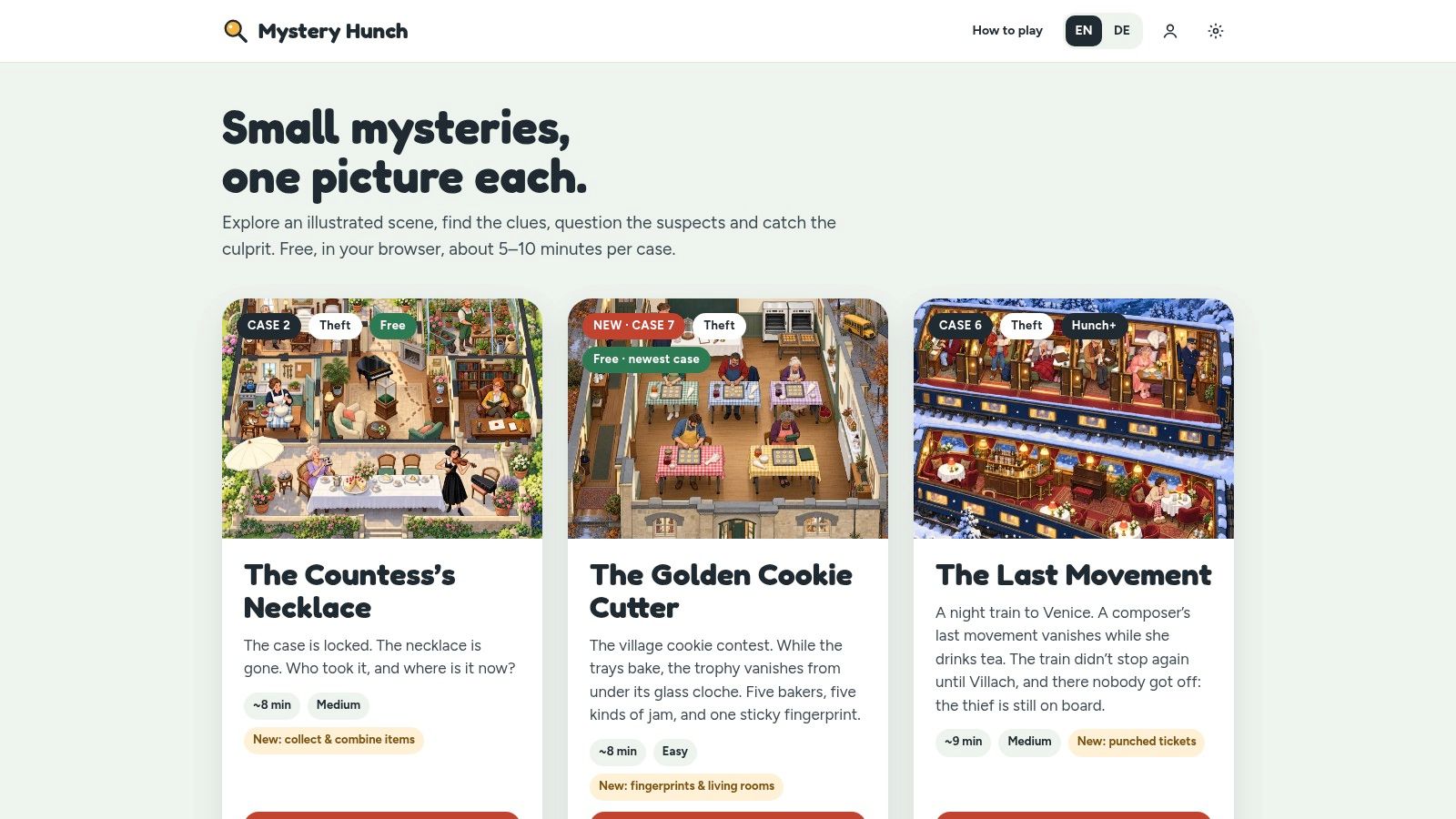
Best for a quick, text-first whodunit with a definite finish. Daily Detective keeps the investigation compact: read a police report, inspect the clues, compare alibis, and choose the culprit. You're evaluating information rather than wandering around hoping an overlooked drawer contains the answer.
That's a good fit when you've got limited attention as well as limited time. The report-and-clue structure keeps the relevant material together, so you can spend your break checking contradictions instead of learning an interface.
What works and what doesn't
- Cost and access: It's free, requires no sign-up, and runs in a browser rather than through an installed game client.
- Investigative style: Reading and elimination matter more than searching an illustrated environment.
- Main limitation: The daily release rhythm won't satisfy someone who wants an extensive catalogue to work through immediately.
- Hardware consideration: Prioritise comfortable text size. There's little benefit to instant browser access if you're squinting through the report.
The practical approach is to separate what a suspect says from what the evidence establishes. A suspicious personality isn't proof, and an awkward alibi isn't necessarily the decisive contradiction. Before accusing anyone, explain to yourself why the strongest alternative suspect doesn't fit.
The format may feel too contained if your favourite part of detective fiction is exploring a location. In that case, an illustrated investigation such as The Hut on the Grauhorn offers a useful contrast to a report-led puzzle.
Choose Daily Detective when you want closure rather than atmosphere. Skip it when clicking through rooms and inspecting objects is the main attraction.
2. Enquetix
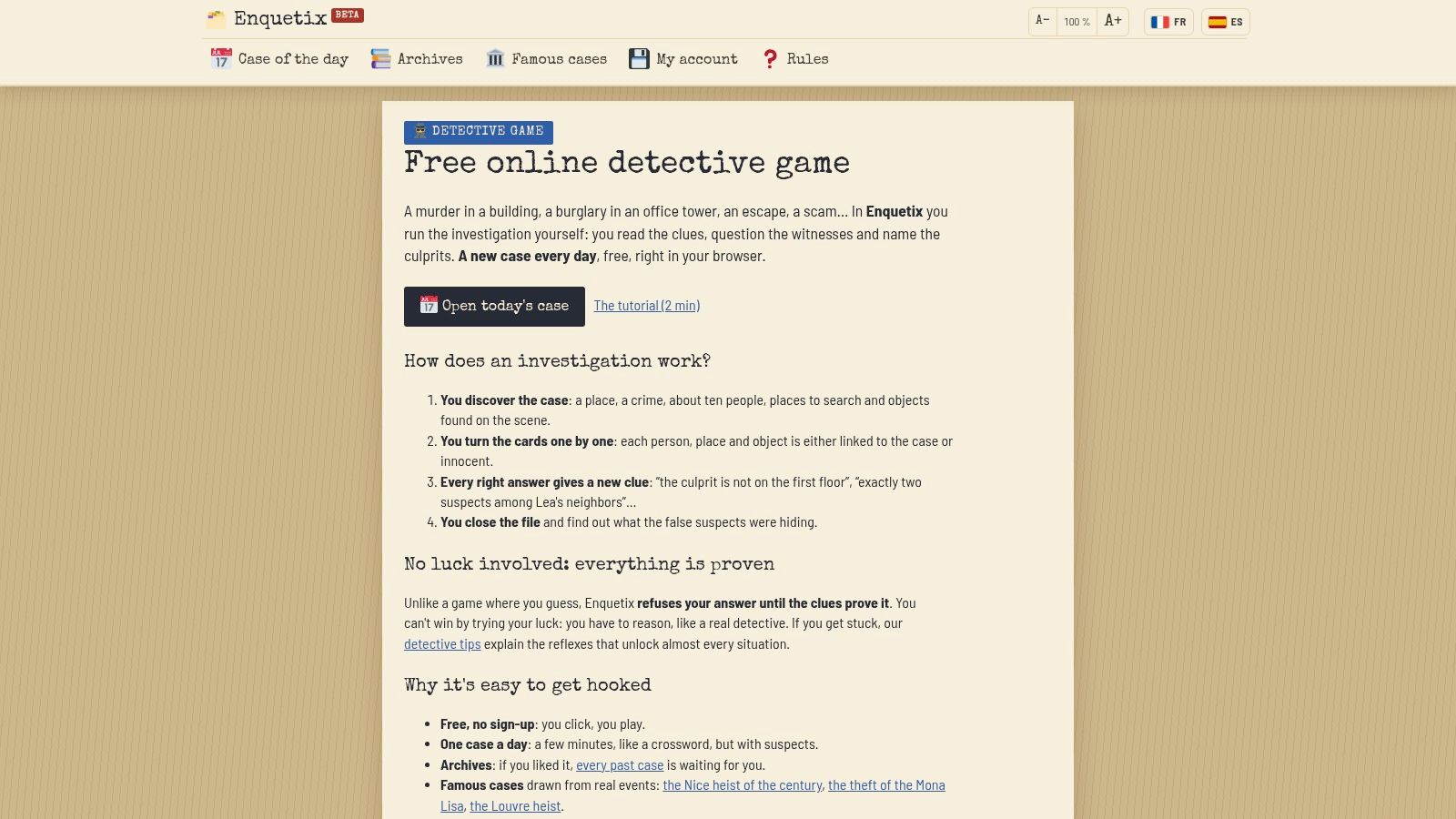
Want a short investigation without being limited to today's puzzle? Enquetix combines daily cases with an archive, making it a better fit when your available time changes from day to day. You can tackle a compact mystery now and return for another when you're not watching the clock.
Its investigations revolve around people, places, objects, and the relationships between them. The pleasure comes from ruling possibilities out, not from moving a character through an elaborate environment.
That distinction matters on a phone. A card-and-clue presentation can suit a small screen, but it still asks you to read carefully and compare details. Browser-based doesn't mean attention-free.
A better fit for evidence sorting
Enquetix is free to play without an account, with an optional account for syncing progress. It works on phones and computers, so the main hardware decision is whether you prefer portable convenience or more room to compare information.
Its strongest advantage over a tightly rationed daily puzzle is flexibility. The archive gives you somewhere to go when you're enjoying the deduction and don't want to stop merely because today's case is finished.
The trade-off is presentation. If examining cards feels like paperwork rather than investigation, the format won't suddenly become more immersive because the crime is interesting. Cases inspired by real events should also be approached as designed puzzles, not as substitutes for documentary accounts.
For a visual alternative, compare that evidence-sorting approach with The Countess's Necklace.
I'd choose Enquetix for a flexible browser puzzle habit. Start a case when you can read without rushing, and don't assume every investigation will fit into the smallest gap in your day.
3. Mystery Hunch
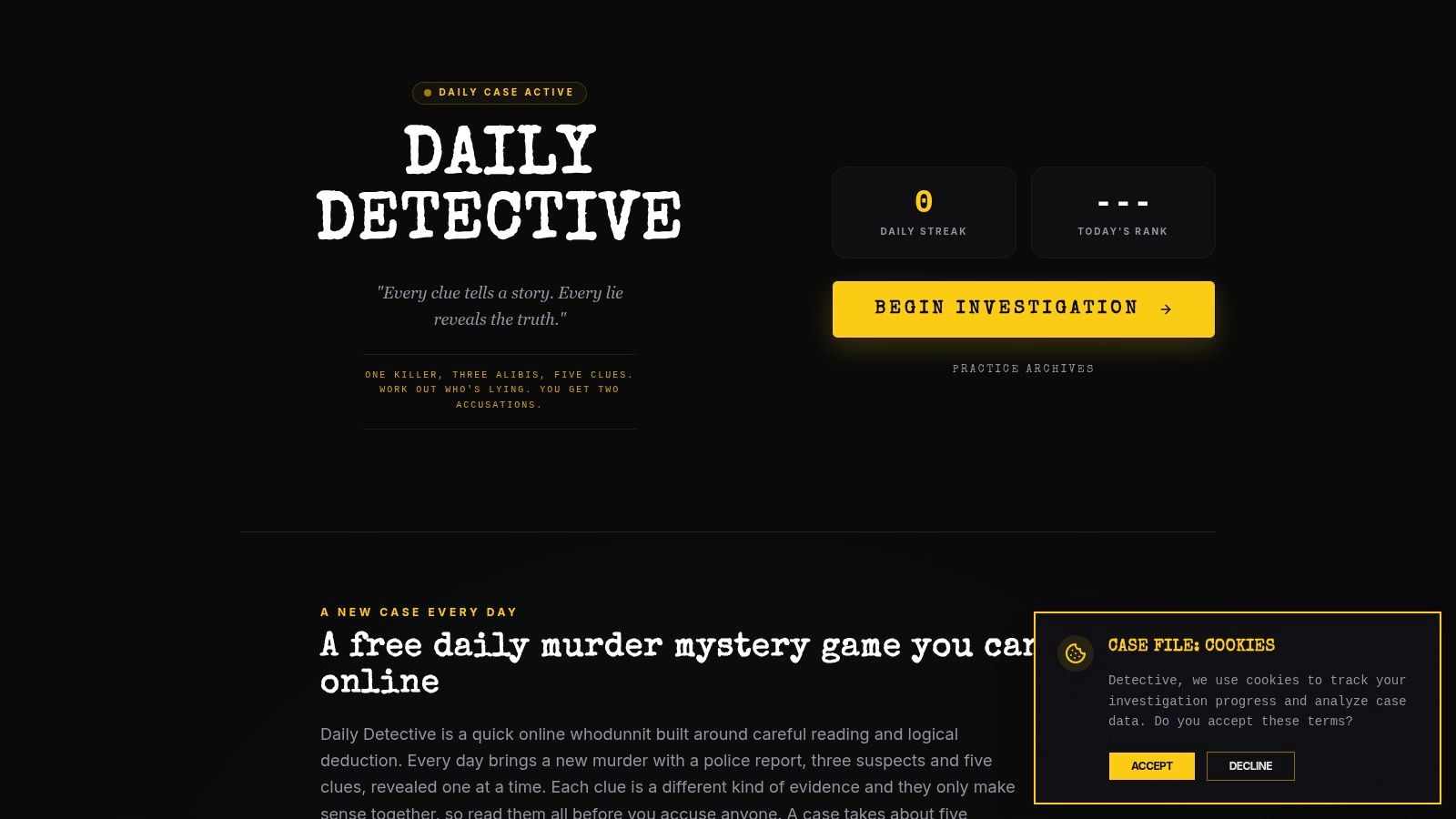
Best for a complete illustrated investigation during a short break. Our game, Mystery Hunch, centres each mystery on an illustrated scene: tap rooms and objects, collect clues, combine evidence in your notebook, and compare what you find with suspects' statements. You then accuse the culprit with proof rather than selecting whoever seems shiftiest.
Cases take about 5–10 minutes, with estimated durations and difficulty labels visible before you begin. That makes the format useful when you want the whole investigative arc, discovery, deduction, and accusation, without committing to an ongoing adventure.
What you actually investigate
The cases vary the kind of reasoning you'll use. The Ring Went Round involves a ring disappearing from a box passed around a table, while Grandma Hilde's Recipe Book pairs a missing book with a wet pantry door. The Halloween theft asks you to investigate a missing ruby eye at a costume party.
These premises give objects and spatial relationships a purpose. Don't just collect everything and immediately accuse someone. Work out what each clue establishes, then test whether a suspect's statement can still be true.
- Guidance: An in-game partner offers optional hints at the cost of a star.
- Replay goals: You can earn up to three stars per case, and earned stars remain when you restart.
- Hardware and presentation: Browser play supports phone and wider-screen layouts, with English and German options and bright or noir visual styles.
- Cost: We offer the early prototype free of charge to collect feedback.
The honest limitation
Mystery Hunch is an early prototype made by one person, not a sprawling, fully settled catalogue. Cases, features, and scoring may change or be removed, so it's a better choice for curious players than for anyone expecting a large, finished commercial adventure.
The compact scenes are also a deliberate trade-off. You get a concentrated clue hunt rather than extensive travel, lengthy interviews, or cinematic storytelling.
I'd recommend it when you want observation and evidence combination in the same short case. If you mainly want character development or a mystery that occupies your thoughts across several evenings, choose a longer narrative game instead.
4. Her Story

In Her Story, your most important investigative tool is a search term. You explore filmed police interviews with a woman questioned about her husband's disappearance and murder, using words from discovered clips to find further material.
This is a short-session game, not a short-case game. You can watch a little footage and stop, but the larger task is interpreting a fragmented account. Your progress depends partly on remembering what you heard and recognising which detail deserves another search.
The format suits adults who enjoy listening closely to testimony. A change in wording, an unexpected reference, or an answer that doesn't quite fit your current theory can matter more than an obvious physical clue.
Before stopping, write down the search term you want to try next and the question you hope it answers.
Where the freedom becomes friction
Her Story doesn't provide the reassuring rhythm of inspecting a room and checking every object off a list. If you need explicit objectives, the open search process can feel opaque. You may uncover something important without immediately understanding why it matters.
It's also heavily dependent on watching and interpreting footage. Players who want object manipulation, environmental exploration, or a conventional accusation screen should look elsewhere.
Cost and hardware: This is a paid game rather than a free browser puzzle. Check the publisher's available versions and their device requirements before purchasing, and choose a setup where interview playback and text are comfortable to follow.
For a contrasting, bounded investigation, Grandma Hilde's Recipe Book keeps the focus on a contained scene.
Choose Her Story for ambiguity and active searching. Don't choose it merely because watching a clip sounds like an easy way to fill a break.
5. The Case of the Golden Idol
A strange death, an unsettling scene, and an explanation that refuses to assemble itself. The Case of the Golden Idol is for players who want to inspect details and then construct an account of what happened, including identities, actions, and motives.
Its scene-based structure makes it more approachable in chunks than a continuously unfolding adventure. You can focus on a particular tableau rather than spending your available time travelling between locations. That doesn't make the deductions easy.
The key distinction is between finding information and understanding it. You may have inspected the relevant details yet still need to work out who benefited, which action came first, or why an apparent explanation doesn't fit.
Treat your answer like an argument
- Start with identities: Establish who people are before leaning too heavily on a theory about their motives.
- Separate observation from inference: An object's location is evidence; your explanation for how it arrived there is still a hypothesis.
- Review the whole account: A plausible name in an answer slot doesn't guarantee that the surrounding explanation makes sense.
Cost and hardware: It's a paid downloadable game. The Steam listing is the place to check current pricing, compatible operating systems, system requirements, and demo availability before buying.
The pixel-art presentation is distinctive, but it won't suit everyone. Neither will the grim subject matter. If the visual style makes scenes hard for you to parse, clever deductions won't compensate for uncomfortable viewing.
I'd pick Golden Idol for concentrated scene analysis, especially if you enjoy revising a theory until every detail fits. Give yourself room to think, and stop after resolving a meaningful part of the explanation rather than abandoning a half-formed guess.
6. Return of the Obra Dinn

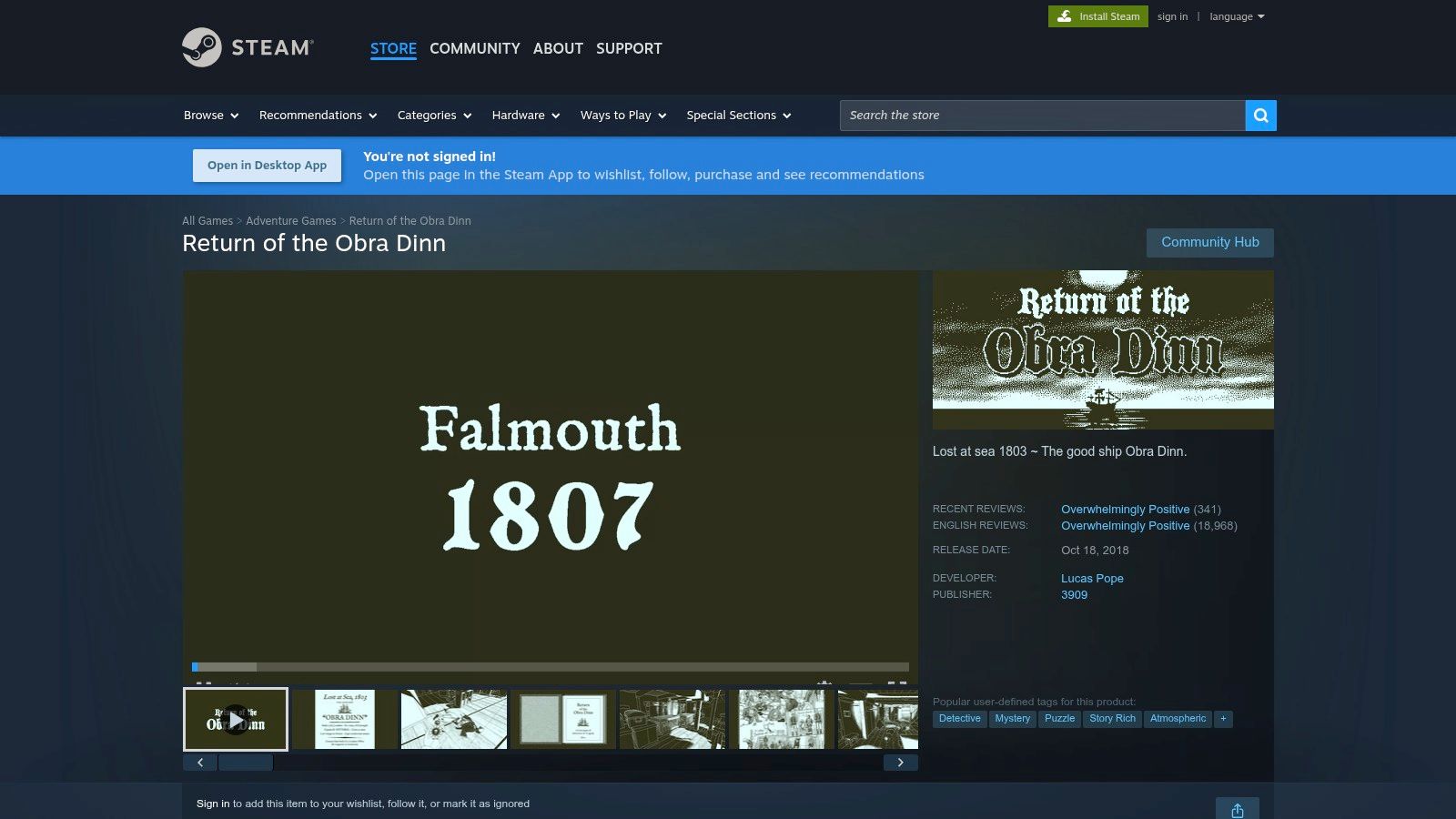
Return of the Obra Dinn is the demanding choice. You're an insurance investigator boarding a ship that has returned without a visible crew, using a special pocket watch to inspect frozen moments and determine identities and causes of death.
The appeal of Return of the Obra Dinn is that deductions connect across scenes. A person you can't identify immediately may become recognisable when another event gives you context. You're reconstructing a network of people and events, not solving isolated riddles.
That makes it a poor default for an interruptible lunch break. You can stop playing, but resuming means recovering the reasoning behind your unfinished theories, not merely remembering which doorway you were about to enter.
Allow time to recover your train of thought
Keep notes that distinguish confirmed identities, working theories, and unanswered questions. Otherwise, yesterday's confident guess can turn into today's assumed fact.
A useful stopping point is a resolved identity or a clearly recorded lead. Stopping while mentally juggling several possible names makes the next session harder than it needs to be.
The retro monochrome presentation is another genuine trade-off. It's striking, but you should assess whether you can comfortably distinguish figures and details before treating the aesthetic as a selling point.
Cost and hardware: This is a paid downloadable game with first-person exploration. Check the Steam requirements against your computer, and consider whether first-person movement and the visual style suit you.
Choose Obra Dinn when you want sustained, interconnected deduction. It belongs on a short-session list because you can divide the investigation, not because it reliably delivers a finished mystery before your coffee cools.
7. Sherlock Holmes Crimes and Punishments

Sometimes you don't want a puzzle that resembles detective work. You want the full routine: examine a crime scene, question a suspect, connect evidence, and decide whom to accuse.
Sherlock Holmes: Crimes and Punishments is the pick for that broader fantasy. Its investigations cover murder, missing persons, and theft, with deductions and decisions about what should happen to the people involved.
The trade-off is overhead. This is a full adventure, so a brief session may advance an investigation without resolving it. Travel, conversations, and scene examination are part of the experience rather than obstacles the game tries to remove.
Best for a planned evening
- Choose it for variety: You want interviews and environments alongside evidence analysis.
- Choose it for judgement: You're interested in the consequences of an accusation, not just whether a puzzle answer is correct.
- Skip it for instant closure: A small gap between obligations isn't the best setting for absorbing a developing case.
- Consider the content: Violence and gruesome material make it less suitable if you want a gentle, low-stress mystery.
The practical mistake is rushing from a plausible theory to an accusation. Keep the evidence for your preferred explanation separate from your feelings about a suspect, then ask what would need to be true for an alternative explanation to work.
Cost and hardware: It's a paid download requiring compatible hardware, not a browser game. Check the Steam listing's operating-system, graphics, and storage requirements before purchasing.
I'd choose it when the appeal is being Holmes, including the questioning and moral decisions. For a pure logic exercise with minimal setup, the earlier browser and scene-based picks are more efficient.
8. Tangle Tower
The residents matter as much as the evidence in Tangle Tower. This illustrated point-and-click mystery sends you through a mansion to investigate a woman's murder, question unusual suspects, and examine the clues around them.
Pick it for character interaction and atmosphere. The hand-drawn locations and story-led investigation offer a different pleasure from a compact elimination puzzle. You spend time with a peculiar household rather than extracting only the information needed to name a culprit.
That explains where it can frustrate. If every conversation feels like a delay between you and the next deduction, you want a more concentrated puzzle game.
Short visits to a longer mystery
Tangle Tower works best in short sessions when you stop after a coherent activity: exploring one location, finishing a useful conversation, working through a suspect's account. Squeezing unfamiliar characters and fresh evidence into a rushed break turns enjoyable dialogue into information you barely retain.
The illustrated presentation is not a guarantee of comfortable play. Judge legibility directly rather than assuming a friendly art style means easy reading. Pay attention to how comfortably you can read dialogue and how easily you can spot interactive details, because a simple deduction still frustrates when the relevant object is hard to see.
Cost and hardware: Expect a paid game rather than a free browser case. The official website lists the available platforms; check your version's device requirements and accessibility settings before buying.
I recommend it to detective-fiction readers who enjoy the suspects as much as the solution. Choose something leaner if your ideal investigation contains little conversation and ends in an immediate answer.
How the detective games compare on format, session length, cost and best use
| Item | Format | Typical Session | Cost | Best For |
|---|---|---|---|---|
| Daily Detective | Browser-based daily clue-and-alibi puzzle | About 5 minutes | Free | A quick, simple daily reasoning challenge |
| Enquetix | Browser-based card-and-clue deduction game | A few minutes; some cases up to about 15 minutes | Free | Evidence-based daily investigations without downloads |
| Mystery Hunch (recommended) | Illustrated browser-based scene investigation | About 5–10 minutes per case | Free | Short, interactive mysteries with clue combining and suspect interviews |
| Her Story | Live-action searchable interview database | Self-paced; varies as you uncover clips | Paid | Nonlinear investigations and story interpretation |
| The Case of the Golden Idol | Point-and-click, scene-based deduction game | Longer, challenging case sessions | Paid; optional demo | Close observation and solving substantial mystery cases |
| Return of the Obra Dinn | First-person exploration and interconnected deductions | Extended, self-paced investigation | Paid | Challenging, detailed deduction across a larger mystery |
| Sherlock Holmes: Crimes and Punishments | Downloadable, story-led detective adventure | Full-length adventure across six cases | Paid | Crime-scene investigations with narrative choices |
| Tangle Tower | Illustrated point-and-click mystery adventure | Longer, story-led playthrough | Paid on most platforms | Suspect interviews, character interaction, and atmospheric storytelling |
Read the table as a time filter first, then a style filter. The browser rows cost nothing and suit short breaks; the paid rows ask for a download but reward longer, self-paced sessions.
Pick Your First Case and Start Investigating
Match the game to the attention you have, not just the minutes on the clock. A lunch break interrupted by messages is different from the same amount of quiet time at home. Text-first browser cases suit quick elimination; illustrated scenes suit close observation; longer mysteries suit players willing to carry unfinished questions between sessions.
Start with a contained case to learn what you enjoy. Do you notice contradictions in statements, spot physical details, or prefer testing a theory across a larger story? Your answer is more useful than a popularity ranking.
A practical stopping rule: Leave yourself a clear next action, not a vague instruction to keep investigating.
For Daily Detective and Enquetix, that might mean finishing the current puzzle rather than opening another. For Her Story, record your next search term. For Obra Dinn, note which identity you're testing and what evidence would support it.
Choose the kind of satisfaction you want
- A finished answer: Start with a short browser whodunit when closure matters more than exploration.
- A scene worth inspecting: Choose an illustrated clue hunt or Golden Idol when objects and relationships are the attraction.
- An ongoing mystery: Pick Her Story, Obra Dinn, Sherlock Holmes, or Tangle Tower when you want an investigation to return to.
Don't treat hints as a failure, either. First identify what you're stuck on: finding evidence, understanding a clue, or choosing between explanations. Then seek the smallest nudge that addresses that problem instead of reading the whole solution.
Clear endings matter when you're fitting games around work or care responsibilities. Research on adult players' stopping behaviour associates mechanics such as time limits and clear round endings with lower reported gameplay duration, but that doesn't mean every short game is easy to leave. Your own stopping plan still matters.
Longer isn't automatically better, and shorter isn't automatically shallow. The right case gives you enough evidence to reason with and enough space to understand why your accusation holds up.
Our project is still an early prototype made by one person who reads every feedback message. If you encounter a bug or have a case suggestion, describe what you clicked, what you expected, and what happened instead. For puzzle feedback, explain where your reasoning stalled without posting the culprit publicly.
Mystery Hunch offers free illustrated browser investigations where you examine scenes, combine clues, and accuse a culprit with proof, with cases designed for about 5–10 minutes. Visit Mystery Hunch, try the newest case free, and send feedback if a clue, interaction, or deduction leaves you stuck.