10 Crime Scene Investigation Online Games to Try in 2026

You've got a short break, a browser tab, and an itch to play detective. You don't want to download a sprawling adventure, sit through a tutorial, or discover that your quick mystery involves an evening of reading witness statements. You want a scene, some suspicious details, and a culprit you can identify from the evidence.
The catch is that crime scene investigation online games cover very different activities. Some ask you to search illustrated rooms. Others hand you police files, recordings, and timelines. Others put you opposite a suspect and let you type your own questions.
Choose by what you want to do, then by the time you can spare. A short visual puzzle suits a coffee break. A document-heavy cold case needs room to pause, compare evidence, and reconsider an attractive but shaky theory.
- Search rooms and objects if you enjoy noticing what's missing, misplaced, or inconsistent.
- Read case files if you'd rather compare statements, reconstruct events, and untangle alibis.
- Talk to suspects if asking follow-up questions sounds more satisfying than hunting for a tiny object.
The picks below distinguish those activities and flag stated session lengths where available. When a game doesn't publish a useful duration estimate, don't assume it'll fit into your break. Free access also varies, from a daily puzzle to a preview or opening chapter.
Table of Contents
- 1. Mystery Hunch
- 2. Criminal Atlas
- 3. Enquetix
- 4. Your Scenario
- 5. PLAY INQUEST
- 6. Forgotten Mystery
- 7. Cold Case Inc
- 8. Jack & Mani
- 9. Midnight Casebook
- 10. Crime Scene 360 – Case 01
- How the Crime Scene Investigation Online Games Compare on Time, Cost and Fit
- Pick Your Next Case and Start Sleuthing
1. Mystery Hunch

Best for searching an illustrated scene and turning observations into a short deduction. Our Mystery Hunch cases take approximately five to ten minutes, so you can choose a mystery without committing your whole evening.
You tap rooms and objects, collect clues, and use a notebook to combine evidence and compare suspects' statements. The important part is the accusation: you need proof, not just a feeling that someone looks suspicious. Keeping each mystery inside an individual scene also puts the emphasis on objects, spatial relationships, and conflicting accounts rather than navigation.
What Works and Where It Falls Short
The cases change the kind of observation you need. A missing object, an unusual arrangement, or an item combination can matter more than clicking every visible surface. I'd recommend this format when you want an actual whodunit without a large case file.
- Clear commitment: Estimated times and easy or medium labels help you choose a suitable challenge.
- Help with a consequence: Your partner can offer hints, but each hint costs a star from the maximum of three.
- Flexible presentation: Phone and desktop layouts, English and German versions, and bright or noir styles offer different ways to play.
Our browser game is free to play and is an early prototype created by a solo developer. That makes it a smaller, evolving collection rather than an extensive detective catalogue. Cases, features, and scoring may change or be removed as feedback comes in.
The trade-off is straightforward: choose this for a compact evidence puzzle, not a forensic simulator or an open-ended interrogation. Before accusing anyone, check whether your notebook supports the connection you're making.
2. Criminal Atlas
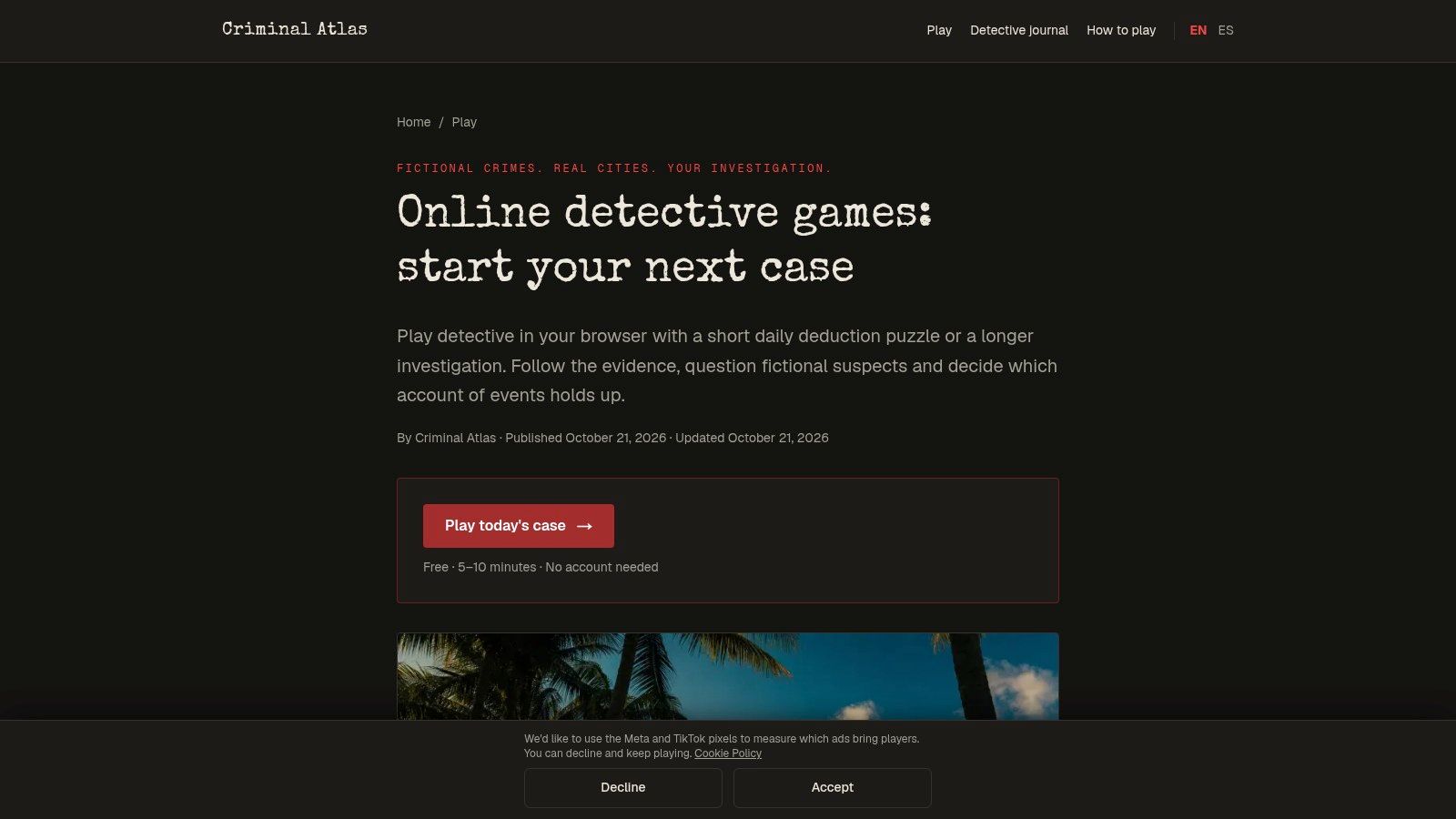
Criminal Atlas suits players who want a quick logic puzzle now and a fuller investigation later. Its daily cases connect suspects, places, and objects. The longer investigations add scene inspection, documents, timelines, and testimony.
According to Criminal Atlas, daily cases are designed for roughly five to ten minutes, while longer investigations typically take 30 to 90 minutes or more. Those are substantially different commitments, so choose the mode before you start.
Choose the Right Kind of Case
The daily format is the better match if your enjoyment comes from eliminating possibilities. You're looking for relationships between clues, not necessarily exploring a richly illustrated room. That's a useful distinction if you arrived expecting a hidden-object game.
The longer investigations make more sense when you want to build a timeline and test testimony against physical evidence. Fictional crimes set in real cities add a setting, but the practical appeal is the change in investigative depth.
- Easy entry: The current daily case is free and doesn't require an account.
- Useful flexibility: Browser support covers phones and computers without an app download.
- Access friction: Some features, including interrogations and hints, require email verification.
I'd start with the daily puzzle to see whether the deduction style clicks. Don't treat its completion time as a promise about the longer cases, and don't open a full investigation just before you need to leave.
3. Enquetix
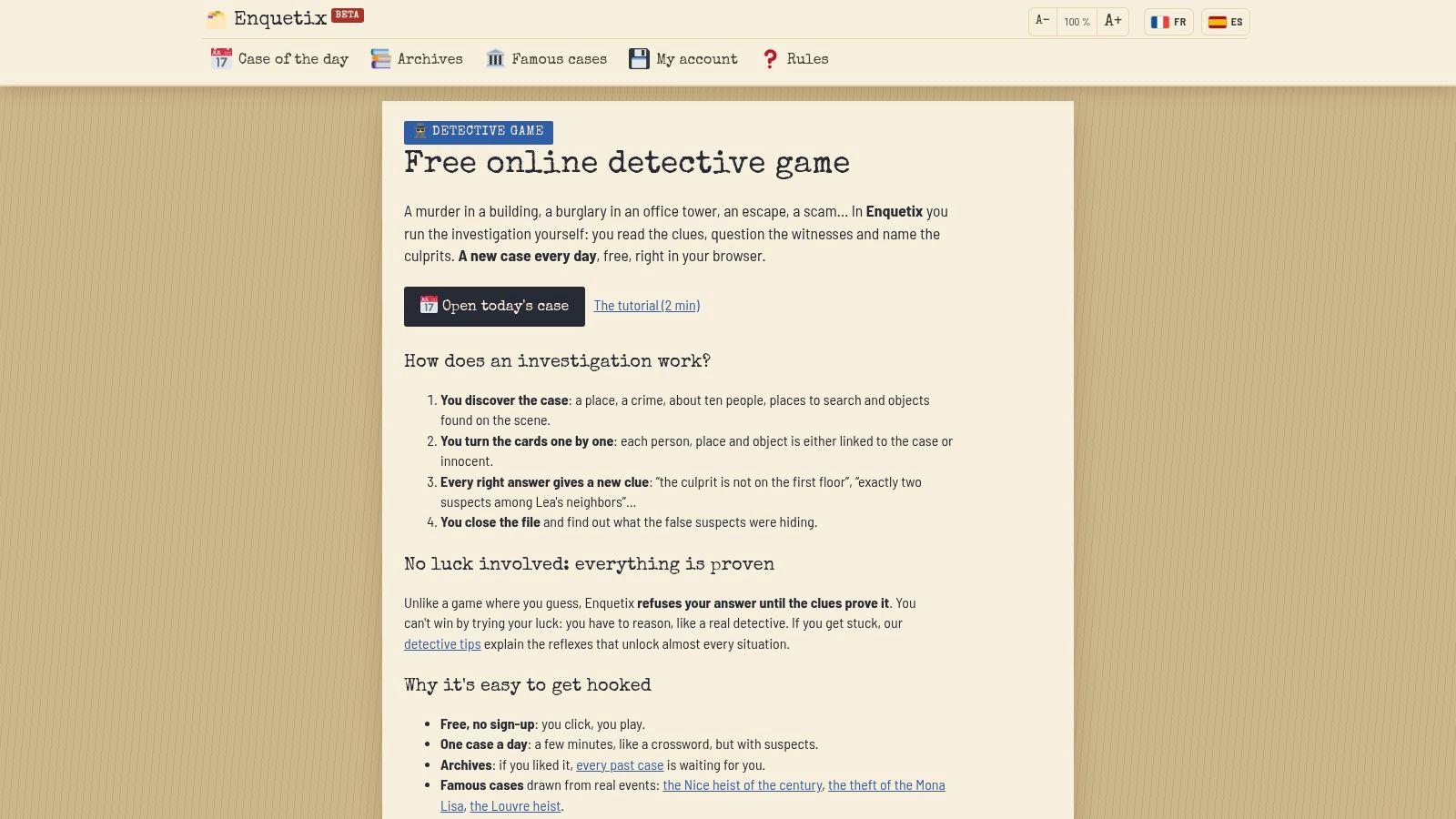
Prefer reading a clue to inspecting every corner of a room? Enquetix is the card-based option. You examine people, places, objects, and clues, then work through the information to identify the culprit.
Enquetix offers free daily cases without signup, plus an archive of previous mysteries. Correct answers reveal additional clues, giving you a visible progression through the reasoning rather than leaving you to wonder whether you missed a clickable patch of wallpaper.
More Logic, Less Visual Searching
This is a good fit if you like the moment when a statement rules someone out. The card format keeps the evidence explicit. You can focus on what a clue establishes and what remains uncertain.
It's less suitable if your favourite part of detective games is physically searching an illustrated scene. A card about an object isn't the same experience as noticing that object yourself.
- Useful accessibility feature: Adjustable text size helps when reading on a smaller screen.
- More cases to revisit: The archive gives you somewhere to go after the current mystery.
- Important limitation: The site describes the game as being in beta.
There isn't a supplied typical completion time, so treat this as short-format deduction with an uncertain finish time, not a guaranteed break-length game. I'd choose it over a scene-search game when reading and elimination sound relaxing, but tiny visual clues sound like work.
4. Your Scenario
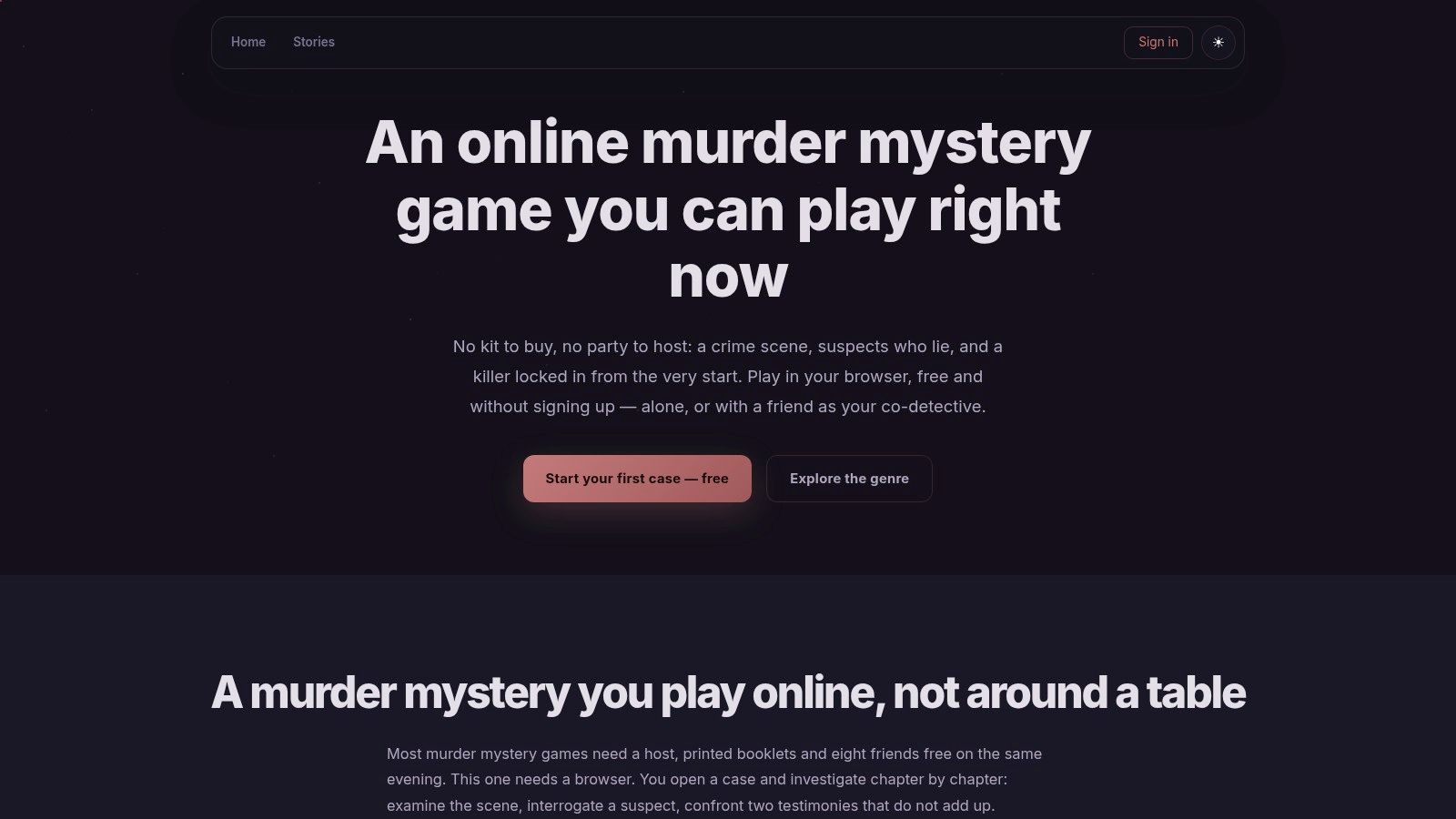
Your Scenario is for asking the question you want to ask. Instead of choosing only from preset dialogue, you type questions to AI-powered suspects, compare their replies, and work toward an accusation.
Your Scenario offers a free opening case in the browser without signup. A shared investigation mode also lets you investigate with a friend on separate screens, while a case file tracks suspects, clues, and unresolved threads.
Ask about a specific event, object, or contradiction. Broad questions give you less useful material to compare.
That approach matters here because conversational freedom can tempt you into chatting instead of investigating. Start with what the scene establishes, then ask a suspect to explain something connected to it. Keep their answer separate from your interpretation.
The site says the solution is fixed before play. That's reassuring for players who want a mystery with an established answer, although AI-generated dialogue still isn't the same as tightly scripted testimony.
There's no stated typical case duration on the reviewed page, and pricing for further stories isn't specified there. I'd reserve this for an open-ended session rather than a tightly timed break.
Choose it for remote collaboration and flexible questioning. Skip it if your ideal mystery is a carefully worded set of statements where every sentence has a fixed role.
5. PLAY INQUEST
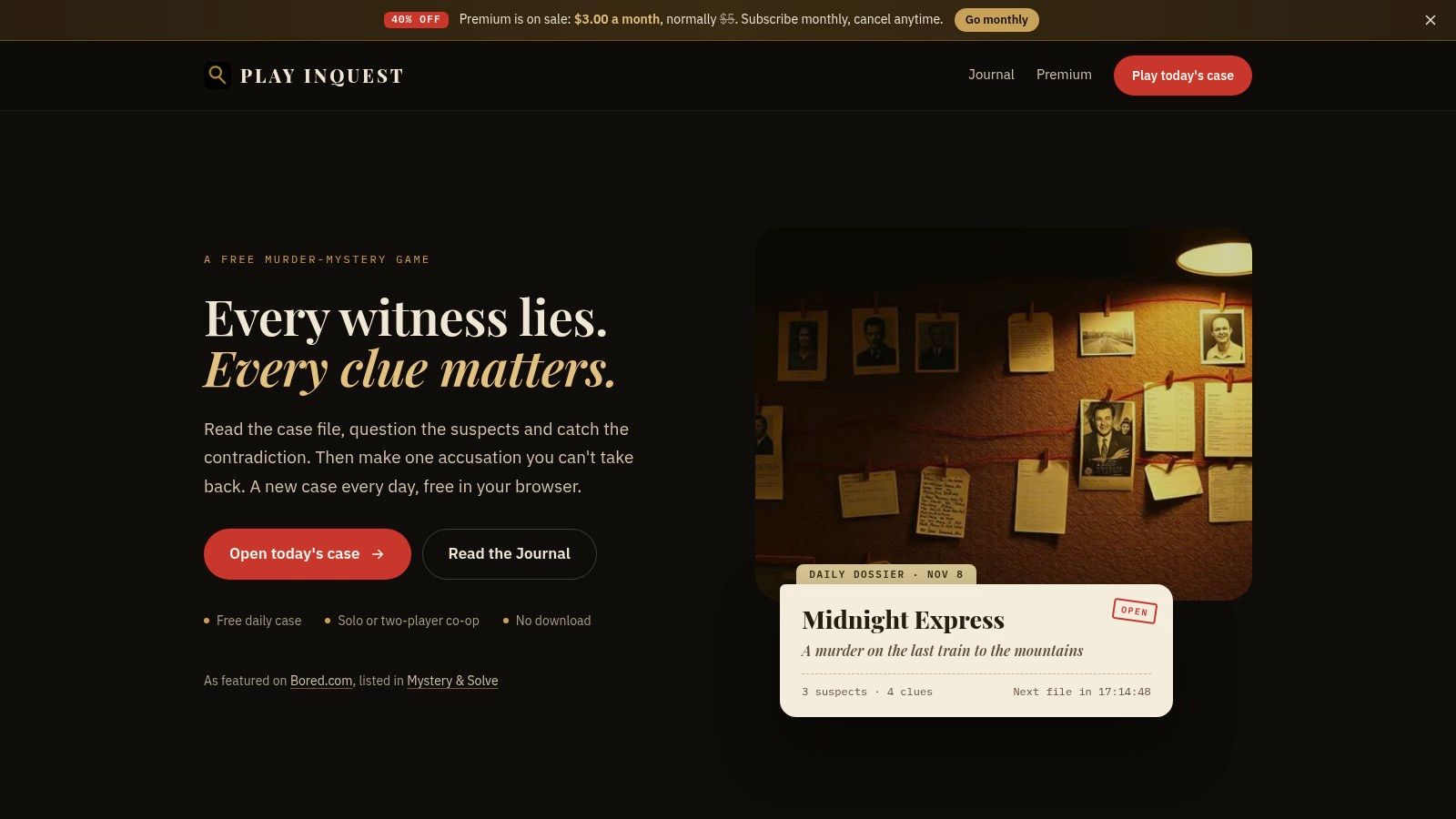
An interesting suspect isn't necessarily the guilty suspect. PLAY INQUEST is better approached as an evidence-and-alibi exercise, with scene searching feeding into a police-dossier-style investigation.
The free daily case at PLAY INQUEST runs without an account or download. You read the file, inspect crime scenes, record clues, and question witnesses. Browser support covers desktop, tablet, and mobile.
Build the Accusation Before Submitting It
The final accusation is a commitment, not an invitation to click through suspects until something works. That makes careful comparison more valuable, but it can feel unforgiving if you prefer experimentation and easy retries.
Use your notes to distinguish opportunity, motive, and evidence. A suspect can have an unpleasant motive without having had access to the scene. Likewise, an alibi only helps if it covers the relevant period and survives comparison with the other material.
- Good for shared reasoning: Solo and co-op play let you investigate alone or discuss the case with another person.
- More reading required: The dossier format is heavier than a simple illustrated-room puzzle.
- Uncertain timing: The site doesn't give a consistent case-length estimate.
I'd pick PLAY INQUEST when you want a mixture of searching and reading rather than either activity alone. If you're playing together, explain your competing theories before submitting. Agreement is useful only when you agree on the evidence, not just the name.
6. Forgotten Mystery

Forgotten Mystery is the step up when a compact puzzle leaves you wanting more material. Its investigations combine scenes, case files, witness statements, forensic reports, intercepted messages, and interrogations.
Forgotten Mystery estimates cases at 20 to 45 minutes and offers a free online case without signup or payment details. Further online cases require membership, so the free investigation is the sensible place to judge whether the format suits you.
Read Across Evidence Types
The attraction is cross-checking. A witness account might sound convincing until you compare it with a report or message. Don't read each document as an isolated story; look for the fact that another piece of evidence can confirm or contradict.
That extra material also creates the main drawback. If you're tired, a broader evidence set can turn into rereading rather than satisfying deduction. Keep a short note of what each source establishes.
- Device flexibility: Browser play supports phones, tablets, and computers.
- Progress limitation: Guest progress stays on the device being used.
- Different formats available: The site also offers printable files and escape-room or party materials, which aren't interchangeable with browser cases.
For a separate scene-focused comparison, there's The Countess's Necklace. Decide whether you prefer a contained scene or a broader file before committing to more cases.
I'd choose Forgotten Mystery for a deliberate sit-down session, preferably on a screen where reports remain comfortable to read.
7. Cold Case Inc
Cold Case Inc belongs in the settle-in category. You investigate fictional digital police files containing statements, photographs, recordings, CCTV, and sometimes material from phones or laptops.
Most cases take one to four hours, according to Cold Case Inc, which also offers the free short case Flat 33 and a free opening chapter of another case. There's no time limit, and account-based progress saving lets you return later.
Treat It Like a File, Not a Race
The strongest reason to choose this format is evidence comparison across media. A recording and a written statement don't demand the same kind of attention. You may need to revisit a passage or replay footage after another discovery changes its meaning.
A larger screen is the practical choice for document-heavy play. You can discuss the case with someone else, but keep a shared record of what you've established so the conversation doesn't become competing recollections.
- Good stopping flexibility: Saved progress supports a case spread across sessions.
- Signup consideration: Flat 33 requires a name and email.
- Main trade-off: The evidence-pack approach asks for more patience than an immediate scene puzzle.
For a separate illustrated-scene option, consider Grandma Hilde's Recipe Book.
I'd recommend Cold Case Inc when reading, reviewing, and reconsidering are the evening's entertainment. Don't choose it because it runs in a browser. Browser access removes installation, not the mental commitment of a substantial investigation.
8. Jack & Mani

If your favourite part of a mystery is challenging a suspect's account, Jack & Mani puts that interaction near the centre. You type questions to AI-powered suspects, compare responses with clues, and look for inconsistencies.
The opening investigation at Jack & Mani is free without signup. Indoor cases run in a browser on desktop, tablet, and mobile, while additional investigations are paid.
Questioning tactic: Ask the suspect to explain an established clue before revealing the theory you want them to confirm.
Free-text interrogation gives you more freedom than a dialogue menu. The trade-off is predictability: generated replies aren't equivalent to fixed statements that every player reads in exactly the same form. If you enjoy closely analysing scripted wording, that distinction may matter more than the conversational freedom.
Jack & Mani also offers group play around a screen, outdoor investigations in selected cities, and an academic language-learning mode. Choose the indoor investigation if you want a fully online experience; outdoor availability depends on location.
There isn't a typical duration stated in the supplied product details. Leave yourself room to follow up rather than assuming a conversation-led case will end quickly.
I'd pick this for players who enjoy formulating questions together. It's a weaker match if you want quiet visual searching or a fixed evidence set with no variation in how suspects respond.
9. Midnight Casebook
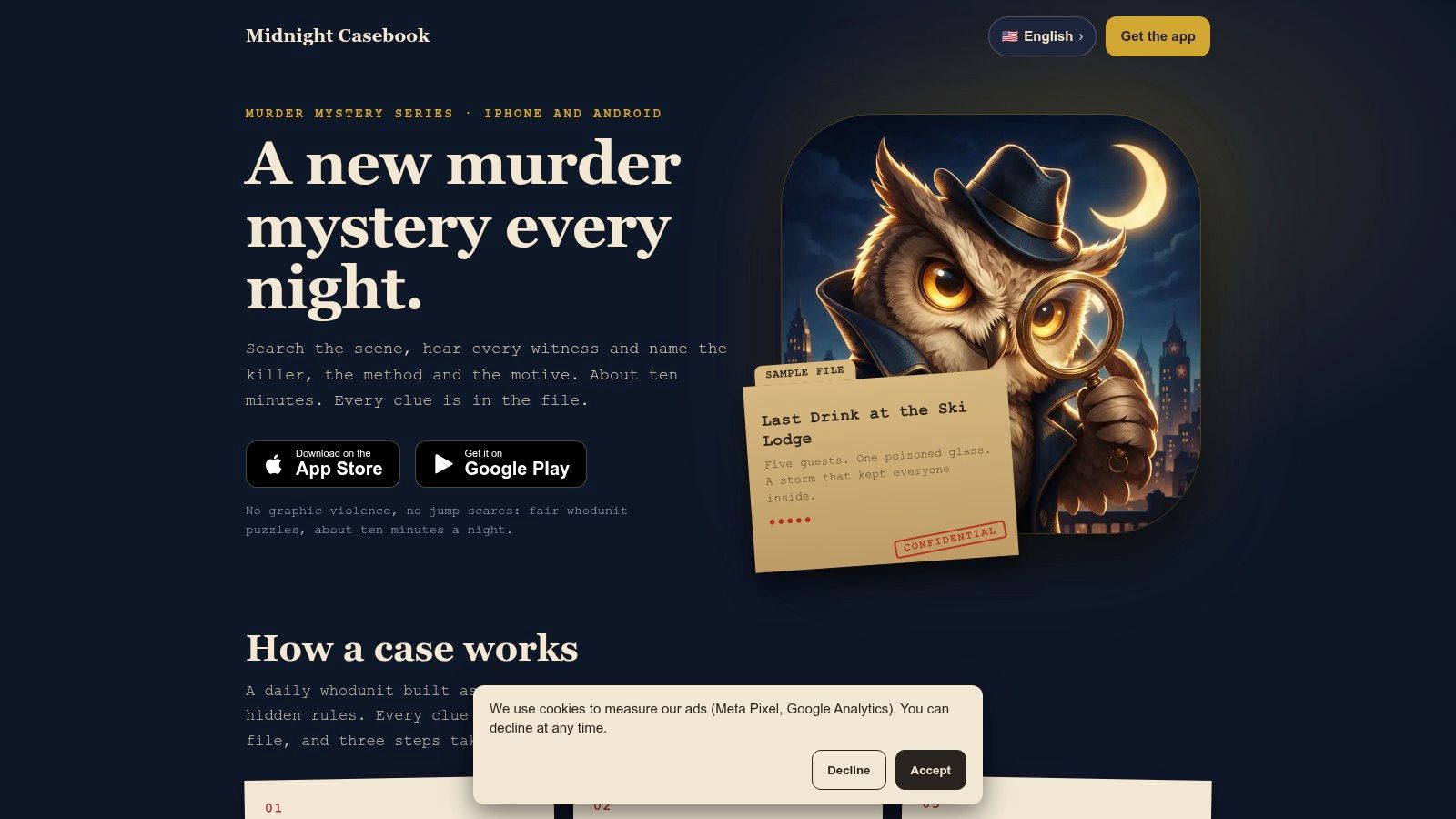
Midnight Casebook combines illustrated searching with voiced witness statements. The aim isn't merely to identify a culprit. You also need to work out how the crime happened and why.
Midnight Casebook describes cases as taking approximately ten minutes, with three accusations available before an explanation if you haven't solved the mystery. That structure gives you some room to reconsider without making endless guessing the entire game.
Check Access Before Planning a Daily Habit
The important limitation is commercial rather than mechanical. The reviewed FAQ says cases require Casebook Pro and doesn't list a free case. Although browser play is offered, the subscription is purchased through the iPhone or Android app.
That's more setup than a free browser puzzle you can open immediately. Check that the access route works for you before treating this as your regular quick mystery.
- Mixed evidence: Illustrated scenes and voiced testimony offer visual and listening tasks.
- Defined objective: Solving who, how, and why encourages a fuller explanation.
- Changing availability: Daily cases rotate, so the available mystery changes over time.
I'd choose it if you like a recurring detective ritual and don't mind paid access. If voiced statements are essential to your enjoyment, it's an appealing distinction; if you need non-audio alternatives, check the current interface before subscribing.
The stated non-graphic whodunit approach also makes this a different proposition from a realistic forensic scene.
10. Crime Scene 360 – Case 01
Crime Scene 360 makes scene handling the main activity. Rather than collecting an object into an inventory, you inspect a first-person environment, photograph evidence, place numbered markers, and build a case file.
Crime Scene 360 offers a free English browser preview without signup or download. The creator says the investigation process is based on real crime-scene practice, but the project remains in development.
Choose It for Procedure, Not a Guaranteed Quick Whodunit
The appeal is paying attention to how evidence gets documented. You also speak with people connected to the case, so the investigation isn't purely an exercise in photographing objects.
The language limitation matters. The full case is currently available only in Portuguese, while English access is limited to the preview. There's no supplied reliable completion estimate, so think of it as an exploratory preview rather than a fully specified evening's mystery.
- Distinctive interaction: Panoramic inspection, evidence photography, and numbered placards make documentation visible.
- Low setup: HTML5 browser access supports desktop or phone.
- Unfinished scope: Development status and limited English access restrict what you can reasonably expect.
For a separate illustrated whodunit, there's The Hut on the Grauhorn.
I'd try Crime Scene 360 when you're curious about procedure and comfortable evaluating a work in progress. Don't mistake a creator's realism claim for a professional qualification, and don't choose it expecting the same pace as a compact illustrated deduction.
How the Crime Scene Investigation Online Games Compare on Time, Cost and Fit
The fastest way to narrow this list is to ask two questions. What will you be doing at the scene, and how long will one session take? Some games have you tapping through rooms for objects. Others hand you a dossier or a deck of clue cards, and a few are built around typing questions at a suspect. Session length matters just as much, because several games here publish no duration at all, which means you are committing blind.
| Item | Play Time | Cost | Best For |
|---|---|---|---|
| Mystery Hunch | 5–10 minutes per case | Free to play in the browser | Short illustrated mysteries and evidence-based deduction |
| Criminal Atlas | 5–10 minutes for daily cases; 30–90+ minutes for longer investigations | Daily case is free; some features require email verification | Players seeking quick puzzles or deeper investigations |
| Enquetix | Not stated; new daily cases | Free, no signup required | Card-based clue deduction and archived cases |
| Your Scenario | Not stated | First case is free; further-story pricing not stated | AI-powered suspect questioning, solo or with a friend |
| PLAY INQUEST | Not stated | Daily case is free, no account required | Dossier-style investigations and cooperative play |
| Forgotten Mystery | 20–45 minutes per case | One online case is free; others require membership | Full investigations with varied evidence types |
| Cold Case Inc | 1–4 hours for most cases | Free short case and first chapter; other cases may be paid | Document-heavy cases that can be paused and resumed |
| Jack & Mani | Not stated | First investigation is free; additional investigations are paid | Open-ended AI interrogations and group investigations |
| Midnight Casebook | About 10 minutes per case | Requires Casebook Pro subscription | Short daily mysteries with illustrated scenes and voiced clues |
| Crime Scene 360 – Case 01 | Not stated | Free English preview | Forensic-style, first-person crime-scene investigation |
Read the table in clusters rather than row by row. For scene searching, Mystery Hunch, Midnight Casebook and Crime Scene 360 put you inside an illustrated or first-person environment. For reading evidence, PLAY INQUEST, Forgotten Mystery and Cold Case Inc lean on documents and case files. For talking to suspects, Your Scenario and Jack & Mani build the investigation around open questioning, while Criminal Atlas and Enquetix sit between those poles with puzzle-driven deduction.
Cost follows a similar pattern. Most games let you try something free, whether that is a daily case, a first case or a preview. The trade-offs show up in the fine print: email verification, memberships, paid follow-up cases, or in Midnight Casebook's case a subscription from the start. Where a game publishes no play time and no clear pricing past the free tier, treat the first session as a test run before you plan an evening around it.
Pick Your Next Case and Start Sleuthing
Start with the activity you enjoy, not the game with the most impressive premise. Searching a room, reading a dossier, and questioning a suspect can all feel like detective work, but they ask for different kinds of attention. Choose the wrong one when you're tired and even a good mystery can feel like homework.
For a brief break, Criminal Atlas's daily mode or Midnight Casebook's stated short format offers a clearer commitment than a game with no published duration. Enquetix suits clue-by-clue reasoning without detailed scene searching. For an evening with reports and recordings, Forgotten Mystery or Cold Case Inc is the more appropriate direction.
Make the Free Case Earn Your Time
Try free access before buying anything, where it's available. Check whether you enjoy the actual investigative loop, not just the opening story. An intriguing murder premise won't compensate if you dislike reading documents or typing questions.
Use a simple note-taking approach:
- Observation: Record what the scene or file establishes.
- Statement: Note what a suspect claims, without treating it as confirmed.
- Inference: Write the connection you're making and what could disprove it.
This keeps a strong hunch from becoming a fact. It also makes hints more useful because you can identify whether you're missing an object, misunderstanding testimony, or making an unsupported leap.
A satisfying solution explains the evidence. It doesn't just reveal the correct name.
Check Comfort as Well as Difficulty
Before settling in, test the text size and scene visibility on your device. Check whether you can identify clues without relying only on colour, move comfortably through the game, and follow any important audio. A short browser game isn't automatically accessible.
For conversation-led games such as Your Scenario and Jack & Mani, decide whether flexible responses are part of the fun or an unwanted complication. For document-heavy cases, make sure you can save progress before leaving. These practical details matter more than polish when you're choosing something for tonight.
Our early-prototype status means cases and scoring may change, so check back for updates rather than assuming everything will stay fixed. Share spoiler-free results with friends, but keep culprit names and decisive clues out of the message. The best recommendation gives someone a reason to investigate without doing the investigating for them.
Want a compact scene instead of a desk full of case files? Visit Mystery Hunch for free illustrated browser mysteries where you collect clues, compare suspects' statements, and accuse the culprit with proof. Pick a case that fits your break, then see whether your first hunch survives the evidence.