10 Computer Detective Games for Browser and PC in 2026

You've got twenty minutes, a browser tab, and a craving for a good whodunit. You don't want to spend your break installing something, learning a sprawling inventory system, or discovering that the interesting deduction happens much later.
Computer detective games cover very different kinds of investigation. Some ask you to inspect an illustrated room and catch a liar. Others give you a logic grid, a fictional search engine, or a ship full of unidentified bodies. Picking the right format matters more than picking the most impressive-looking game.
For a quick break, browser cases and daily puzzles make sense. For an uninterrupted evening, a PC mystery can give you room to follow leads, question characters, and reconsider an early theory. Neither format is automatically better. A satisfying deduction doesn't need a huge map, but it does need enough evidence to make your answer feel earned.
Choose by attention, not just availability. A game that opens instantly can still demand sustained concentration.
The picks below move from short browser investigations toward longer, more involved mysteries. Session recommendations describe when I'd play them, not guaranteed completion times. Puzzle speed depends on whether you spot the key connection immediately or spend your break confidently pursuing the wrong suspect.
Start with the kind of detective work you enjoy: examining objects, eliminating possibilities, reading testimony, or connecting scattered facts.
Table of Contents
- 1. Mystery Hunch
- 2. Clues by Sam
- 3. Murdle
- 4. Enquetix
- 5. Midnight Casebook
- 6. The Roottrees Are Dead
- 7. Duck Detective: The Secret Salami
- 8. Tangle Tower
- 9. The Case of the Golden Idol
- 10. Return of the Obra Dinn
- How the Computer Detective Games Compare on Access and Investigation Style
- Pick a Case Tonight and See Where Your Instincts Land
1. Mystery Hunch
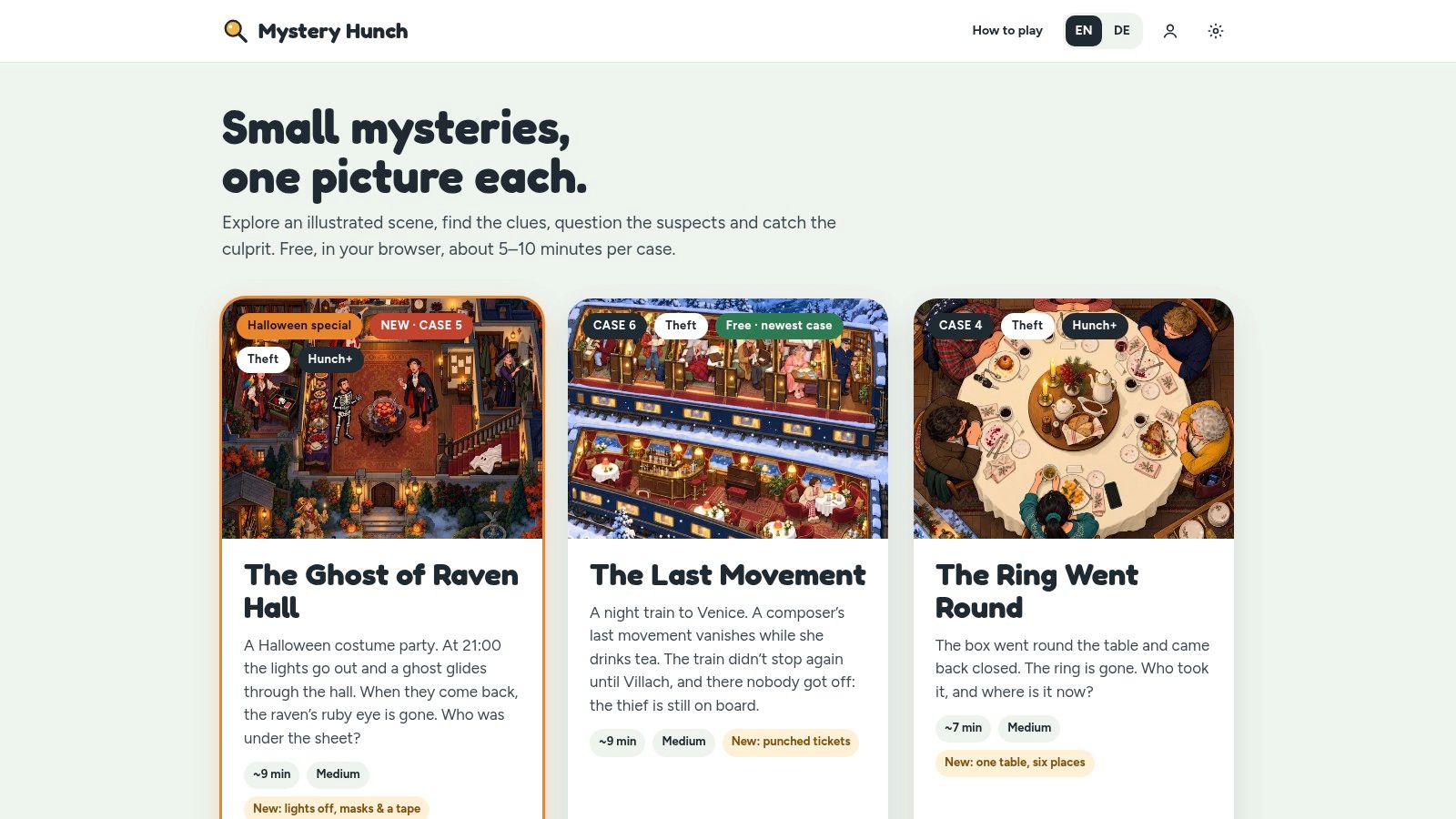
Best for a brief browser break when you want a crime scene, not a spreadsheet. Mystery Hunch offers free illustrated cases where you tap rooms and objects, gather clues, compare suspects' statements, and accuse the culprit with proof.
Each case takes about five to ten minutes. You can combine evidence in a notebook rather than keeping every observation in your head, which makes the format a useful starting point for players who like whodunits but don't want a long adventure.
The important distinction is between finding something suspicious and proving what happened. Explore the scene, read the statements, then use the notebook to connect them. Clicking every object isn't the same as solving the case.
A Small Investigation With a Clear Finish
The cases introduce different investigative ideas, including seating arrangements, masks, item combinations, and pencil rubbings. That gives you more variety than repeatedly looking for a single hidden object.
- Approachable structure: Difficulty labels and case summaries help you choose an investigation that fits your mood.
- Optional help: A partner can provide a hint at the cost of a star, with up to three stars available per case.
- Flexible presentation: Phone-friendly and wider-screen layouts, English and German options, and bright or noir visual styles offer different ways to play.
I'd start with the opening Mystery Hunch case when you want to test whether scene-based deduction suits you.
The trade-off is scope. This is an early prototype made by one person, not a sprawling commercial adventure. Cases, features, and scoring may change or be removed while the developer gathers feedback. Choose it for a compact investigation, not a promise of an extensive, permanent case library.
2. Clues by Sam

If your favorite part of detective fiction is eliminating suspects, Clues by Sam gets straight to that work. It's a free daily browser puzzle about identifying innocent characters and criminals from the available clues.
There's no mansion to wander around. You examine a suspect grid and work out which conclusions the evidence supports. That makes it a good fit for a short coffee break when you'd rather reason than read a scene-setting introduction.
The useful habit here is to separate a confirmed deduction from a promising guess. Marking a character because they seem likely can undermine the rest of your reasoning.
Pick It for a Daily Deduction Habit
Hints can point toward relevant clues or characters you can identify, rather than immediately handing over the entire solution. Use that support when you can't identify your next logical move, not just because you're impatient to finish.
- Works well: Quick browser access, focused logic, and shareable results.
- Offers more: Optional weekly bonuses, puzzle packs, and account-based extras.
- Falls short: The suspect grid won't satisfy someone looking for physical evidence or an explorable crime scene.
I'd choose Clues by Sam during a routine break where a daily puzzle feels like enough. If you're settling down for an evening of consecutive mysteries, the daily format may feel restrictive unless you want to explore its extra content.
3. Murdle
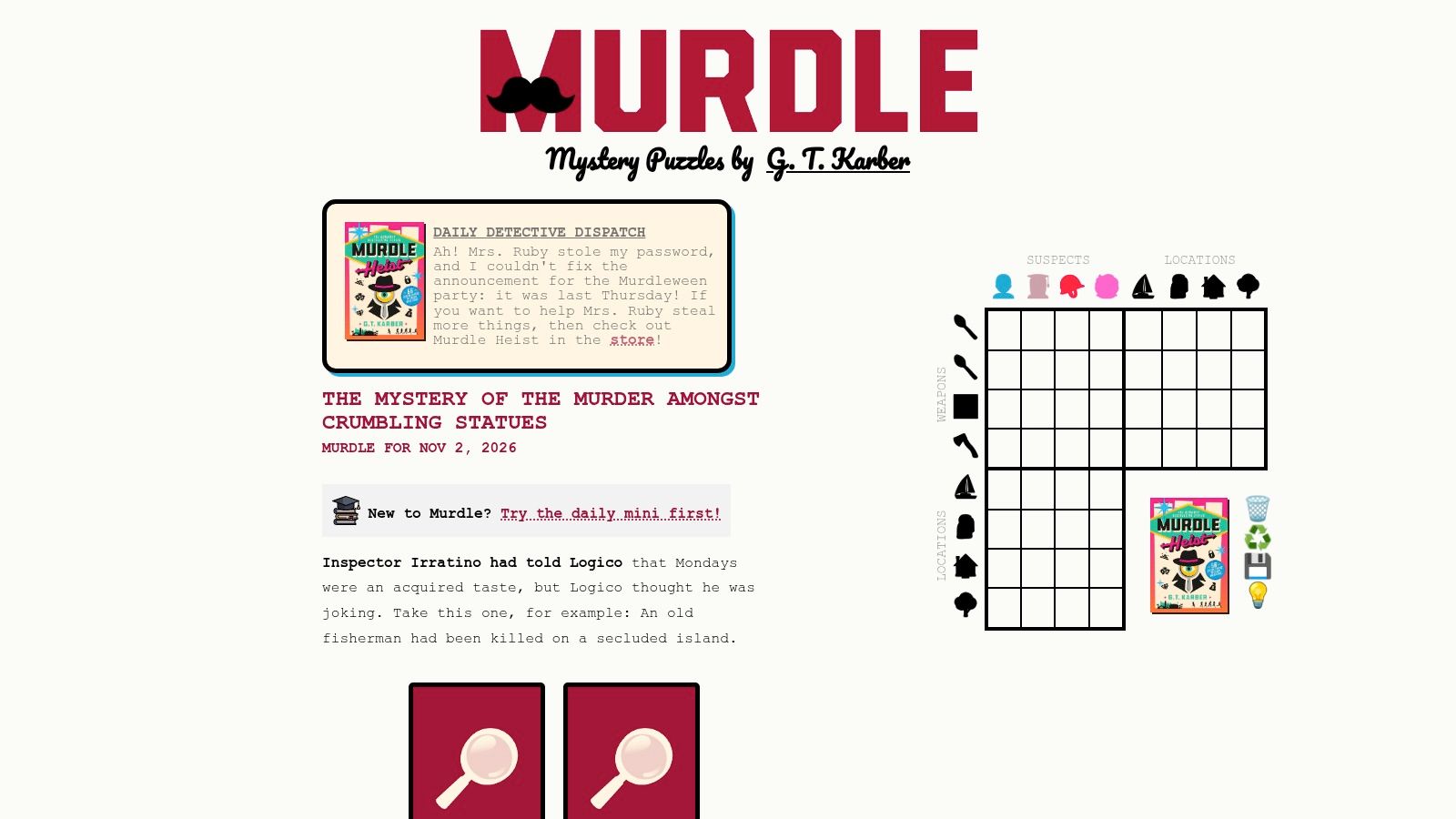
Murdle is the pick for people who enjoy crossing out impossibilities. G. T. Karber's daily murder-mystery puzzle asks you to connect suspects, weapons, and locations until the crime fits together.
The appeal is the recognizable whodunit framework. You're not merely sorting abstract symbols. You're deciding which person belongs with which details of a murder, using a grid to keep those relationships straight.
That grid is also the main trade-off. If marking exclusions feels satisfying, Murdle gives you a clear way to externalize your reasoning. If it feels like homework, a stronger murder premise probably won't change your mind.
Don't fill a square because the story sounds plausible. Fill it because a clue or an elimination supports it.
Start Small When Your Break Is Uncertain
The Mini provides a shorter entry point than the main puzzle. I'd choose it when interruptions are likely, then save the main daily mystery for a quieter stretch.
Hints are available, and companion books offer a separate route for players who enjoy the format away from a screen. The browser puzzle itself is free to play.
Murdle works best when you want deliberate, methodical deduction rather than exploration. Don't start a tougher daily puzzle expecting a guaranteed quick finish. Your stopping point depends on how comfortably you can hold the relationships together, not on how quickly the page loads.
4. Enquetix
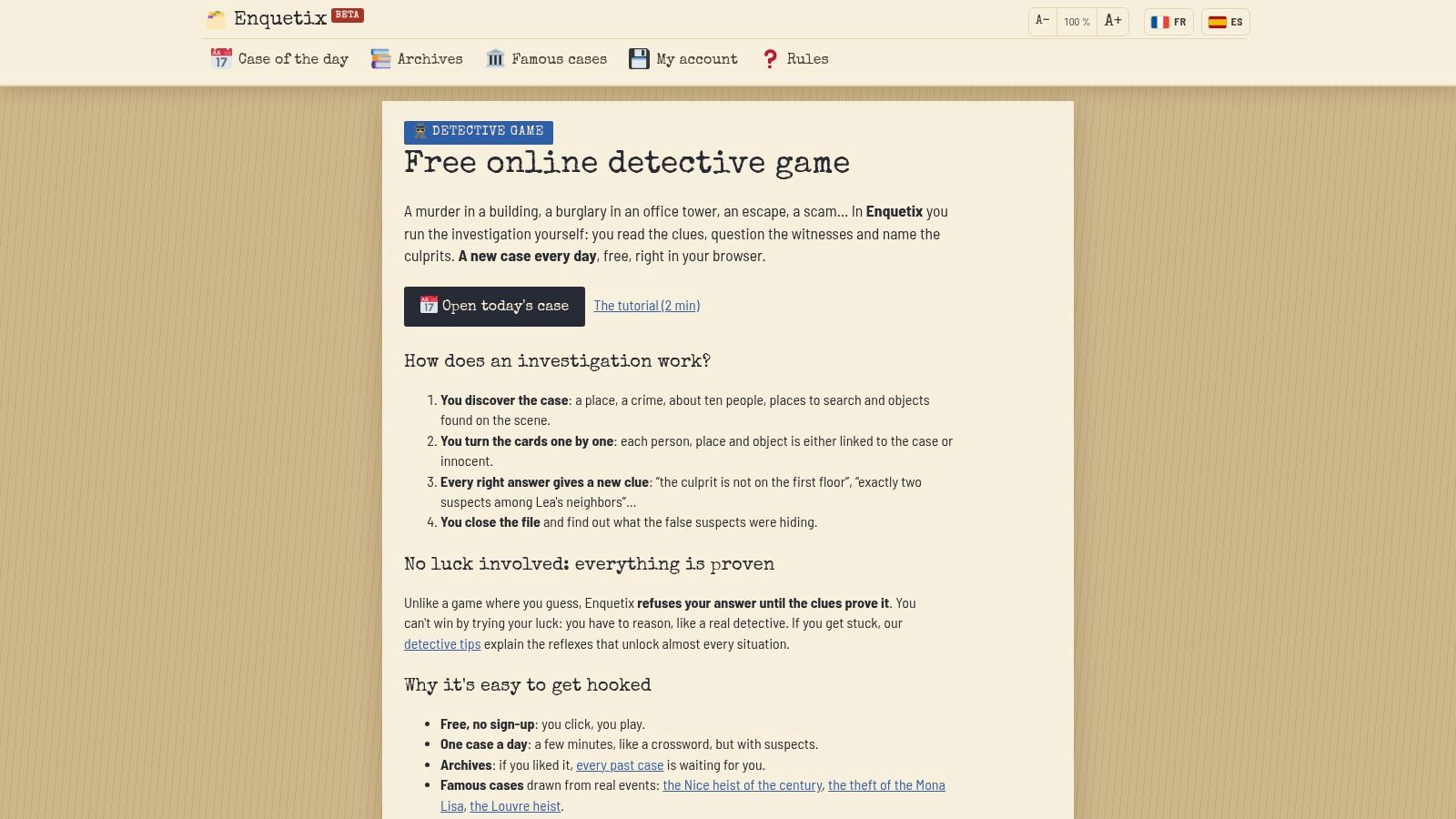
Want a browser mystery without waiting for tomorrow's puzzle? Enquetix combines a daily case with an archive of past investigations.
Its cases revolve around suspects, places, and objects. You turn cards to uncover witness information and evidence, then use those details to rule out possibilities. It's closer to working through a compact case file than searching an illustrated room.
That distinction matters on a casual break. You can focus on what each piece of evidence establishes without spending your attention hunting for tiny hotspots.
- Access: Free browser play without signing up.
- Getting started: A tutorial and detective tips explain the approach.
- Device choice: Computer and phone play suit different break-time setups.
Better for Evidence Readers Than Room Explorers
I'd choose Enquetix when you want a short investigation and the option to continue into another case afterward. The archive makes it more flexible than a strictly daily-only routine.
The compromise is presentation. Cards aren't a substitute for physically exploring a crime scene, and the English version comes from a French setting. If polished dialogue and elaborate atmosphere are your main reasons for playing, this may feel comparatively spare.
Approach each card with a concrete question: does it establish a location, eliminate a suspect, or connect an object to the crime? That keeps the investigation focused on deduction instead of turning cards and hoping the answer becomes obvious.
5. Midnight Casebook

A suspect's wording can be more interesting than a locked drawer. Midnight Casebook suits that preference, framing its daily browser mystery around a written crime scene, character statements, and a multipart solution.
You're working toward who committed the crime, how they did it, and why. That encourages you to build an explanation rather than stop as soon as somebody looks suspicious.
Choose it for a quiet reading break. It's less suited to playing while half-listening to a meeting or repeatedly switching tabs, because interpreting statements is the central activity.
Read for Claims You Can Test
Say a suspect describes where they were when something happened. Treat that as a claim to compare with other evidence, not a fact because the character sounds convincing.
The same discipline helps with motive. A reason to want the victim gone doesn't automatically establish the method or opportunity.
- The strength: Story-forward deduction without installing a game.
- The compromise: Reading carries the experience; you won't explore a spatial crime scene.
- The limit: A daily case may leave you wanting more if you're looking for a backlog.
Midnight Casebook is free to try. I'd pick it over a logic grid when you want a little character and narrative during a break, but I'd choose a longer adventure if you're in the mood to inhabit a setting rather than read through a compact mystery.
6. The Roottrees Are Dead
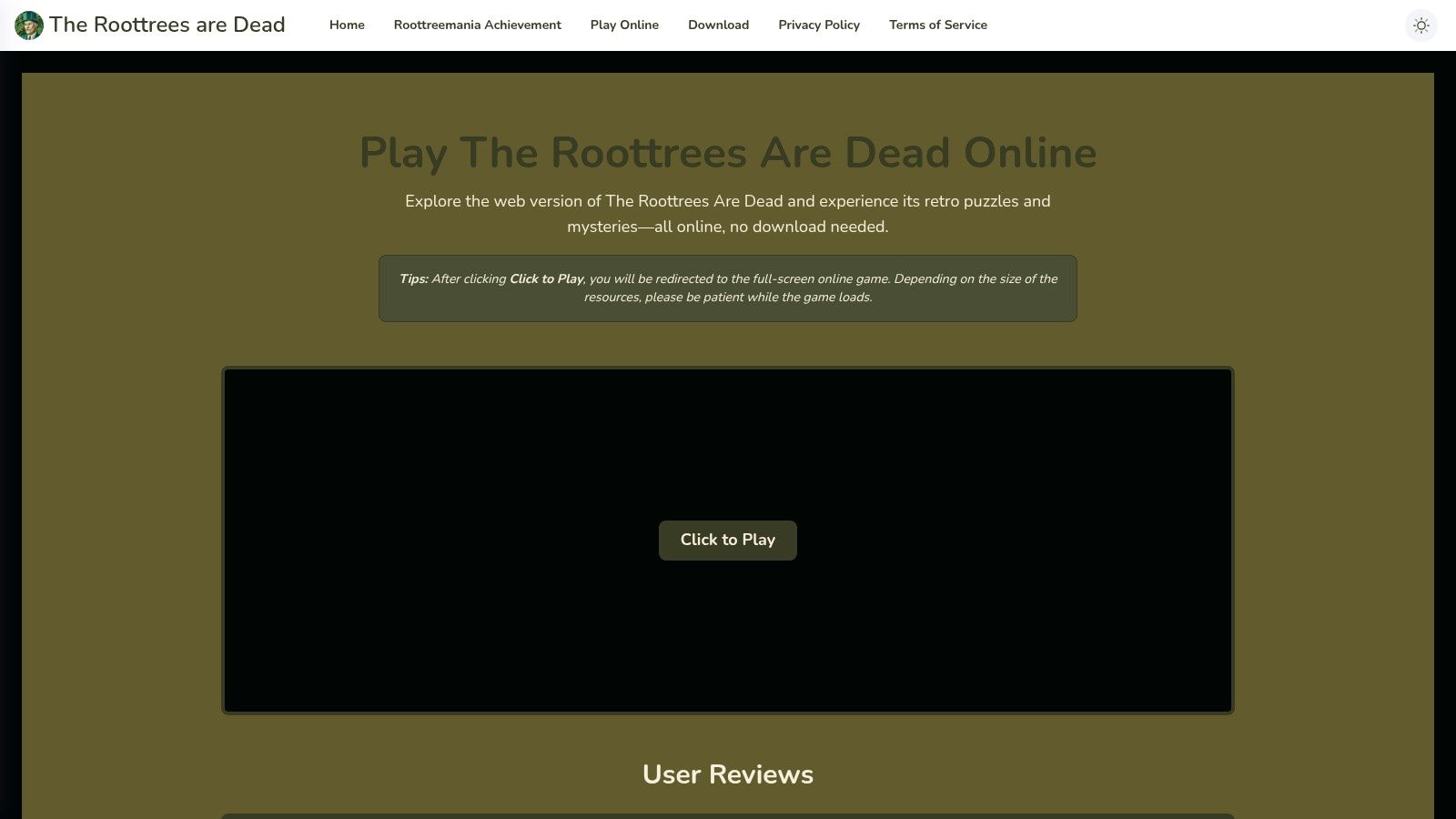
Browser access doesn't necessarily mean a quick case. The Roottrees Are Dead asks you to reconstruct a wealthy family's history through a retro-styled computer interface.
Instead of catching a culprit in a room, you're establishing identities and relationships. You follow leads, connect scattered information, and determine where people belong in a family tree.
I'd choose it for an uninterrupted evening when you're happy to keep notes. It's a poor fit for a hurried break where you'll forget why a particular name mattered as soon as you close the tab.
Follow Leads, Not Just Names
A useful approach is to write down the question behind each search. Are you trying to identify a person, confirm a relationship, or distinguish between plausible candidates?
That prevents an absorbing research interface from turning into aimless browsing.
- Browser option: Lets you sample the investigative concept without downloading.
- Paid PC edition: Expands the experience for players who want a larger commitment.
- Main trade-off: Genealogy rewards patient cross-referencing, not rapid accusations.
The appeal is the feeling of independently pursuing a lead. The drawback is that uncertainty can persist while you gather enough context to resolve it.
If you're choosing between this and a daily suspect puzzle, ask whether you want a clean elimination problem or a growing web of connections. Roottrees is the stronger recommendation for the latter, especially when you can return to it with your notes intact.
7. Duck Detective: The Secret Salami

Not every investigation needs a grim crime scene. Duck Detective: The Secret Salami puts a down-on-his-luck duck on an office theft case, with voiced characters and a deliberately silly noir tone.
You question suspects, collect clues, and fill missing words into deductions. That gives the investigation a visible structure: you're assembling conclusions rather than wondering what kind of answer the game expects.
I'd save it for a relaxed evening when you want a self-contained story and some comedy. It's a paid game, so it makes less sense than a free browser puzzle if you only want a momentary distraction.
Know your preference: Guided deduction can feel welcoming or restrictive, depending on how much freedom you want.
Personality Over Procedural Realism
The humor isn't incidental. If a duck detective already sounds irritating, the accessible investigation probably won't overcome the tone.
If the premise appeals, the combination of interviews, clue gathering, and conclusion-building offers more character interaction than a daily grid. You get a detective adventure rather than a bare deduction exercise.
The main compromise is openness. Experienced mystery players may prefer a game that lets them pursue less structured theories. Duck Detective is a better recommendation when you want personality, approachable puzzles, and a clear investigative direction, especially after a tiring day when a demanding web of evidence sounds like work.
8. Tangle Tower

Choose Tangle Tower when you want to visit the mystery's setting, not just process its evidence. SFB Games' illustrated point-and-click adventure takes you into a peculiar mansion to investigate a murder.
You examine objects, question suspects, and solve puzzles. Hand-drawn art and voice acting make the cast and location part of the attraction, rather than decoration around a logic problem.
That broader experience needs room. I'd start it on an evening when you can explore without constantly watching the clock, then return when you're ready to continue the story.
A Mansion Comes With Adventure-Game Detours
Tangle Tower blends evidence gathering with environmental puzzles. If you want every challenge to be a direct test of your murder theory, those detours may interrupt the part you enjoy most.
- Choose it for: Expressive suspects, scene exploration, and a distinctive illustrated setting.
- Expect to do: Move between examining objects, listening to dialogue, and solving puzzles.
- Accept the trade-off: Some challenges lean toward adventure-game logic rather than pure deduction.
The paid game is available on multiple platforms. Choose your version around where you'll comfortably read, inspect scenes, and listen to the characters.
Tangle Tower is the better fit than a compact browser case when atmosphere matters as much as reaching the answer. It's less suitable when you want to open a tab, make a decisive deduction, and leave immediately afterward.
9. The Case of the Golden Idol
The Case of the Golden Idol gives you illustrated scenes to inspect and narrative conclusions to assemble. Its central pleasure is working out what happened from the evidence in front of you.
People, objects, and their relationships matter. You collect relevant words and use them to complete explanations, while the individual cases connect into a broader mystery.
I'd choose it for a focused evening when you want to wrestle with a theory. Individual scenes offer a defined investigative target, but that doesn't make them effortless quick-break puzzles.
Explain the Event Before Filling the Blanks
Try describing the scene in plain language before committing to the game's wording. Who acted, what changed, and which observation supports your explanation?
That approach keeps word placement from becoming a guessing exercise. If your theory only works after ignoring an awkward detail, reconsider the theory.
- Strongest feature: Careful observation feeds directly into your conclusions.
- Main difficulty: The less-guided format asks you to tolerate uncertainty.
- Purchase consideration: The game is paid, with additional story content sold separately.
The stylized art also deserves a moment of attention before you decide whether it suits you. You need to parse visual details, not merely appreciate the overall look.
Choose Golden Idol over a conversational adventure when you'd rather reconstruct events than interview a cast. It's especially suitable for an evening where solving a difficult scene is more appealing than making steady, easy progress.
10. Return of the Obra Dinn

A ship, a missing crew, and a supernatural pocket watch make Return of the Obra Dinn a very different investigation from a suspect interview. You revisit moments from the crew's final voyage and determine people's identities and fates.
The work happens across scenes. A detail that seems unimportant in one moment may help establish who somebody is elsewhere, so isolated guesses won't take you as far as careful cross-referencing.
This is a paid PC mystery I'd reserve for a weekend or an uninterrupted evening. Don't choose it because you want the quickest route to feeling clever.
Keep observation and interpretation separate. Knowing where somebody stood isn't the same as knowing who they were.
A Strong Fit for Patient Observation
The monochrome, retro-inspired presentation is distinctive, but it also affects how you read the evidence. Make sure you're comfortable examining those visuals before choosing it for a long session.
There's no conventional suspect-interview loop to fall back on. You'll need to connect appearances, situations, and details from the voyage.
The reward is a mystery built around sustained inference rather than combat. The compromise is a heavier memory and attention burden than a compact browser case.
Choose Obra Dinn when you want an investigation to occupy your thoughts between sessions. Skip it for now if you're tired, interruption-prone, or looking for frequent reassurance that every deduction is correct.
How the Computer Detective Games Compare on Access and Investigation Style
Start with Access, then read across to the kind of thinking each game asks for. Mystery Hunch runs free in the browser with cases of about five to ten minutes; the daily browser rows suit repeat short sessions, while the paid rows fit a full evening.
| Item | Access | Investigation Style | Best For |
|---|---|---|---|
| Mystery Hunch | Free browser play | Explore an illustrated scene, compare clues with statements, and accuse with proof | Quick, self-contained whodunits with varied mechanics and optional hints |
| Clues by Sam | Free browser puzzle; daily cases and extras | Solve suspect-grid puzzles using clues and optional hints | Quick daily logic puzzles and shareable results |
| Murdle | Free browser puzzle; daily main puzzle and Mini | Deduce suspects, weapons, and locations with a logic grid | Fans of classic whodunit deduction and daily challenges |
| Enquetix | Free browser game; no sign-up required | Turn evidence and witness cards to rule out possibilities | Short investigations with an archive of past cases |
| Midnight Casebook | Free daily browser mystery | Read the crime setup and suspect dialogue, then deduce who, how, and why | Story-forward mysteries built around reading and interpretation |
| The Roottrees Are Dead | Browser version available; expanded PC edition is paid | Research leads through an in-game computer to reconstruct a family tree | Longer investigations connecting identities and scattered facts |
| Duck Detective: The Secret Salami | Paid game | Interview suspects, collect clues, and complete deduction prompts | A compact, funny detective story with approachable puzzles |
| Tangle Tower | Paid game; available on multiple platforms | Explore a mansion, examine objects, question suspects, and solve puzzles | Players seeking an expressive, explorable mystery adventure |
| The Case of the Golden Idol | Paid game; additional story content sold separately | Inspect illustrated scenes and assemble evidence-based narrative conclusions | Challenging deduction across linked cases |
| Return of the Obra Dinn | Paid game | Revisit moments from a ship's final voyage and identify each crew member's fate | Players who enjoy demanding, interconnected investigations and careful observation |
Use the table as a filter. If you want statements to compare and a clean accusation, stay near the top. If you want a heavier chain of inference, move toward Golden Idol and Obra Dinn.
Pick a Case Tonight and See Where Your Instincts Land
Choose the session first, then the game. For a quick browser break, scene-based cases give you objects and statements to compare without asking you to settle into a long adventure. For a daily habit, Clues by Sam and Murdle put structured deduction at the center.
If reading testimony is what you enjoy, Midnight Casebook is the more natural choice. Enquetix makes sense when you want compact cases with an archive, while The Roottrees Are Dead suits an evening of following leads and organizing relationships.
Match the Investigation to Your Energy
For a relaxed story-led session, Duck Detective offers comic character work and guided conclusions. Tangle Tower is the stronger match when you want to explore a setting, listen to suspects, and enjoy the atmosphere around the mystery.
Golden Idol and Obra Dinn ask for more patience with uncertainty. Choose them when revising a theory sounds enjoyable, not frustrating.
- For a short break: Prefer a clearly bounded case or a smaller daily puzzle.
- For steady practice: Return to a deduction format you understand and enjoy.
- For a weekend: Pick a mystery whose interconnected clues reward sustained attention.
Don't judge a game only by whether you solved it without help. A useful hint can preserve the pleasure of making the final connection yourself. In a study of cognitively challenging puzzle games, players whose psychological needs were satisfied showed more resilient behavior and greater enjoyment, a useful reason to value support rather than treat it as cheating.
Make Sure You Can Read the Evidence Comfortably
Simple graphics don't guarantee an accessible mystery. Before committing to a longer session, check whether you can comfortably read clue text, distinguish important objects, and use the required controls.
The practical questions in this gaming accessibility overview are especially relevant to detective play: whether clues depend on color, whether audio information has a visual equivalent, and whether text and input options meet your needs. These are functional requirements when the evidence itself is the game.
Mystery Hunch remains an early prototype, so its cases and scoring may change. Treat that as an invitation to give specific feedback about confusing clues or interactions, rather than assuming every rough edge is intentional.
Above all, choose a mystery you can give your attention to tonight. A small case solved thoughtfully is more satisfying than a grand investigation you're too distracted to follow.
Mystery Hunch offers free illustrated browser investigations where you examine scenes, combine clues in a notebook, and check suspects' statements before accusing someone with proof. Visit Mystery Hunch, pick a case that fits your break, and see whether your first hunch survives the evidence.