Clue Online Game: How It Differs from the Board

Your friends are around the Clue board, someone's guarding their notes, and an accusation involving the study and the candlestick is about to go badly. That's a lovely evening when everyone's free. Tonight, though, you've got a browser open, nobody else at the table, and just enough energy for a small mystery.
You can still get the satisfying part: spotting something odd, testing a story, and realizing why a suspect's explanation can't be true. You just need to know whether you're opening a digital board game or a solo scene-based puzzle.
Table of Contents
- A Clue Online Game in Plain Terms
- Board Night Compared With a Browser Case
- What the 1949 Design Still Gives a Browser Case
- From Looking Around to Naming the Culprit
- Clue Patterns Inside One Illustrated Scene
- Why a Short Case Can Still Stall You
- Privacy, Data and Safety in Free Browser Mysteries
- Start With One Free Case Tonight
A Clue Online Game in Plain Terms
A clue online game, in the sense used here, is a solo whodunit played in a browser, built around looking rather than dealing cards. You study an illustrated place, inspect objects, read suspects' statements, and assemble enough evidence to name the culprit.
Say a necklace has disappeared during dinner. Instead of asking another player to show you a card, you examine the display case, check where the guests were standing, and compare their accounts. The answer comes from the scene and its contradictions, not from discovering which cards someone else holds.
That distinction matters because the search phrase covers different experiences. Someone looking for Clue online might want the familiar board game with remote opponents. Someone else wants a short detective puzzle they can finish alone.
Check before you start: A digital adaptation recreates a board game. A scene-based mystery gives you a crime to investigate directly.
Clue, known as Cluedo outside North America, is familiar enough to serve as shorthand for deduction. Its reach is substantial: BBC coverage reports Hasbro's attribution of more than 150 million copies sold worldwide to the franchise.
That familiarity can create the wrong expectation. A solo browser case usually keeps the crime, suspects, locations, and evidence-based elimination, but removes hidden hands and conversation with opponents. You aren't trying to read your friend's expression when you name a weapon. You're trying to explain why a wet doorway contradicts someone's story.
Neither format replaces the other. The useful question is simpler: do you want company tonight, or do you want a mystery you can investigate without arranging company?
Board Night Compared With a Browser Case
Choose the board when you want a social evening of deduction and guarded information. Choose a scene-based browser case when you want to investigate alone in a short sitting.
The biggest difference isn't the screen. It's where the uncertainty lives. At the table, other players hold information you need. In a solo case, the designer has placed that information in objects, dialogue, and relationships you haven't understood yet.
Classic Clue beside a clue online game
| Part of the case | Classic Clue or Cluedo | Clue online game |
|---|---|---|
| Who plays | A small group at one table | Usually a solo player |
| How evidence works | Hidden cards you reveal and cross off | Objects, places, and statements you collect |
| What you eliminate | Suspect, weapon, and room | Claims that don't match the scene |
| Social bluffing | You watch what other players reveal and conceal | None; you reason alone |
| Typical time | An activity for a shared game night | A compact case intended for a short sitting |
| How you win | Correct who, where, and how | Accusation supported by proof |
| Help when stuck | Informal nudges or agreed house rules | Optional hints, sometimes with a score penalty |
Hidden information versus overlooked information
In classic Clue, crossing something off your sheet means you've learned it can't be in the solution. Another player's response can be useful even when you don't see every card involved. Paying attention between your own turns is part of playing well.
A browser case asks for a different kind of attention. You might already possess every necessary clue and still lack the answer because you've interpreted a statement too generously. A suspect saying they never entered the pantry means something different from saying they never touched its door.
That makes a wrong hunch feel different, too. Nobody else steered the conversation or distracted you with a suspicious suggestion. You can return to the evidence and identify exactly where your assumption slipped in.
The social side of the board also deserves a little precision. Clue isn't permission to lie about the cards you must show. The fun comes from controlling what you reveal within the rules, choosing useful suggestions, and watching what others appear to know.
A solution versus an explanation
At the board, the final accusation identifies the hidden combination. In a narrative browser case, selecting the right suspect may not be enough. You may need to attach the object or contradiction that supports your accusation.
That's a meaningful improvement if you enjoy detective fiction for its explanations. Guessing the culprit because they look shifty shouldn't feel equivalent to proving that their account is impossible.
Official digital adaptations of Clue also exist on phones and computers. They belong on the board-game side of this comparison when they preserve its rules. An illustrated room with tappable evidence is a different design, even if both experiences involve suspects and murder.
Let the company row decide first. If you want to laugh about someone's terrible accusation, gather the group. If you want to think and reach a clean conclusion, choose the solo case.
What the 1949 Design Still Gives a Browser Case
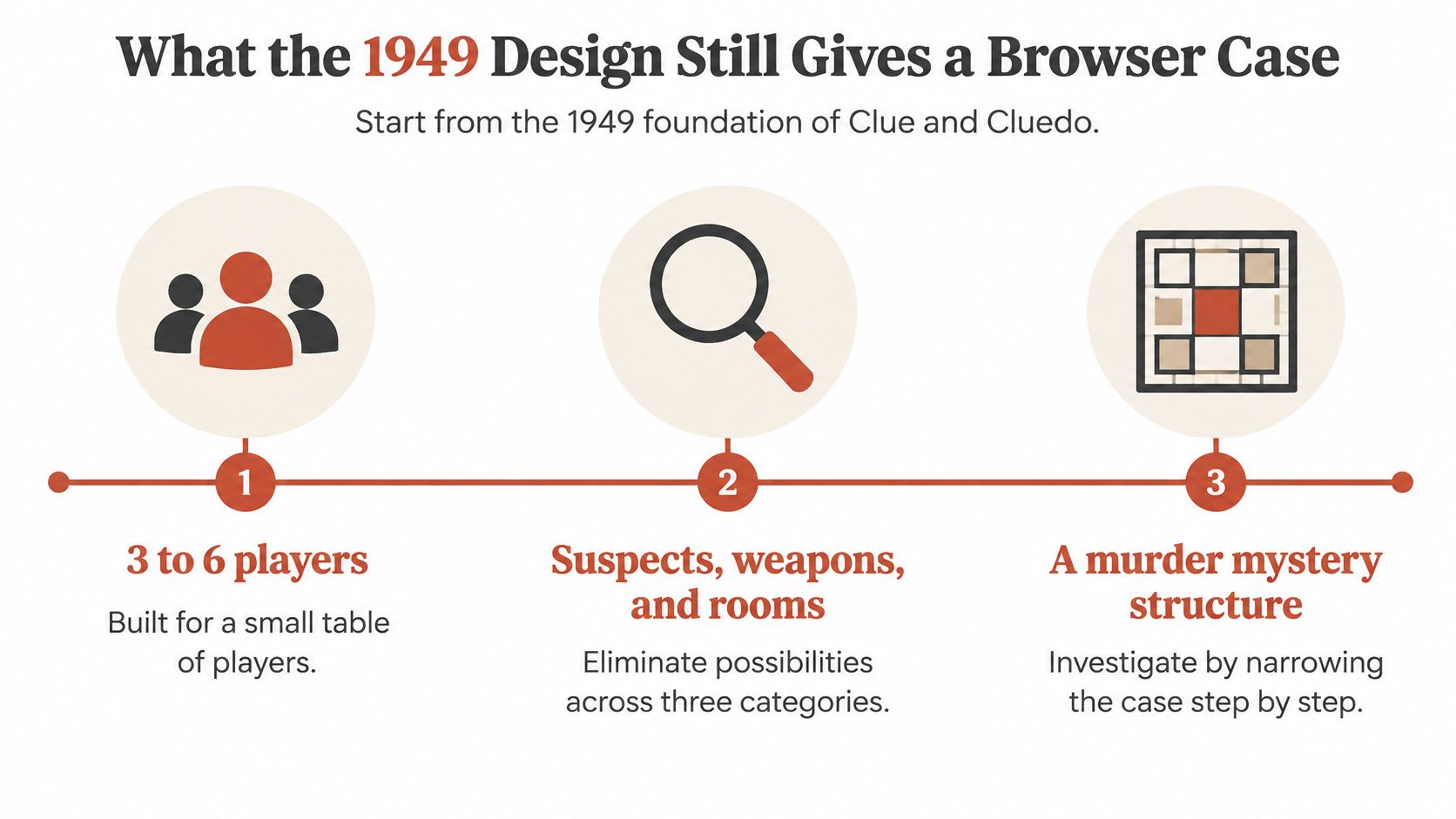
According to Wikipedia's Cluedo history, British designer Anthony E. Pratt devised the game in 1943, before its commercial release in 1949; the original design supported three to six players investigating through suspects, weapons, and rooms.
The important inheritance isn't the mansion décor. It's a manageable problem: a crime with defined possibilities that you can narrow through evidence.
What survives without the table
- A bounded cast: You investigate the people the case introduces, rather than inventing an unknown intruder whenever the evidence becomes awkward.
- Meaningful locations: A doorway, seat, or cupboard can establish access or make an account impossible.
- Elimination through evidence: You reject an explanation because it conflicts with something established, not because you dislike the suspect.
Consider a theft at a country house. A guest claims to have stayed outdoors, but an object they describe was only visible inside a closed room. That contradiction gives you a reason to investigate further. It doesn't depend on dice, movement, or another player's hand.
What stays behind
The browser puzzle can discard the confidential envelope and physical tokens. It can also remove turn order and the need to assemble a group. Those are methods of organizing a shared game, not requirements for deduction itself.
The analogy is simple: the board is a checklist you complete in public; the browser case is a photograph you interrogate in private. Both reward narrowing possibilities, but the solo version makes observation do more of the work.
From Looking Around to Naming the Culprit
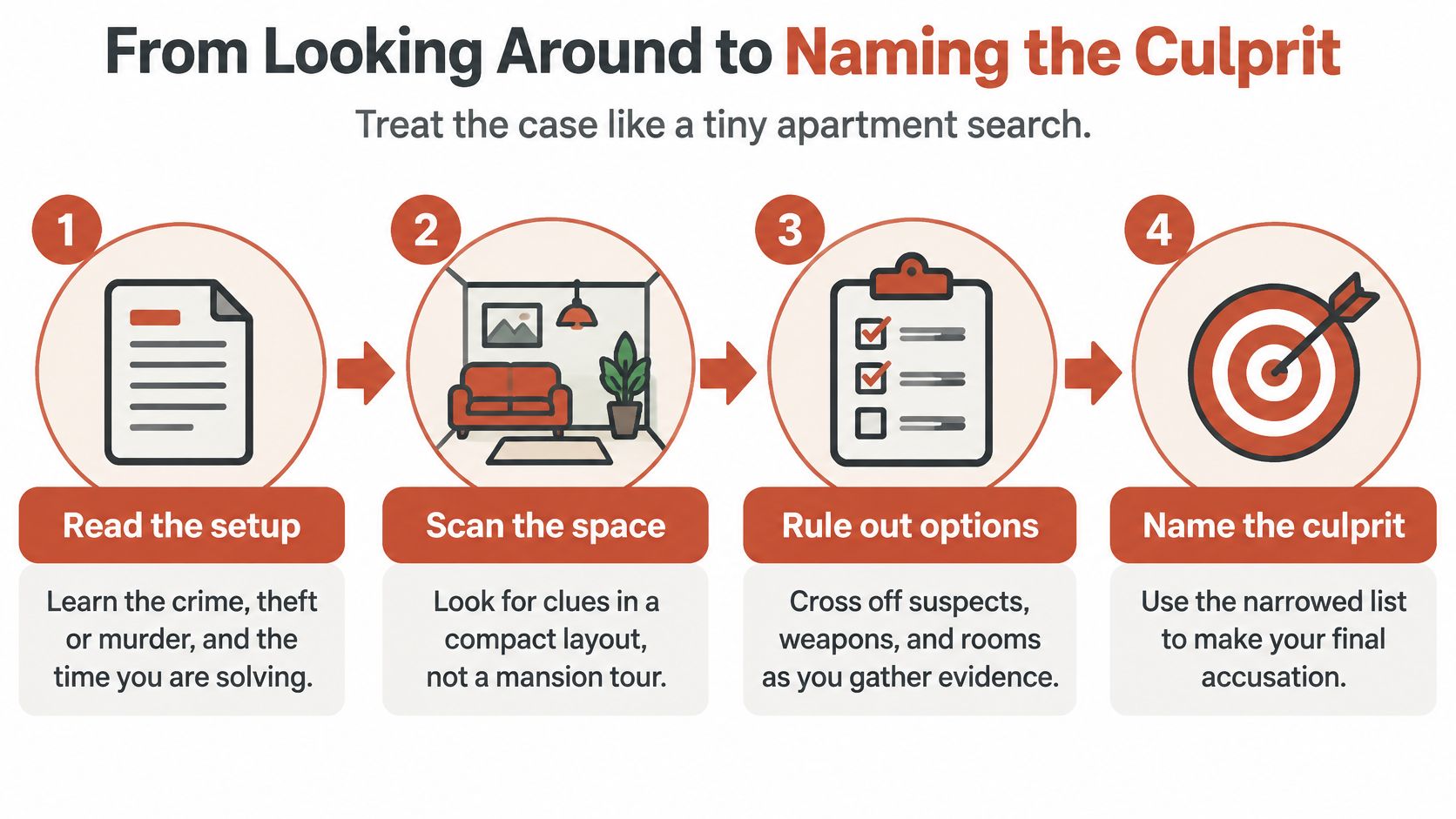
Treat the case like a tiny apartment search, not a mansion tour. You don't need to rush through every visible object. You need to establish what happened, identify which facts could distinguish the suspects, and test those facts in a sensible order.
Follow the investigation loop
Read the setup. Establish whether you're investigating theft, murder, or another event. Notice the stated objective and any expected duration before you commit.
Scan before tapping. Look across the whole illustration for entrances, people, containers, and anything that seems out of place. A broad view helps you understand where individual discoveries belong.
Inspect rooms and objects deliberately. Open the things the interface lets you examine, then distinguish evidence from decoration. An ordinary cup may matter because of where it sits, not because cups are always suspicious.
Turn statements into testable claims. Replace a vague impression such as this person sounds nervous with a concrete note such as this person says they never entered the kitchen. You can test the latter against the scene.
Connect evidence in the notebook. Pair an object with a statement or a location with a claimed movement. If the game supports combining clues, ask what relationship the combination expresses rather than trying every pairing blindly.
Accuse with a reason. Before submitting, finish the sentence: this suspect's account fails because this evidence establishes something incompatible with it. If you can't finish that sentence, keep investigating.
Use a narrow hint when necessary. Take enough help to restart your reasoning, then return to the evidence. Repeatedly rereading the same sentence without changing your question rarely helps.
Finding the clue isn't the same as understanding it.
Keep observation separate from interpretation
Say you discover a damp patch beside a door. The observation is that the patch exists. The interpretation might be that someone entered from outside, but a spilled jug could offer another explanation.
Good deduction keeps those layers separate until another fact resolves the ambiguity. You might check the weather, the jug, or a suspect's description of their route. That's more reliable than promoting your first plausible story into a fact.
For a contained starting point, open The Countess's Necklace and practice phrasing each discovery as an observation before deciding what it means. Don't look for the culprit's name elsewhere; the useful exercise is building the explanation yourself.
A single-scene layout limits travel and helps you hold the relevant space in mind. When you finish cleanly, you should be able to retell the proof briefly without listing every object you clicked.
Clue Patterns Inside One Illustrated Scene
A well-built scene is already asking questions. Who could reach that place? Was the person behind the mask really the person everyone assumed? What could have changed while nobody was watching?
These questions repeat across settings, even when the stories look unrelated. A dinner table and a snowed-in hut can both test position. A costume party and a mistaken sighting through a window can both test identity.
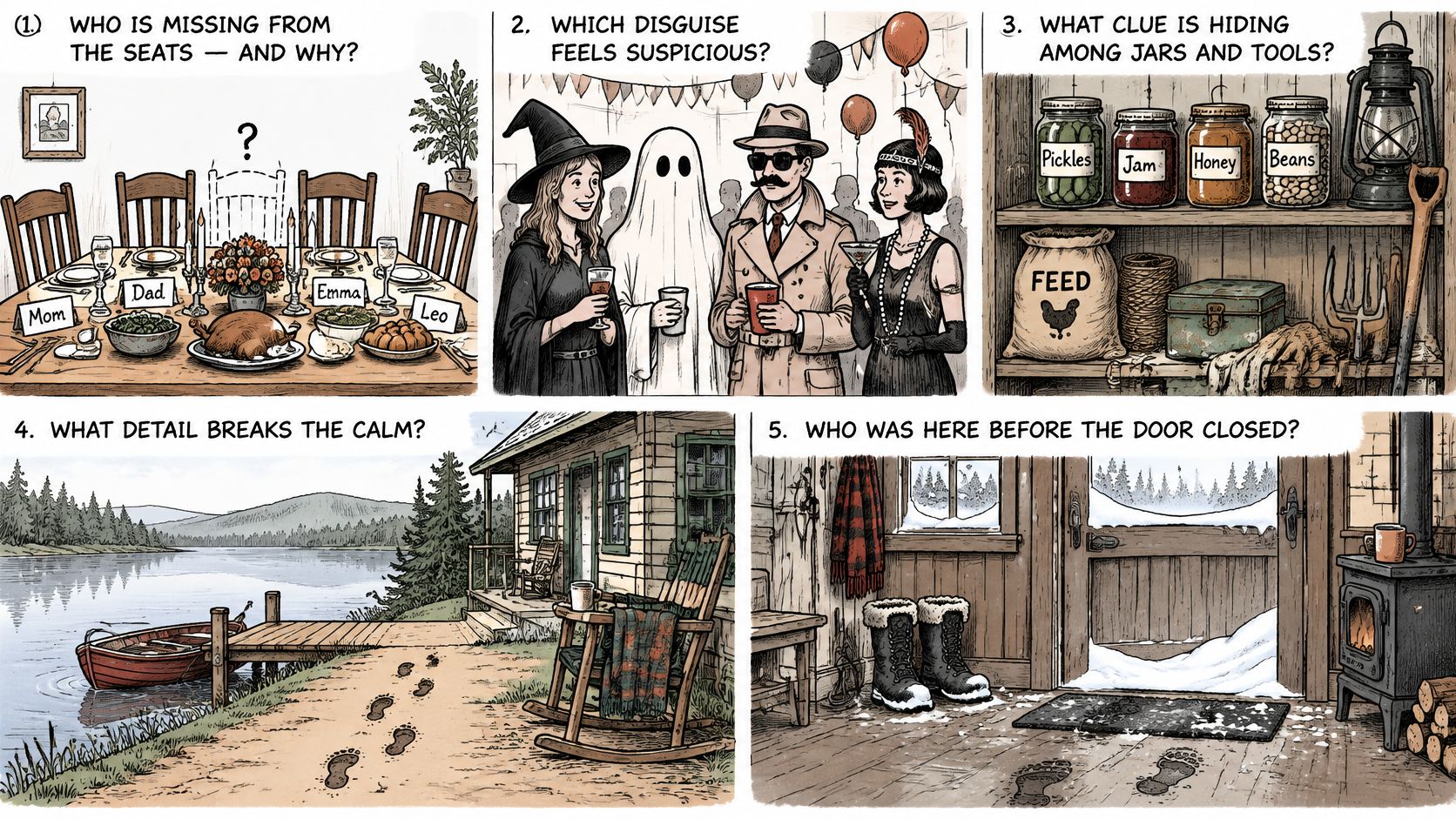
Read the question behind the object
Seating is like a reach test. At a dinner table, the important fact may be who could touch a box without leaving their chair. Position establishes opportunity, although opportunity alone doesn't prove guilt.
A closed container works like an access puzzle rather than a strength contest. If a box returns shut but empty, ask what the case establishes about its openings, handling, and contents. Don't assume the lock was broken unless you have evidence.
With a mask or costume, think of identity as a borrowed coat. A witness may accurately remember the outfit while incorrectly identifying the wearer. Look for details that belong to a person rather than a role.
A blackout is a gap in the timeline. Compare the last established state before darkness with the first established state afterward. The relevant question is what could happen within that gap, not merely who dislikes the victim.
Physical traces work like receipts for contact. A wet mark, pencil rubbing, or recording can preserve something a suspect would prefer to deny. Their meaning still needs context: a wet pantry door doesn't identify a person by itself.
Scene patterns and what they prove
| Pattern | What you notice | What it can prove |
|---|---|---|
| Seating or position | Who sat or stood where | Who had opportunity |
| Closed container | An item missing from something that stayed shut | Who could have reached inside |
| Mask or costume | A face or role that can be swapped | Whether the person you saw was who you think |
| Blackout or gap | What changed while nobody could see | The moment when the act could fit |
| Physical trace | A rubbing, a wet mark, or a recording | Who touched the spot or whose account holds up |
Treat the final column as a question to establish, not an automatic verdict. A clue becomes persuasive when the case rules out reasonable competing explanations.
For a position-and-statements exercise, consider The Hut on the Grauhorn. Approach the setting by asking what each person could know, rather than treating an alibi as true because it sounds complete.
Theft and murder can use the same reasoning patterns. The crime changes the stakes; your preferred puzzle style might still be spatial reasoning, disguise, or traces. Choose the kind of question you enjoy answering.
Why a Short Case Can Still Stall You
You've found the room, tapped the obvious objects, and read every statement. Still, one detail refuses to fit. A short case can stall because it asks you to notice a small visual clue, remember a suspect's exact wording, and connect the two while other facts compete for attention.
A pause can point to different problems. You may be missing an inference, or the interface may make a useful clue hard to see.
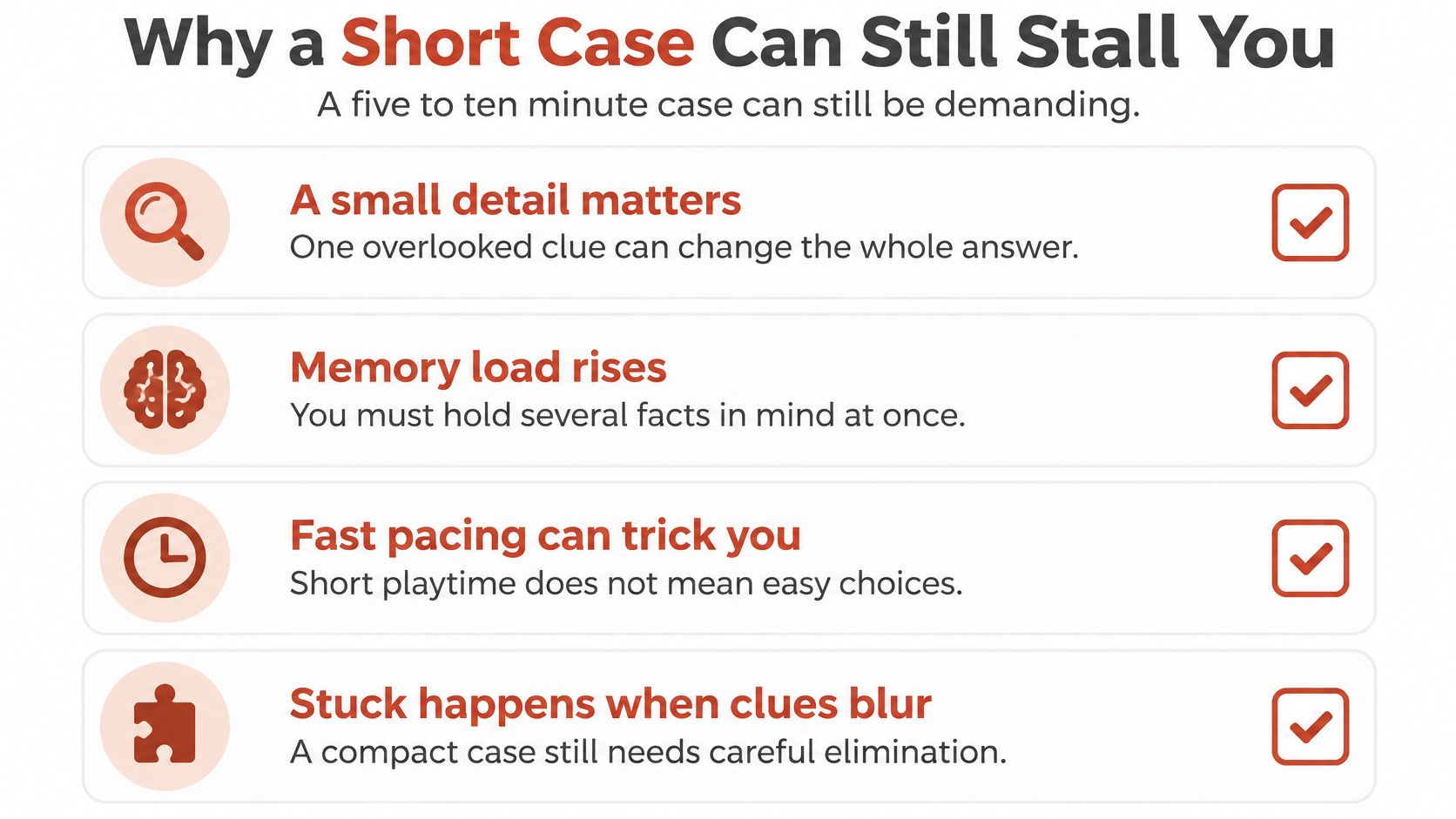
Diagnose the stall before asking for the answer
- You can't find the object: Scan by shape, contrast, and location instead of tapping randomly. Check scene edges, entrances, and objects mentioned in dialogue.
- You found it but can't connect it: Put the clue's established meaning beside a suspect's claim. Ask which exact words the clue supports or contradicts.
- You want the solution immediately: If a hint is available, use one that points you toward a relevant area or relationship without doing the inference for you.
Visual search helps explain why a scene can slow you down. A review of scene perception and visual search examines how scanning and visual features affect the search for objects. In a puzzle, there's a useful difference between carefully spotting a clue and having to inspect every pixel because the scene gives no visual priority.
Fairness check: Evidence should make you doubt a suspect's story, not make you doubt your eyesight.
Short doesn't automatically mean accessible
A brief case can still be difficult to use if its text is hard to read or its clues depend on a single way of seeing or hearing them. Check whether clues remain distinguishable without color alone, statements are available as readable text, and important events can be understood without sound.
Try the page enlarged and the sound muted. If possible, check keyboard operation, visible focus, scalable text, screen-reader compatibility, reduced motion, and transcripts for spoken information.
If a detail stays unreadable, more deduction won't help. Change the presentation if you can, or choose another game. A hint should help you reason through a clue, not make up for information you couldn't perceive.
Privacy, Data and Safety in Free Browser Mysteries
A quiet detective puzzle can feel private because nobody else appears on screen. That doesn't tell you whether the page stores progress locally, sends analytics, or connects to outside services.
Separate what the game needs to function from optional forms and notifications. An email field for updates isn't necessarily a requirement to play, and a browser game isn't necessarily account-free.
Check what happens behind the scene
- Progress storage: Find out whether saves stay on your device or belong to an account. Clearing browser storage may affect a local save.
- Starting requirements: Distinguish mandatory sign-in from an optional notification form.
- Outside services: Read the privacy notice for analytics, advertising, embedded content, and other third parties.
- Information requests: Pause if a hint or reward unexpectedly asks for personal details.
- Blocking behavior: Check whether the case remains usable with your normal cookie and script protections enabled.
Look for contact features separately
Chat, public profiles, leaderboards, and feedback tools create different exposure from a self-contained puzzle. A solo format removes the need for conversation with opponents, but it doesn't guarantee that every surrounding website feature is private.
Don't put personal information into a public result or a bug report. If you subscribe to updates, check how to unsubscribe; if you report a problem, include the gameplay issue rather than unrelated identifying details.
Your pre-play check can be brief: locate the privacy notice, confirm what's required to start, inspect any social features, and understand how progress is kept. If those answers are unclear, don't trade personal information merely to reach the opening scene.
Start With One Free Case Tonight
Choose the board if you want an evening with other people. Choose a solo scene if you want to investigate at your own pace, without waiting for a turn or finding someone to play against.
For a first case, look for a clear crime summary, an expected duration, and a difficulty label. An easy theft can be a comfortable warm-up; a medium murder may suit you if you already enjoy reconciling conflicting accounts. The useful distinction is how much interpretation you want, not how dramatic the title sounds.
Make the first session a small experiment
Our Mystery Hunch homepage offers free illustrated browser mysteries where you explore a scene, find clues, question suspects, and catch the culprit. Each case takes about 5–10 minutes; you can combine evidence in a notebook, accuse with proof, and earn up to three stars, with a partner hint costing one star.
We're an early prototype made by one person, not a finished long-form campaign. Cases, features, and scoring may change or be removed as we collect feedback. That makes a short trial more sensible than committing to a marathon.
- Choose for fit: Read the case summary before starting instead of choosing solely by its picture.
- Finish before replaying: Decide whether the explanation makes sense before chasing a cleaner score.
- Keep feedback spoiler-free: Say whether a clue was readable, a statement was confusing, or the proof felt fair without revealing the culprit.
Then stop if you've had enough. A satisfying small mystery doesn't need to become an evening of clearing every case.
Mystery Hunch offers free illustrated detective puzzles you can play in your browser, with evidence to inspect and suspects to question. Visit Mystery Hunch, choose a case that suits your mood, and see whether investigating alone gives you the deduction fix you wanted tonight.