Case Files Game Guide: How Evidence and Deduction Work
A case files game is a mystery game where you play the detective, exploring a scene, combining clues and accusing a culprit with proof instead of watching a sleuth do it.
You've found a suspicious object, read an alibi and noticed something that doesn't quite fit. The satisfying part isn't clicking everything in sight. It's working out which details belong together, then making an accusation you can defend.
Table of Contents
- What Is a Case Files Game
- How a Case Plays Out From First Clue to Accusation
- Clue Types and What Each One Tells You
- Case Files Games Across Tabletop, PC and Browser
- Myths That Trip Up New Detectives
- Playing Case Files on Any Device With Accessibility Needs
- Pick Your First Case and Start Deducting
What Is a Case Files Game
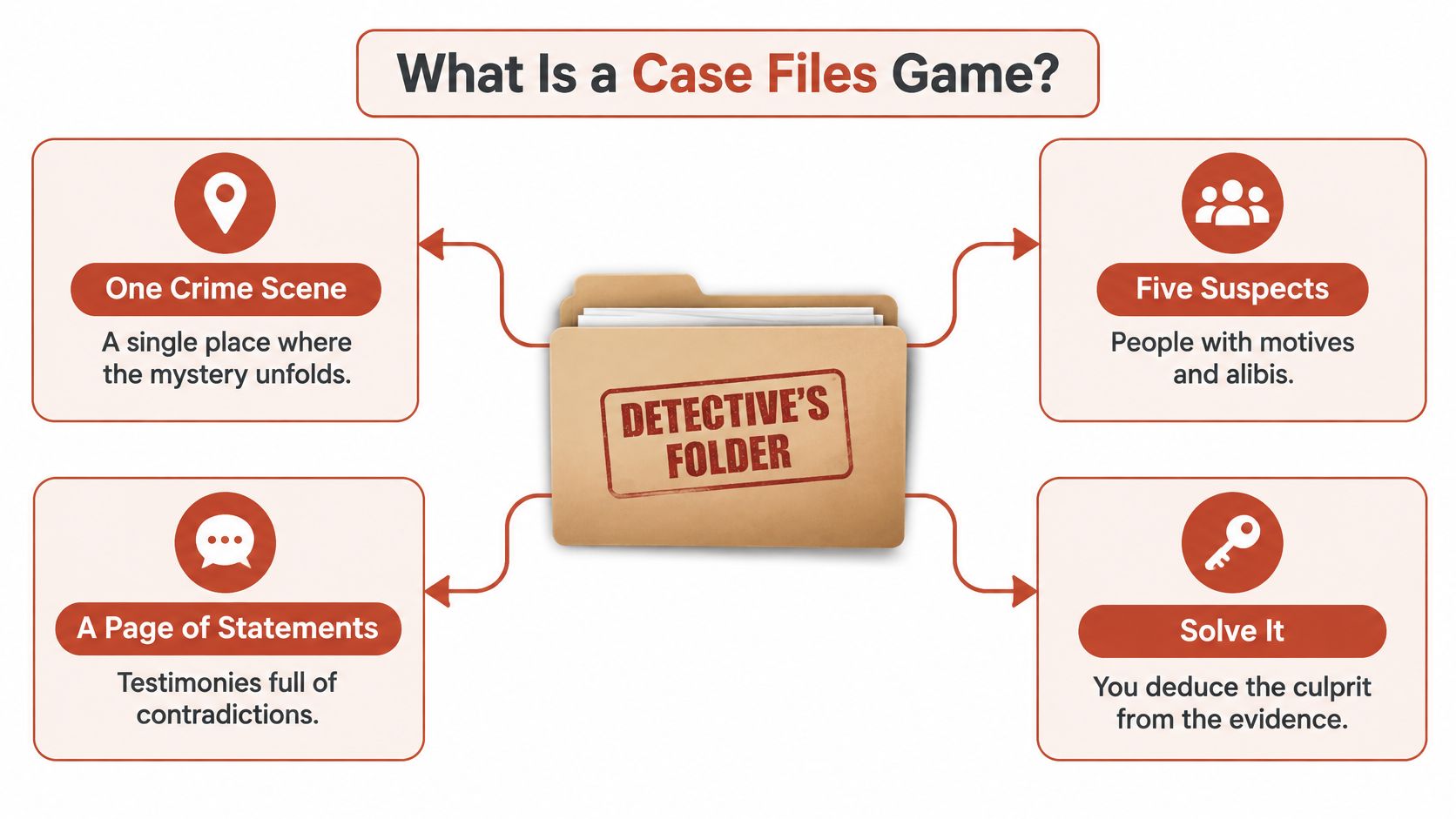
Someone slides a detective's folder across the table. In this imaginary case, there's a crime scene, five suspects and a page of statements. Your assignment is simple: work out what happened.
Inside that folder, you might find a photograph of an empty display case, a guest list and a witness's account of a blackout. None tells the whole story. You have to decide which observations matter and which explanations survive contact with the evidence.
That's the appeal of a case files game. You're not waiting for Sherlock Holmes to announce the missing connection. You're responsible for finding it, using material the game has made available.
Recognize the evidence-to-accusation chain
Genre labels overlap, so look at what the player must do to finish.
- Hidden-object play emphasizes locating items in a scene. An investigation may surround the search, but finding the object can be the main challenge.
- Escape-room play emphasizes opening locks, decoding messages and overcoming barriers.
- Visual novels emphasize reading, conversation and narrative choices.
- Case-file deduction emphasizes connecting observations to an explanation and supporting that explanation with evidence.
A game can borrow from all these formats. The useful distinction is whether finding something ends the puzzle or gives you material for another inference.
Detective's test: If you can explain why a clue matters, not just where you found it, you're doing deduction.
What makes a case feel manageable
A compact case usually gives you a bounded problem: a limited setting, identifiable suspects and a specific question to answer. That question might concern a theft rather than a murder. The stakes change, but your job remains to distinguish a plausible story from a supported one.
A notebook, optional guidance and a clear accusation screen can make that process easier to follow. For a concrete reference while you learn the vocabulary, keep the Mystery Hunch homepage handy.
You don't need specialist knowledge to begin. You need to notice what the game establishes, separate it from what you're assuming and remain willing to change your theory.
How a Case Plays Out From First Clue to Accusation
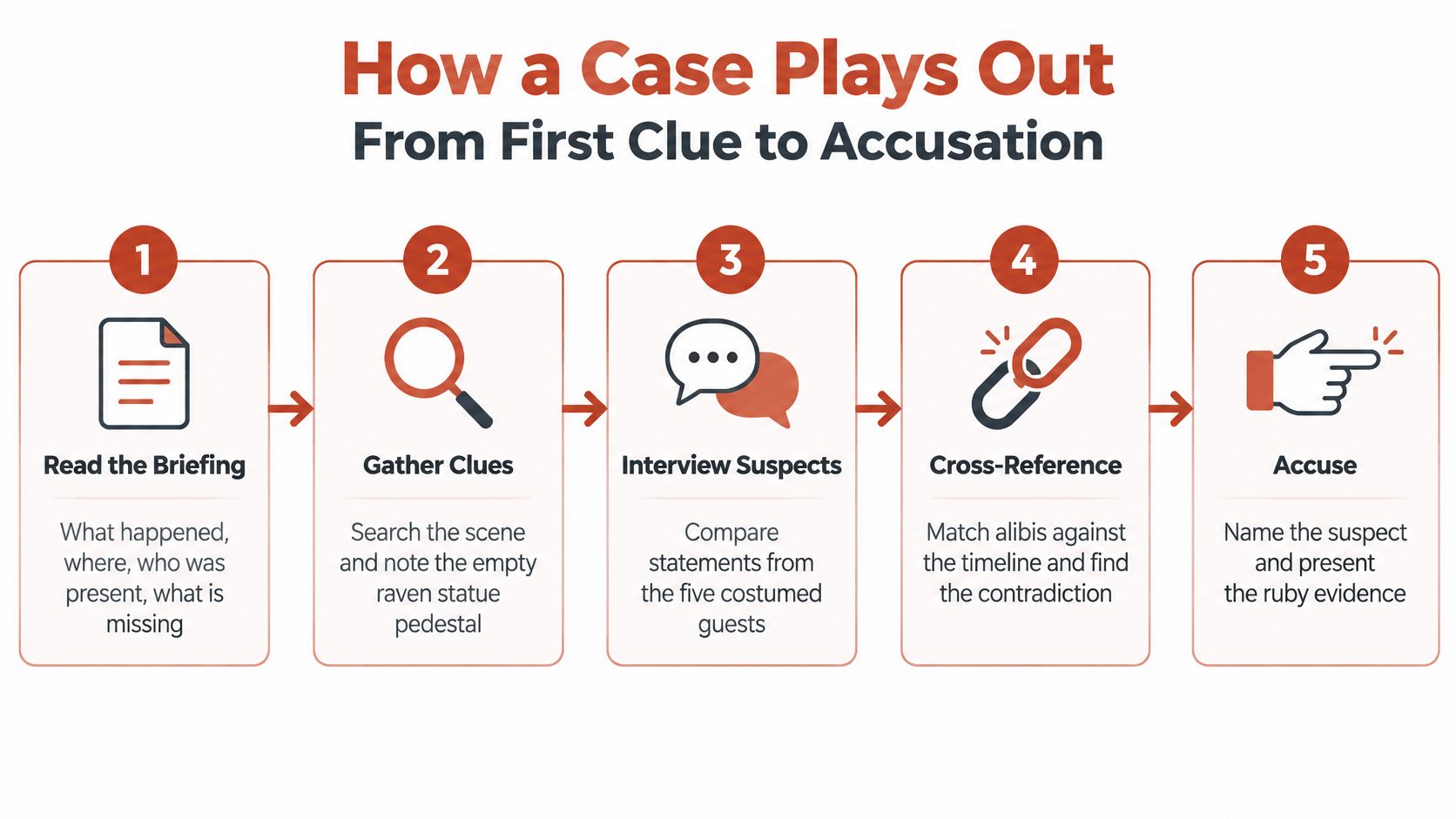
Say a ruby disappears from a raven statue during a costume party. The following example is hypothetical, not a walkthrough or a solution to a published case.
Your first instinct might be to choose the guest who sounds shiftiest. Resist that urge. Follow the evidence through a repeatable investigation instead.
Gather before you judge
Read the briefing. Establish what disappeared, where it belonged and who was present. Watch for the difference between the last confirmed sighting and the moment someone discovered the loss. Those events don't necessarily happen together.
Explore the scene. Examine the statue, nearby furniture, doors and discarded objects. Suppose you discover a torn mask and muddy shoes beside the garden entrance. Inspect their descriptions instead of deciding immediately that either belongs to the thief.
Record raw observations. Write that the mask has a torn ribbon, not that the thief dropped their disguise. The first is an observation; the second is a theory. Keeping them separate prevents an early guess from contaminating everything you collect afterward.
Combine related evidence. A costume list might connect the mask's design to a guest. A pencil rubbing might reveal an impression left on a notepad. Choose combinations for a reason: shared material, matching damage, ownership or a clear physical use. Random pairing can produce progress without understanding.
Test the explanation
Cross-check statements against objects. Suppose a guest says they stayed at the dinner table throughout the party. Muddy shoes might challenge that account, but only if you can establish whose shoes they are and when they became muddy. A contradiction needs both sides connected.
Eliminate explanations that don't fit. Check whether another guest had access to the statue, whether someone could have borrowed a costume and whether an apparent alibi covers the relevant interval. Keep an alternative alive until the evidence rules it out.
Accuse with supporting proof. Your explanation should connect a named suspect to the relevant action, not merely show that they behaved oddly. In this imagined case, matching a torn ribbon to a costume establishes ownership; finding the ruby in that costume's concealed pocket would provide a much stronger connection to the theft.
Review the result. If a game scores your investigation, treat the result as feedback rather than a verdict on your intelligence. Ask whether you missed an observation, made an unsupported inference or submitted the wrong evidence. Replaying is more useful when you can name what you'll do differently.
Don't ask only who looks guilty. Ask what you'd expect to find if your explanation were true.
For a separate investigation setting, you can open The Hut on the Grauhorn and apply this method without carrying over any of the fictional party's assumptions.
The loop is compact, but the reasoning is substantial: observe, connect, test and justify.
Clue Types and What Each One Tells You
A clue is useful because it limits the explanations that could be true. Its appearance alone doesn't tell you how much weight to give it.
A missing object establishes an absence. A witness statement establishes what someone claims. Neither automatically establishes the culprit.
Clue types and the deductions they unlock
The examples below illustrate possible deductions, not guaranteed solutions.
| Clue type | Example from a case | What it lets you deduce |
|---|---|---|
| Physical evidence | A necklace missing from a locked case | The necklace is absent; unauthorized removal needs confirmation before theft is certain |
| Suspect statement | A guest claims to have slept all night | An account you can test against objects, witnesses and the timeline |
| Spatial clue | The seating order around a dinner table | Who could reach the box, glass or victim, subject to movement |
| Time clue | A wet pantry door or a sudden blackout | A possible sequence or opportunity window, once its context is established |
| Concealment clue | A pencil rubbing over a notepad or a hidden tape | Information that wasn't immediately visible or available |
| Combination clue | A mask matched against a costume list | A possible connection between an anonymous object and a named person |
Consider the wet pantry door. Wetness isn't a timestamp by itself. You need context, such as a description explaining that the surface had recently been dry or that opening the door caused the moisture. Only then can it help challenge someone's account of their movements.
Make the notebook your external memory
A Liberty University doctoral study on digital-game support discusses how task guidance can affect extraneous cognitive load. The practical lesson is to avoid spending your attention repeatedly retrieving information when you could be reasoning about it.
For each entry, preserve:
- Observation: What the game showed or stated.
- Source: The object, location or person supplying it.
- Interpretation: What you think it means, with uncertainty left visible.
A torn mask and a missing costume ribbon may become meaningful together. But matching them establishes a connection to the costume, not necessarily who wore it during the crime.
Notebook rule: Revise the theory, not the original observation.
That habit makes your reasoning traceable. When an accusation feels uncertain, you can inspect the link that needs support rather than reread every statement.
Case Files Games Across Tabletop, PC and Browser
Detective games don't need a particular screen or box. Different formats ask you to handle evidence differently, and that changes the kind of attention you'll use.
The familiar closed-circle template has a long history. According to The Strong's National Toy Hall of Fame, Anthony E. Pratt and his wife, Elva, developed the concept behind Cluedo in 1943, and it reached commercial release in 1949, published as Cluedo in the United Kingdom and Clue in North America.
The important inheritance is structural: a restricted set of suspects, locations and possible answers. Instead of inventing any explanation imaginable, players eliminate possibilities within an agreed set of rules.
Choose the format by the work you enjoy
| Format | Examples | What you spend your attention on |
|---|---|---|
| Deduction board game | Cluedo or Clue | Tracking exclusions and narrowing possible combinations |
| Dossier-style tabletop investigation | Sherlock Holmes Consulting Detective; Detective: A Modern Crime Board Game | Following leads through documents, locations and accounts |
| Digital hidden-object mystery | Mystery Case Files | Inspecting illustrated scenes and finding relevant items |
| Narrative deduction | Her Story; Return of the Obra Dinn | Interpreting fragments and reconstructing events or identities |
| Browser micro-case | Compact illustrated investigations | Inspecting a bounded scene and checking an accusation |
If you enjoy organizing possibilities, a deduction grid may feel satisfying. If you prefer choosing which lead to pursue, a dossier-style investigation gives that choice more prominence. Narrative deduction asks you to tolerate incomplete context while you assemble a larger explanation.
Finding objects and interpreting them are different pleasures
Digital mysteries also brought scene inspection to a broad casual audience. The Mystery Case Files series history records the release of Mystery Case Files: Huntsville on November 14, 2005, and reports more than $1 million in digitally distributed sales in fewer than three months.
Those results describe that game's commercial reception, not the difficulty or quality of every detective puzzle. The useful distinction for a player is mechanical: do you want the challenge to come mainly from spotting objects or from explaining their relationships?
Neither preference is wrong. A cluttered illustration can provide an absorbing search, while a sparse room can support a demanding inference.
Before choosing, examine the game's description of the final task. Identifying an object, opening an exit, reconstructing a sequence and presenting evidence against a suspect are related activities, but they aren't interchangeable.
Myths That Trip Up New Detectives
I'm not clever enough for detective games
You don't have to recognize the answer immediately. A workable method is more useful than an impressive first guess.
When you're stuck, choose a specific claim and ask what would confirm or contradict it. Testing whether a guest could reach a cabinet is manageable. Trying to solve the entire mystery in your head can feel overwhelming.
- Shrink the question: Investigate access, ownership or timing separately.
- Keep uncertainty visible: Mark an association as possible until another clue supports it.
- Accept revision: Dropping an attractive theory is progress when the evidence no longer fits.
Using a hint means I failed
A hint can help you resume reasoning rather than replace it. A study of instructional support in game-based learning found that support delivered before or after a level reduced extraneous cognitive load and improved solution identification at the beginning of medium-difficulty levels.
That supports treating help as scaffolding, not an automatic answer button. A useful progression would direct attention toward an overlooked area, identify a relevant relationship and reveal a near-solution only if needed.
Before requesting help, state your obstacle plainly: you can't find another clue, you don't understand a connection or you can't choose between explanations. That makes it easier to use the smallest useful nudge.
This is just hidden object with extra steps
Finding the mask answers where it was. Matching it to a costume answers who may be connected to it. Establishing when it was discarded answers a different question again.
Those aren't decorative steps. They're different reasoning tasks, and they're where an evidence-centered game earns its detective label.
I can just guess the culprit
You might select the correct name by chance. That doesn't mean your explanation accounts for the case.
Before accusing, finish this sentence in your own words: the suspect could do it because of this evidence, and this other evidence connects them to the act. If the explanation relies on someone seeming unpleasant, secretive or nervous, keep investigating. Suspicion is a reason to check, not a substitute for proof.
Playing Case Files on Any Device With Accessibility Needs
Running in a browser doesn't automatically make a mystery accessible. A player still needs to discover interactive objects, read statements and understand every clue required for the solution.
The 2025 ESA survey found that 21% of adult U.S. players reported having a disability, while 49% of players with disabilities said game accessibility was extremely or very important. Those findings make independent access to evidence a central concern, not an optional finishing touch.
Test the deduction path before committing
- Text and magnification: Enlarge a statement and a notebook entry. Check that words don't disappear behind buttons or get cut off.
- Keyboard navigation: Move through controls without a pointer. Look for a visible focus indicator and a usable order between objects, dialogue and evidence.
- Visual interpretation: Check whether descriptions communicate details conveyed by color, darkness, seating positions or small marks.
- Audio alternatives: A spoken statement or meaningful sound should have an equivalent you can read.
- Comfort and guidance: Check sound controls, movement effects and whether hints remain understandable with your preferred settings.
Try these checks on the device you'll use. A clue that's comfortable to inspect on a wide display may be difficult to distinguish on a phone.
A fair mystery can hide the answer. It shouldn't make the required evidence inaccessible.
These are evaluation criteria, not claims that every browser mystery supports every feature. If you encounter an inaccessible hotspot, record the object and the action you couldn't complete when sending feedback. That's more actionable than reporting that the case was difficult, because it distinguishes an interface barrier from a reasoning challenge.
Pick Your First Case and Start Deducting
A case files game gives you evidence and asks you to turn it into a defensible explanation. For your first attempt, choose a setting that makes you curious rather than a difficulty label that feels impressive.
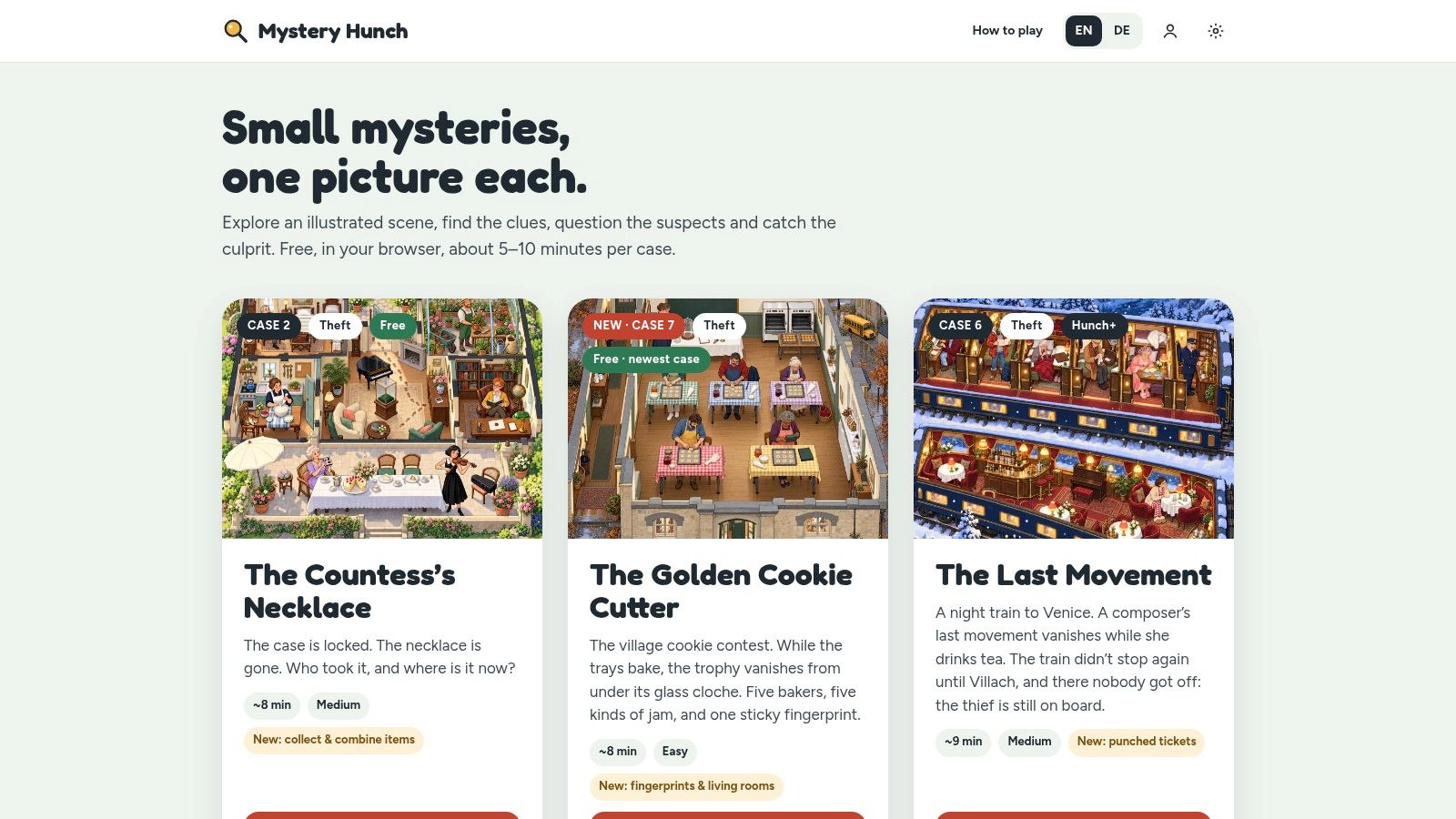
The selection screen can help you compare story hooks before committing.
Choose a manageable first investigation
Our Mystery Hunch cases are free to play in the browser, with phone and wider-screen layouts. Each takes about 5–10 minutes, and players make proof-backed accusations to earn up to three stars per case.
For an initial attempt, use a light-touch checklist:
- Start with Easy: Give yourself room to learn the interaction pattern before seeking a harder puzzle.
- Choose an appealing theme: A domestic theft may interest you more than an isolated mountain murder.
- Leave breathing room: Treat the estimated duration as guidance, not a deadline.
- Keep observations literal: Don't turn a suspicious detail into a verdict.
- Allow a hint: Decide beforehand that asking for help is acceptable if you stop making meaningful progress.
Mystery Hunch case lineup
| Case | The mystery | Play time | Difficulty |
|---|---|---|---|
| The Hut on the Grauhorn | A snowed-in hut keeper is found dead, and five guests all say they were asleep | About 6 minutes | Medium |
| The Countess's Necklace | A necklace vanishes from a locked case | About 8 minutes | Medium |
| Grandma Hilde's Recipe Book | A wet pantry door and a missing recipe book | About 7 minutes | Easy |
| The Ring Went Round | A ring disappears from a box that went around the table and came back closed | About 7 minutes | Medium |
| Theft | A raven's ruby eye goes missing at a Halloween costume party | About 9 minutes | Medium |
If a locked-display puzzle catches your attention, The Countess's Necklace offers that premise. If you'd rather begin with the Easy label, choose Grandma Hilde's Recipe Book.
You can also watch the accompanying video before choosing your investigation.
Don't aim for a perfect performance on your first run. Aim to explain your final choice without relying on a hunch you can't connect to anything in the scene. That's a useful standard whether you solve immediately or need help.
Our project is an early prototype, so cases, features and scoring may change. Progress and settings are stored only in your browser and may be lost, so don't treat a saved result as permanent.
Mystery Hunch offers free illustrated browser mysteries where you gather clues, compare statements and accuse with proof. Visit Mystery Hunch, choose Grandma Hilde's Recipe Book for an Easy start, and build an accusation you can explain from the evidence.