7 Best Murder Mystery Games for Adults in 2026

It's Friday night. You've got a free hour, someone's suggested a murder mystery, and you're trying to work out whether that means a quick puzzle on your phone or a table covered in police reports until bedtime. Both sound good. They're not interchangeable.
The best murder mystery games for adults fit the evening you have. Format comes first: browser, shared-screen investigation, online co-op, or physical case files. Then comes challenge: spotting a contradiction isn't the same task as connecting witness accounts across a stack of documents. Session length matters just as much. A satisfying short case beats abandoning a sprawling investigation halfway through.
These picks start with quick browser games, move into collaborative online deduction, and finish with physical evidence you can spread across a table. None requires you to host a costume party or perform an improvised interrogation.
One important distinction: not every catalogue below is exclusively about murder. Some include theft and other crimes. Where a publisher doesn't give a dependable session estimate or difficulty rating, I've left that uncertainty visible rather than supplying a suspiciously precise number.
Table of Contents
- 1. Mystery Hunch
- 2. Case & Candle
- 3. Midnight Casebook
- 4. NOIR
- 5. Unsolved Case Files
- 6. ThinkFun Cold Case A Pinch of Murder
- 7. Cryptic Killers
- How the seven murder mystery games compare on format, session length, challenge, and cost
- Pick Your Murder Mystery Based on the Evening You Have
1. Mystery Hunch
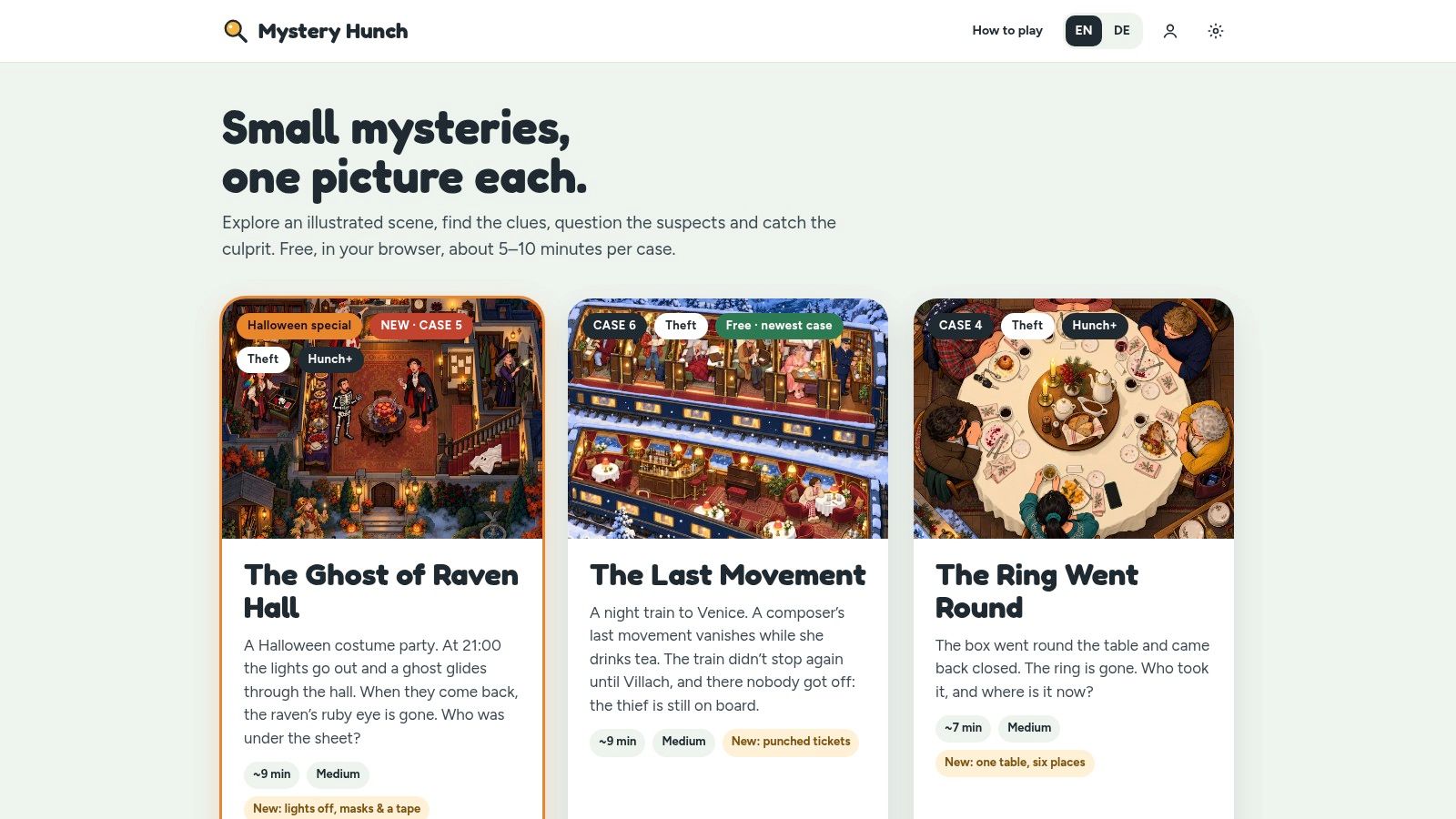
Best for a complete investigation during a short break. Our illustrated cases centre on a single scene. You tap rooms and objects, collect clues, and use a notebook to combine evidence and check suspects' statements before accusing someone with proof.
That structure matters. You're not just clicking until the game declares success. You need to connect what you've found with what somebody claims happened. A spatial detail or apparently ordinary object can matter as much as a suspicious statement.
- Format: Free browser play, with phone and wider-screen layouts.
- Challenge: Cases carry Easy or Medium labels.
- Session length: Current case estimates run approximately six to nine minutes.
- Help: An in-game partner offers hints, with each hint costing one star.
Where the Short Format Works
For a murder investigation, The Hut on the Grauhorn is the clearest starting point. A snowed-in hut keeper is dead, and the guests' accounts need checking. Other cases involve missing valuables, so choose by premise if homicide is essential to your evening.
Different investigations introduce different mechanics, including combining items, pencil rubbing, seating arrangements, masks, and blackouts. Those variations give you something to reason about beyond finding every clickable object. You can earn up to three stars per case, although replaying a solved mystery is more about improving your approach than discovering an entirely new culprit.
Practical rule: Use a hint when you've stopped forming new theories. Preserving a score isn't worth turning a relaxing puzzle into repetitive tapping.
The limits are straightforward. These are brief, single-scene investigations, not sprawling detective adventures. Our project is an early prototype made by one person, and cases, features, and scoring may change or be removed.
English and German versions, bright and noir visual styles, and sound settings give you useful presentation choices. They shouldn't be mistaken for a guarantee that every accessibility need is covered.
Pick this if: You want free, low-commitment detective work with visible difficulty labels and optional help.
2. Case & Candle

A quiet date night doesn't need character sheets. Case & Candle is a better fit when you'd rather compare witness accounts together than pretend to be suspects.
The browser format removes the physical setup. You read records, follow leads, compare accounts, and build an accusation. Its emphasis is on interpreting information rather than searching an illustration for hidden objects.
Format: Browser, solo or shared screen. Challenge: Reading-led deduction with optional hints. Session length: Case-dependent; don't assume the longer investigations are brief puzzles.
Shared Screen, Not Remote Multiplayer
According to Case & Candle, the complete introductory case, The Shortest Day, is free, while longer cases are listed at £9.99 each with 12 months of access. That makes the free investigation the sensible place to test whether you enjoy its writing and evidence format before buying.
The lack of a timer or score suits players who want to pause and argue through a theory. The downside is that sharing a screen isn't synchronized remote multiplayer. If you're in different homes, you'll need your own screen-sharing arrangement.
- Works well: Taking turns summarizing statements and explaining why a lead matters.
- Works less well: Letting the faster reader control every page and every decision.
- Main trade-off: Convenient browser access, but purchased cases don't come with permanent access.
If you want to establish whether you enjoy deduction before settling into longer records, try The Hut on the Grauhorn as a compact contrast. The distinction is scene-based observation versus a more document-led investigation.
Pick this if: You want a low-pressure, shared-screen mystery and don't need built-in remote co-op.
3. Midnight Casebook
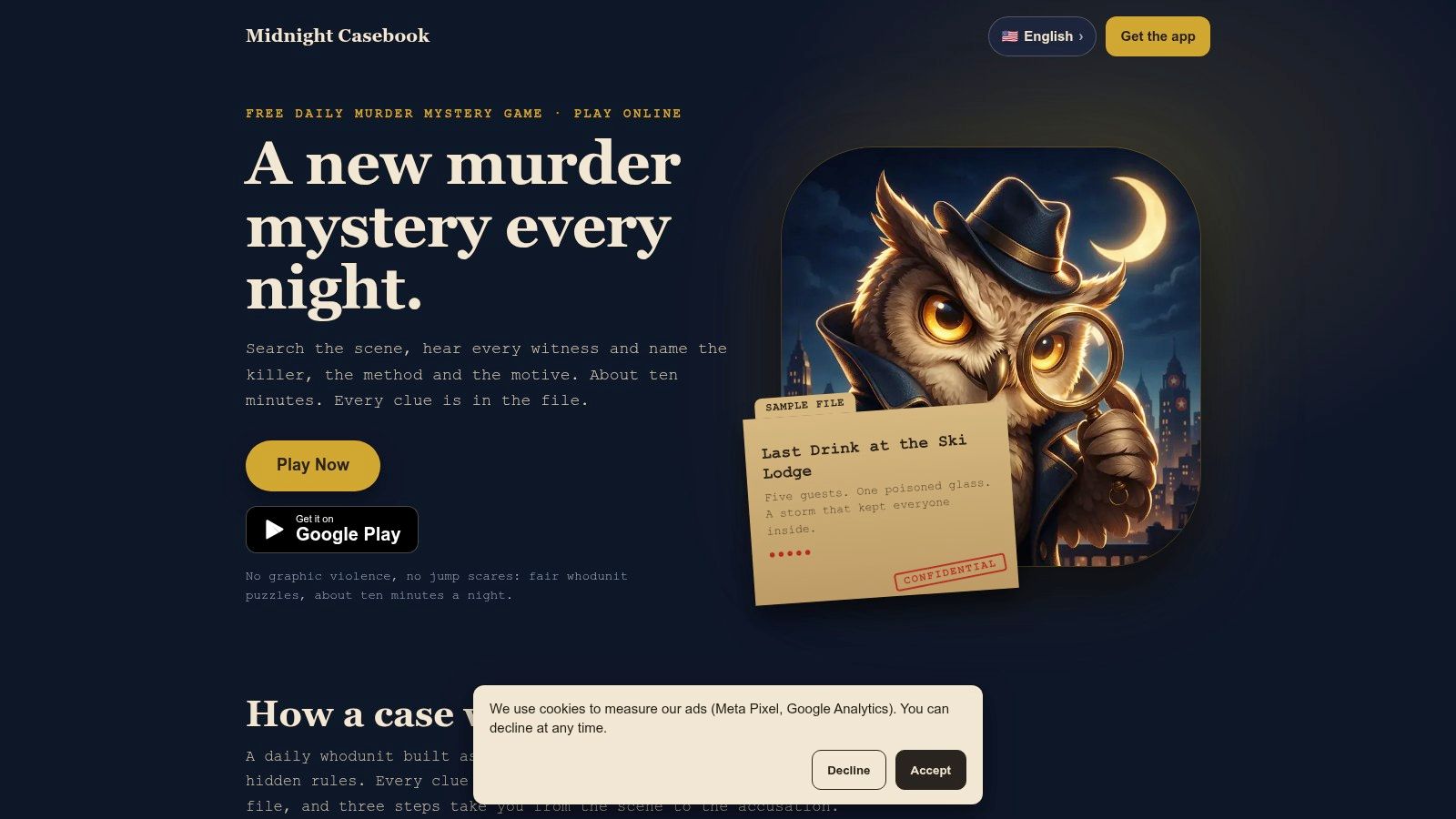
Midnight Casebook suits the player who wants a small detective ritual rather than a game-night production. Open the browser, inspect the scene, consider the witnesses, and decide what happened.
The accusation asks for more than a name. You need the killer, method, and motive. That's a useful distinction if you dislike mysteries where identifying the most suspicious person seems sufficient.
On Midnight Casebook, the publisher estimates a case takes about ten minutes and offers free daily play plus the first three cases. The paid plan opens the archive, all hints, and the longer Sunday Dossier.
- Format: Browser investigation with illustrated scenes and voiced witness statements.
- Challenge: Short-form deduction across who, how, and why; repeated accusation attempts are allowed.
- Session commitment: A compact daily case, with a longer format available separately.
Choose It for the Routine
Voiced statements add a different presentation style from text-only case files. Before choosing it for a shared space or an audio-sensitive player, check whether the available text presentation meets your needs. Voice acting alone doesn't establish whether a game can be solved comfortably without sound.
A daily mystery works best when you enjoy the routine as much as the individual solution.
The release structure is also the limitation. Free daily access isn't the same as freely choosing anything from a large archive. If you want to keep selecting cases during the same evening, the subscription boundary matters.
For a separate scene-based puzzle without waiting on a daily release, The Countess's Necklace offers a theft investigation rather than a murder.
Pick this if: You want a brief daily whodunit with voiced testimony and a structured accusation.
4. NOIR
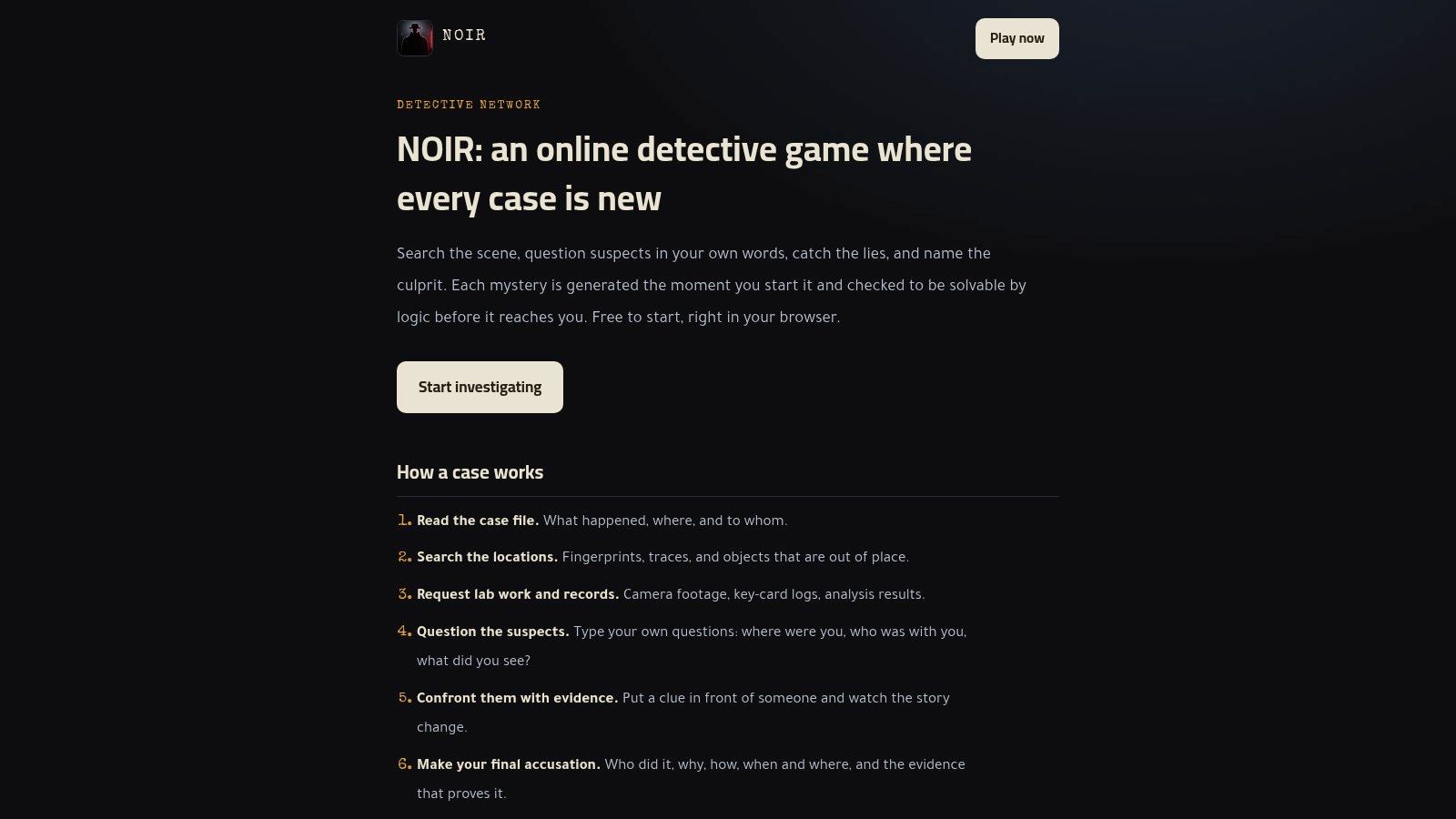
Being on separate sofas shouldn't mean watching someone else do all the detecting. NOIR is the most relevant choice here when built-in online collaboration matters more than sharing a single browser window.
NOIR supports private co-op rooms for two to six players, with shared evidence and in-case live chat. It also supports solo investigation and generates cases from a seed, rather than limiting play to a fixed authored sequence.
Format: Browser, solo or private online co-op. Challenge: Evidence and contradiction checking, with case-dependent demands. Session length: No dependable estimate is established here, so don't schedule it as a guaranteed quick break.
Replayability Versus Authored Storytelling
Generated cases give you a reason to return after learning a solution. The site says its cases are checked for logical solvability. That's a useful design claim, but it isn't the same promise as memorable characters or carefully paced dramatic revelations.
I'd choose it for friends who enjoy testing theories together. I wouldn't choose it primarily for a polished, fixed narrative with a deliberate emotional arc.
- Strong fit: Remote players who want to participate directly rather than spectate.
- Potential frustration: Discussion can stall if everybody investigates without sharing discoveries.
- Scope warning: Its investigations aren't exclusively murder mysteries.
Give the group a simple habit: whenever someone finds evidence, explain both what it says and what theory it changes. Otherwise, shared clues can become a collection nobody has interpreted.
English and Arabic are listed as language options. As with any collaborative game, agree on the playing language before starting, especially when the solution depends on exact wording.
Pick this if: You want browser-based remote co-op and fresh cases more than a fixed, authored storyline.
5. Unsolved Case Files

Clear the table before opening Unsolved Case Files. This is the physical-evidence option for an evening when reading, sorting, and revisiting documents is the activity, not an interruption.
The appeal is tactile. You can place related materials beside each other, pass a statement across the table, and keep a suspicious detail visible while checking another document. Its staged investigation gives that work direction instead of asking for a single unsupported guess.
The company estimates an average play time of two to three hours on Unsolved Case Files. Treat that as a dedicated table session, not something to squeeze in before leaving the house.
- Format: Physical cold-case files, playable solo or with a group.
- Challenge: Sustained evidence reading and connecting information across materials.
- Session length: A longer evening, with room for discussion and rereading.
- Practical cost: Ordering, delivery, and enough clear space to keep evidence organized.
Make the Evidence Available to Everyone
Don't appoint a permanent reader who keeps every document. Let players inspect the original materials, then put related clues together. If someone proposes a culprit, ask which evidence supports the accusation and which detail still doesn't fit.
That style suits quiet participants because they can contribute an observation without performing a character. It can still exclude people if small text, crowded tables, or inaccessible evidence become obstacles.
If you're unsure whether your group likes deduction at all, Grandma Hilde's Recipe Book offers a lower-commitment theft puzzle before you order a box.
Shipping availability also matters, particularly for international buyers. Choose the case and delivery route before promising it for a specific evening.
Pick this if: You want tangible evidence and can give the investigation a proper table-night slot.
6. ThinkFun Cold Case A Pinch of Murder
A smaller group doesn't need a smaller appetite for evidence. ThinkFun Cold Case: A Pinch of Murder offers a boxed investigation without asking you to assemble a party.
The official ThinkFun product page lists it for one to four players. You work through physical case materials, piece together the story, and submit answers online.
Format: Physical box with online answer submission. Challenge: Document interpretation and reconstructing events. Session length: No supported duration is established here, so reserve an unhurried evening rather than promising a precise finish.
A Small-Group Box With a Digital Dependency
The online submission step is easy to overlook. This is a tactile alternative to browser-only investigation, but it isn't an entirely offline experience. Have an internet-connected device available when you're ready to submit your conclusions.
For couples, the useful approach is to inspect materials independently, then compare interpretations. Reading everything aloud together can become slow, while dividing the evidence permanently can leave each player missing context. Share discoveries, then swap documents when an accusation starts taking shape.
Buying advice: Choose a fixed case for the pleasure of solving it, not because you expect the same mystery to stay surprising afterward.
The main trade-off is replayability. Once you know how a fixed investigation resolves, reopening it won't recreate the original uncertainty. That isn't necessarily poor value, but it's different from a generated case system.
There's no recurring subscription attached to the self-contained case. You do need to purchase and receive the box, and you shouldn't infer broad player satisfaction from a sparse review sample.
Pick this if: You want a self-contained physical mystery for solo play, a couple, or a small group.
7. Cryptic Killers
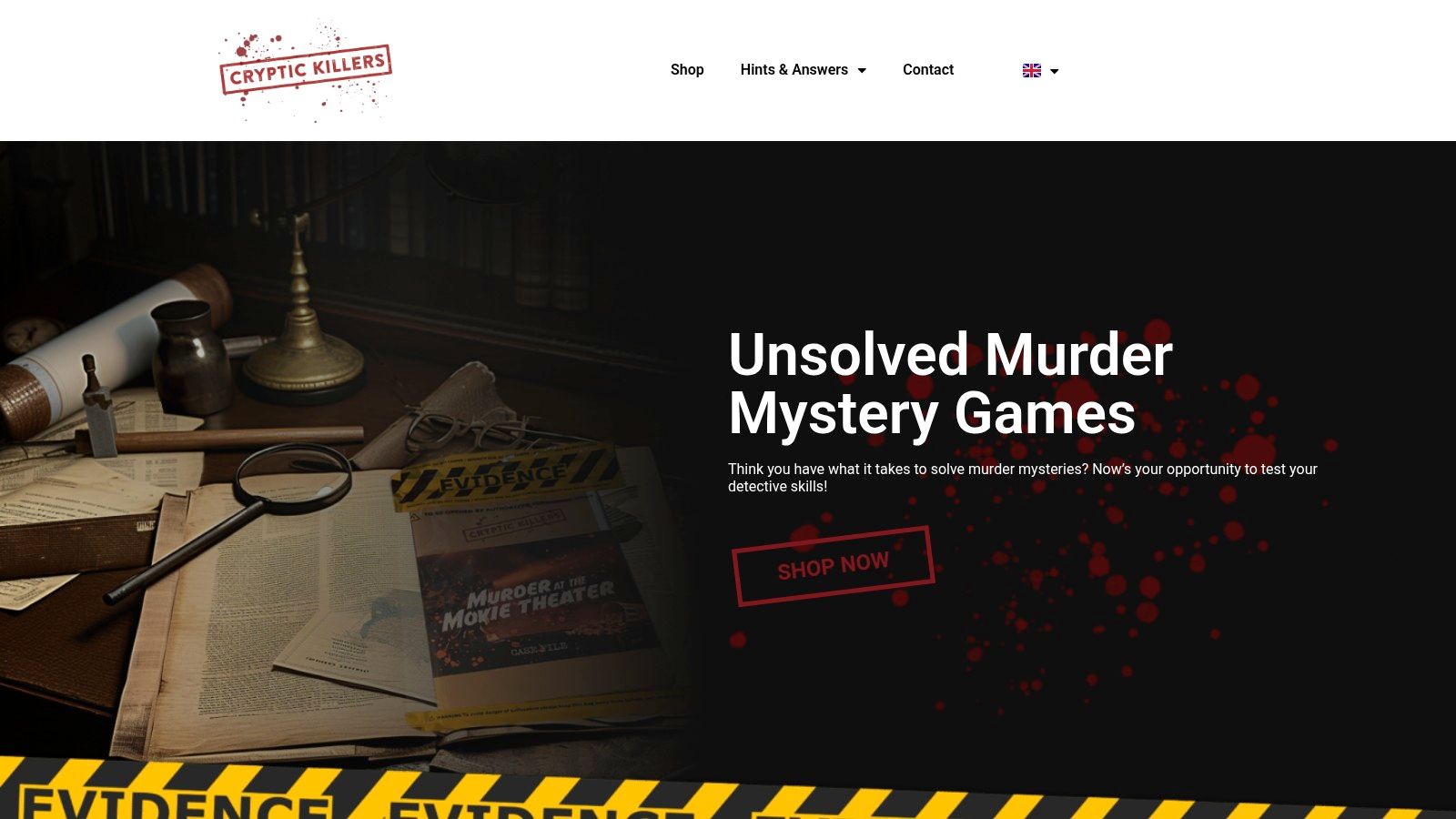
Start with the case premise and difficulty, not just the most dramatic cover. Cryptic Killers makes the most sense when you want to choose a setting and settle into a substantial evidence-reading session.
Its physical files are supplemented by online material. Depending on the case, you'll work with police reports, witness statements, photographs, and records. Online hints and answers provide a route forward when the group can't resolve a contradiction.
Cryptic Killers lists its cases as multi-hour activities for one to ten players. That range describes participation capacity, not a guarantee that every group size gets the same experience.
- Format: Physical evidence plus online case portals.
- Challenge: Varies by case, with difficulty ratings available.
- Session length: Multi-hour, rather than a casual browser break.
- Main advantage: A themed catalogue lets you choose the investigation as well as the format.
Match the Case to the Readers
With a larger group, access to evidence becomes the practical issue. If a document matters, pass it around or make sure everyone can inspect it. Don't let the quickest reader become the only person who understands the timeline.
Hints are useful when they restart reasoning. Before opening one, state the exact question you can't answer. That helps distinguish a missing connection from a document nobody has read carefully.
Physical delivery is unavoidable, and international buyers need to account for currency conversion, shipping, and taxes rather than treating the displayed shop price as their final cost.
I'd favour this over a short browser mystery when choosing a theme is part of the fun and your group enjoys detailed reading. I'd avoid it when attention is already split between dinner, conversation, and people arriving late.
Pick this if: You want a themed, longer physical investigation with online support when you get stuck.
How the seven murder mystery games compare on format, session length, challenge, and cost
The main trade-off is format: a short browser puzzle asks for a brief stretch of focused deduction, while a physical case file calls for a longer session. Use the table to compare the expected time, challenge, and cost before choosing.
| Item | Format | Typical Session | Challenge Level | Cost |
|---|---|---|---|---|
| Mystery Hunch | Browser-based illustrated mystery | About 6–9 minutes | Easy to medium | Free to play in the browser |
| Case & Candle | Browser-based, solo or shared-screen for two | Self-paced; duration varies | Deduction using records and witness statements | One case free; longer cases £9.99 each |
| Midnight Casebook | Browser-based daily mystery with voiced statements | About 10 minutes | Identify the killer, method, and motive | Daily play and first three cases free; paid plan provides access to the archive and extras |
| NOIR | Browser-based generated cases with 2–6-player co-op | Duration varies | Logic-focused evidence deduction | Free to start; further pricing unspecified |
| Unsolved Case Files | Physical case-file investigation | 2–3 hours | Staged cold-case investigation | Purchase price varies |
| ThinkFun Cold Case: A Pinch of Murder | Boxed case with online answer submission | Duration varies | Case-file deduction | Physical box; purchase price plus shipping and tax |
| Cryptic Killers | Physical case files with online evidence | Multi-hour | Varies by case; difficulty ratings provided | Physical case file; purchase price plus shipping and tax |
Mystery Hunch is the shortest option listed, with illustrated browser cases estimated at about six to nine minutes. Its cases are marked easy or medium, making the time and challenge easy to gauge before starting.
For physical games, plan around the table session rather than the box alone. Unsolved Case Files lists a two-to-three-hour investigation; ThinkFun's and Cryptic Killers' session lengths vary by case. Physical purchases may also involve shipping and tax.
Pick Your Murder Mystery Based on the Evening You Have
Start with the kind of evening you can offer. A short browser session suits a spare moment; a physical case file needs table space and time to sort through evidence. Difficulty matters too, but the format and session length determine whether the game fits your plans.
For a brief solo or shared-screen session, Mystery Hunch offers free illustrated browser cases. Each takes about six to nine minutes, with easy or medium difficulty labels. Tap rooms and objects to collect clues, combine evidence in a notebook, and check suspects' statements before accusing someone with proof. Hints cost one star, so use them when progress stalls. Pick this if you want a quick, low-commitment investigation.
Case & Candle suits a quiet evening spent discussing documents. Midnight Casebook fits a recurring daily routine, while NOIR suits remote players who want to investigate together. Pick these if you prefer browser play and can match the game's pace and format to your group.
Let Participation Decide the Final Choice
Physical files make sense when handling evidence is part of the fun. Unsolved Case Files suits a dedicated table session; ThinkFun offers a boxed case for a smaller group; Cryptic Killers gives you different themes and difficulty choices. Pick these if your group is ready to read, compare evidence, and spend longer on a case.
Consider how everyone wants to take part. Some players prefer quiet reading before discussion; others enjoy frequent conversation. For a home game, check practical details such as lighting, sound, seating, and room to move.
- For quiet players: Choose evidence-led cooperation and give everyone time to think before discussing.
- For mixed reading speeds: Keep documents available so players can work through them at their own pace.
- For audio-sensitive settings: Check whether voiced evidence has a text alternative.
- For uncertain tastes: Try a free case before paying for a longer investigation.
Each game offers a different payoff: a quick contradiction to solve, a shared deduction, or a table spread with reports and alibis. Match that payoff to the time and attention your group can give.
Free browser cases let you try observation, testimony, and evidence-based accusations without arranging a full game night. Save a shipped box for an evening when nobody needs to rush the ending.
Mystery Hunch is free to play in the browser, with illustrated cases that take about six to nine minutes. Visit Mystery Hunch to choose a case by its difficulty and duration, then try a complete investigation.