7 Mystery Puzzles for Adults to Solve Online in 2026

You've got half an hour before bed, a stack of half-finished puzzles, and no patience for another game that wants a download, an account, or your entire evening. You want a suspicious death, a few useful clues, and the satisfaction of catching someone in a lie. Preferably before your tea goes cold.
The trouble is that mystery puzzles for adults can mean very different things. Some let you tap around an illustrated room and inspect objects. Others hand you police interviews and messages to cross-reference. Others put a murder theme around a logic grid, with hardly any scene exploration at all.
None of those approaches is automatically better. The useful question is whether you enjoy looking, reading, questioning, or eliminating possibilities. Pick the wrong format and even a clever puzzle can feel like homework.
These seven games are arranged around those preferences, rather than ranked as interchangeable alternatives. Each has a session-length note, a clear explanation of the mechanic, and a reason you might want to skip it. Start with scene investigations if you want to play detective. Head toward the later choices if your ideal evening involves a notebook and a satisfying chain of deductions.
Table of Contents
- 1. Mystery Hunch
- 2. PLAY INQUEST
- 3. Cold Case Inc Flat 33
- 4. Ask the Truth
- 5. Suspectle
- 6. Casebook by SnackTurn
- 7. Deduce
- How the seven mystery puzzles compare at a glance
- Pick One Case Tonight and See Who Did It
1. Mystery Hunch
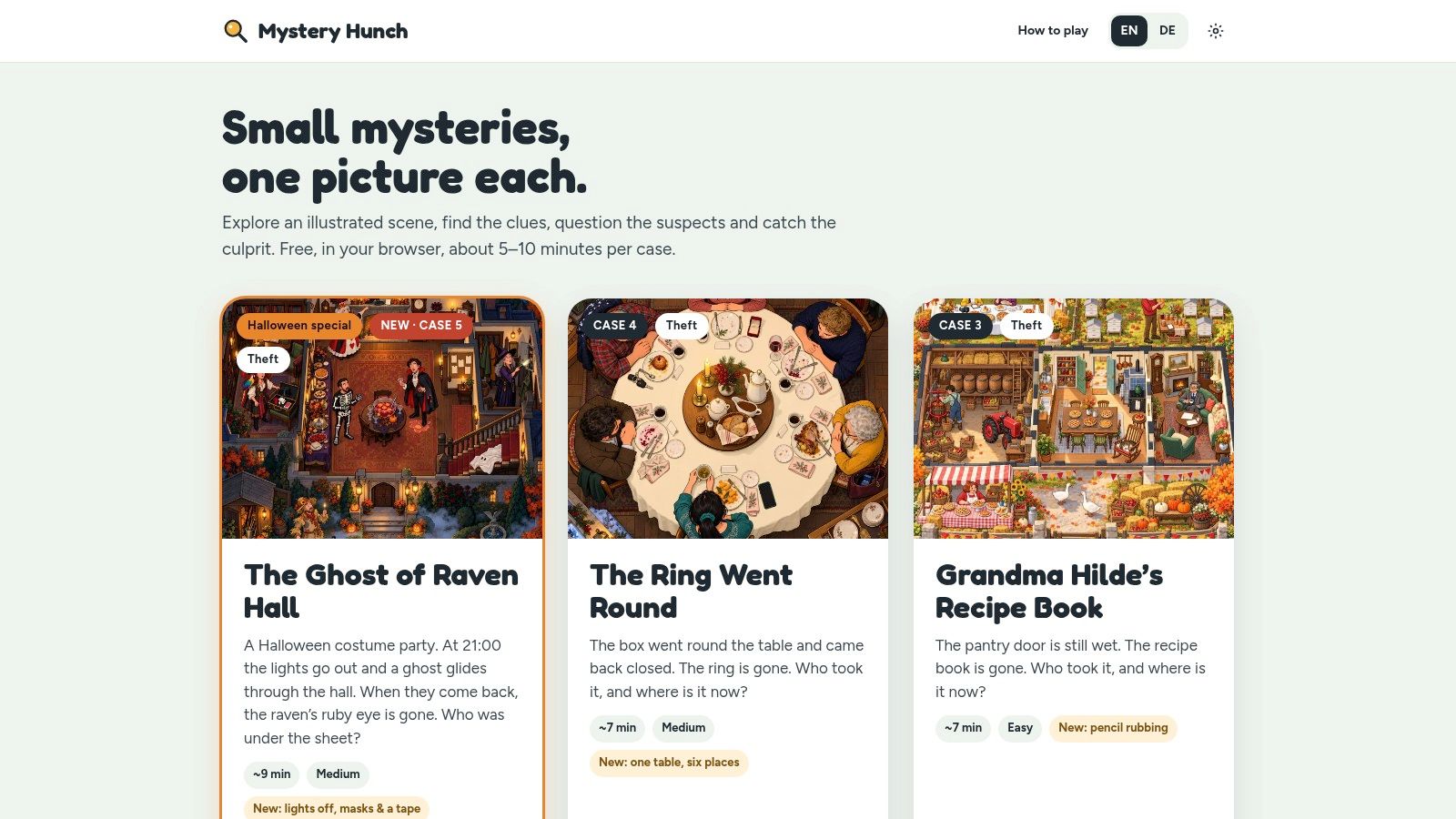
Best for a complete illustrated investigation without a long commitment. Our free browser game takes approximately five to ten minutes per case, with individual estimates and difficulty labels shown before you begin.
You investigate a single illustrated scene, tapping rooms and objects for clues. Then you combine evidence in a notebook, check suspects' statements, and accuse the culprit with proof. That last step matters: finding something suspicious isn't the same as explaining who committed the crime.
The cases give you different kinds of evidence to work with. The Ring Went Round involves a ring that disappears from a box passed around a table. The Hut on the Grauhorn puts you in a snowed-in mountain hut with a dead keeper and guests who say they were asleep.
What makes the short format work
The notebook keeps clue collection connected to deduction. Instead of tapping everything and hoping the game announces a solution, you need to consider which objects and statements belong together. Mechanics such as seating arrangements, pencil rubbing, and masks give you different things to examine.
- Session length: Short enough to finish a case during a break, rather than leave a sprawling investigation open overnight.
- Help when stuck: A partner provides hints, with each hint costing a star from the available three-star score.
- Presentation choices: English and German options, bright and noir visual styles, and phone and wider-screen layouts let you adjust the experience.
Practical rule: Before accusing anyone, separate what you observed from what a suspect merely claimed.
The limitation is scope. There are five listed cases, and this is an early prototype made by one person, not an established catalogue with endless investigations. Cases, features, and scoring may change as feedback comes in.
Skip it if you want a sprawling case file, lengthy interviews, or an evening-long story. It's a better fit when you want to inspect a scene, connect the evidence, and reach an ending without a lengthy setup.
2. PLAY INQUEST
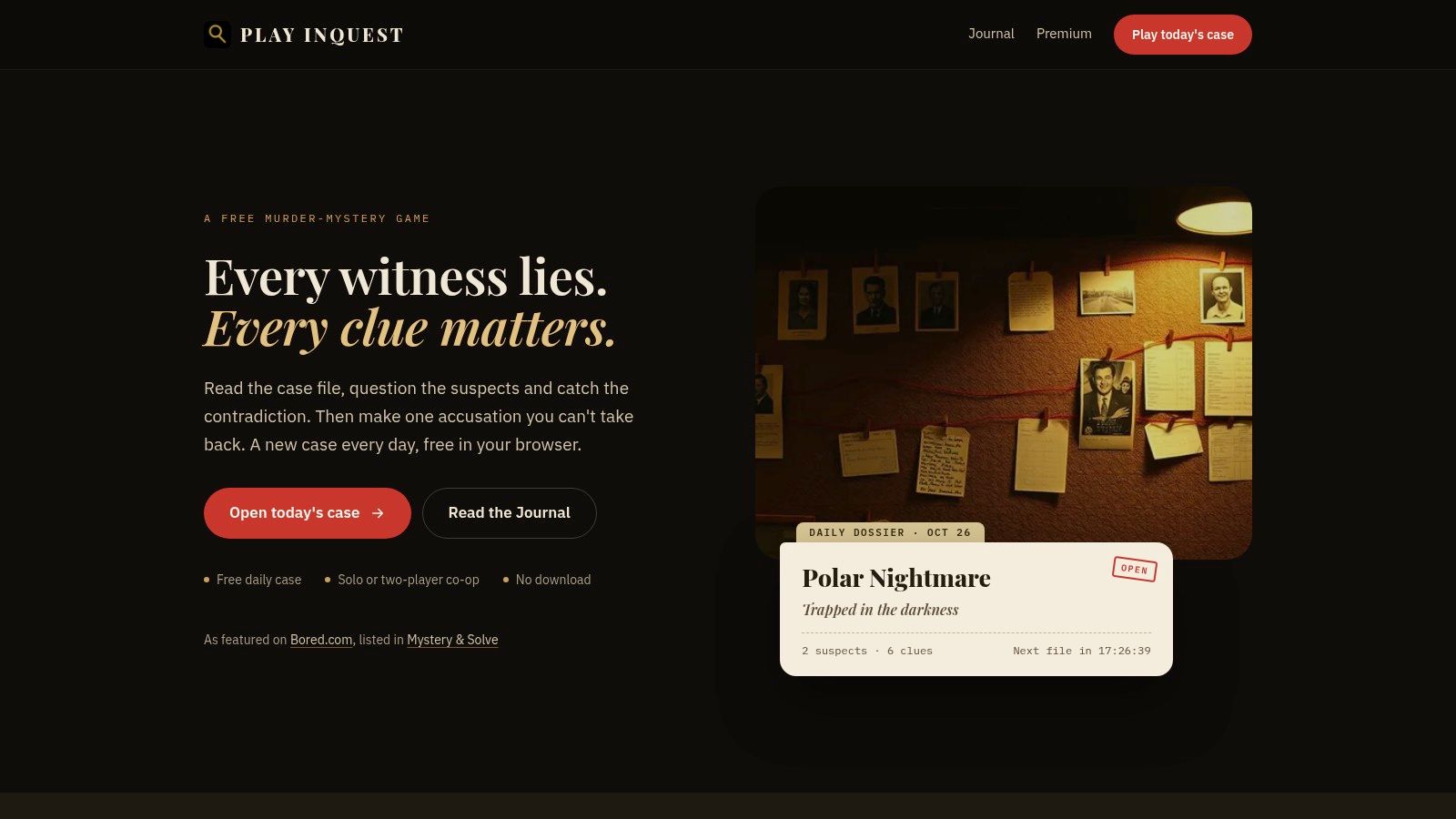
Want someone else to challenge your suspect theory? PLAY INQUEST is the pick for investigating together, with a shared case and in-game chat rather than an improvised conversation around separate screens.
The core loop stays close to a traditional whodunit. You search scenes, question witnesses, review evidence, and make an accusation. That combination suits players who want both physical clues and statements to evaluate, rather than a puzzle built entirely around object hunting.
Session length: The site doesn't give a standard solving time for every case. Treat it as a flexible short-session option, not a guaranteed finish before a hard deadline.
Use the free case before committing
The free daily case and tutorial offer a sensible starting point. You can try the daily investigation without an account, while the larger authored casebook requires sign-in and a paid Premium plan.
The useful distinction is between trying the format and wanting a continuing supply of cases. Don't subscribe just because the premise sounds appealing. First decide whether searching scenes and questioning witnesses gives you enough information to form an accusation you can explain.
- Choose it for: Browser-based investigation on desktop, tablet, or mobile, especially when you want a shared case.
- Watch for: The access boundary between the free daily offering and the paid casebook.
- Skip it if: You need every case available without signing in, or you want a clearly stated duration before starting.
With a partner, avoid agreeing on a suspect too early. Ask each other which evidence would rule that person out, then look for contradictions rather than reassurance.
Try the daily investigation at PLAY INQUEST before deciding whether you need the full casebook.
3. Cold Case Inc Flat 33
Flat 33 is for the player who would rather open an interview transcript than tap another cupboard. Its appeal is the evidence-file format: police records, phone messages, scene photographs, and CCTV that you examine as parts of the same investigation.
The free introductory case has a complete ending. That's an important distinction from a teaser that stops just as you become invested. You can judge whether you enjoy the document-reading approach without buying the resolution.
According to Cold Case Inc's Flat 33 page, the estimated solving time is 10–12 minutes, while its paid full cases typically take one to four hours. Don't assume the introductory case represents the commitment of everything else in the catalogue.
Read a statement as a claim to test, not as a reliable summary of what happened.
The practical technique is to organise evidence by event. Match what someone says they did against what a message, photograph, or timestamp can actually establish. Keep uncertainty visible in your notes instead of quietly turning an assumption into a fact.
The trade-off is reading and setup
Flat 33 includes built-in notes and hints, so you don't need to construct an elaborate external case board. It also works as a shared-screen investigation, where players can discuss a document before moving on.
However, an email address and an emailed sign-in link are required to start. That makes it less suitable when your main requirement is immediate, account-free play.
Skip it if transcripts feel like work, you want an animated environment, or you're unwilling to use email access. Choose it when the satisfying part is comparing records and explaining why seemingly compatible accounts can't all be true.
4. Ask the Truth
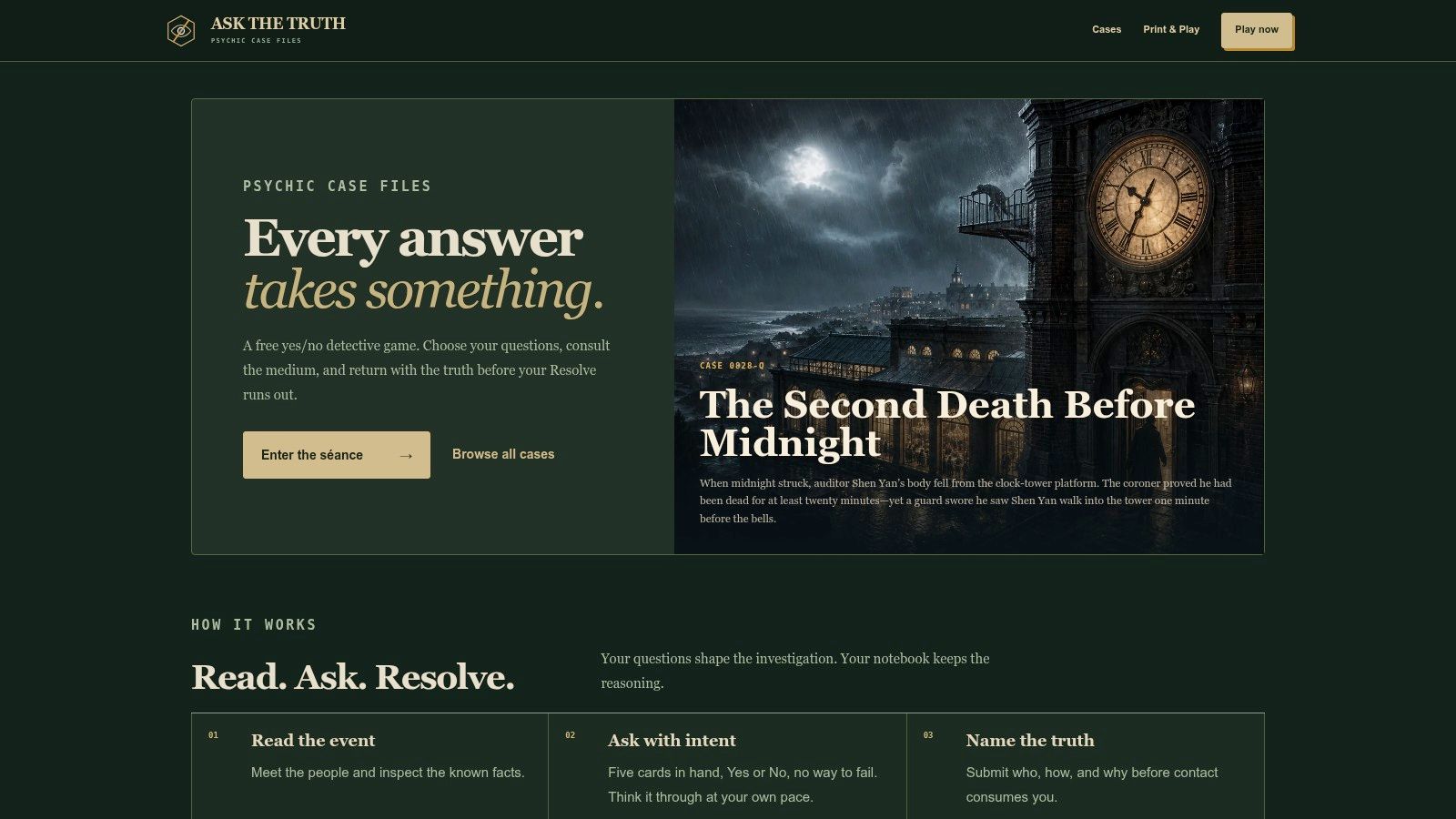
Sometimes the interesting puzzle isn't interpreting an answer. It's deciding which question deserves to be asked.
Ask the Truth builds its mysteries around choosing eligible yes-or-no questions. You use the fixed answers, notebook, and collected evidence to establish responsibility, method, and motive. There's less emphasis on wandering through a richly illustrated crime scene.
Session length: There isn't a dependable universal duration to use here. Allow room to read the question cards carefully rather than treating it as a timed sprint.
The distinctive constraint is Resolve, which limits your inquiries. A question can be relevant to the story without being useful to your current deduction, so indiscriminate questioning is a poor strategy. You need to consider what an answer would let you eliminate.
Ask questions that separate explanations
Say you're deciding between an accident and a deliberate act. A question about whether someone knew the victim may add background, but a question about access to the relevant object could help distinguish those explanations. That's the kind of decision this format encourages.
- What works: Strategic question selection gives you something meaningful to do before the answer appears.
- What takes adjustment: Resolve can run out, so you can't assume you'll be allowed to ask everything.
- Who should skip it: Players seeking unrestricted interrogation, substantial scene exploration, or German-language cases.
The English-language public game is free in the browser and doesn't require an account or download. Its question-card format is direct, but it won't provide the same visual discovery as an illustrated investigation.
Choose Ask the Truth if narrowing the question list sounds more enjoyable than searching the room.
5. Suspectle
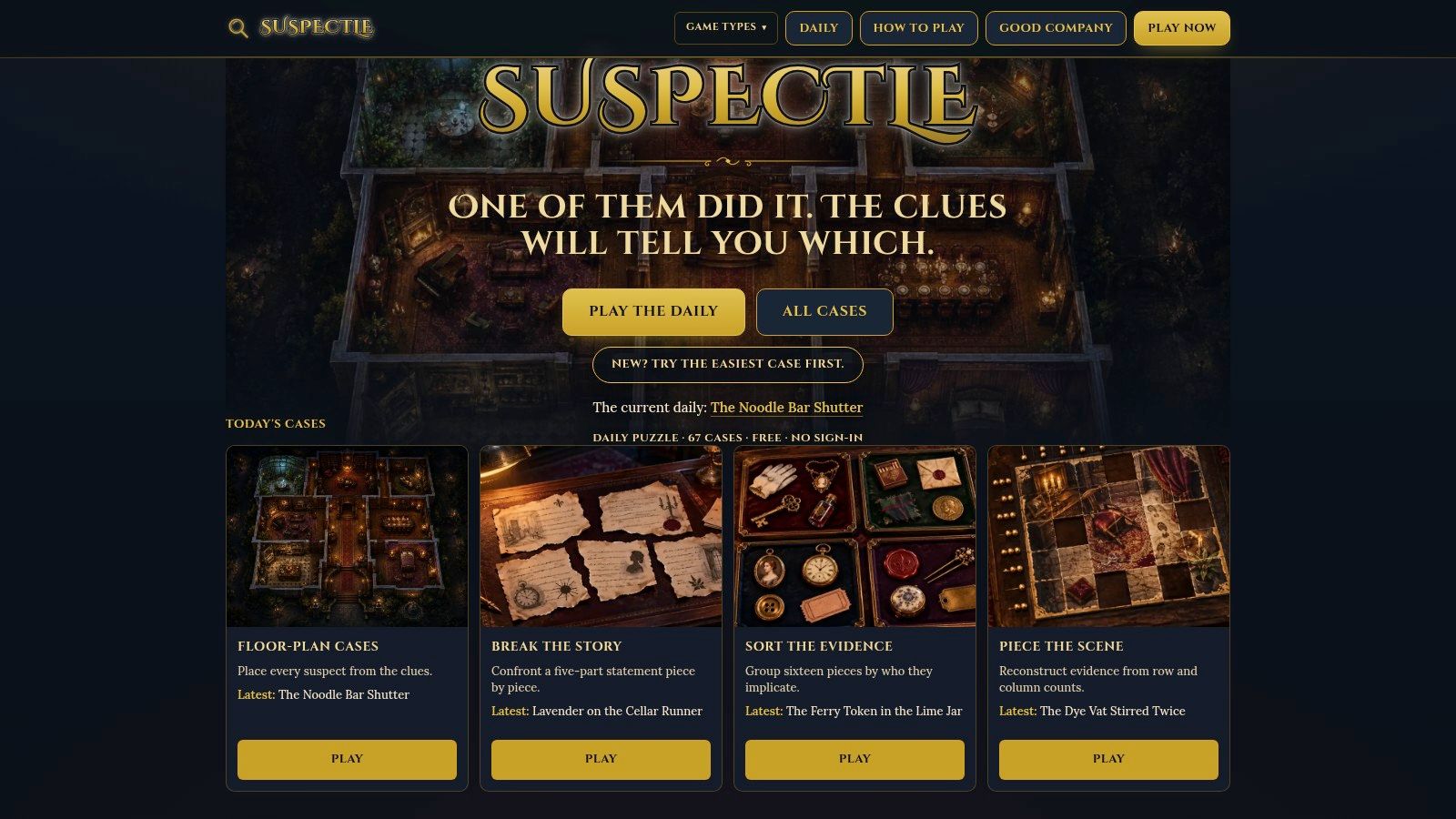
Suspectle suits the player who likes deduction but gets bored when every case uses the same puzzle format. Its collection includes floor-plan placement, statement analysis, evidence sorting, and scene reconstruction.
That variety is the main reason to choose it. You might enjoy determining where people stood but have less patience for sorting evidence into categories. Trying different mechanics helps you find the kind of reasoning you actually want to repeat.
The daily puzzles provide a starting point, while an archive lets you continue when you're enjoying yourself. Basic play is free, without an account or download.
Session length: It depends on the puzzle type and difficulty. The harder challenges aren't necessarily quick diversions, so start with a more approachable level when your available time is limited.
Expect logic first, story second
Suspectle is more puzzle collection than character-driven detective adventure. That's a strength if you want clear constraints and varied problems. It's a limitation if the pleasure of a mystery comes from getting to know suspects and questioning their motives.
Solving advice: Keep confirmed placements separate from working theories. Otherwise, a tentative assumption can distort every deduction after it.
For placement puzzles, mark what cannot fit before deciding what must fit. For statement analysis, check precisely what a sentence establishes, especially when it refers to location or another person's account.
Skip it if you want detailed room exploration, long conversations, or a story that develops across an investigation. Choose Suspectle when you want mystery-themed reasoning with enough mechanical variety to avoid repeating the same exercise each evening.
6. Casebook by SnackTurn
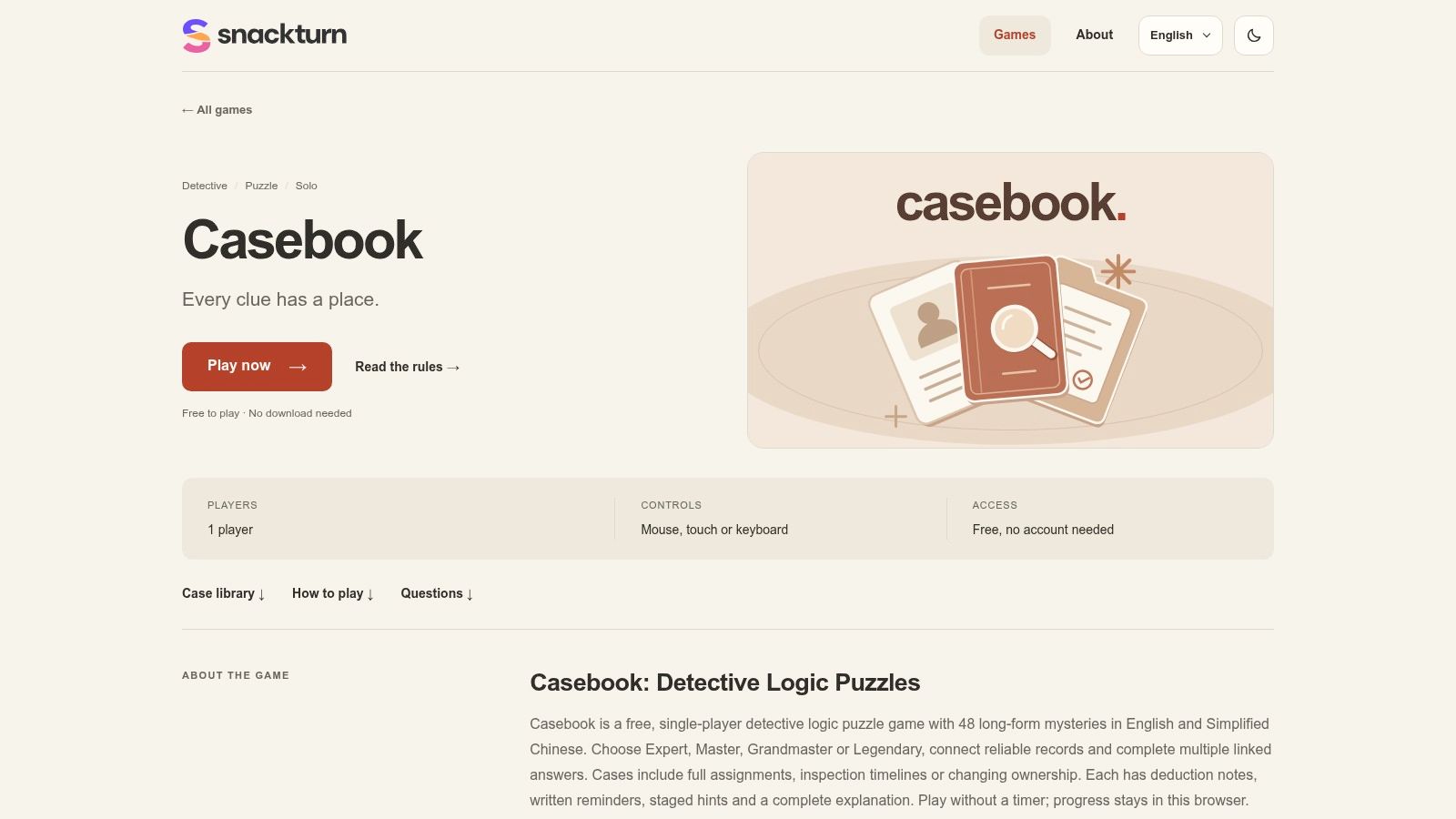
A missing object, a changing owner, an alibi that only works in a particular place. Casebook by SnackTurn turns those relationships into structured deduction puzzles rather than a scene you search.
Its Casebook game page lists 48 cases across four difficulty levels. The full library is free, and you can choose any case rather than working through them in a fixed sequence.
Session length: Difficulty determines the commitment, and there's no universal duration to promise. There's also no timer, so it's a useful choice when you want to reason carefully rather than race.
Better for deliberate solving than dramatic reveals
The puzzle types include alibis and places, timelines, and objects and owners. Those are related skills, but they need different notes. A timeline benefits from an ordered sequence; an ownership puzzle benefits from tracking who had an object before and after a transfer.
Staged hints, deduction notes, and complete explanations support players who want to understand a solution rather than merely reveal it. Use a hint when you can name your sticking point. You'll get more out of the explanation if you know which inference you missed.
- Choose it for: A free library of structured logic problems with room to increase the challenge.
- Keep in mind: Progress saves in the current browser and doesn't sync between devices.
- Skip it if: You want illustrated crime scenes, suspect conversations, or an investigation driven mainly by narrative.
That local saving matters if you regularly switch between phone and computer. Pick the device you're likely to return to before starting a demanding case.
Casebook is a strong fit when your favourite part of detective fiction is reconstructing the sequence, not inhabiting the setting.
7. Deduce
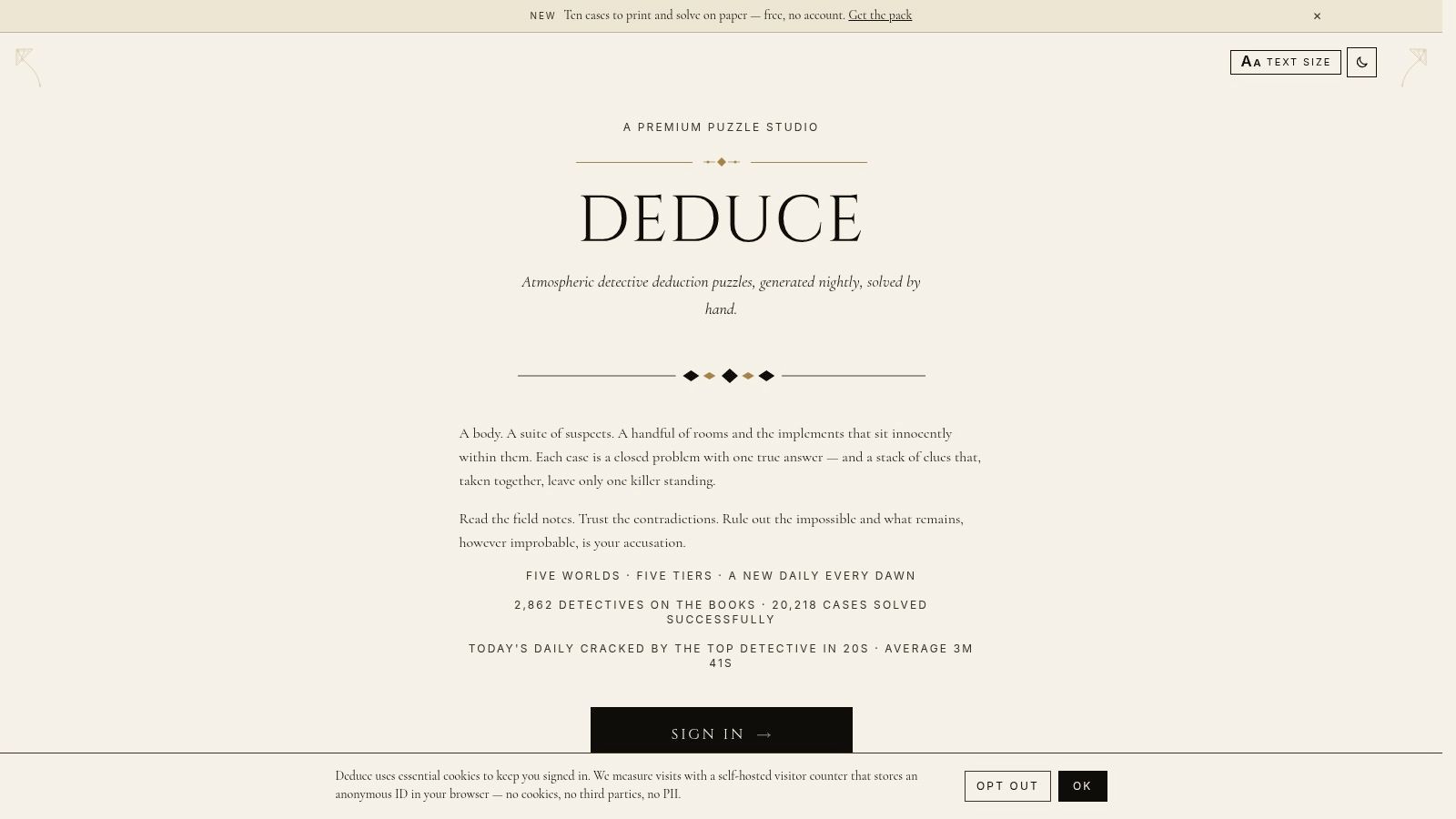
Deduce is the clearest choice here for someone who already likes logic grids. Your task is to use clues to identify the culprit, room, and weapon, rather than explore an environment or interview a cast of characters.
According to Deduce, most puzzles take an estimated 10–20 minutes, and cases have a single solution checked for logical solvability. The format gives you a defined deduction problem, not an open-ended search for something you might have overlooked.
Daily cases and the archive are free. Basic play doesn't require registration, although a free account is needed for streak tracking, cross-device progress, and higher ranks.
Let the grid do the remembering
The practical advantage of a grid is that you can record exclusions instead of repeatedly holding them in your head. A clue that rules out a room still matters, even when it doesn't immediately identify the right room.
Work through direct facts first. Then revisit linked clues after each confirmed assignment, because a relationship that was ambiguous earlier may become decisive once another possibility disappears.
- Best feature: A focused format for players who want a complete chain of logical elimination.
- Main limitation: Little of the environmental discovery or character interaction you get from a scene-based mystery.
- Reason to slow down: A wrong accusation ends the streak, so certainty matters more than speed.
Printable puzzle packs are also available if you prefer making deductions away from the browser. That's useful when the puzzle appeals but another screen session doesn't.
Skip it if you're looking for a story-rich detective adventure. Choose it when you want the murder premise, the clues, and a grid you can finish with confidence rather than a lucky guess.
How the seven mystery puzzles compare at a glance
| Item | Typical play time | Core format | Cost | Best for |
|---|---|---|---|---|
| Mystery Hunch | 6–9 minutes per case | Illustrated scene investigation with clues and suspect statements | Free | Quick, self-contained whodunits |
| PLAY INQUEST | Short cases; varies | Search crime scenes, question witnesses, review evidence; solo or co-op | Free daily case; Premium $3/month or $3.50 for 30 days | Browser-based investigations and co-op deduction |
| Cold Case Inc, Flat 33 | 10–12 minutes for the free case; full cases take 1–4 hours | Investigate records, interviews, CCTV, messages, and photos | Free introductory case; full cases currently listed at £4.99 each on sale | Document-focused case-solving |
| Ask the Truth | Not specified; varies | Solve a mystery by choosing yes-or-no questions | Free | Strategic questioning and deduction |
| Suspectle | Varies by puzzle; harder levels take longer | Murder-mystery logic puzzles with varied mechanics | Free | Daily logic puzzles and repeat play |
| Casebook by SnackTurn | Varies by case; longer levels take more time | Structured deduction puzzles using records, timelines, and assignments | Free | Untimed logic puzzles with hints and explanations |
| Deduce | Usually 10–20 minutes | Daily murder-mystery logic-grid puzzle | Free | Logic-grid fans seeking a daily challenge |
Pick One Case Tonight and See Who Did It
Choose by how you want to investigate, not by which homepage makes the grandest promise. If you want to inspect objects and challenge statements, choose a scene-based case. If you enjoy comparing accounts, choose a document file.
For a shared evening, PLAY INQUEST offers a cooperative investigation. For solo reading and cross-referencing, Flat 33 is the more natural starting point. Ask the Truth makes sense when deciding what to ask is part of the appeal.
Match the format to your energy
Logic puzzles suit a different mood. Suspectle offers varied mechanics, Casebook suits deliberate work with records and relationships, and Deduce gives grid fans a clearly defined daily problem. Don't choose a demanding puzzle just because its difficulty label sounds impressive.
Play a single case before deciding whether to explore an archive or pay for more. Notice where you enjoyed yourself: discovering a clue, identifying a contradiction, or proving that an alternative was impossible. That reaction is more useful than whether you finished quickly.
A good first case should make you want another investigation, not make you feel obliged to finish the catalogue.
Keep the brain-training promises in perspective, too. A University at Albany account of a study involving 200 students reports no immediate improvement in attention after a single 10-minute Sudoku or maze session. That finding doesn't evaluate detective games, but it's a good reason not to confuse enjoyable reasoning practice with a proven cognitive treatment.
You don't need a medical benefit to justify a pleasant evening solving a case. Concentrating on evidence and reaching an explanation can be enough. If you get stuck, use the available help and work out which inference you missed.
Our own project is an early prototype made by one person, and feedback helps shape what comes next. If something is confusing, describe the action you tried and what you expected. If you enjoyed the ending, share a spoiler-free result so someone else can investigate without having the culprit revealed.
For a complete illustrated scene investigation in roughly five to ten minutes, visit Mystery Hunch and choose a free browser case. Inspect the scene, combine clues in your notebook, and make an accusation you can support with evidence.
Published via the Outrank tool