Noir Deductive Mystery Game: How Atmosphere Shapes Clues
You've got a coffee going cold and a little time to spare. A detective game opens on a shadowy room, someone's lying, and you're ready to catch them. Then you spend your break tapping furniture without knowing what matters.
A good noir deductive mystery game should make you suspicious of people, not confused by the controls. Its atmosphere should change how you interpret evidence, not stop you from finding it. The pleasure comes from spotting the gap between someone's story and what the room actually tells you.
Table of Contents
- The Noir Traits That Shape Every Clue
- Why Dark Scenes Still Need Bright Clues
- How the Deduction Loop Runs From Scene to Accusation
- Five Browser Cases and What Each Asks You to Prove
- Following One Murder Case From Clue to Culprit
- Where Atmosphere Starts Costing You Clues
- Start Your First Noir Case in Under Ten Minutes
The Noir Traits That Shape Every Clue
Film noir's classic period spans the 1940s and 1950s, its literary roots lie in American hard-boiled crime fiction of the Great Depression, and French critic Nino Frank helped introduce the term in 1946, as outlined in this history of noir's development.
That background matters because noir is a storytelling framework, not just a dark colour palette. You're rebuilding hidden events in a city where respectable people may be corrupt and frightened people may lie. The trick is separating what someone conceals from what they did.
Noir traits and what they do to clues
| Noir trait | What it looks like in a scene | What it does to the clue |
|---|---|---|
| Unreliable testimony | Suspects give statements that conflict with objects in the room | Each claim becomes a lead you can check |
| Institutional or personal corruption | A respectable figure hides a motive behind a routine | Clues point to motive, not just access |
| Morally compromised suspects | Several people lie for small, human reasons | The proof must separate harmless lies from the real culprit |
| Cynical narration | Terse, world-weary text and dialogue | Hints read like gossip, not tutorials |
| Low-key lighting and muted colour | Dark rooms with shadowed corners | Clues need contrast to stay findable |
| Period settings | 1940s-style rooms with letters, ledgers and keys | Old objects carry the evidence |
The most useful distinction is between lying and committing the crime. In an imagined case, a clerk might deny entering an office because they were stealing stationery. That lie gives you something to investigate, but it doesn't prove they killed the person inside.
Corruption changes the questions, too. A ledger might reveal who benefited from keeping a business open, rather than who merely possessed its key. You're asking what someone stood to lose, then checking whether the physical evidence supports that motive.
Keep uncertainty in the people
Cynical narration can make a clue feel at home in the story. A detective might describe an immaculate ledger as suspiciously tidy. That's flavour, though, not proof that its owner altered it.
The underlying logic should remain checkable even when the characters aren't trustworthy. If changing the colours leaves every clue and inference untouched, the game is noir in mood alone.
Why Dark Scenes Still Need Bright Clues
A noir scene is dark on purpose. That creates a practical problem: the letter you need can disappear into the atmosphere you came to enjoy.
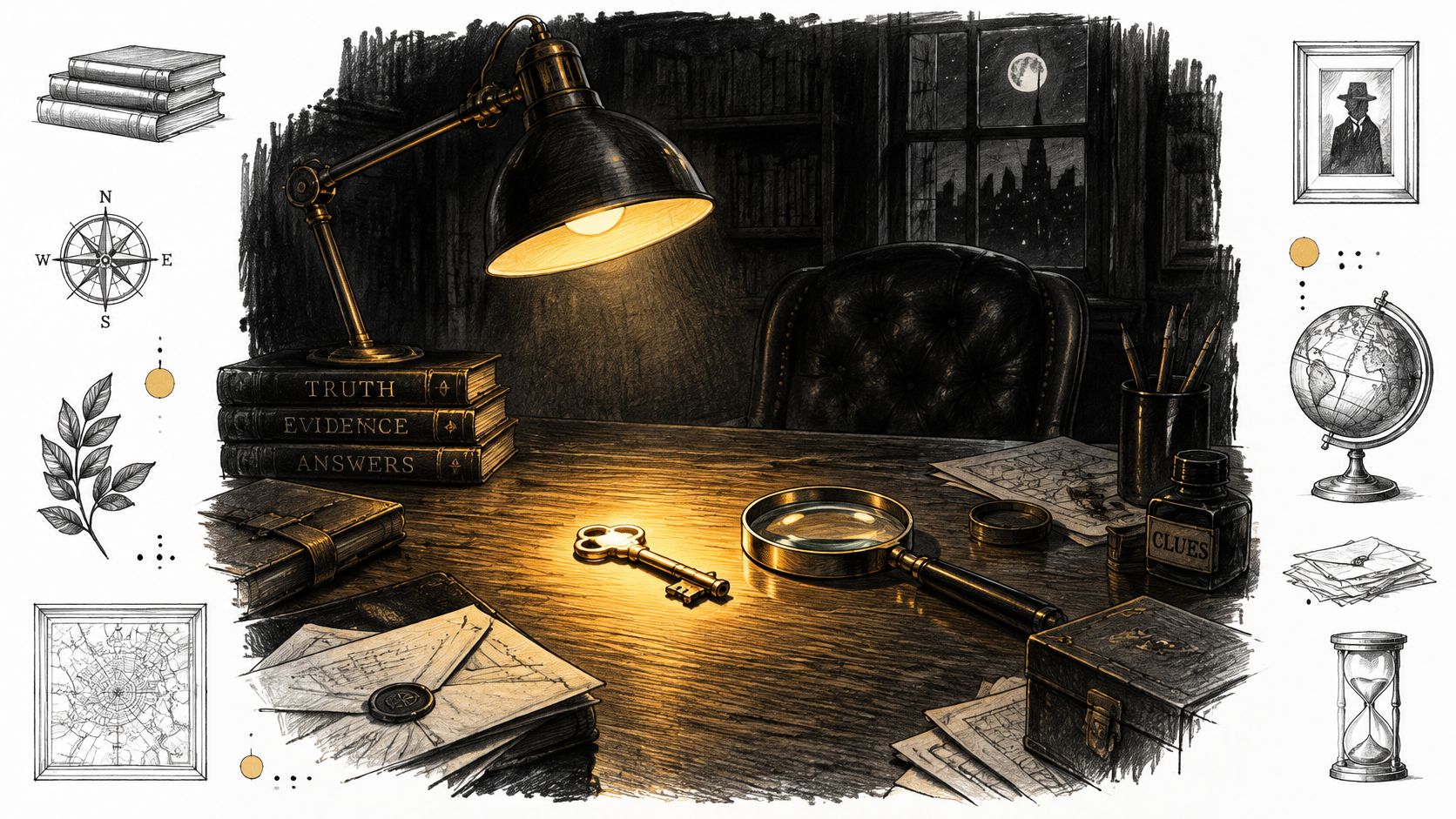
Consider an imagined desk scene. A candle catches the torn edge of a letter, making the paper stand out without lighting up the whole room. When you inspect it, a notebook entry identifies it as a torn letter that appears to match the note on the desk.
The desk below illustrates the balance between a gloomy setting and an object that attracts attention.
Make it visible, then make it meaningful
Two separate jobs have to happen before a clue helps you. Visual salience decides whether your eye lands on the object at all. Information scent decides whether you bother picking it up. A supermarket shelf works the same way: bright packaging gets a product noticed, then the label has to convince you it belongs in your basket.
Each job can fail on its own. A pale letter on a dark desk fails the first test, because nobody sees it. A glowing paperweight that turns out to be decoration fails the second, because its shine promised relevance it never had.
This matters more in a short case than in a long game. When a case takes five to ten minutes, every minute spent squinting at a shadowy corner is a minute taken away from weighing evidence. Atmosphere and deduction compete for the same small budget.
Designers can keep the signals restrained:
- Contrast: Give the letter a slightly lighter edge than the desk.
- Lighting: Let a nearby lamp illuminate the relevant surface.
- Silhouette: Make a key's outline distinguishable from surrounding clutter.
- Cursor feedback: Change the pointer over an inspectable drawer, while providing a usable touch-screen equivalent.
Practical rule: Make the object discoverable without making its interpretation automatic.
You should notice the torn letter. You should still have to work out whose account it challenges.
Try the decorative-object test
Watch what a player taps before finding required evidence. If they repeatedly inspect decorative books but miss the letter, don't immediately add another hint. First check whether the letter has enough contrast and enough contextual meaning.
Compare phone and desktop behaviour separately. Record clue discovery, the wait before the first interaction, and taps that don't lead anywhere useful. A scene that works with a pointer may still be frustrating under a thumb.
Keep hotspot behaviour, notebook placement and evidence markers consistent across cases. Familiar layouts let players spend their attention interpreting evidence rather than relearning the interface each time.
How the Deduction Loop Runs From Scene to Accusation
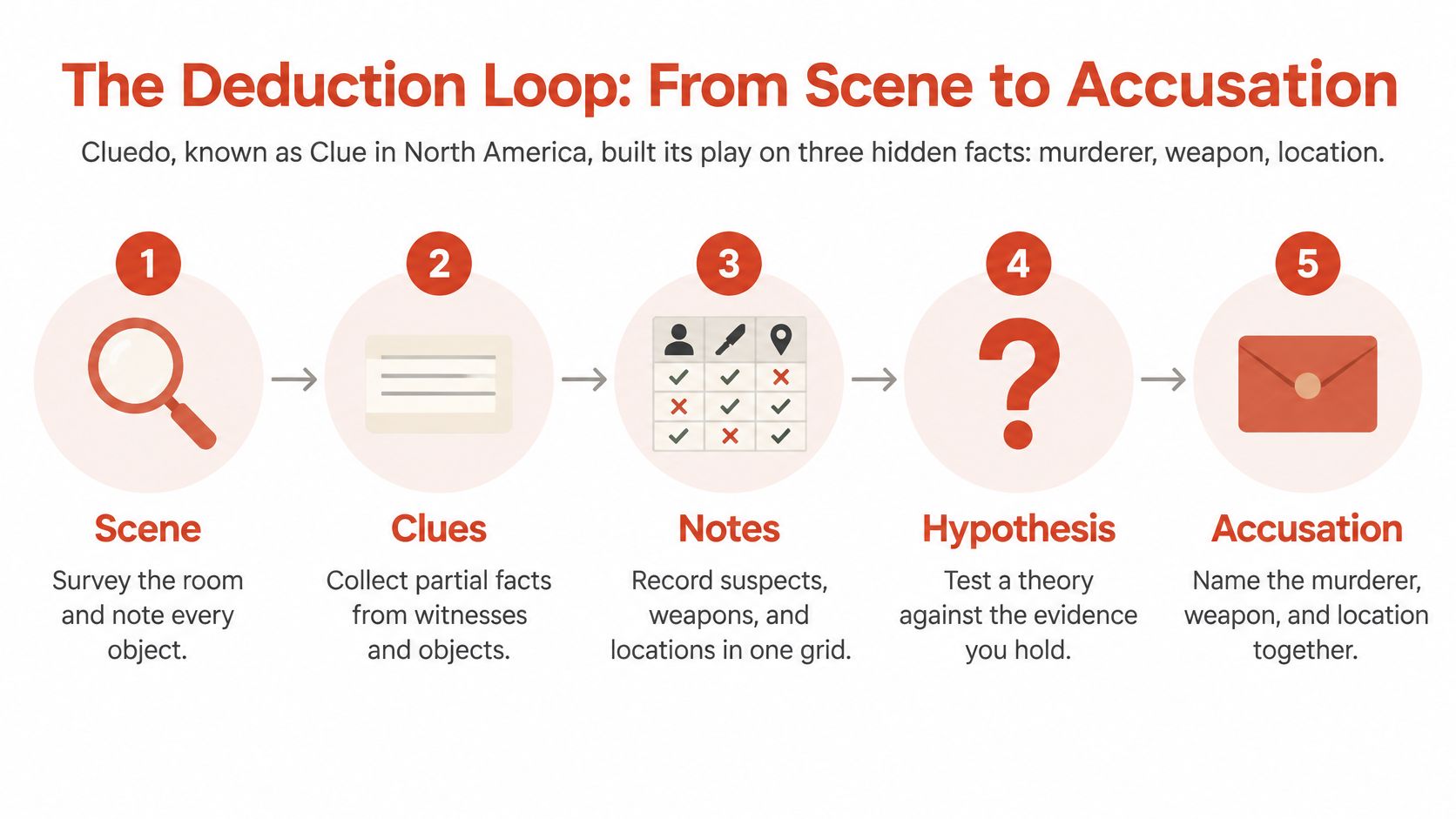
Cluedo, known as Clue in North America, centres on three concealed facts, the murderer, weapon and location, establishing a compact pattern of gathering partial information, eliminating possibilities and making an accusation.
A browser mystery can use that same basic structure without copying the board game's rules. At Mystery Hunch, players tap rooms and objects, combine evidence in a notebook, and check suspects' statements before accusing with proof. A completed case can earn up to three stars.
The broad flow is easy to recognise.
A practical investigation checklist
Scan the scene and inspect objects that look out of place. Start with observation rather than a favourite suspect. The usual slip is inventing a story before you know what's present.
Log each clue with its source. A key found beside a doorway and a key found among someone's belongings don't support the same inference. Recording only “key” throws away useful context.
Read each suspect's statement. Look for checkable claims about time, place and actions. A nervous tone may be interesting, but “I never entered the pantry” gives you something concrete to test.
Combine compatible items. Use the notebook to explore connections the interface supports. Don't treat every possible pairing as equally meaningful, and don't assume that collecting an item means you've finished examining it.
Mark contradictions between statements and evidence. Describe the conflict precisely. “Their account disagrees with the object's location” is more useful than “they seem suspicious.”
Clear suspects whose claims hold up. Narrow the possibilities instead of collecting accusations. Be careful, though: confirming someone's whereabouts during one event doesn't automatically explain everything they did.
Build the accusation from proof. Identify who acted, what happened and where, using the questions the case actually asks. Before submitting, check whether your evidence establishes the conclusion or merely makes it plausible.
Don't confuse a theory with an answer
Think of this like checking a shopping receipt. A total that feels wrong gives you a reason to investigate. You still need to find the item or charge that explains the difference.
The same applies to a suspect. Motive starts a line of inquiry; a contradiction sharpens it; connected evidence supports the accusation. The final answer should survive a cross-check, not depend on how confidently you clicked.
For a short case, that process needs to fit into a single sitting. The challenge should come from making the connection, not from repeating a search you've already completed.
Five Browser Cases and What Each Asks You to Prove
Five cases, four thefts and one murder. All of them run free in the browser, and the hook column below tells you the actual starting point: the question each scene wants answered.
| Case | Crime | Length | Difficulty | Clue hook |
|---|---|---|---|---|
| Case 1: The Hut on the Grauhorn | Murder | About 6 min | Medium | Snowed-in hut keeper is dead; five guests say they were asleep |
| Case 2: The Countess's Necklace | Theft | About 8 min | Medium | Necklace missing from a locked case |
| Case 3: Grandma Hilde's Recipe Book | Theft | About 7 min | Easy | Wet pantry door and a missing recipe book |
| Case 4: The Ring Went Round | Theft | About 7 min | Medium | Ring vanishes from a box that went round a table and came back closed |
| Case 5: Theft | Theft | About 9 min | Medium | Raven's ruby eye goes missing at a Halloween costume party |
Pick the question that interests you
Grandma Hilde's Recipe Book is the natural warm-up because it carries the Easy rating. A wet pantry door sits next to a missing recipe book, so the job is to connect the odd detail to the theft instead of filing it away as decoration.
The Hut on the Grauhorn gives you the opposite problem. The hut keeper is dead and five guests all say they were asleep, which means you hold five matching alibis and little else. Your job is to find the one account the scene refuses to support.
The Countess's Necklace makes access the obvious question, since the necklace vanished from a locked case. Treat the lock as a condition the true answer has to explain. A locked case that still loses its contents is telling you something about method.
The Ring Went Round is about movement. A box travelled around a table and came back closed, yet the ring inside was gone. The case splits what the guests could see from what they assumed stayed inside.
In Theft, a raven's ruby eye goes missing during a Halloween costume party. Costumes give everyone a built-in disguise, so the case rewards checking who was really behind each mask.
Same evidence standard, different shapes
Read the five hooks together and a pattern appears. Every case restricts what could have happened: snow traps the suspects inside the hut, a locked case narrows access to the necklace, a closed box limits when the ring could leave. That is noir doing real work. The gloomy setting acts like a fence around the solution, and in a case this short the fence has to matter.
The classic who, what and where still apply, though a theft swaps the murder weapon for a method. Ask who took the object, how they managed it, and which clue proves it.
Each case takes about five to ten minutes, and that budget is why the hook matters so much. A two-hour film can afford fog and saxophone purely for mood. A nine-minute case needs every shadow to either narrow the suspect list or get out of the way. Start with the Easy case, then pick whichever Medium question makes you most curious.
Following One Murder Case From Clue to Culprit
You open The Hut on the Grauhorn. The keeper is dead, the hut is snowed in, and the guests say they were asleep.
The objects and statements below are invented teaching examples, not actual case clues or a solution. They show how to reason through this kind of scene without spoiling what you'll discover.
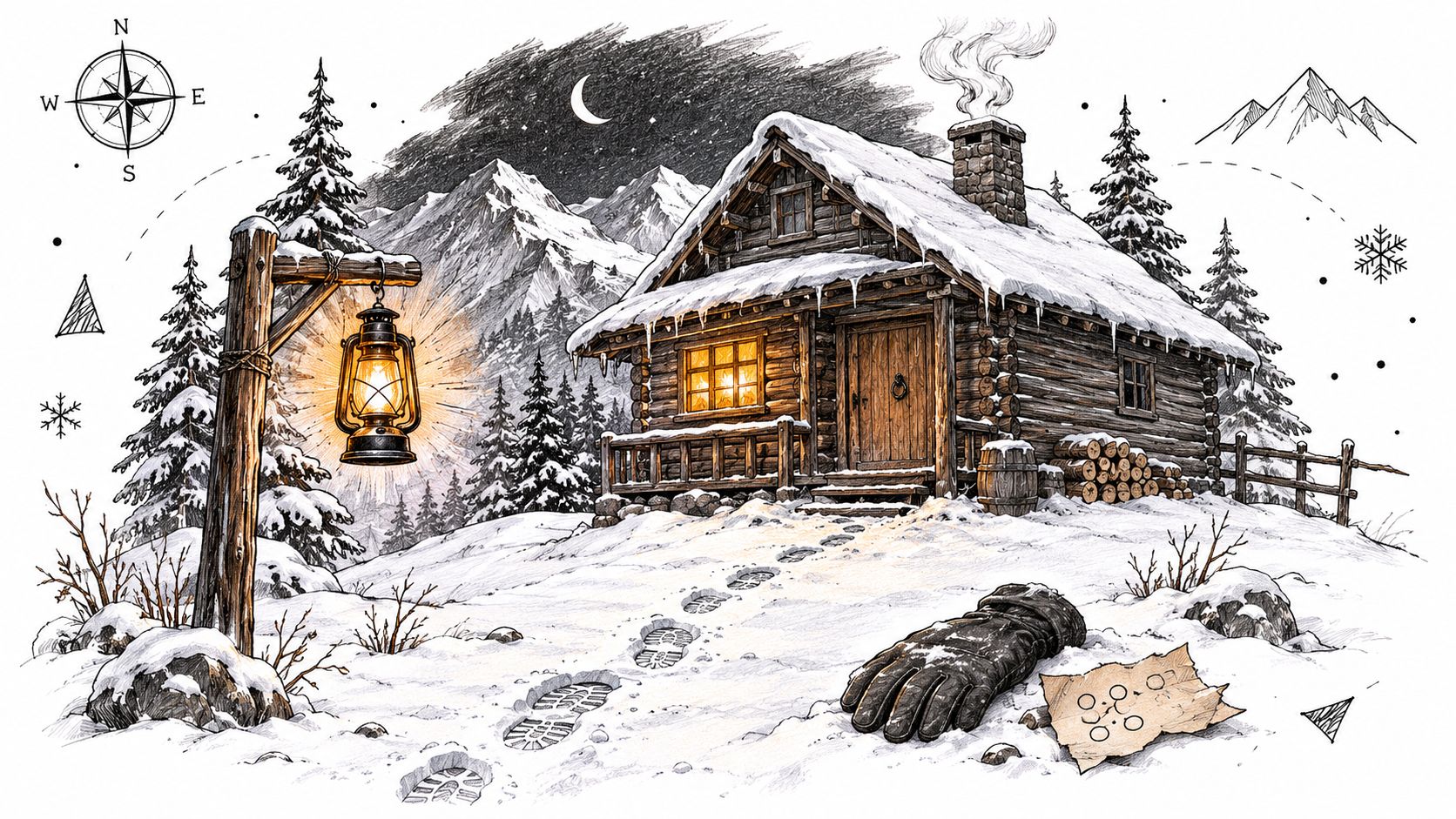
A snowy cabin gives you the right setting for the imagined investigation.
Observe before explaining
You tap a stove. It's warm, so you record its condition and location without deciding who used it.
Next, you inspect a wet boot beside the door. You add where it was found, but you don't attach it to a guest yet. A nearby object isn't automatically someone's possession.
Then you notice a stopped clock. Your imagined notebook now preserves:
- Stove: Warm when inspected, in the shared room.
- Boot: Damp, beside the entrance, ownership unconfirmed.
- Clock: Stopped, with no established explanation.
You read a guest's statement. She insists she never left her bunk, and you immediately think about the boot. But you don't yet know whether it belongs to her or when it became wet.
Another guest says he slept through the night. The warm stove makes you wonder whether someone was awake, but residual warmth alone doesn't establish who tended it or when.
A clue can challenge your assumption without contradicting a suspect.
Check the missing connection
Here's the moment of doubt: both accounts feel questionable, yet neither object establishes a lie. Only the clock remains unexplored, and you're tempted to make it explain everything.
Go back to the scene before reaching for a hint. Ask whether you missed an inspection detail or overlooked a source label. That's a sensible check, not a guarantee that every stalled investigation comes from a missed object.
For a separate visual pause, there's also this video.
Suppose, purely within this teaching example, a closer inspection shows that the clock's mechanism is broken. You can no longer treat its displayed time as a reliable timestamp. You've made progress by removing a weak inference, even though you haven't identified anyone.
That's the discipline a fair accusation needs. Connect a person's opportunity and, where supported, their motive to the physical evidence. Don't invent a motive to fill a gap.
When you try The Countess's Necklace, carry over that habit rather than any imagined cabin clue. Inspect what a detail actually proves before deciding which story you want it to tell.
Where Atmosphere Starts Costing You Clues
In a short mystery, atmosphere competes with the time you need to process evidence. A long introduction may establish a wonderful mood while leaving you less room to compare statements. Slow transitions and hard-to-read rooms create the same trade-off.
There's also a memory problem. You're tracking objects, people, positions and contradictions while trying to build an explanation. Nielsen Norman Group's usability guidance supports recognition over recall and progressive disclosure: keep useful context visible, and defer less-needed functions until they become relevant.
Diagnose the friction before adding hints
| Symptom | Likely cause | Fix |
|---|---|---|
| Taps decorative objects before finding evidence | Clue contrast too low for the dark palette | Raise contrast or add a cursor cue before adding hints |
| Right clues collected but accusation fails | Retrieval problem: notebook hides the comparison | Show evidence and statements side by side in the notebook |
| Forgets which suspect said what | Working-memory overload | Keep suspect names and statement excerpts visible |
| Stuck on combining items | Compatible pairs not yet surfaced | Surface combine options once matching items are collected |
| Many restarts on phones | Switching between scene and notebook costs time | Measure switching time on mobile and simplify the layout |
| Session runs long before the case starts | Atmospheric intro eats the short session | Trim the lead-in and reach the first clue quickly |
These are diagnostic possibilities, not verdicts about every player. Decorative taps point back to the visibility problem. Collected evidence followed by failed accusations suggests a different question: can the player retrieve and compare what they already know?
Forgetting who said what is a reason to preserve suspect names beside statement excerpts. A player shouldn't have to remember a face, leave the notebook, reopen dialogue and return just to check a sentence.
Keep the reasoning visible
Combination problems call for relevant options, not a permanent wall of controls. Show the comparison or combination tool when the player has compatible material. Keep evidence cards and source locations available alongside it.
Phone restarts deserve their own investigation. Watch whether players repeatedly move between views because related information can't fit together. Measure that switching cost before deciding the mystery itself is too hard.
An overlong introduction needs a simpler edit: reach an inspectable object sooner. Keep the characterful sentence that helps interpretation; question the extra paragraph that changes nothing the player can reason about.
Design check: Remove unnecessary remembering before you remove necessary thinking.
Earned stars remain after a restart, so experimentation needn't erase earlier progress. That's useful protection, but it doesn't excuse confusing presentation. Adding hints may help someone finish while leaving the underlying retrieval problem untouched.
Start Your First Noir Case in Under Ten Minutes
Start with Grandma Hilde's Recipe Book, then move to a Medium case when you want a tougher comparison. Its familiar setting offers a manageable place to practise distinguishing an observation from an explanation.
Open the case, scan the room and inspect the wet pantry door before reading the statements. Then use the investigation checklist above rather than jumping straight from an unusual object to an accusation.
Keep a small record beside your first case.
Make the session a useful test
Check the case's length label before starting. You can open the browser case selection without installing anything, and play is free. A partner can help if you get stuck, with each hint costing one star.
Record only what will help you compare attempts:
- Case name: Which investigation did you choose?
- Accusation: Whom did you name?
- Proof: Which evidence supported your answer?
- Result: Did the accusation hold, and where did you hesitate?
Don't judge the atmosphere only by whether you liked the artwork. Ask whether the scene helped you notice relevant details, and whether the notebook let you test their meaning.
The project is an early prototype offered free to collect feedback. Cases, features and scoring may change or be removed at any time. If something makes your reasoning harder to express, record that specific obstacle rather than merely calling the case difficult.
Mystery Hunch offers free illustrated mysteries where you examine a scene, question suspects and accuse with evidence. Visit Mystery Hunch, choose a case, and test whether you can separate a suspicious story from a provable one.
Generated with the Outrank tool