The 10 Best Mystery and Puzzle Games for Sharp Detectives

You've got ten free minutes, a browser tab open, and an itch to solve something. Not sweep a cursor across wallpaper until a hidden key lights up. Not follow a helpful arrow through a mystery that's already solved itself. You want a clue that changes your mind about a suspect.
The tricky part is that mystery and puzzle games ask you to think in very different ways. Examining an illustrated room isn't the same pleasure as completing a deduction grid. Working out where everyone stood isn't the same challenge as choosing which question to ask before your resources run out.
The picks below are organized around those differences, rather than a claim that every detective wants the same thing. Some suit a short break; others deserve an uninterrupted stretch. Where a game provides a session estimate, you'll find it alongside the mechanics. Where there isn't a supported estimate, there's no invented stopwatch verdict.
A satisfying mystery should let you explain why the culprit is guilty, not just celebrate that you clicked the right person.
Choose according to what you want to do: inspect, eliminate, arrange, question, or make a quick judgment. Those verbs tell you more about a session than the presence of a trench coat or a chalk outline.
Table of Contents
- 1. Mystery Hunch
- 2. Murdoku
- 3. Super Detective
- 4. Clues by Sam
- 5. Murdle
- 6. Ask the Truth
- 7. Deduce
- 8. Suspectle
- 9. The Detective's Desk
- 10. Case60
- Top 10 Mystery & Puzzle Games Comparison
- Pick Your Next Case
1. Mystery Hunch
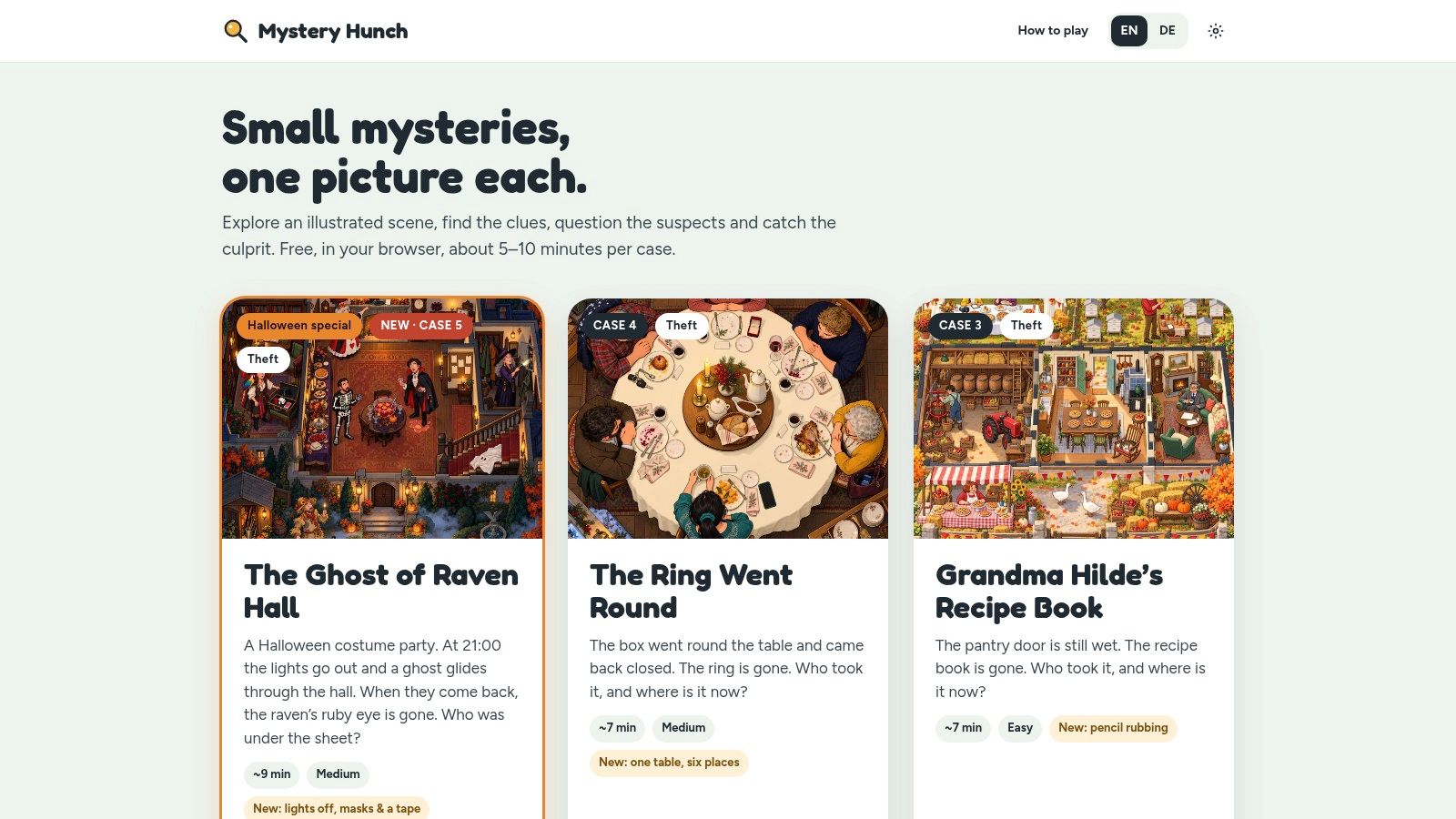
Best for connecting physical evidence with suspect statements. Mystery Hunch keeps each investigation inside an illustrated scene, so your attention stays on the relationship between what you can see and what people claim happened.
Tap rooms and objects, collect clues, and combine evidence in your notebook. Then compare your findings with suspects' statements before making an accusation backed by proof. The important distinction is that discovering an object isn't necessarily the end of the puzzle. You still need to understand what it establishes.
The current collection contains five cases, with listed estimates of approximately six to nine minutes and easy or medium difficulty labels. Settings include a Halloween costume party, a dinner table, and a snowed-in mountain hut. Different cases introduce seating arrangements, pencil rubbing, masks, a blackout, and item combinations.
Short cases with a clear scoring trade-off
You can earn up to three stars per case, while asking your partner for a hint costs one star. Restarting doesn't erase earned stars. That's a transparent trade-off, although players who dislike scoring penalties may still hesitate to ask for help.
- Good fit: You want scene exploration, evidence organization, and a final accusation rather than a standalone logic board.
- Practical convenience: It's free in the browser, supports phone and wider-screen layouts, and offers English and German alongside bright and noir visual styles.
- Honest limitation: The collection is small, and the project is an openly disclosed early prototype made by one person. Cases, features, and scoring may change.
For a concrete starting point, The Hut on the Grauhorn puts a dead hut keeper and conflicting possibilities inside a snowbound setting. Approach it by separating what each guest says from what the scene supports.
The strongest reason to choose this format is context. A clue belongs somewhere, a statement refers to something, and your job is to connect them rather than merely finish collecting.
2. Murdoku
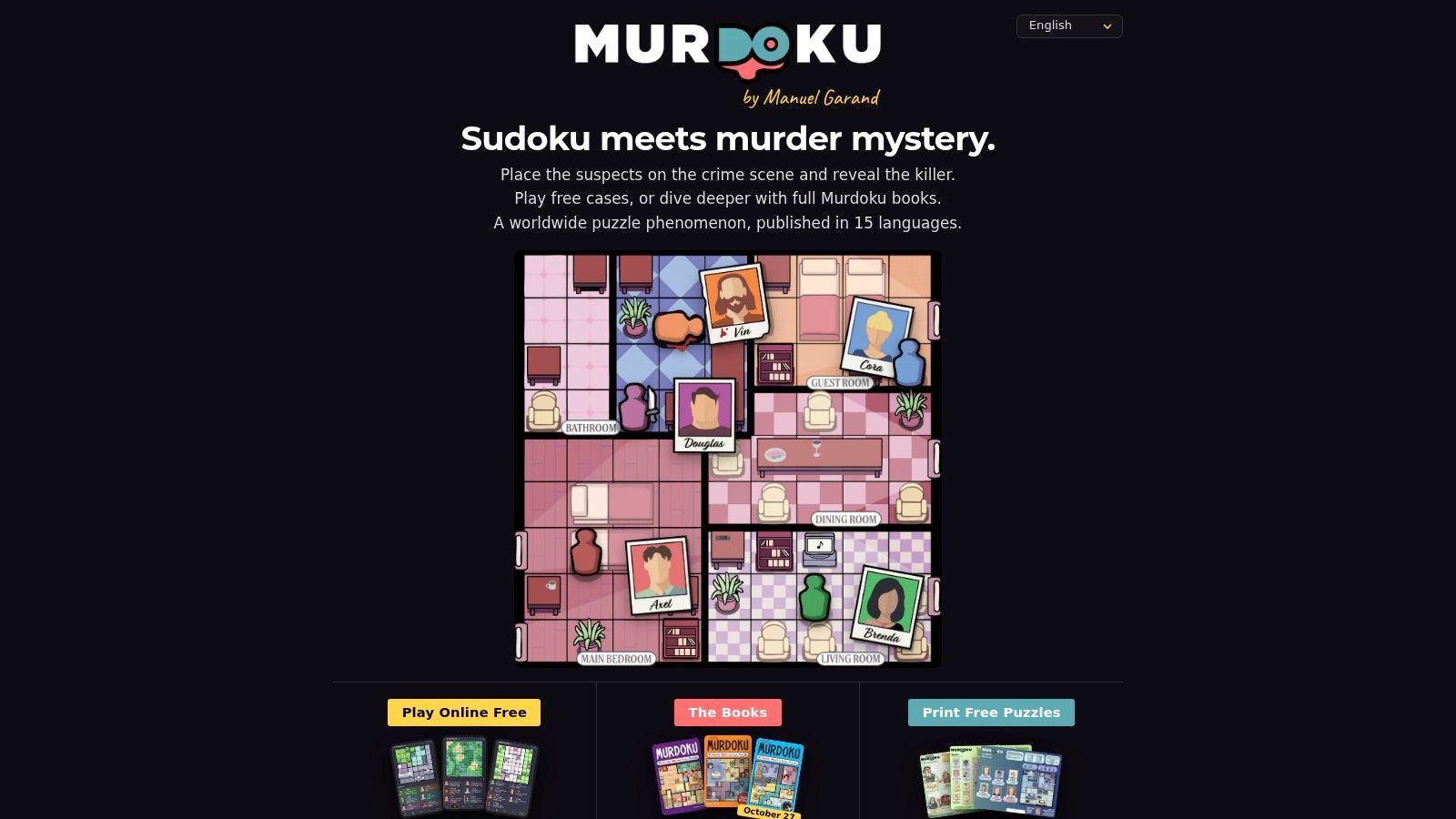
Prefer arranging people to rummaging through drawers? Murdoku turns the crime scene into a placement problem. You use clues to position suspects on a grid and identify the killer, blending Sudoku-style organization with spatial deduction.
The useful question isn't whether someone looks suspicious. It's whether their position remains possible after you account for the other clues. That makes the illustrated setting part of the reasoning surface rather than a backdrop for a conventional suspect list.
Murdoku's website offers free browser puzzles, weekly releases, and printable cases, with additional material available in paid books. Multiple languages are also listed. There isn't a supported completion-time estimate in the supplied product information, so don't assume a weekly puzzle will fit neatly into a short break.
Choose it for spatial constraints
The paper option is a meaningful distinction. If you like making marks, circling possibilities, or stepping away from a screen, you don't have to change puzzle styles to do that.
- What works: Locations and relationships give you something concrete to reason about.
- What doesn't: There's no point choosing it for object collection or conversational investigation. Placement is the main attraction.
- Content trade-off: The free online selection is narrower than the book collection.
A useful solving habit is to keep confirmed placements separate from plausible placements. Something can fit without being proven, and a tidy-looking arrangement isn't evidence that you've finished.
Choose Murdoku when your favorite detective moment is reconstructing where everyone must have been. Skip it when you mainly want to discover what happened by exploring a scene.
3. Super Detective

A floor plan gives you a different kind of case file. In Super Detective, witness clues and room relationships help you place people correctly and identify the killer. The appeal is a chain of deductions, not an inventory full of curious objects.
Super Detective provides five free cases every Monday, with five difficulty levels spanning 4×4 to 8×8 layouts. Its locations include lodges, trains, and museums, and the browser game supports phones, tablets, and computers. Free cases don't require sign-up, while additional cases are available in paid packs.
That progression makes it a sensible option if you want to learn a format and then increase the challenge without learning a different interface. However, there's no supported session estimate to attach to those difficulty levels. A larger layout isn't a reliable promise about how long you'll need.
Practical rule: When a hint reveals the next deduction, work out why it follows before placing the person. Otherwise, you've borrowed an answer without learning the move.
Better for structured reasoning than searching
Hints are designed to show the next deduction, and guessing isn't the intended route. That's useful when you want assistance with reasoning rather than a pointer toward an overlooked hotspot.
The limitation is equally clear: you're solving a floor-plan logic puzzle. A lodge setting doesn't turn the experience into a freely explorable lodge.
Choose Super Detective if you enjoy reading constraints, checking room relationships, and steadily narrowing possibilities. If your favorite part of a mystery is opening a drawer and discovering an unexpected connection, its structure may feel too prescribed.
4. Clues by Sam
Clues by Sam makes you justify the next move. Its daily suspect grid asks you to identify criminals and innocents from revealed clues, while preventing unsupported guesses.
That restriction changes the goal. You're not merely trying to land on the correct classification; you need a logical reason to make it. For players who tend to rush, that's a useful nudge toward distinguishing certainty from suspicion.
Clues by Sam includes a tutorial, hints, and tools for tagging or dimming clues. Its daily puzzles become harder through the week, and optional paid packs provide more material. No supported completion-time estimate is supplied, so treat the daily format as a release schedule rather than a promise of brevity.
A good match for careful eliminators
The tagging and dimming tools matter because deduction isn't only about understanding clues. It's also about remembering which implications you've already handled.
- Choose it for: A constrained suspect grid where reasoning matters more than trying answers.
- Useful support: A tutorial and hints help you learn the format rather than confront an unexplained board.
- Main limitation: The free daily cadence won't suit someone who wants an uninterrupted evening of fresh cases.
A sensible approach is to revisit a clue after every confirmed classification. Information that seemed unhelpful earlier may become decisive once another character's status is established.
The detective theme here supports an abstract logic exercise. You won't search a room or cross-examine a witness, but you can get the satisfaction of a conclusion that follows from the evidence. Choose it when proving a small deduction sounds more appealing than uncovering a large story.
5. Murdle
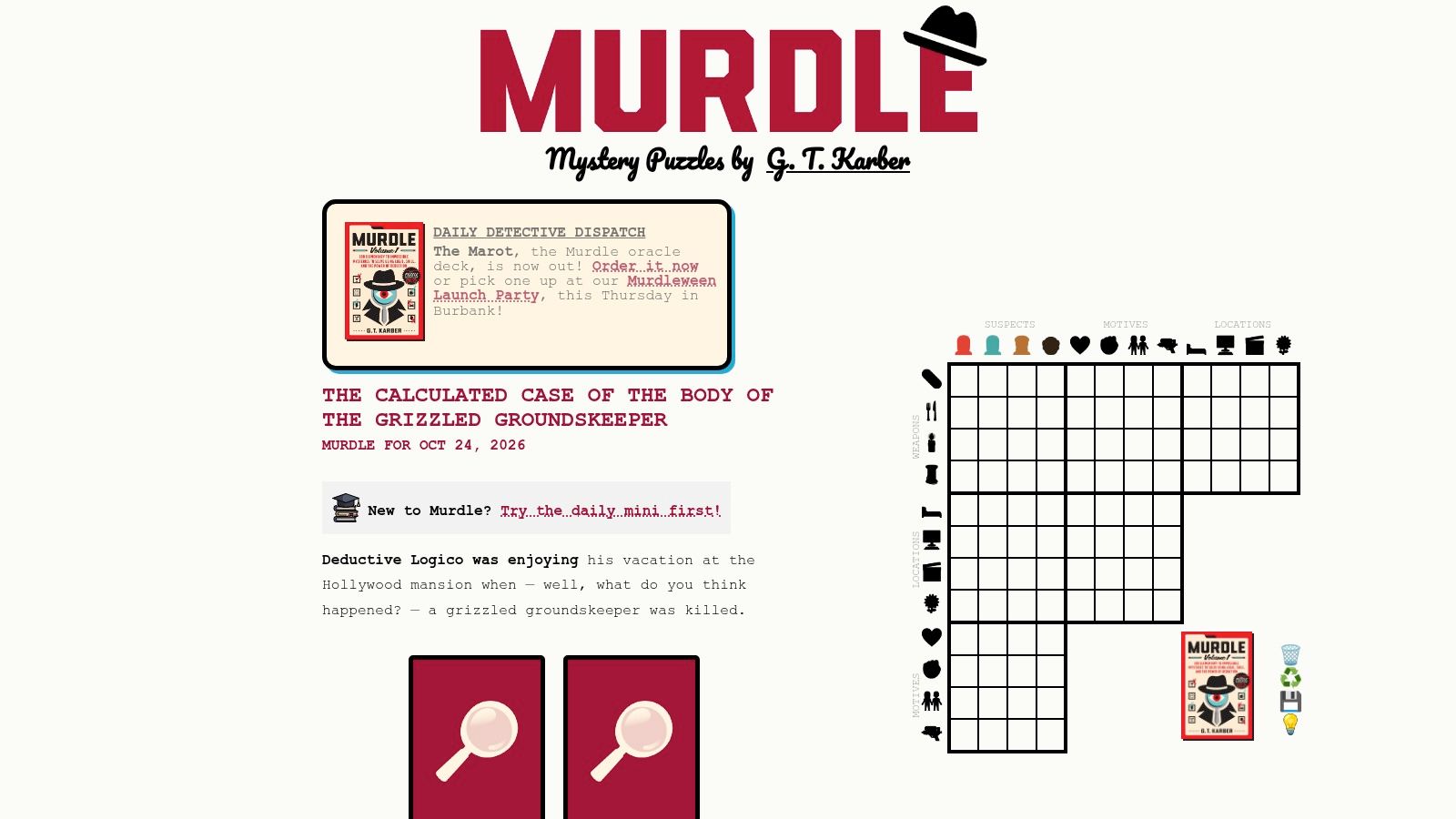
Suspects, weapons, locations, and a grid for keeping them straight: Murdle suits the methodical detective. You read clues, record relationships, rule out combinations, and keep working until the remaining arrangement makes sense.
Murdle offers a daily browser mystery, a Mini alternative, hints, and paid books with additional puzzles. The Mini gives you a smaller option, but there's no supported minute-by-minute estimate to promise for either format.
The pleasure is in maintaining a consistent account of the case. A clue may establish a relationship directly or rule out an option that lets you infer something elsewhere. If you enjoy watching scattered restrictions become a complete arrangement, this is the right kind of work.
The grid is the investigation
Don't choose Murdle expecting to search crime scenes or interrogate suspects. You're reasoning from supplied clues rather than deciding where to investigate next.
- Strong point: The recognizable deduction-grid format keeps your evidence organized.
- Weak point: Daily online play is less suited to binge-solving than a substantial free archive.
- Best habit: Mark exclusions carefully. An empty cell and a ruled-out cell shouldn't mean the same thing in your notes.
For contrast, Grandma Hilde's Recipe Book offers a scene-based alternative to the grid format. That's a useful comparison if you're unsure whether you prefer discovering evidence or organizing evidence you've already received.
Neither approach is more detective-like. Murdle's strength is explicit elimination: you can inspect your own reasoning and see which relationships still need proof.
6. Ask the Truth
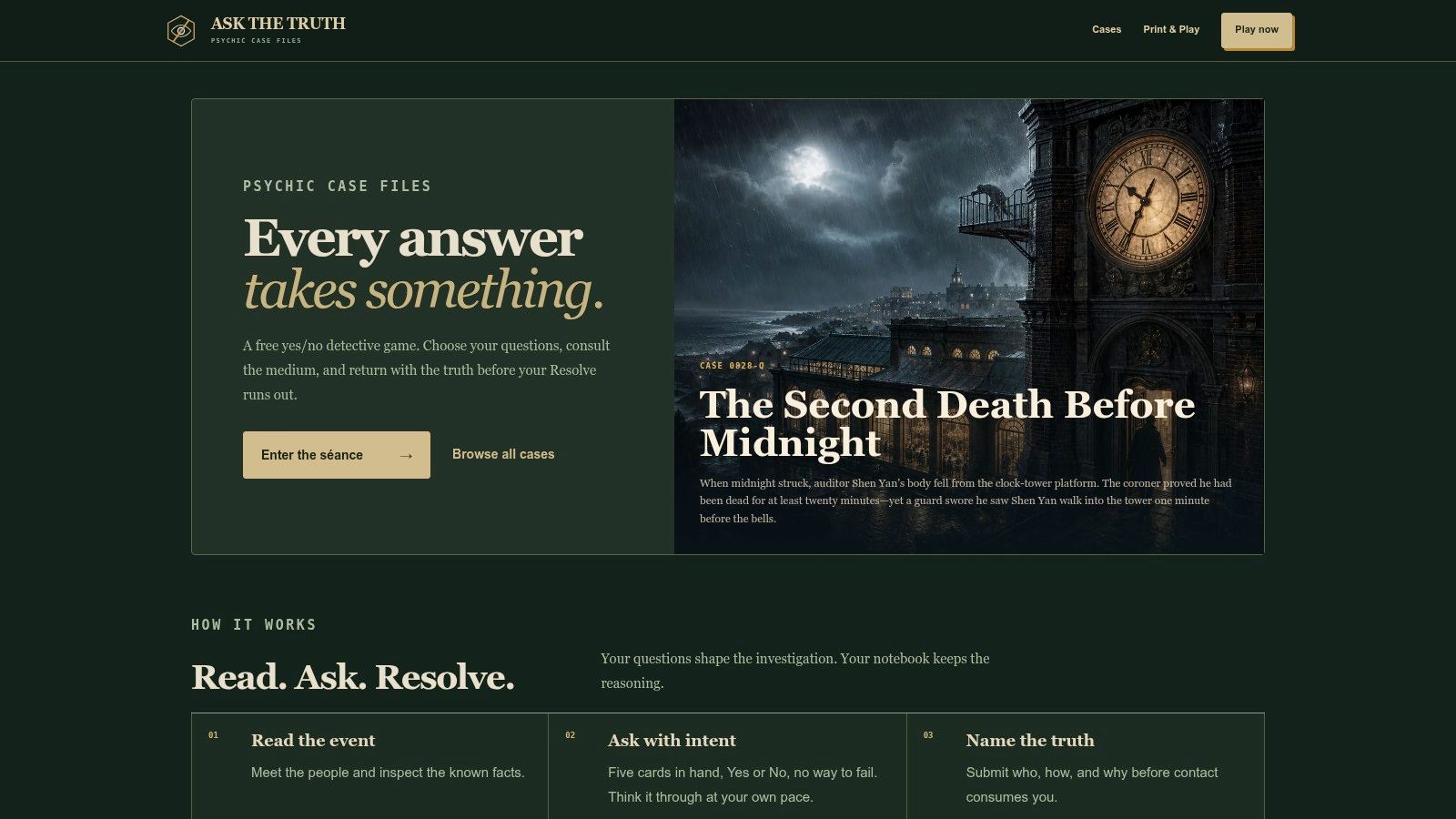
The key decision in Ask the Truth is what to ask next. You review an unusual event, select authored yes-or-no inquiries, collect evidence, and submit an explanation covering responsibility, method, and motive.
That makes information gathering part of the puzzle. Instead of receiving every useful statement at the outset, you have to choose inquiries that help distinguish competing explanations.
Ask the Truth is free in desktop and mobile browsers, requires no account or download, and lets you resume cases in the same browser. Answers are fixed and authored rather than generated during play. The public game is in English, and no supported session-duration estimate is supplied.
Ask a question because its answer could change your theory, not merely because the question is available.
Questioning has a cost
Each inquiry uses Resolve, so careless questioning can limit a run. That creates a different pressure from a countdown: you need to be selective, even if you're taking your time.
The evidence notebook helps you organize what you've learned, but organization alone won't choose the next useful question. Before asking, consider what a yes would establish and what a no would eliminate.
The limitation is the authored question set. This isn't unrestricted conversation with a suspect, and you can't assume the game will understand a question you invent yourself.
Choose it if your favorite mystery moment is narrowing an explanation through careful inquiries. Skip it if you dislike spending a limited resource to obtain information, or if you'd rather inspect physical evidence than work through a question-led case.
7. Deduce
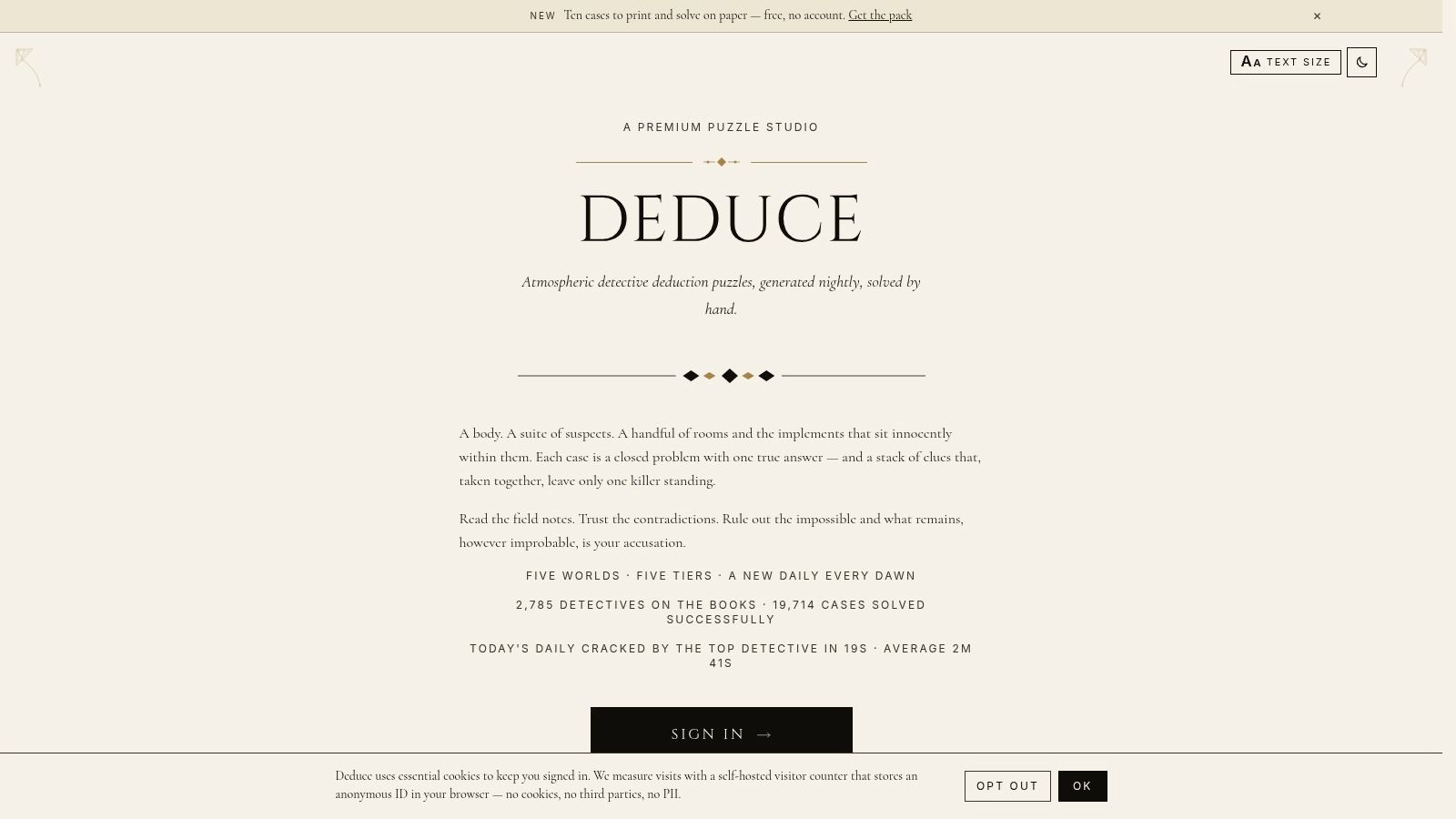
Deduce is the stronger fit when you want more than today's puzzle. Its archive lets you keep solving, while printable case packs offer an alternative to browser play.
The core format is conventional logic-grid deduction. You connect a victim, suspects, rooms, and weapons through clues, rather than search an illustrated environment for evidence. The site describes its puzzles as verified to have a single solution.
Deduce estimates cases at 10–20 minutes and offers five detective ranks, with harder cases introducing additional clue types. An optional account supports streaks, saved progress, and access to higher ranks. That makes it a more deliberate session choice than a puzzle you open moments before leaving.
An archive changes the practical value
A daily release is useful for building a routine, but an archive is useful when your free time doesn't follow that routine. You can choose a case when you're available rather than wait for the next release.
- Good fit: You enjoy conventional grids and want a supply of past cases.
- Useful flexibility: Printable packs let you solve away from a screen.
- Important limit: Its estimated sessions may exceed a short break, and visual exploration isn't part of the main loop.
Don't confuse the single-solution claim with a promise that every step will feel obvious. You still need to maintain the grid accurately and recognize which clues become useful after an elimination.
Choose Deduce for a sustained deduction habit. It's particularly appealing if finishing a daily puzzle usually leaves you wanting another case rather than a result-sharing screen.
8. Suspectle
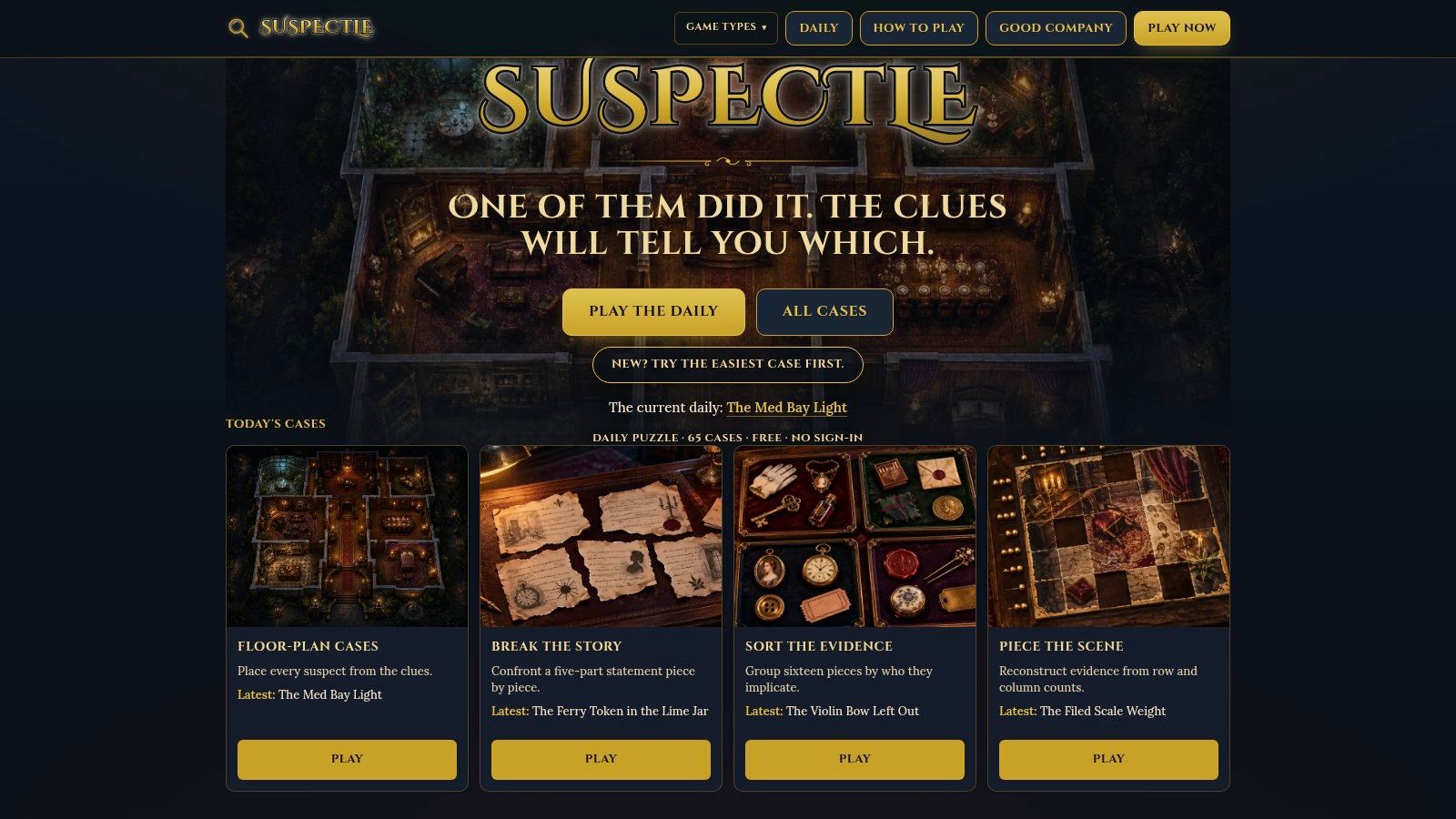
Who was alone with the victim? Suspectle uses that question to give its logic board a spatial focus. Suspects occupy rows and columns, and you reason about their arrangement to identify the relevant relationship.
That's a different mental task from matching a suspect to a weapon in a conventional grid. You need to track positions and what those positions imply, not merely assign categories.
Suspectle offers daily cases, past puzzles, and difficulty settings ranging from Starter to Case File. No account or download is required, and the cases are presented as solvable through reasoning rather than guessing. There isn't a supported session estimate in the supplied information.
Spatial thinking without scene searching
The archive makes it suitable for more than a daily visit, while the difficulty options give newcomers a gentler entry point. However, the site doesn't save progress to a user profile, so don't treat account-free access as equivalent to cross-device continuity.
- Pick it if: You enjoy reasoning about who could occupy a position and what that implies about nearby people.
- Pass if: You want objects to inspect, witness dialogue, or a visually searchable crime scene.
- Watch for: A plausible arrangement isn't necessarily a demonstrated arrangement. Keep checking which placements the clues require.
The strongest comparison is with Murdoku: both appeal to spatial thinkers, but Suspectle's defining question focuses attention on being alone with the victim.
Choose it when you want the board itself to carry the mystery. The detective work happens through relationships between positions, not through a long narrative or a collection of discovered objects.
9. The Detective's Desk

Open a dossier, inspect crime-scene photographs, collect evidence, and assemble your thinking on a corkboard. The Detective's Desk offers a broader investigation loop than the grid-first games.
You can question suspects, use a notepad, and make an accusation. That gives you more investigative activities, but it also asks you to manage a larger collection of information.
The Detective's Desk estimates most cases at 20–40 minutes and describes suspect replies as AI-generated. Daily browser cases are free, older investigations move into a cold-case archive, and guest play is available. Signing in saves progress and streaks.
Give the dossier room to breathe
This is a better choice for an uninterrupted stretch than a tiny gap between commitments. Photographs, evidence, notes, and conversations are more appealing when you have time to compare them rather than skim toward an accusation.
The AI-generated replies are a meaningful distinction from fixed, authored questioning. Players who specifically want a tightly scripted interrogation should account for that difference. Interrogations are optional, so conversation doesn't have to be the center of your session.
Evidence discipline: Keep the contents of the dossier separate from your interpretation of them. A convincing theory still needs support.
The cold-case archive is useful if you miss a daily release or prefer choosing when to investigate. The trade-off is complexity: more investigative surfaces don't automatically make the final deduction clearer.
Choose The Detective's Desk when you want case-file handling and evidence review, not merely a murder-themed logic board. Leave it for later if you're about to be interrupted.
10. Case60

Case60 is about committing to a reading of the evidence quickly. You read a brief case, choose a suspect, and review the explanation after answering.
Case60's opening season contains 60 cases, each built around a 60-second challenge. It runs in the browser without an account, download, or payment, and stores progress locally in the browser.
That's the clearest fit for someone who wants a contained challenge with an explicit endpoint. It's also the least exploratory option here: you aren't searching a room, deciding which witness to question, or building a large deduction grid.
Read the explanation, even when you're right
The post-answer explanation is important because a correct selection can come from a sound deduction or a lucky hunch. Comparing your reasoning with the explanation helps you tell those apart.
- What works: A brief case and a firm deadline make the commitment easy to understand.
- What doesn't: Timed multiple choice leaves little room to follow your own investigative route.
- Who should be cautious: Players who find reading under pressure frustrating may prefer an untimed format.
If you'd rather examine a scene than race through a case summary, The Countess's Necklace offers that contrasting approach. The distinction is about the activity you want, not which format deserves the detective label.
Choose Case60 for quick interpretation followed by an explanation. Don't choose it expecting the freedom of a full investigation. Its appeal is the small, decisive puzzle, and its main limitation is that you have to make peace with the clock.
Top 10 Mystery & Puzzle Games Comparison
| Game | Core Gameplay | Session & Content | Standout Features | Price & Access | Best For |
|---|---|---|---|---|---|
| 🏆 Mystery Hunch | Explore illustrated scenes, collect and combine clues, check statements, then accuse | 5 cases; about 6–9 minutes each | ✨ Bright or noir styles, varied case mechanics, optional hints; ★ mobile-friendly | 💰 Free browser play; English and German | 👥 Players wanting a short, visual detective investigation |
| Murdoku | Place suspects in a crime-scene grid using spatial logic | Weekly online puzzles; printable cases | ✨ Sudoku-style crime-scene deduction | 💰 Free online puzzles; paid books | 👥 Fans of spatial reasoning and paper puzzles |
| Super Detective | Solve closed-location murders with floor-plan logic | 5 free cases weekly; 5 difficulty levels | ✨ Hints reveal the next deduction | 💰 Free weekly cases; paid packs | 👥 Logic-puzzle beginners and experienced solvers |
| Clues by Sam | Use clues on a grid to identify criminals and innocents | New daily puzzle; difficulty rises through the week | ✨ Tutorial, hints, and grid tools | 💰 Free daily play; optional paid packs | 👥 Players who enjoy structured deduction |
| Murdle | Connect suspects, weapons, and locations with a deduction grid | Daily puzzle plus a Mini option | ✨ Mini puzzle for a shorter challenge | 💰 Free browser puzzle; paid books | 👥 Fans of classic logic-grid mysteries |
| Ask the Truth | Ask authored yes-or-no questions and record evidence | Case-based investigations; progress can resume in-browser | ✨ Question-led play with consistent case answers | 💰 Free browser play; English | 👥 Players who like solving mysteries by questioning |
| Deduce | Link victims, suspects, rooms, and weapons with logic clues | Daily cases, archive, and ranked difficulty | ✨ Verified single-solution puzzles; printable packs | 💰 Free puzzles and printables | 👥 Logic-grid fans seeking an archive and progression |
| Suspectle | Use a row-and-column board to work out who was alone with the victim | Daily cases, archive, multiple difficulty levels | ✨ Distinctive “alone with the victim” mechanic | 💰 Free browser play; no account required | 👥 Players who want a fresh spatial logic format |
| The Detective's Desk | Review dossiers and photos, collect evidence, question suspects, and accuse | Daily cases and cold-case archive; typically 20–40 minutes | ✨ Evidence corkboard and optional interrogations | 💰 Free browser play; guest access available | 👥 Players wanting a longer, fuller investigation |
| Case60 | Read a brief case, choose a suspect, then review the explanation | 60 cases; 60 seconds per challenge | ✨ Quick rounds with answer explanations | 💰 Free browser play; no account required | 👥 Players looking for fast, timed mystery quizzes |
Pick Your Next Case
The best choice depends on what you want to do with the evidence. Scene exploration, grid deduction, spatial placement, and questioning are different pleasures, even when every game ends by naming a culprit.
For a compact scene-based starting point, choose Mystery Hunch. For a familiar deduction grid, head toward Murdle or Deduce. Murdoku and Suspectle suit players who like reasoning about positions, while The Detective's Desk makes more sense when you have room for a fuller case-file investigation.
Don't treat a missing duration estimate as a minor detail if you're playing during a break. Daily describes how often a puzzle arrives, not how quickly you'll finish it. An archive, a smaller variant, or a resumable case may matter more than the release schedule.
Match the friction to the fun
Some effort belongs in a good mystery. Holding competing explanations in mind, spotting a contradiction, and revisiting an assumption are part of the attraction. Struggling to understand the controls or remember what a notebook symbol means is a different problem.
- Want to discover evidence? Choose scene exploration or dossier review rather than a game that supplies all its clues upfront.
- Want to prove every move? Favor structured deduction, especially formats that discourage unsupported guesses.
- Want positional reasoning? Look for floor plans, rows, columns, and placement constraints.
- Want consequential questions? Choose a question-led investigation and consider whether spending a limited resource sounds enjoyable.
- Want a hard stop? A timed challenge gives you one, but it may replace leisurely reasoning with pressure.
Hints deserve the same attention as difficulty labels. A hint that explains an inference can teach you how the puzzle works; a revealed answer can get you moving without resolving your confusion. Neither is automatically wrong, but they serve different needs.
Accessibility is also more specific than whether a game runs on your phone. Before committing, consider whether you can read the clues comfortably, distinguish evidence states, revisit statements, and work without unwanted time pressure. A short mystery isn't automatically an easy-to-use mystery.
The most useful test comes after the accusation: can you explain why the evidence supports your answer and rules out the alternatives? If you can, you've done more than find the right button.
Pick the style that sounds enjoyable now, rather than the one that sounds most impressive. Afterward, share a spoiler-free result or suggest the kind of case you'd like next: a seating puzzle, a locked-room problem, a contradictory witness, or an object whose significance only becomes clear when you connect it to another clue.
Visit Mystery Hunch for free illustrated browser mysteries built around scene exploration, clue combinations, and accusations backed by proof. Choose a short case, examine what the suspects' stories leave out, and send a spoiler-free result or a suggestion for a future investigation.
Made with the Outrank app